Adjuvant Medical Care
eBook - ePub

Adjuvant Medical Care

  1. 502 pages
  2. English
  3. ePUB (mobile friendly)
  4. Available on iOS & Android
eBook - ePub

Adjuvant Medical Care

About this book

Despite tremendous gains in medical knowledge, most conditions are managed, rather than cured, by medications. As a result, countless patients seek supplemental modes of care to better control their symptoms and conditions to improve their overall wellbeing. This reality spotlights the need for adjuvant medical procedures.

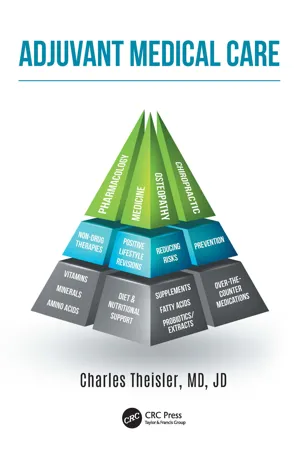
Adjuvant medical care refers to any supportive therapy that enhances the outcome of medical measures already in place. Adjuvant care does not replace primary or traditional treatments, but instead serves as add-on care to the initial medical treatment plan prescribed by a health care provider. The addition of one or more non-prescription therapies (e.g., nutritional support, over-the-counter remedies, home care, dietary measures, supplements, etc.) to the primary medical management regimen has become increasingly popular and mainstream thanks to scientific studies that have documented favorable outcomes for many patients.

The verifiable scientific merit of these additional medical options demonstrates their usefulness in the treatment of many medical conditions. The purpose of this handbook is to provide support to doctors and patients who are interested in safe and effective non-prescription and non-pharmacological medical therapies for specific conditions to minimize symptoms and optimize recovery and quality of life.

• Helps doctors and patients discover additional therapies that can reduce pain, advance health outcomes, minimize complications and disability, and extend life.

• Presents safe, reliable, and practical options that are available to reduce symptoms, maximize recovery, and positively augment the management of a variety of conditions.

• Provides medical insight into less traditional, yet often effective, supportive options for enhancing and optimizing patient response to care.

This book is a valuable resource for both doctors and patients who are committed to achieving the best possible medical outcomes through a variety of coordinated approaches.

Frequently asked questions

Yes, you can cancel anytime from the Subscription tab in your account settings on the Perlego website. Your subscription will stay active until the end of your current billing period. Learn how to cancel your subscription.
No, books cannot be downloaded as external files, such as PDFs, for use outside of Perlego. However, you can download books within the Perlego app for offline reading on mobile or tablet. Learn more here.
Perlego offers two plans: Essential and Complete
  • Essential is ideal for learners and professionals who enjoy exploring a wide range of subjects. Access the Essential Library with 800,000+ trusted titles and best-sellers across business, personal growth, and the humanities. Includes unlimited reading time and Standard Read Aloud voice.
  • Complete: Perfect for advanced learners and researchers needing full, unrestricted access. Unlock 1.4M+ books across hundreds of subjects, including academic and specialized titles. The Complete Plan also includes advanced features like Premium Read Aloud and Research Assistant.
Both plans are available with monthly, semester, or annual billing cycles.
We are an online textbook subscription service, where you can get access to an entire online library for less than the price of a single book per month. With over 1 million books across 1000+ topics, we’ve got you covered! Learn more here.
Look out for the read-aloud symbol on your next book to see if you can listen to it. The read-aloud tool reads text aloud for you, highlighting the text as it is being read. You can pause it, speed it up and slow it down. Learn more here.
Yes! You can use the Perlego app on both iOS or Android devices to read anytime, anywhere — even offline. Perfect for commutes or when you’re on the go.
Please note we cannot support devices running on iOS 13 and Android 7 or earlier. Learn more about using the app.
Yes, you can access Adjuvant Medical Care by Charles Theisler in PDF and/or ePUB format, as well as other popular books in Medizin & Klinische Medizin. We have over one million books available in our catalogue for you to explore.

Information

Publisher
CRC Press
Year
2022
eBook ISBN
9781000632330
Edition
1
Topic
Medizin

MEDICAL CONDITIONS

Acetaminophen (Tylenol) Poisoning

Acetaminophen (Tylenol) overdose, or poisoning, is one of the most common poisonings. Mild poisoning may not cause any symptoms. When present, however, symptoms of acute acetaminophen poisoning are typically minor until about 48 hours or longer after ingestion. Symptoms include anorexia, nausea, vomiting, and right upper quadrant abdominal pain. Acetaminophen toxicity in the U.S. has replaced viral hepatitis as the most common cause of acute hepatic failure and is the second most common cause of liver failure requiring transplantation.1

Medical Management Techniques

Activated Charcoal: Patients who have taken significant overdoses need further measures to prevent absorption or to increase elimination of the drug.
The American Academy of Clinical Toxicology recommends taking oral-activated charcoal 50 gm (orally or by nasogastric tube) if ingestion of a substantial amount of drug has taken place within the past one hour.
Methionine: For acetaminophen (Tylenol) poisoning, 2.5 gm of the amino acid methionine every four hours for four doses is used to prevent liver damage and death. Methionine must be given within 10 hours of taking the acetaminophen. This should be done by a healthcare professional.2
In Europe, oral methionine (10 gm over 12 hours) is approved as an agent to restore depleted glutathione stores and to prevent hepatotoxicity after large acetaminophen ingestions.3
Oral methionine is as effective as acetylcysteine in preventing severe liver damage and death after acetaminophen overdose. However, as with acetylcysteine, it must be given within 10 hours of ingestion to be effective.3
N-acetylcysteine, a derivative of the amino acid L-cysteine, taken within eight hours of a Tylenol overdose mitigates liver toxicity4 and is effective in reducing the death rate and preventing the permanent harm caused by acetaminophen poisoning. For this use, N-acetylcysteine given by mouth (140 mg/kg, followed by 70 mg/kg every four hours for three days)5 is as effective as when given intravenously.1 N-acetylcysteine remains the preferred antidote for acetaminophen overdose in the U.S., Canada, Scotland, and most of England.6,7 Taking both Tylenol and NAC together can provide a convenient and effective way of preventing toxicity associated with large doses of acetaminophen.8 As a caution, taking N-acetylcysteine at the same time as activated charcoal may decrease the effectiveness of NAC to prevent poisoning.

Acne Vulgaris

Acne vulgaris is the most prevalent chronic skin disease in the U.S. It is the most common chronic skin disorder among the adolescent age group, affecting 90%–95% of the midteen population. Acne also affects young adults and can persist into the 30s and 40s.1 It is characterized by areas of pimples (e.g., blackheads, whiteheads, pustules, cysts, etc.), greasy skin, and possible scarring. Acne is primarily thought to be due to overactivity of the sebaceous (oil) glands in the skin where sebum and dead skin block pores and become inflamed. Outbreaks tend to occur where sebaceous glands are most numerous on the face and upper chest, back, or shoulders. Complications include scarring, cutaneous abscesses, and acneiform lesions.
With most prescription acne drugs, results may not be apparent for four to eight weeks, and the skin may get worse during that time. A chronic persistent clinical course along with the emergence of resistance to common antibiotics has led to trials of numerous novel agents in acne management.

Management Options

Benzoyl Peroxide: Medical treatment should begin with a benzoyl peroxide agent because these are available over the counter and have an extensive history of safety and efficacy. Products are available in a wide range of vehicles (soaps, lotions, gels) and strengths vary from 2.5% to 10%. Higher strengths dry the skin but otherwise are no more effective against acne than the lower strengths.2 Individuals with acne vulgaris should be aware that benzoyl peroxide reflects the base of treatment upon which other agents are added. For example, benzoyl peroxide plus oral and topical antibiotics and/ or retinoids are often combined in more severe cases.3
Soap: Mild, non-comedogenic opaque or glycerin facial soap or gentle cleanser (e.g., Cetaphil) is recommended.4
Peeling Agents: Products containing salicylic acid (0.5%–10%)5 or alpha hydroxy acids such as glycolic, malic, lactic, or citric acids have been shown to be effective as peeling agents to remove dead skin cells.6,7
Retinoids/Antibiotics: Retinoids are a form of vitamin A. Topical retinoids, either prescription or over-the-counter, along with benzoyl peroxide are typically employed for noninflammatory acne. Oral antibiotics are often used in combination with benzoyl peroxide, retinoids, and topical antibiotics for moderate to severe acne vulgaris.8
Zinc: Zinc is a promising alternative to other acne treatments owing to its low cost, efficacy, and lack of systemic side effects. Zinc has been employed extensively both topically and systemically for the management of acne vulgaris.
The efficacy of topical anti-acne medications containing zinc acetate or octoate with or without erythromycin is either equal to or superior to erythromycin, tetracycline, or clindamycin used alone in reducing the severity of acne and the number of lesions.9
Oral zinc sulfate is reportedly more effective in the treatment of severe acne than for the treatment of mild to moderate acne, but nausea, vomiting, and diarrhea occur frequently.
Acne treatment with oral zinc salts appears to be equally effective compared with systemic tetracyclines (minocycline, oxytetracycline).1
Niacin: Studies have shown that using both niacin (2,000 mg/day) and nicotinamide (600 mg/day) for 12 weeks can improve acne. The authors of one study concluded that niacin (500 mg q.i.d.) is an effective drug in the treatment of moderate and severe acne and that the therapeutic effect of niacin is more effective than nicotinamide.10
5% Nicotinamide Gel: 5% nicotinamide gel was as effective as 2% clindamycin gel for the treatment of mild to moderate acne vulgaris. No side effect was observed during the treatment.11 In another study, 4% nicotinamide gel was of comparable efficacy to 1% clindamycin gel in the treatment of acne vulgaris.12
Azelaic Acid: A 20% azelaic acid cream (Azelex) was found to be an effective acne treatment when used twice a day for at least four weeks. It is even more effective when used in combination with erythromycin.13
Diet: Studies failed to support a link between the consumption of chocolate or sugar and acne. However, there is strong evidence that low glycemic index diets show favorable improvements. Dairy products should be limited or eliminated because there is evidence that milk and whey proteins increase the number of acne lesions.14
Ketogenic Diet: Insulin, due to a number of factors, combined with skin that is colonized with Cutibacterium acnes can lead to an inflammatory skin response and acne vulgaris. A ketogenic diet could help ameliorate acne because it results in minimal insulin secretion.13,15
Combination Therapy: The combination of 5% benzoyl peroxide and 3% erythromycin (Benzamycin) is a highly effective acne treatment. The combination of 5% benzoyl peroxide and 1% clindamycin in a premixed gel has also been studied and was found to be superior to either agent alone in the treatment of inflammatory and noninflammatory lesions.16
Stress, Hygiene, and Diet: Many people think that acne is caused by stress, lack of hygiene, or diet, but no studies support these associations.16
Cosmetics: Affected individuals should use oil-free, noncomedogenic cosmetics. Oil from hair products and suntan lotions can also exacerbate acne.16
Vitamins A, D, and E play a role in maintaining healthy skin, so these vitamins may help prevent acne.17
Aloe Vera Gel: Applying aloe gel in the morning and evening, in addition to a prescription anti-acne medicine, improved acne by about 35% in both children and adults.18,19
Omega-3 Fatty Acids: There is clear confirmation for the reduction of acne with regular consumption of omega-3 fatty acids (2,000 mg/day) or γ-linoleic acid (400 mg/day) for ten weeks.20
Acrodermatitis Enteropathica

Primary acrodermatitis enteropathica, also called zinc malabsorption syndrome, is a rare genetic disorder that blocks the absorption of zinc through intestinal cells. There are congenital and acquired forms of the disorder.
The onset of symptoms such as diarrhea, an inflammatory rash around the mouth and/or anus, as well as hair loss is usually seen around four to six weeks after weaning or even earlier in infants not on breast milk. The infant initially becomes irri...

Table of contents

  1. Cover Page
  2. Half Title Page
  3. Title Page
  4. Copyright Page
  5. Table of Contents
  6. Dedication
  7. Acknowledgment
  8. Introduction
  9. Medical Conditions
  10. Schizophrenia
  11. Sciatica
  12. Scleroderma
  13. Scorpion Stings
  14. Scurvy
  15. Seborrhea/Seborrheic Dermatitis/Dandruff
  16. Sepsis/Septic Shock
  17. Sickle Cell Anemia/Hemoglobin SS Disease
  18. Sinusitis (Acute)
  19. Smell Perception/Anosmia/Parosmia
  20. Smoking (Cessation)
  21. Solar Urticaria/Sun Allergy
  22. Steatorrhea
  23. Stroke
  24. Post-Stroke Management (Brain Hypoxia/Ischemic Damage)
  25. Subacute Combined Degeneration of the Spinal Cord
  26. Subcorneal Pustular Dermatosis (SPD)
  27. Sunburn
  28. Tardive Dyskinesia (TD)
  29. Taste Disorders
  30. Testosterone
  31. Thrombophlebitis/Superficial Vein Thrombosis
  32. Tick Bites
  33. Tinnitus
  34. Tooth Loss
  35. Traumatic Brain Injury
  36. Transient Ischemic Attack (TIA)
  37. Tremors
  38. Trigeminal Neuralgia
  39. Triglycerides/Hypertriglyceridemia
  40. Tropical Sprue
  41. Tuberculosis (TB)
  42. Tyrosinemia
  43. Ulcerative Colitis
  44. Ulcers—Leg/Foot
  45. Ulcers—Peptic/Gastroduodenal
  46. Ulcers—Pressure Ulcers/Decubitus Ulcers/Bedsores
  47. Uremia/Uremic Syndrome
  48. Urethritis
  49. Urinary Tract Infection (UTI)
  50. Urticaria/Hives
  51. Uveitis
  52. Vaginal or Vulvovaginal Atrophy/Atrophic Vaginitis/Genitourinary Syndrome of Menopause (GSM)
  53. Vaginitis (Candida/Yeast Infection)
  54. Varicose Veins/Venous Insufficiency
  55. Vertigo—Cervical Vertigo/Cervicogenic Dizziness
  56. Vitamin E Deficiency
  57. Vitiligo
  58. Warts
  59. Wernicke-Korsakoff Syndrome
  60. Whooping Cough/Pertussis
  61. Wilson’s Disease
  62. Wound Care (Chronic)/Delayed Healing
  63. Wrinkles
  64. Xanthelasma
  65. Xeroderma Pigmentosum
  66. Notes