This book is available to read until 23rd December, 2025
- 128 pages
- English
- ePUB (mobile friendly)
- Available on iOS & Android
eBook - ePub
Available until 23 Dec |Learn more
About this book
Starmap is an introductory pictorial guide of our universe. It contains vivid NASA images, diagrams, and depictions of the cosmos with easy-to-understand explanations and descriptions. It contains full-page pictures of our universe. It makes a great coffee-table book and is great for virtual learning.
Frequently asked questions
Yes, you can cancel anytime from the Subscription tab in your account settings on the Perlego website. Your subscription will stay active until the end of your current billing period. Learn how to cancel your subscription.
At the moment all of our mobile-responsive ePub books are available to download via the app. Most of our PDFs are also available to download and we're working on making the final remaining ones downloadable now. Learn more here.
Perlego offers two plans: Essential and Complete
- Essential is ideal for learners and professionals who enjoy exploring a wide range of subjects. Access the Essential Library with 800,000+ trusted titles and best-sellers across business, personal growth, and the humanities. Includes unlimited reading time and Standard Read Aloud voice.
- Complete: Perfect for advanced learners and researchers needing full, unrestricted access. Unlock 1.4M+ books across hundreds of subjects, including academic and specialized titles. The Complete Plan also includes advanced features like Premium Read Aloud and Research Assistant.
We are an online textbook subscription service, where you can get access to an entire online library for less than the price of a single book per month. With over 1 million books across 1000+ topics, we’ve got you covered! Learn more here.
Look out for the read-aloud symbol on your next book to see if you can listen to it. The read-aloud tool reads text aloud for you, highlighting the text as it is being read. You can pause it, speed it up and slow it down. Learn more here.
Yes! You can use the Perlego app on both iOS or Android devices to read anytime, anywhere — even offline. Perfect for commutes or when you’re on the go.
Please note we cannot support devices running on iOS 13 and Android 7 or earlier. Learn more about using the app.
Please note we cannot support devices running on iOS 13 and Android 7 or earlier. Learn more about using the app.
Yes, you can access STARMAP by Edward Alan Ridgill M.D. in PDF and/or ePUB format, as well as other popular books in Physical Sciences & Astronomy & Astrophysics. We have over one million books available in our catalogue for you to explore.
Information
Chapter 1

Our Neighborhood in the Universe
OUR SUN
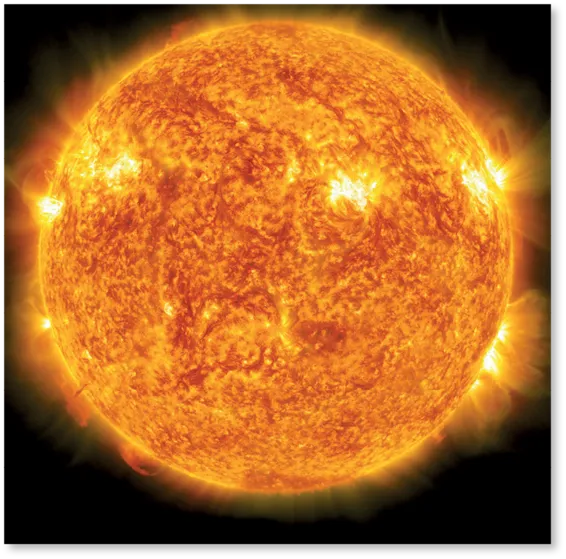
The Sun is the star at the center of the Earth’s solar system. It is a sphere of hot plasma, heated by a continuous nuclear fusion reaction in its core. The sun radiates energy mainly as light and infrared radiation. The temperature of the sun’s core is 26,999,540 degrees Fahrenheit (14,999,727 Celsius). Its surface temperature is about 11,000 degrees Fahrenheit.
The sun’s diameter is 864,000 miles (1.9M kilometers), which is 109 times the size of the Earth. Its mass is 330,000 times that of Earth. The sun is part of the Cassiopeia constellation in the Milky Way galaxy.
In addition to heat and light, the sun also emits a low-density stream of charged particles (mostly electrons and protons) known as the solar wind that propagates throughout the solar system at about 279 miles per second (450 kilometers/sec). The solar wind and the much higher energy particles ejected by solar flares can have dramatic effects on the Earth ranging from power line surges to radio interference to the beautiful aurora borealis. The solar wind has large effects on the tails of comets and even has measurable effects on the trajectories of spacecraft. Further study of the solar wind will be done by the Wind, ACE, and SOHO spacecraft from the dynamically stable vantage point directly between the Earth and the sun about 1.6 million kilometers from Earth.
The Sun is about 4.5 billion years old. Since its birth, it has used up about half of the hydrogen in its core. It will continue to radiate “peacefully” for another 5 billion years or so; however, its luminosity1 will approximately double in that time. As the Sun ages, it will get bigger. When this happens, it will consume some of the objects close to it, including Mercury and Venus. Eventually, the Sun will run out of hydrogen fuel. It will then be forced into ...
Table of contents
- Contents
- Introduction
- Chapter 1
- Chapter 2
- Chapter 3
- Chapter 4
- Chapter 5
- Chapter 6
- Chapter 7
- Chapter 8
- Chapter 9
- Chapter 10
- Chapter 11
- Chapter 12
- Notes
- About the Author