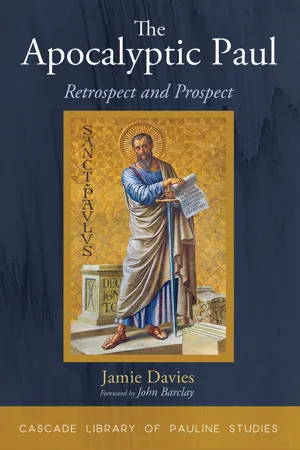
- 208 pages
- English
- ePUB (mobile friendly)
- Available on iOS & Android
eBook - ePub
About this book
The Apocalyptic Paul is rapidly becoming one of the most influential contemporary approaches to the apostle's letters, and one which has generated its share of controversy. Critiques of the movement have come from all sides: Pauline specialists, scholars of Jewish and Christian apocalyptic literature, and systematic theologians have all raised critical questions. Meanwhile, many have found it a hard conversation to enter, not least because of the contested nature of its key terms and convictions. Non-specialists can find it difficult to sift through these arguments and to become familiar with the history of this movement, its most important contemporary voices, and its key claims. In the first part of this book, New Testament scholar Jamie Davies offers a retrospective introduction to the conversation, charting its development from the turn of the twentieth century to the present, surveying the contemporary situation. In the second part, Davies explores a more prospective account of the challenges and questions that are likely to energize discussion in the future, before offering some contributions to the apocalyptic reading of Paul through an interdisciplinary conversation between the fields of New Testament scholarship, Second Temple Jewish apocalypticism, and Christian systematic theology.
Information
PART ONE
Retrospect
chapter 1
The Genealogy of the Apocalyptic Paul
Given the vibrancy of the present debate over the Apocalyptic Paul, it may come as something of a surprise to those new to the conversation that the recent history of apocalyptic in Pauline scholarship began with pessimism. Published in 1970, when the debate on apocalyptic thought in Paul was heating up, the provocative title of Klaus Koch’s short survey Ratlos vor der Apokalyptik said it all: modern New Testament scholarship had been “perplexed” or “stumped” by apocalyptic (the English title The Rediscovery of Apocalyptic is regrettably tame). Before charting its renaissance, Koch began with an overview of the study of apocalyptic at the start of the twentieth century, which he saw as a lamentable state of affairs. In one section, for example, he described how apocalyptic had become so thoroughly ignored in German-language research that “where treatment of the book of Daniel in Old Testament commentaries was unavoidable, or where the heading ‘apocalyptic’ had to be discussed in books of reference, foreign scholars had to come to the rescue.”1
It was not that apocalyptic had been completely forgotten, of course. The late-nineteenth century German Religionsgeschichtliche Schule certainly did not ignore it, as the work of Johannes Weiss demonstrates. Beginning with him and Albert Schweitzer, this first chapter offers something of a whistle-stop tour through major figures in twentieth-century Pauline scholarship who have investigated the question of “apocalyptic” in relation to Paul, ending with the programmatic work of J. Louis Martyn at the close of the century. As I hope will become clear, however, this is more than a work of genealogical due diligence, since the contours of these founding debates continue to shape the discussions today.
1.1 Johannes Weiss and Albert Schweitzer: The Strange New World of Apocalyptic
Johannes Weiss and Jesus’s Apocalyptic Proclamation
Though this is a story about interpreters of Paul, it begins with the message of Jesus. Against the prevailing consensus of nineteenth-century Protestant liberal scholarship in Germany, Johannes Weiss argued that the signature theme of Jesus’s teaching, the “kingdom of God,” ought not to be understood as a subjective, inward, or spiritual experience, but the expression of an objective reality rooted in and inextricably tied to Jewish apocalyptic eschatology.2 This eschatological interpretation represented something of a turning point in New Testament interpretation more broadly, but it came into particular focus through Weiss’s engagement with the views of his father-in-law, Albrecht Ritschl. Over against Ritschl’s interpretation of the kingdom as an immanent and expanding “moral society” or its expression of “moral goods,” Weiss argued that at the heart of Jesus’s message were apocalyptic convictions concerning the radical transcendence of the kingdom. Weiss’s apocalyptic Jesus espoused a cosmological dualism of a “twofold world” characterized by conflict and was driven by an imminent expectation of the eschatological event of God’s deliverance.3 In short, in Jesus’s understanding the kingdom “is not a matter for human initiative, but entirely a matter of God’s initiative.”4
This was an apocalyptic-eschatological reading of the kingdom that threatened the foundations of the liberal Protestant account of Jesus’s central message, and indeed that whole approach to modern theology, but Weiss did not press his convictions that far. He was keenly aware that his historical conclusions concerning the apocalyptic and eschatological nature of Jesus’s teaching on the “kingdom of God” did not automatically answer the theological questions concerning what we might make of that today. The apocalyptic Jesus of Weiss’s historical investigations was decidedly foreign to the contemporary church and its ethical challenges and stood as a rebuke of “lives of Jesus” that created him in the image of modern liberal Protestantism. While praising his contemporaries for the attention given to the kingdom of God (rather than taking Pauline theology as its point of departure), Weiss observed that this theme had not been described in historically faithful terms but had instead been filled out with distinctly modern liberal notions, transforming it into some kind of ethical ideal. “The ...
Table of contents
- Title Page
- Series Introduction
- Foreword
- Preface
- Acknowledgments
- Introduction: “Stumped by Apocalyptic”?
- Part One: Retrospect
- Part Two: Prospects
- Conclusion: The Tone and Tasks of the Apocalyptic Paul
- Bibliography
Trusted by 375,005 students
Access to over 1.5 million titles for a fair monthly price.
Study more efficiently using our study tools.
Frequently asked questions
Yes, you can cancel anytime from the Subscription tab in your account settings on the Perlego website. Your subscription will stay active until the end of your current billing period. Learn how to cancel your subscription
No, books cannot be downloaded as external files, such as PDFs, for use outside of Perlego. However, you can download books within the Perlego app for offline reading on mobile or tablet. Learn how to download books offline
Perlego offers two plans: Essential and Complete
- Essential is ideal for learners and professionals who enjoy exploring a wide range of subjects. Access the Essential Library with 800,000+ trusted titles and best-sellers across business, personal growth, and the humanities. Includes unlimited reading time and Standard Read Aloud voice.
- Complete: Perfect for advanced learners and researchers needing full, unrestricted access. Unlock 1.5M+ books across hundreds of subjects, including academic and specialized titles. The Complete Plan also includes advanced features like Premium Read Aloud and Research Assistant.
We are an online textbook subscription service, where you can get access to an entire online library for less than the price of a single book per month. With over 1.5 million books across 990+ topics, we’ve got you covered! Learn about our mission
Look out for the read-aloud symbol on your next book to see if you can listen to it. The read-aloud tool reads text aloud for you, highlighting the text as it is being read. You can pause it, speed it up and slow it down. Learn more about Read Aloud
Yes! You can use the Perlego app on both iOS and Android devices to read anytime, anywhere — even offline. Perfect for commutes or when you’re on the go.
Please note we cannot support devices running on iOS 13 and Android 7 or earlier. Learn more about using the app
Please note we cannot support devices running on iOS 13 and Android 7 or earlier. Learn more about using the app
Yes, you can access The Apocalyptic Paul by Jamie Davies in PDF and/or ePUB format, as well as other popular books in Teologia e religione & Critica e interpretazione biblica. We have over 1.5 million books available in our catalogue for you to explore.