Indirect Translation Explained is the first comprehensive, user-friendly book on the practice of translating indirectly in today's world. Unlike previous scholarly approaches, which have traditionally focused on translating from the original, this textbook offers practical advice on how to efficiently translate from an already translated text and for the specific purpose of further translation.
Written by key specialists in this area of research and drawing on many years of translation teaching and practice, this process-focused textbook covers a range of languages, geographical settings and types of translation, including audiovisual, literary, news, and scientific-technical translation, as well as localization and interpreting. Since this topic addresses the concerns and practices of both more peripheral and more dominant languages, this textbook is usable by all, regardless of the language combinations they work with.
Featuring theoretical considerations, tasks for hands-on practice, suggestions for further discussion and diverse, real-world examples, this is the essential textbook for all students and autodidacts learning how to translate via a third language.
In this chapter we will familiarize ourselves with the concept of indirect translation by looking at the key main trends in past and present-day indirect translation situations. We will also discuss the future prospects of this practice and outline how indirect translation is handled in research and training.
Learning outcomes
This chapter prepares the ground for what will be discussed in the eight core chapters to follow. Upon successful completion of this chapter, you will be able to:
Problematize the concept of indirect translation using appropriate terminology.
Discuss common misconceptions associated with this practice.
Warm-up activity
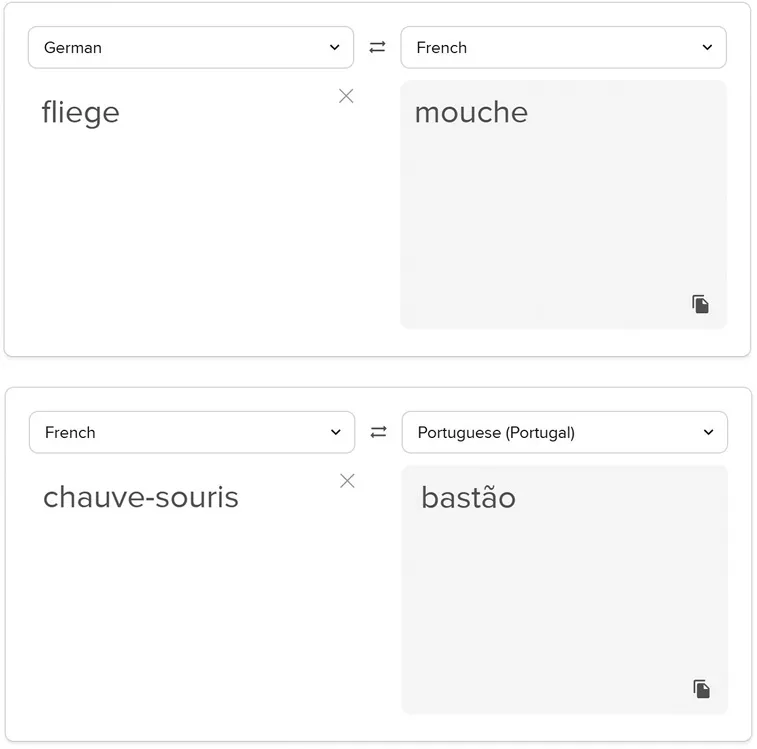
Look at the raw output generated by a machine translation engine in Figure 1.1. Can you spot the English pivot hack? What does this image say about the relevance of indirect translation today?
Figure 1.1Simulation of raw output generated by an MT engine in July 2021
What is indirect translation?
Indirect translations are translations of translations. In the English language, the terminology that translators use to label this practice varies immensely and is in constant flux. Possible alternatives include compilative, double, eclectic, intermediate, mediated, pivot, relay, retranslation, second-hand and secondary translation. Sometimes the choice depends on the translation domain in which a translator works. For instance, interpreters typically talk about relay interpreting, whereas subtitlers and people specializing in machine translation tend to opt for pivot (translation). The choice may also be informed by the linguistic tradition you come from: translators working with Romance languages often prefer to call this practice “indirect translation”, while those working with the Chinese language tend to prefer “relay” when describing this practice in English (Assis Rosa, Pięta and Maia 2017, 117).
Some people understand indirect translation in a narrow sense: as a translation via a third language (e.g., St. André 2019; Landers 2001, 130). In these narrow terms, a translation is achieved in two steps: a first translation from language A into language B, then a second translation by a different translator from language B into language C.
However, others take indirect translation more broadly (e.g., Gambier 1994; Toury 2012, 82). They recognize that the definition is broad enough to include, or at least overlap with, a great diversity of intralingual, interlingual, intramodal and intermodal translation processes. Possible examples include:
Retranslation: adapting the text to a new audience or to new times.
Back translation: translating back to the source language to, for example, look for discrepancies.
Support translation: using target texts in other languages when you are looking for alternative solutions in your target language (Dollerup 2000).
Novelization of a film or video game which is itself based on a book. For example, Christopher Wood wrote a novelization of the James Bond film The Spy Who Loved Me. The film itself is a cinematographic adaptation of an Ian Fleming novel.
Speech-to-text interpreting (also referred to as live subtitling): interpreting into another language which is then rendered as written text with keyboards (e.g., stenotype, velotype) or speech recognition software.
Compilative translation: when you translate not from one but several source texts, thus compiling different sources in one plural target text. Literary classics such as Boccacio’s Decameron may be read as this type of compilative patchwork of short stories, coming from different languages, genres and oral traditions (Maia 2021).
In this book we pay particular attention to indirect translation understood in the narrow sense (as a translation via a third language). However, when relevant, we also refer to other practices that can be subsumed under the broad term of indirect translation, such as the ones listed above.
Whether understood in a narrow or broad sense, indirect translation includes at least one of the two processes that form two sides of the same coin, requiring overlapping competences: translating from a translation and translating with a further translation in mind.
When does indirect translation happen?
Indirect translation has an age-old history. Take, for example, the Bible. The Old Testament, originally written in Hebrew, Aramaic and Greek, was translated into Latin and from there into many different vernacular languages. Jesus is claimed to have spoken Aramaic. However, no written version in Aramaic has been preserved. This is why, when St. Jerome translated the Bible into Latin (in the early fourth century), he used other Latin and Greek sources. Over time, St. Jerome’s version (commonly known as the Vulgate) overtook the original version. When, in the sixteenth century, after centuries of bans and persecutions, the Catholic Church finally began to sponsor vernacular translations of the Bible, the only acceptable source text was not the Hebrew/Aramaic/Greek original but St. Jerome’s Latin translation. This indirect route was standard procedure for many Bible translations until the early twentieth century.
Other historical examples can be found in the literary domain, as many world literature classics have been subject to indirect translation. The pivotal role of French and German in further European translations of Dostoyevsky (Boulogne 2015) or the developments around the Arabian Nights (Borges 1997) are examples of how translations would serve as source texts for further translation. In some cases, these source texts are preserved (published or archived). In other cases, these source texts are lost to history (e.g., cribs or oral translations by an informant).
There are also many historical examples of indirectness related to the translation of philosophical, scientific and technical texts. One telling example is Chinese law, which was transplanted at the beginning of the twentieth century from Europe via Japan. From the standpoint of translation, this means that some laws of civil law countries such as Germany or France were first translated into Japanese, and from there into Chinese (Ng 2014). Another case in point is the activity of the so-called Toledo School, which, in the twelfth and thirteenth centuries, made the scientific and philosophical heritage of the Islamic world available to medieval Europe. Many of these Arabic texts were themselves translations of Greek and Roman works, which adds an extra element to this indirect trajectory. This long-standing indirect transmission of astronomical, medical and philosophical knowledge, from Europe to the Middle East and then back to Europe, paved the way for the Renaissance. Without all these indirect translations, the world as we know it would not be the same.
At the same time, in certain periods and geopolitical regions, some languages became more powerful than others. They often served as regional pivots for linguistic contacts in these regions. Pivot languages facilitate translation between two (or more) other languages. For example, between the fourteenth and eighteenth centuries, when Latin was still the main pivot language across Europe, Middle Low German acted as a regional hub language for contacts within the Hanseatic League—a network of merchant communities in northwestern and central Europe. Another telling example is Russian, which roughly between the 1950s and 1990s—at a time when English was already assuming its position as the main pivot language worldwide—worked as a regional pivot in the transfer of texts between the former Soviet republics, and between these republics and Western countries (Witt 2013; Witt 2017). It thus became the language of censorship, controlling what got in and got out (Gambier 2003). In turn, Portuguese, as the language of the metropole of the Portuguese Empire, has for centuries worked as an important pivot for contacts between local languages of Lusophone Africa, and between these languages and the rest of the world (Halme-Berneking 2019).
Where do you translate indirectly?
From the discussion so far, it should be clear that indirect translation is not restricted to a specific geographic or linguistic area but is performed the world over. Typically, indirect translation is done from one peripheral language into another via a more central language. This means that indirect translation is a matter relevant to both more peripheral languages and more central languages.
It should also have become clear that, although it tends to be associated almost exclusively with printed books and conference interpreting, indirect translation can be easily found in myriad multimodal, multimedia and interactive textual forms currently available, as well as various language learning situations and settings (the marketplace, international trains, museums, learning environments, live festivals, etc.). Some examples of other domains where indirect translation is most likely to be commissioned include:
Interpreting. Relay arrangements play an important role both in conference and community settings (courts, police, social services, etc.) and they are incorporated into different working modes (e.g., consecutive, simultaneous, whispered). The role of technology has facilitated this modality in simultaneous interpreting (via the use of, for example, pivot booths). For example, in Canada’s Northwest Territories, relay in consecutive mode is part of public service interpreting practices, serving various aboriginal languages in combination with English and French (Biscaye 1993).
Institutional translation. With the increase in the number of language combinations in many intergovernmental (e.g., the European Union and the United Nations) and non-governmental institutions (e.g., Amnesty International), a system of relay languages is used. Documents are first translated into a major language, for example English, French or German, then from that language into many others (Tesseur 2015).
Localization. In localization, translation needs to be planned for from the very outset and at eve...
Table of contents
Cover
Half-Title Page
Endorsement
Series Page
Title Page
Copyright Page
Dedication
Table of Contents
List of Figures
List of Tables
Acknowledgements
1 Introduction
2 Interpreting
3 Scientific-Technical Translation
4 Localization
5 Literary translation
6 Audiovisual translation
7 News Translation
8 Project Management
9 Conclusions
Glossary
Index
Trusted by 375,005 students
Access to over 1.5 million titles for a fair monthly price.
Study more efficiently using our study tools.
Frequently asked questions
Yes, you can cancel anytime from the Subscription tab in your account settings on the Perlego website. Your subscription will stay active until the end of your current billing period. Learn how to cancel your subscription
No, books cannot be downloaded as external files, such as PDFs, for use outside of Perlego. However, you can download books within the Perlego app for offline reading on mobile or tablet. Learn how to download books offline
Perlego offers two plans: Essential and Complete
Essential is ideal for learners and professionals who enjoy exploring a wide range of subjects. Access the Essential Library with 800,000+ trusted titles and best-sellers across business, personal growth, and the humanities. Includes unlimited reading time and Standard Read Aloud voice.
Complete: Perfect for advanced learners and researchers needing full, unrestricted access. Unlock 1.5M+ books across hundreds of subjects, including academic and specialized titles. The Complete Plan also includes advanced features like Premium Read Aloud and Research Assistant.
Both plans are available with monthly, semester, or annual billing cycles.
We are an online textbook subscription service, where you can get access to an entire online library for less than the price of a single book per month. With over 1.5 million books across 990+ topics, we’ve got you covered! Learn about our mission
Look out for the read-aloud symbol on your next book to see if you can listen to it. The read-aloud tool reads text aloud for you, highlighting the text as it is being read. You can pause it, speed it up and slow it down. Learn more about Read Aloud
Yes! You can use the Perlego app on both iOS and Android devices to read anytime, anywhere — even offline. Perfect for commutes or when you’re on the go. Please note we cannot support devices running on iOS 13 and Android 7 or earlier. Learn more about using the app
Yes, you can access Indirect Translation Explained by Rita Bueno Maia,Ester Torres-Simón,Hanna Pięta in PDF and/or ePUB format, as well as other popular books in Languages & Linguistics & Linguistics. We have over 1.5 million books available in our catalogue for you to explore.