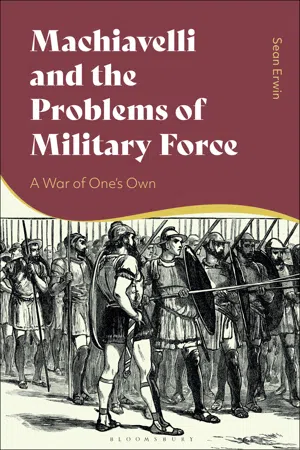
Central to Niccolò Machiavelli's writing is the argument that a successful state is one that prefers to lose with its own arms (arma propriis) than to win with the arms of others (arma alienis). This book sheds light on Machiavelli's critiques of military force and provides an important reinterpretation of his military theory.
Sean Erwin argues that the distinction between arma propriis and arma alienis poses a central problem to Machiavelli's case for why modern political institutions offer modes of political existence that ancient ones did not. Starting from the influence of Lucretius and Aelianus Tacticus on the Dell'arte della guerra, Erwin examines Machiavelli's criticism of mercenary, auxiliary, and mixed forces.
Giving due consideration to an overlooked conceptual distinction in Machiavelli studies, this book is a valuable and original contribution to the field.
- 208 pages
- English
- ePUB (mobile friendly)
- Available on iOS & Android
eBook - ePub
About this book
Information
1
Atomic War: The Influence of Lucretius on Machiavelli’s Art of War
1. Introduction
Sergio Bertelli first wrote of the 1961 discovery in the Vatican Library of Machiavelli’s hand transcription of De rerum natura (Rossiana 884),1 which contained a copy of Lucretius’ text bound with the Eunech of Terence.2 Scholars accept that Machiavelli began transcribing his copy of Lucretius’ De rerum natura around 1497.3 Alison Brown, Paul Rahe, Robert Roecklein, Ada Palmer, and Vittorio Morfino, among others, have argued convincingly that the influence of Lucretius and Epicurean philosophy can be discerned in Machiavelli’s texts like the Discourses, the Prince, the Florentine Histories, and his long poem, The Golden Ass, and that Machiavelli’s notions of free will, religion, and natural philosophy exhibit Epicurean influence.
For instance, Brown argues that Lucretius’ influence on Machiavelli spans his works and shows up especially in Machiavelli’s reasoning on ethical themes.4 Weighing the marginal notations Machiavelli made in the De rerum natura,5 Brown establishes numerous parallels between the Roman poet and the Florentine, especially in their understandings of free will and the role they ascribe to religion as an instrument of politics. Brown’s analyses detect Lucretian influence throughout Machiavelli’s works, from texts like the Discourses to his plays, and she concludes that Lucretian Epicureanism forms the cornerstone of Machiavelli’s philosophy.6
Paul Rahe also argues that Lucretius influenced Machiavelli and locates in the Roman poet the reason for Machiavelli’s break from the Aristotelian political tradition. Rahe finds the clearest sign of Lucretian influence in Machiavelli’s repudiation of religion and natural teleology.7 In addition, he highlights passages where he sees Machiavelli to be critical of Lucretius and Epicureanism in general. For instance, Rahe hears irony behind Machiavelli’s setting the Art of War in the sheltered gardens of the Oricellari family given the observations the condottiere captain, Fabrizio Colonna, makes in Book 1 about the softness of those accustomed to fight in the shade. Rahe assembles evidence that Machiavelli would not support the withdrawal from political life necessary to achieve Epicurean ataraxía—i.e., the pleasures taken in calmness of mind and freedom from the pains of emotional disturbance advocated by both Lucretius in the De rerum natura and Epicurus as transmitted through Diogenes Laertius.8
Rahe goes further and argues that Machiavelli’s silence on the question of the famous Epicurean atomic swerve—the clinamen—should also be read as his rejection of this Epicurean position and his willingness to embrace natural determinism.9 However, Rahe does not work with Machiavelli’s transcription of the De rerum natura directly. Rahe’s analysis does not acknowledge Machiavelli’s marginal comments in Book 2 of De rerum natura, where Machiavelli clearly links the possibility of freedom of the will to Lucretius’ description of the atomic swerve.
On the other hand, Ada Palmer analyzes the fifty-four manuscripts of the De rerum natura that remain from this period, including Machiavelli’s manuscript. Her investigations show that Machiavelli is the only one of the Renaissance Lucretian annotators to include in his copy extensive marginal notes on the section of De rerum natura Book 2 that addresses the technical details of Epicurean atomistic physics, including the nature of the primordia and the discussion of the clinamen.10 Palmer’s study shows that Machiavelli was unusual among Renaissance transcribers of Lucretius in the attention he gave to passages in the De rerum natura that discuss atomistic natural principles like the clinamen.
Robert Roecklin would extend Palmer’s line of reasoning even further.11 Roecklin hears the reference to mixed bodies in these chapters as a challenge to approach Machiavelli’s philosophy “from the vantage point of the theory of body that underlies his philosophy.”12 For Roecklin, Machiavelli’s references to the physics of mixed bodies in these chapters are important because in them it is evident that Machiavelli relies upon Epicurean terminology.13
Vittorio Morfino argues that Machiavelli accepts the Epicurean physics of mixed bodies. Morfino contends that Lucretius and, following him, Machiavelli, adopt a notion of corporeality that subordinates considerations of a body’s form to its susceptibility to mutate and change. On Morfino’s reading of Lucretius, an individual body occurs as an event generated from the ongoing exchange of relations among the aggregated primordia that compose it and those in its environment that support it. Morfino argues that agency in a Lucretian context must be understood from this basic fact.14 For Morfino, Machiavelli’s narratives describe the actions of agents like Cesare Borgia from several different perspectives because multiple layers of different kinds of interacting bodies take part in the event. As with Roecklin, Morfino’s readings of Machiavellian exemplars like Borgia would depend greatly on accepting the thesis that Machiavelli unconditionally adopts Lucretian atomism.15
A notable lacuna in these analyses concerns the Art of War, composed during the same time period as these other texts. The difficulty of establishing potential lines of influence between the De rerum natura and the Art of War is compounded due to the highly technical nature of the discussions on warfare that dominate the latter text. Scholars often neglect the Art of War on the basis of its focus on the minutiae of Renaissance military practice, which they judge a limitation of the text when measured against Machiavelli’s more genuinely political works.
On the other hand, scholars like Gabriele Pedullà argue that the Art of War is critical to understanding Machiavelli’s notion of the political, not despite, but because of these highly technical discussions; argues Pedullà: “To be a good political leader is not enough, because you have to become a military expert as well: this is Machiavelli’s fundamental belief.”16 For Pedullà, Machiavelli’s obsession with saddle construction, the angle of wagon wheels, and the proper width of roads and ditches in fortified towns and encampments shows his concern for the “microphysics of action” and how the concrete domains of practice and discipline serve as vectors for understanding his political thought.17 Machiavelli’s attention to the filigree of warfare signals his conviction that the spheres of practice and discipline forge chains of association that map onto subjectivity itself.18 On this reading, military discipline acts as the foundation for the domain of subjectivity by generating, and then capturing, that domain.
Machiavelli’s historical concerns with the atomistic physics and psychology spelled out in the De rerum natura offer a powerful vantage point through which to re-examine Machiavelli’s treatment of the transformational power of military discipline as spelled out in the Art of War. This chapter and the next examine Fabrizio Colonna’s discussion of the differences between the phalanx form utilized by the Greeks and the Swiss and the manipular legion of the Romans in Books 2 and 3 of the Art of War from a Lucretian framework. This chapter investigates two points of contact with Lucretius that emerge from the mercenary captain’s analyses. First he favors his neo-Roman brigade over the Macedonian phalanx and Swiss pike squares on the basis of “its greater life,” which it owes to materialist principles immanent to its organization. Second, the greater effectiveness of the brigade over the phalanx consists in its capacity for renewing itself, a theme that links Machiavelli’s discussion of battalion organization to passages in the Discourses and the Florentine Histories where the Florentine’s reasoning also exhibits a strong atomist influence.
As we will see, of all Machiavelli’s texts, the Art of War most offers itself to being read as a project of Lucretian bioengineering.19 As a dialogue between young Florentines and a mercenary captain, it begins by enumerating the ills following from the current state of military affairs on the Italian peninsula that stem from the reliance princes and republics have on professional mercenary and auxiliary troops, or what he discusses exhaustively in the Prince and the Discourses as the dangers of relying on arma alienis. It concludes by relying on both narrative and diagrammatic elements to generate a function...
Table of contents
- Cover
- Half-Title Page
- Series Page
- Title Page
- Contents
- Acknowledgments
- Introduction: The Problem of Hiero II
- 1 Atomic War: The Influence of Lucretius on Machiavelli’s Art of War
- 2 Practical Proportions: Aelianus Tacticus in Machiavelli’s Art of War
- 3 Industries of Failure? Mercenaries and the Arms of Others
- 4 Instrumental and Aleatory Aspects of Auxiliary Force in Machiavelli
- 5 Transforming Compounds: Machiavelli’s Analyses of Mixed Force
- Conclusion: Captains of Critique
- Notes
- Bibliography
- Index
- Copyright
Trusted by 375,005 students
Access to over 1.5 million titles for a fair monthly price.
Study more efficiently using our study tools.
Frequently asked questions
Yes, you can cancel anytime from the Subscription tab in your account settings on the Perlego website. Your subscription will stay active until the end of your current billing period. Learn how to cancel your subscription
No, books cannot be downloaded as external files, such as PDFs, for use outside of Perlego. However, you can download books within the Perlego app for offline reading on mobile or tablet. Learn how to download books offline
We are an online textbook subscription service, where you can get access to an entire online library for less than the price of a single book per month. With over 1.5 million books across 990+ topics, we’ve got you covered! Learn about our mission
Look out for the read-aloud symbol on your next book to see if you can listen to it. The read-aloud tool reads text aloud for you, highlighting the text as it is being read. You can pause it, speed it up and slow it down. Learn more about Read Aloud
Yes! You can use the Perlego app on both iOS and Android devices to read anytime, anywhere — even offline. Perfect for commutes or when you’re on the go.
Please note we cannot support devices running on iOS 13 and Android 7 or earlier. Learn more about using the app
Please note we cannot support devices running on iOS 13 and Android 7 or earlier. Learn more about using the app
Yes, you can access Machiavelli and the Problems of Military Force by Sean Erwin in PDF and/or ePUB format, as well as other popular books in Philosophy & Medieval & Renaissance Philosophy. We have over 1.5 million books available in our catalogue for you to explore.