What can philosophy teach us about cinema? Can cinema transform how we understand philosophy? How should we describe the competing approaches to philosophizing on film? New Philosophies of Film answers these questions by offering a lucid introduction to the exciting developments and contentious debates within the philosophy of film. Mapping out the conceptual terrain, it examines both analytic and continental approaches to cinema and puts forward a pluralist film philosophy, grounded in practical examples from film, documentaries and television series.
Now thoroughly updated to showcase the most recent developments in the field, this 2nd edition features:
· New chapters on phenomenology, cinematic ethics, philosophical documentary film and television as philosophy, incorporating feminist, socio-political, ethical and ecological approaches to cinema
· Contemporary case studies including Carol, Roma, Melancholia, two Derrida documentaries, and the Netflix series Black Mirror
· Expanded coverage of Gilles Deleuze and Stanley Cavell, two of the most influential philosophers of film
· An updated bibliography, filmography and reading lists, with links to online resources to support further study
Demonstrating how the film-philosophy encounter can open up new paths for thinking, New Philosophies of Film is an essential resource for putting interdisciplinary inquiry into practice.
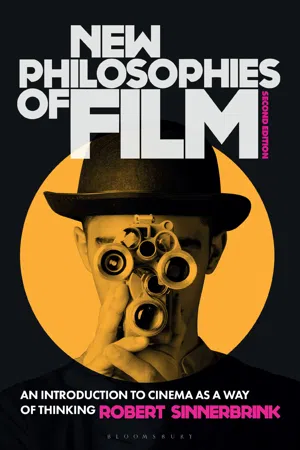
eBook - ePub
New Philosophies of Film
An Introduction to Cinema as a Way of Thinking
- 432 pages
- English
- ePUB (mobile friendly)
- Available on iOS & Android
eBook - ePub
About this book
Trusted by 375,005 students
Access to over 1.5 million titles for a fair monthly price.
Study more efficiently using our study tools.
Information
Part I
The Analytic-Cognitivist Turn
1The Empire Strikes Back: Critiques of ‘Grand Theory’
2The Rules of the Game: New Ontologies of Film
3Adaptation: Philosophical Approaches to Narrative
In Part I of this book I introduce some of the new approaches to philosophising on film, which I have dubbed the analytic-cognitivist paradigm, analysing the related strands of its critique of the preceding model of film theorising, so-called ‘Grand Theory’. This approach has produced a host of powerful theories addressing philosophical, psychological and aesthetic aspects of film (see Livingston and Plantinga 2009). In Chapter 1, I examine the influential critique of ‘Grand Theory’ developed during the 1990s by David Bordwell, Noël Carroll, Richard Allen, Murray Smith and a host of other theorists. Underlying this critique is a dispute between competing ways of doing philosophy, associated with the vexed analytic/‘Continental’ philosophy divide (see Critchley 2001; Glendinning 2006; Sinnerbrink 2010). After addressing the critique of ‘Grand Theory’, I examine Carroll’s philosophy of film (his ‘dialectical cognitivism’), which argues against ‘medium essentialism’ (the idea that film has a definable medium that would determine aesthetic style and value); against interpretation (which conflates film theory with film criticism); and against the ‘film as language’ thesis (that language provides an appropriate model for theorising film). I also consider Bordwell’s related critique of film hermeneutics and of speculative film theory, suggesting that there are problems with Bordwell’s critique of the hermeneutic (interpretative) approach to film. Although generating a rich array of new theoretical work, the analytic-cognitivist turn can also be challenged for its sometimes ‘reductionist’ approach to the complex aesthetic, hermeneutic and ideological dimensions of film. In good dialectical fashion, the challenge is to incorporate theoretical innovations in the new approaches, yet retain what remains valuable in the older paradigms. The aim, in short, is to avoid both reductionism and dogmatism (the bugbear of so-called ‘Grand Theory’).
1
The Empire Strikes Back:
Critiques of ‘Grand Theory’
Chapter Outline
The Philosophical Turn in Film Theory
The Critique of ‘Grand Theory’
Criticisms of ‘Grand Theory’
Carroll’s Dialectical Cognitivism
Cognitivism Goes Pluralist
The Philosophical Turn in Film Theory
As Adrian Martin observes (2006), every 15 years or so film studies seem to undergo a distinctive kind of theoretical ‘turn’. From the psychoanalytic turn of the 1960s and 1970s through the historiographic turn of the 1980s and 1990s, we now find ourselves, Martin remarks, in the midst of a ‘philosophic turn’ that was sparked by Deleuze’s Cinema books in France and Cavell’s works in the United States (2006: 76). In the 15 years or more since Martin’s observation, we still appear to be working through this philosophical turn (see Elsaesser 2019; Rawls, Neiva and Gouveia 2019). As Martin remarks, the Deleuzian turn was followed by ‘various certified philosophers exploring their passions for cinema – Bernard Stiegler, Alain Badiou, Slavoj Žižek, Giorgio Agamben, and Jacques Rancière, among others’ (2006: 76). To explain this ‘philosophical turn’ in film theory, some philosophers have cited the general cultural popularity of film, its pedagogical potential (particularly for teaching philosophy) and the rise of cognitivist approaches in psychology and philosophy of mind (see Carroll 2008; Gaut 2010; Shaw 2008). Although these are all relevant factors, the most obvious reasons for the turn were institutional and theoretical: the collapse of what Bordwell and Carroll (1996) called ‘Grand Theory’ – 1970s and 1980s film theory that combined psychoanalytic, semiotic and ideologico-critical perspectives – and its replacement by historicist, culturalist and media-oriented approaches. In the so-called ‘theoretical vacuum’ that followed the demise of ‘Grand Theory’ and the cultural-historicist turn, so Carroll claims, philosophy offered the theoretical resources required to renew the ‘classical’ problems of film theory that had been left in abeyance by the previous paradigm (see Carroll 1988a, 1988b).
Whatever their theoretical orientations, the new wave of ‘post-Theory’ philosophers of film defined themselves against the older paradigm of institutionalised film theory of the 1970s and 1980s inspired by psychoanalysis, structuralism, semiotics, cultural theory and various strands of German critical theory and French post-structuralism.1 The title of Noël Carroll’s 1988 book says it all: Mystifying Movies: Fads and Fallacies in Contemporary Film Theory (1988a).2 The new philosophical film theory challenging the prevailing theoretical models styled itself as analytic rather than ‘Continental’ in inspiration; cognitivist rather than psychoanalytic in approach; scientistic rather than hermeneutic in orientation; concerned with drawing upon and applying empirical research rather than engaging in speculation or interpretation. It aimed at a ‘rational’ understanding of film rather than at plumbing unconscious desire; and was concerned to use plain language and theoretical arguments rather than what critics derided as metaphysical jargon. With its preference for analytical argument and empirically testable models, analytic-cognitivist film theory has become an increasingly influential approach to the philosophical study of film.
The story becomes intriguing at this point, for the new philosophers of film were challenging a very specific theoretical approach. Noël Carroll usefully distinguishes between the then ‘contemporary film theory’ (semiological approaches that also drew on psychoanalytical and Marxist theories of ideology) and ‘classical film theory’, which included earlier theorists (like Arnheim and Bazin) along with more recent ones (such as V. F. Perkins and Stanley Cavell) (1988a: 1).3 According to Carroll, semiological film theory had a first wave (for example, Christian Metz), taking its inspiration from linguist Ferdinand de Saussure; and then a second wave (1970s screen theory), in which this semiological approach was combined with (Lacanian) psychoanalytic and (Althusserian) Marxist theories of ideology. This second wave of film theory also acquired a political inflection during the mid- to late 1970s through the feminist analysis of gender and a critique of the ideological function of Hollywood film.
The Critique of ‘Grand Theory’
Noël Carroll’s critique of ‘Grand Theory’ targets its uncritical commitment to eclectic strains of ‘Continental’ philosophy (1996: 37–68). Indeed, Carroll identifies what we might call ‘five obstructions’, pace Lars von Trier, to what he argued were more rationally defensible ways of theorising on film, difficulties that stem, he claims, from the flawed foundation of ‘Continental’ theory:
1)A monolithic conception of film theory, according to which a ‘foundational’ theoretical paradigm is assumed to account for all relevant aspects of film; this is linked with an implausible ‘medium essentialism’, which sought to explain all relevant phenomena in terms of the film medium.
2)The conflation of film theory with film interpretation, according to which film theorists adopt a theoretical framework (Lacanian psychoanalysis, for example), and then ‘confirm’ the theory in question by finding its concepts or ideas instantiated in specific film examples, which are interpreted using the adopted theoretical framework in a question-begging, circular manner.
3)Political correctness, ‘culture wars’ rhetoric aside, this unfortunate term refers to the criticism that the progressive ethico-political claims of film theory were rendered plausible or defensible thanks to their solidarity with emancipatory social-political movements (of the 1960s and 1970s and beyond). More particularly, it refers to the dogmatic defence of theoretical claims, concepts or analyses because of their political value, utility or contribution to emancipatory movements or causes rather than their theoretical cogency, explanatory power or evidentiary basis.
4)Charges of formalism, according to which ways of theorising about film without a ‘political’ or ideological focus are dismissed as ‘formalist’ or as lacking substantive content; or the unwarranted rejection of theoretical claims as ethico-politically vacuous because of their theoretical rather than practical focus.
5)Biases against truth, which refers to the postmodernist dismissal of truth as an ideological construct, a relativist claim that rests on an untenable ‘argument from absolute truth’ (any truth claim about film presupposes an absolutist concept of truth; there is no such concept; ergo truth claims about film are ‘ideologically suspect’, hence false or pernicious) (Carroll 1996: 38–56).
Taken together, these five obstructions hampered philosophical theorisation of film, Carroll argued, prompting the need for a ‘paradigm shift’ towards more analytic-cognitivist forms of theory that were not beholden to these ethico-political constraints (Carroll 1996: 56–68).
There are two features of so-called ‘Grand Theory’ deemed most troubling by analytic-cognitivist critics: 1) the ‘decentred’ conception of the human subject whose claims to rational autonomy are undermined by the role of the unconscious in psychic life, and by the shared background structures of language, culture and ideology; and 2) the conviction that film, whether in its popular or modernist forms, is not just an art or popular cultural audiovisual medium but an ideologico-political battleground over forms of social and cultural representation (in particular, of gender, sexuality, class, race and cultural identity). The upshot of these two theses – the challenge to rational autonomy (posited by psychoanalytic theory), and the ideologico-political function of film (posited by Marxist and...
Table of contents
- Cover
- Half-Title Page
- Dedication
- Series Page
- Title Page
- Contents
- New Preface: Philosophical Film Theory Today
- Acknowledgments
- Introduction: Why Did Philosophy Go to the Movies?
- Part I The Analytic-Cognitivist Turn
- 1 The Empire Strikes Back: Critiques of ‘Grand Theory’
- 2 The Rules of the Game: New Ontologies of Film
- 3 Adaptation: Philosophical Approaches to Narrative
- Part II From Cognitivism and Phenomenology to Film-Philosophy
- 4 A.I. Artificial Intelligence: Cognitivism Goes to the Movies
- 5 Body Double: Adventures in Phenomenology
- 6 Bande à part: Deleuze’s Cine-Philosophy
- 7 Now, Voyager: Cavell as Film-Philosopher
- 8 Scenes from a Marriage: On the Idea of Film as Philosophy
- 9 What is Cinematic Ethics? Cuáron’s Roma (2018) as Case Study
- Part III Cinematic Thinking
- 10 Photobiographies: The ‘Derrida’ Documentaries as Film-Philosophy
- 11 Planet Melancholia: Romanticism, Mood and Cinematic Ethics
- 12 Television as Philosophy: Reflections on Black Mirror
- Conclusion: A Dialogue on the Future of Film-Philosophy
- Notes
- Filmography
- References
- Index
- Copyright
Frequently asked questions
Yes, you can cancel anytime from the Subscription tab in your account settings on the Perlego website. Your subscription will stay active until the end of your current billing period. Learn how to cancel your subscription
No, books cannot be downloaded as external files, such as PDFs, for use outside of Perlego. However, you can download books within the Perlego app for offline reading on mobile or tablet. Learn how to download books offline
Perlego offers two plans: Essential and Complete
- Essential is ideal for learners and professionals who enjoy exploring a wide range of subjects. Access the Essential Library with 800,000+ trusted titles and best-sellers across business, personal growth, and the humanities. Includes unlimited reading time and Standard Read Aloud voice.
- Complete: Perfect for advanced learners and researchers needing full, unrestricted access. Unlock 1.5M+ books across hundreds of subjects, including academic and specialized titles. The Complete Plan also includes advanced features like Premium Read Aloud and Research Assistant.
We are an online textbook subscription service, where you can get access to an entire online library for less than the price of a single book per month. With over 1.5 million books across 990+ topics, we’ve got you covered! Learn about our mission
Look out for the read-aloud symbol on your next book to see if you can listen to it. The read-aloud tool reads text aloud for you, highlighting the text as it is being read. You can pause it, speed it up and slow it down. Learn more about Read Aloud
Yes! You can use the Perlego app on both iOS and Android devices to read anytime, anywhere — even offline. Perfect for commutes or when you’re on the go.
Please note we cannot support devices running on iOS 13 and Android 7 or earlier. Learn more about using the app
Please note we cannot support devices running on iOS 13 and Android 7 or earlier. Learn more about using the app
Yes, you can access New Philosophies of Film by Robert Sinnerbrink in PDF and/or ePUB format, as well as other popular books in Philosophy & Film & Video. We have over 1.5 million books available in our catalogue for you to explore.