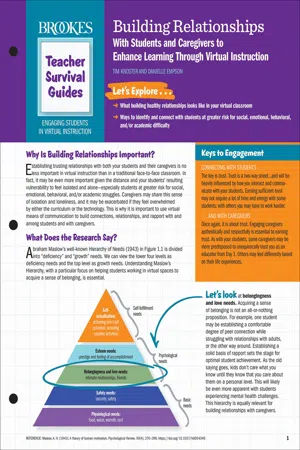
Building Relationships with Students and Caregivers to Enhance Learning Through Virtual Instruction
eBook - ePub

Building Relationships with Students and Caregivers to Enhance Learning Through Virtual Instruction

  1. 6 pages
  2. English
  3. ePUB (mobile friendly)
  4. Available on iOS & Android
eBook - ePub

Building Relationships with Students and Caregivers to Enhance Learning Through Virtual Instruction

About this book

Enrollment in virtual and blended schools is on the rise—introducing new challenges with student engagement, social–emotional wellness, and behavior management. Help is here with this laminated quick–guide, one of four concise Teacher Survival Guides on Engagement of Students in Virtual Instruction. Designed to help teachers meet their students' needs, this guide unlocks one of the keys to success in online learning environments: establishing trusting relationships. Tim Knoster and Danielle Empson show teachers how to create healthy relationships in a virtual classroom, build connections and rapport with both students and caregivers, and identify and connect with students at greater risk for social-emotional and/or academic difficulty. Teachers will gain useful insights from sample scenarios and student behavioral profiles, real–world teaching tips, and strategy adaptations for virtual classrooms. GET THE COMPLETE SERIES: The four Teacher Survival Guides on Engagement of Students in Virtual Instruction are filled with the ready–to–use guidance K–12 teachers need to boost engagement, student wellbeing, and positive behavior in virtual settings. Packed with bite–sized nuggets of insight—including keys to engagement, teaching tips, proven strategies, and FAQs—these laminated, six–panel guides will help any teacher take immediate action to support their students' academic, social–emotional, and behavioral success. Learn more about the other quick-guides in the series: Enhancing Student Engagement by Virtually Establishing, Teaching, and Reinforcing Desired Behavior
Engaging Students in Virtual Instruction Through Opportunities to Respond
Addressing Undesired Student Behavior During Virtual Instruction

Frequently asked questions

Yes, you can cancel anytime from the Subscription tab in your account settings on the Perlego website. Your subscription will stay active until the end of your current billing period. Learn how to cancel your subscription.
At the moment all of our mobile-responsive ePub books are available to download via the app. Most of our PDFs are also available to download and we're working on making the final remaining ones downloadable now. Learn more here.
Perlego offers two plans: Essential and Complete
  • Essential is ideal for learners and professionals who enjoy exploring a wide range of subjects. Access the Essential Library with 800,000+ trusted titles and best-sellers across business, personal growth, and the humanities. Includes unlimited reading time and Standard Read Aloud voice.
  • Complete: Perfect for advanced learners and researchers needing full, unrestricted access. Unlock 1.4M+ books across hundreds of subjects, including academic and specialized titles. The Complete Plan also includes advanced features like Premium Read Aloud and Research Assistant.
Both plans are available with monthly, semester, or annual billing cycles.
We are an online textbook subscription service, where you can get access to an entire online library for less than the price of a single book per month. With over 1 million books across 1000+ topics, we’ve got you covered! Learn more here.
Look out for the read-aloud symbol on your next book to see if you can listen to it. The read-aloud tool reads text aloud for you, highlighting the text as it is being read. You can pause it, speed it up and slow it down. Learn more here.
Yes! You can use the Perlego app on both iOS or Android devices to read anytime, anywhere — even offline. Perfect for commutes or when you’re on the go.
Please note we cannot support devices running on iOS 13 and Android 7 or earlier. Learn more about using the app.
Yes, you can access Building Relationships with Students and Caregivers to Enhance Learning Through Virtual Instruction by Timothy Knoster,Danielle Empson in PDF and/or ePUB format, as well as other popular books in Education & Behavioural Management. We have over one million books available in our catalogue for you to explore.

Information

Connecting With Students Who Appear to Be Vulnerable

Why Is It Important to Connect?

Personal connection is particularly important with any student who may be struggling with course content or your established behavioral expectations and/or who is experiencing stressors that are becoming overwhelming. It can also make all the difference with students who struggle with interpersonal relationships, self-regulation of their actions when feeling upset, and social problem solving. Students who struggle with interpersonal interactions are more vulnerable for feeling marginalized by their peers and others; look to proactively increase rapport building with these students. Related to this, having a connection with at least one caring adult has long been acknowledged as a major protective factor for children at risk for developing mental health challenges, including suicidal ideation. This is particularly important given increased depression and anxiety among young children and adolescents.
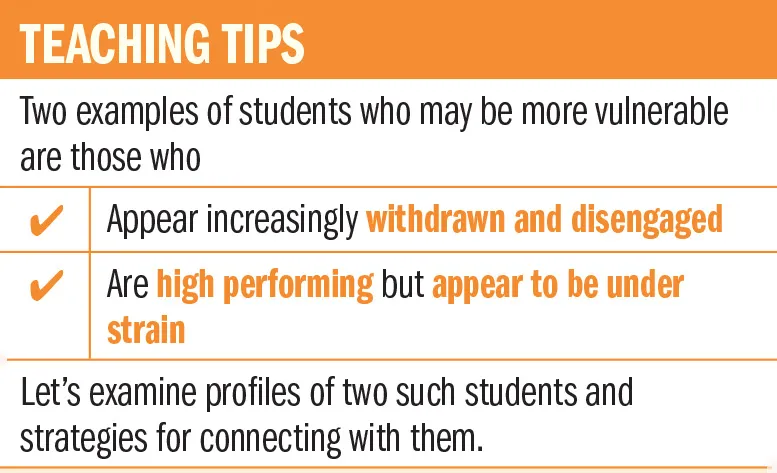
Teaching Tips: Teaching tips are listed in a two-column table, with the information in the right-hand column and a checkmark in the left-hand column.

© iStock.com/shironosov

PROFILE: Student Who Appears Withdrawn

ALEX is a 9-year-old in your virtual fourth-grade classroom. Alex is not one of the kids who immediately comes to mind when you are thinking about students of concern. In fact, Alex appears very compliant
almost to a fault. You can’t recall the last time you had to redirect Alex for overt misbehavior during virtual instruction.
WARNING SIGNS: You have noticed that Alex has started to not respond to questions you pose during synchronous instruction. To the best of your recollection, Alex does not appear comfortable sharing anything about experiences outside of school—interests, hobbies, or even dislikes. Although you have always known Alex to be relatively quiet, Alex has appeared more sullen and withdrawn during the past few weeks. You don’t know what is exacerbating this withdrawal, but your gut instinct tells you to explore ways to help Alex become more comfortable with interacting with classmates. After doing a little investigative work, you discover that Alex is interested in photography.

STRATEGIES - 1 2 3

STRATEGY 1

Talk with colleagues and indirectly explore with classmates thro ugh observation to learn more about Alex’s interests.
WHY IT WORKS: This helps you to get a fuller picture of who Alex is and identify possible avenues for connection—in this case, Alex’s interest in photography.
HOW TO ADAPT IT: Reach out to others who know Alex, including Alex’s parents. Consider using a formal interest inventory to gain greater insight concerning all your students, with particular focus on Alex.

STRATEGY 2

Once you know more about stu...

Table of contents

  1. Cover
  2. Why Is Building Relationships Important?
  3. Connecting With Students Who Appear to Be Vulnerable
  4. Connecting With Caregivers
  5. BUILDING STRONG RELATIONSHIPS: What It Looks Like
  6. ABOUT THE AUTHORS
  7. Copyright