![]()
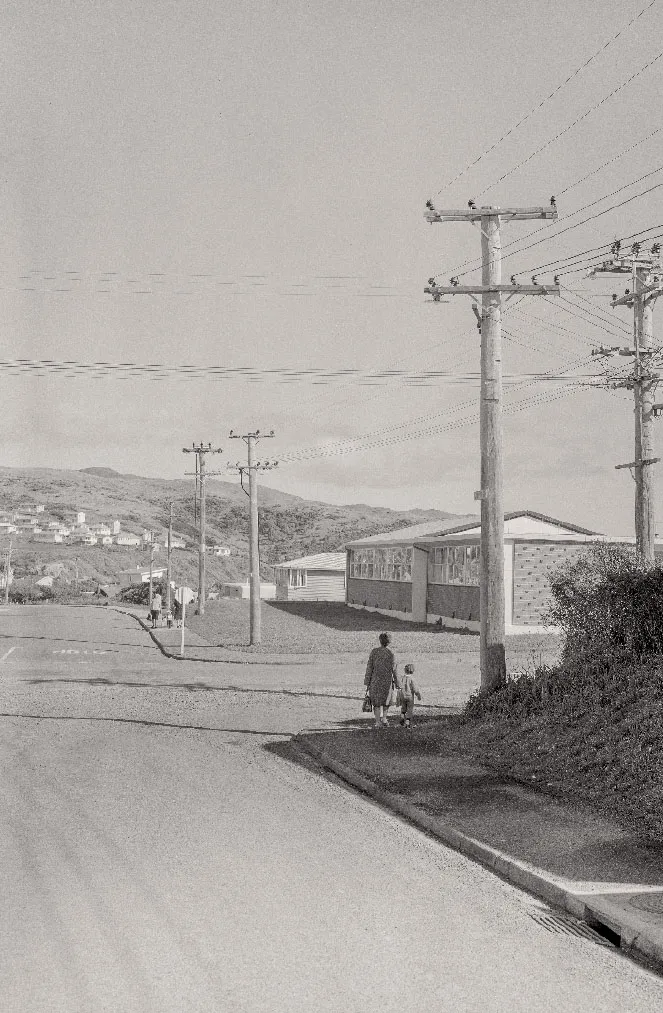
Suburban street, Porirua, circa 1960. Duncan Winder photograph, Alexander Turnbull Library, DW1852-F
BACKWATER BOHEMIANS
One
My sixties began at sea.
I was eighteen months old and on my way home to New Zealand on the passenger ship Rangitoto with my parents Conrad and Marei. They had gone to Britain early in 1959 in search of the cultural and intellectual riches of which they felt starved in their own country, expecting to stay two, three years, maybe longer. In London they attended premiere productions at the Royal Court Theatre, saw the latest Ingmar Bergman films and mime artist Marcel Marceau, marched against the atom bomb, heard philosopher Bertrand Russell speak and visited the progressive educator A. S. Neill at his school, Summerhill.
The pace of cultural life in Britain was overwhelming. Con wrote home: ‘In theatre, cinema, politics, literary circles, everywhere events speed by so fast that you have scarcely made up your mind to see or do something than you have lost the opportunity. Massive protest movements well up overnight out of the big heart of the English working class against every dirty move of their overlords.’1
But the casual teaching work he was relying on had not been as regular as he had hoped, and their own one-year-old overlord put limits on how much time he and Marei could devote to loftier pursuits. Changing nappies, scrubbing spattered food off the floor of their rented Chelsea flat and rescuing the family wallet from the lavatory (my favourite receptacle) dominated their lives. And though they had been dazzled by the speed and vitality of London’s cultural life, Con, a socialist and idealist, was appalled by how entrenched the British class structure seemed to be. In a particularly flamboyant letter he described ‘the intolerable arrogance of the rich, the nannies wheeling great fat overfed congenital imperialists in prams as big as stage coaches …’2
New Zealand, by comparison, seemed still unformed, full of utopian potential. So after just a year away Con was returning to his former job at the Ministry of Works. He explained in an aerogramme, written from the ship on New Year’s Eve and mailed to his in-laws from somewhere in the Caribbean, that he wanted to start a weekly left-wing newspaper. Marei had ‘some fruitful looking thoughts about drama’. With the help of the Public Service Investment Society they would buy a house in Wellington. ‘We have definite ideas about age and type of house, as well as of locality. Also boundless faith in the future.’3
‘A GREY, FRIENDLY ENVIRONMENT’
What was this country they had run from, and to which they were now returning with such optimism?
In 1960 there were a little under two and a half million New Zealanders. About 154,000 were Māori. Despite the myth of the country’s homogeneity, there were both cultural and economic divisions. The day-to-day life of, say, a rural Māori whānau such as the one Ans Westra would document in her controversial 1964 school bulletin Washday at the Pa, bore little resemblance to that of an urban Pākehā family in a suburb like Karori or Fendalton.4 As the decade unfolded, the kind of life Westra depicts would become less common as Māori moved in unprecedented numbers from the country to the cities, drawn by a boom in manufacturing. In 1960, the Waitangi Day Act was passed, making 6 February ‘a national day of thanksgiving in commemoration of the signing of the Treaty of Waitangi’. However, the Act did not provide for a public holiday, which Prime Minister Walter Nash said would be too costly and would only emphasise divisions that society should be trying to eradicate. ‘We should not think of ourselves as Maoris or Pakehas, but rather as one people,’ he said.5 Yet the differences between Māori and Pākehā — in cultural values, economic status, health and crime statistics — would become only more pronounced.
Most New Zealanders had a roof over their heads, and the number of families owning their own homes was rising. Though only 403 people were registered as unemployed, almost ten thousand were in psychiatric institutions. The major cities were growing, and the farms were flourishing, with international prices for wool and dairy products at record highs. Incomes, too, were on the up. Families could mostly get by on a single wage, so while the man worked, the married woman usually stayed home, unpaid, to look after children, house and husband. Women were the nominal recipients of the Family Benefit, a weekly universal government grant of 15 shillings per child to assist with household costs. If you were a widow you were eligible for a special benefit, but the same did not apply if you were divorced, separated or a solo mother.
University intakes were also booming. In a couple of years’ time a bursary system covering student fees and boarding costs would be introduced. Over the course of the decade, bursaries would increase and the number attending university would more than triple.
But there was also what Sandra Coney, looking back, identified as ‘a strong strand of philistinism and anti-intellectualism’, with academics and artists ‘stereotyped as bearded, sandalled beatniks — failures when it came to the real business of being a New Zealand man’.6
And what did the real business of being a man involve? The national heroes were almost all sportsmen: Snell and Halberg with their Olympic medals for running, Hillary ‘the bee keeper who climbed mountains’.7 And, most of all, rugby players. Rugby, which became a game in the 1820s when someone at a posh school in England picked up a football and ran with it, had been played here for almost as long as Pākehā have been in the country. With its national team drawn from the best provincial players, there was a myth that the All Blacks were the embodiment of the country’s social unity. This is despite the fact that only men participated in the game, and that when the national team went to play against the other most rugby-possessed nation, South Africa, Māori were not allowed on the field.
If New Zealand had a culture in which practicality and physicality were valued more than words and ideas, when it came to rhetoric men again dominated. In spite of having pioneered women’s suffrage, sometimes touted as a measure of the country’s egalitarianism, the New Zealand Parliament in 1960 included only four women among its eighty members.
Another mark of manliness was the ability to drink a lot of beer in as little time as possible. Public bars were female-free zones where beer was served by the jugful. Due to an anachronism left over from regulations introduced during the First World War, all pubs had to close at 6 p.m. The hour between 5 p.m., when men knocked off work, and closing time an hour later, was known as the six o’clock swill, during which pub-goers consumed as much beer as possible before staggering home to their families. To Dutch-born Boyd Klap, who arrived in New Zealand in 1951, the way men spoke to each other in the male-only public bars was strikingly different from the way he heard them speak in their homes. In Holland, socialising was traditionally done as a family unit, which naturally included men, women and children.8
The five-day working week was similar. Shops normally closed half an hour before the pubs, though they remained open for a few extra hours one night a week, usually Fridays, so you could buy the things you might need over the weekend: oil for the lawnmower, paint for the shed, white bread for sandwiches after the game. Then they shut their doors and didn’t reopen until Monday.
But if few people engaged in paid work on weekends, they found plenty to keep them busy. After a year in New Zealand in the late 1950s, American educational psychologist David Ausubel would observe: ‘I have never seen any people tackle sport, gardening or household projects with greater energy or enthusiasm.’ As for their diligence as wage-earners, he noted that ‘the forty-hour week and morning and afternoon tea are observed with scrupulous religiosity’.
Ausubel saw a people proud of their country’s apparent egalitarianism and ‘fond of contrasting their conceptions of equality’ favourably ‘with those of the British’. But he found the society insular, with ‘a strong undercurrent of repressed hostility’, and noted a ‘coolness toward strangers’, except in Māori homes where he had ‘precisely the opposite feelings’, discovering that in those places ‘the guest is king’. Among Pākehā he noted an ‘authoritarian, moralistic and punitive approach to children’ reminiscent of Victorian England, and remarked on ‘the apparent paradox of an advanced Welfare State coexisting with an essentially mid-Victorian social ideology’. Male drinking habits he found ‘suggestive of prolonged adolescent revolt against the authoritarianism of their secondary school days …’9
These were some of the same traits visiting English writer and proto-countercultural figure Anna Kavan had noted more than a decade earlier. ‘I don’t like the set-up between the sexes,’ she wrote, ‘… the men getting together around the bottles and the women getting on with the chores. The men worrying about the Labour Government and the women worrying about something in the oven.’10
‘A grey, friendly environment’ was how the country appeared to Boyd Klap, ‘where the men were very poorly dressed and the women were overdressed. The women with the blue and the pink berets with a pin through it … and the guys — brown shoes with grey trousers, and often pullovers. But I don’t think it was grey in terms of grey trousers. It was grey in terms of the buildings and the streets and the six o’clock closing and going home and talking about sport only and not international affairs or politics.’11
Though there was not yet a counterculture as it would come to be known, almost any kind of cultural activity might, against this grey backdrop, have seemed countercultural. The country’s first National Orchestra had been founded only after the Second World War, and included a number of recent immigrants and refugees from Europe. Classical music was part of a cultural package these new New Zealanders brought with them, along with an appreciation of poetry, painting, architecture and decent coffee.
Modern thinkers such as the Austrian architect Ernst Plischke and Berlin-born town planner Gerhard Rosenberg had brought innovative ideas about society and housing. The Czech immigrant Mirek Smisek was showing for the first time that a New Zealander could be a full-time, independent ceramicist. Dutch-born Eelco Boswijk in Nelson and German Odo Strewe in Auckland had recently opened cafés, Chez Eelco and Babel respectively. In Wellington in 1957, British-born Fabian socialist Roy Parsons had opened Parsons Books in the iconic Massey House on Lambton Quay, designed by his friend Plischke. The shop included a café, run by the Jewish refugee Harry Seresin, where customers were encouraged to pass the time with coffee and conversation. Goulash and apple strudel were on the menu. To these exotic aesthetes the arts were alive. Attuned to innovations, they were natural allies and mentors to the burgeoning local Bohemia, while their baby-boomer offspring would grow up to be bohemians almost by default.
In 1950, John O’Shea and Roger Mirams had launched Pacific Films in Wellington. This would not only confront New Zealand with a somewhat critical representation of itself in the feature films of O’Shea, but also offer both a training ground for creative artists and sanctuary for non-conformists. Earlier still, Denis Glover’s Caxton Press and Bob Lowry’s Pilgrim Press helped the careers of New Zealand poets and novelists, going on to publish the likes of Janet Frame, Frank Sargeson, Allen Curnow and James K. Baxter. Around the same time a bohemian and predominantly gay scene revolved around the Queen Street studio of Auckland filmmaker Robert Steele, who had arrived from Australia in the late 1920s and, with Rex Harris, operated a lively salon that attracted dancers and theatre performers.12
Despite such noble enterprises, Kiwis committed to a life in the arts tended to dwell on the margins, both socially and economically, and were dismissed as dreamers or elitists. When future filmmaker Geoff Murphy finished school at the end of 1956, he wanted to be a jazz trumpet player or abstract artist, but there seemed no way to make a living from either option. His parents insisted he take up a cadetship with the New Zealand Railways. As Ausubel noted: ‘Tolerance for non-conformity and unorthodox opinions is relatively low, practically all newspapers tend uniformly to present the same conservative point of view, and vigorous controversy about significant issues is surprisingly sparse.’13
The Cold War between the US and Soviet Union that had begun as the superpowers jostled for power and influence after the Second World War entered its second phase with the nuclear arms race — with the space race as its entertainment division. Despite New Zealand’s emotional ties to Mother England, it had become evident that Britain, weakened by the war, could no longer be relied on to defend its far-flung empire. Increasingly bound to America, New Zealand’s government bought into its anti-communist rhetoric. In 1951, a long and bitter dispute saw waterside workers vilified and branded as communists by the recently elected National government. The watersiders had struck for better pay. The government, arguing that the strikers were putting the country’s vital export trade in jeopardy, declared a state of emergency, granted sweeping powers to the police and made it an offence to assist strikers in any way. Even to provide food for the strikers’ families was deemed a crime. After the strike was crushed, industrial action and public protest of any kind were scarce for more than a decade.
The New Zealand Security Service (later renamed the New Zealand Security Intelligence Service, and generally referred to as the SIS), modelled on Britain’s MI5, was established in 1956 with a brief to combat the perceived growth of Soviet intelligence operations down under.14 Though its chief role seems to have been snooping on Eastern Bloc representatives in New Zealand at the behest of its powerful American and British allies, it also involved surveilling any citizens with sociali...