- 146 pages
- English
- ePUB (mobile friendly)
- Available on iOS & Android
About this book
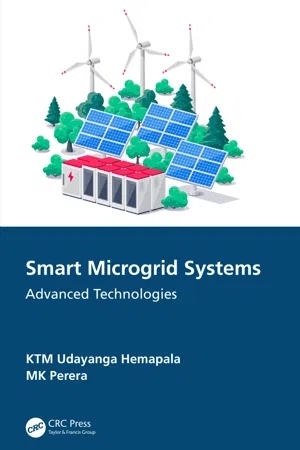
This book highlights microgrids as integrating platforms for distributed generation units, energy storages and local loads, with an emphasis on system performance via innovative approaches. It explains the smart power system concept, transmission, distribution, and utilization, and then looks at distributed generation technologies and hybrid power systems. Smart approaches, an analysis of microgrid design architecture and its implementation, the mitigation of cyber threats, and system optimization are also included. Case studies related to microgrid modeling and simulation are placed at the end of each chapter.
FEATURES
- Focuses on applications of expert systems for microgrid control
- Explores microgrid applications for power networks and applications of expert technologies
- Reviews design and development technologies related to renewable energy for a weak power network
- Discusses cyber security for microgrids
- Includes case studies related to actual developments and research
This book is aimed at researchers and graduate students in power engineering and electronics.
Tools to learn more effectively

Saving Books

Keyword Search

Annotating Text

Listen to it instead
Information
1Overview of Smart Power Systems
1.1The Conventional Power Grid
1.1.1 Overview of a Conventional Power Grid

- High power plant capacity
- Lengthy transmission network
- Uni-directional power flow
- Low load controllability
1.1.2 Problems Associated with Conventional Power Systems
1.1.2.1 Cascading Failure
1.1.2.1.1 Fukushima Nuclear Power Plant Accident

1.1.2.1.2 Blackout in Sri Lanka (2020)
1.1.2.2 Environmental Issues
1.2 Future Grid
- Decentralized power system with more distributed generation: The distributed nature of a smart grid ensures the integration of decentralized power generation such as solar panels, wind turbines, and biomass generators. The future power system needs to integrate green technologies, as this has now become a compulsory requirement due to global warming and other environmental issues.
- Consumers become producers (Prosumers): A prosumer is an individual who both consumes and produces at the same time.
- Multi-directional power flow: Once consumers become producers, the power flow will be in both directions. The system operators should then have the capability to control the variable distributed generation based on renewable energy. Otherwise, the system may be unstable.
- Flexible loads from participating in demand response programs.
- Adaptive and islanding capabilities.
- Self-healing capabilities: Self-healing refers to the ability to identify power grid problems in real time and safely respond by self-correcting.
1.2.1 What Is a Smart Grid?
1.2.2 Smart Grid Characteristics

Table of contents
- Cover
- Half-Title Page
- Title Page
- Copyright Page
- Table of Contents
- Preface
- Acknowledgements
- Authors
- Introduction
- 1 Overview of Smart Power Systems
- 2 Distributed Generation Technology
- 3 Overview of Microgrids
- 4 Novel Approaches to Microgrid Functions
- 5 Cyber Security for Smart Microgrids
- 6 Expert Systems for Microgrids
- 7 Conclusion
- Index
Frequently asked questions
- Essential is ideal for learners and professionals who enjoy exploring a wide range of subjects. Access the Essential Library with 800,000+ trusted titles and best-sellers across business, personal growth, and the humanities. Includes unlimited reading time and Standard Read Aloud voice.
- Complete: Perfect for advanced learners and researchers needing full, unrestricted access. Unlock 1.4M+ books across hundreds of subjects, including academic and specialized titles. The Complete Plan also includes advanced features like Premium Read Aloud and Research Assistant.
Please note we cannot support devices running on iOS 13 and Android 7 or earlier. Learn more about using the app