Addresses the very topical, crucial and original subject of parameter identification and optimization within multiscale modeling methods
Multiscale Modelling and Optimization of Materials and Structures presents an important and challenging area of research that enables the design of new materials and structures with better quality, strength and performance parameters as well as the creation of reliable models that take into account structural, material and topological properties at different scales. The authors' approach is four-fold; 1) the basic principles of micro and nano scale modeling techniques; 2) the connection of micro and/or nano scale models with macro simulation software; 3) optimization development in the framework of multiscale engineering and the solution of identification problems; 4) the computer science techniques used in this model and advice for scientists interested in developing their own models and software for multiscale analysis and optimization.
The authors present several approaches such as the bridging and homogenization methods, as well as the general formulation of complex optimization and identification problems in multiscale modelling. They apply global optimization algorithms based on robust bioinspired algorithms, proposing parallel and multi-subpopulation approaches in order to speed-up computations, and discuss several numerical examples of multiscale modeling, optimization and identification of composite and functionally graded engineering materials and bone tissues. Multiscale Modelling and Optimization of Materials and Structures is thereby a valuable source of information for young scientists and students looking to develop their own models, write their own computer programs and implement them into simulation systems.
Describes micro and nano scale models developed by the authors along with case studies of analysis and optimization
Discusses the problems of computing costs, efficiency of information transfer, effective use of the computer memory and several other aspects of development of multiscale models
Includes real physical, chemical and experimental studies with modern experimental techniques
Provides a valuable source of information for young scientists and students looking to develop their own models, write their own computer programs, and implement them into simulation systems.
1 Introduction to Multiscale Modelling and Optimization
A wide selection of materials exhibits unusual in‐use properties gained by control of phenomena occurring in mesoscale, microscale, and nanoscale during manufacturing. Examples of such materials range from constructional steels (e.g. AHSS – Advanced High Strength Steels for automotive industry [8] and titanium alloys for aerospace industry [10]) through various materials for energy applications [6] to new biocompatible materials for ventricular assist devices [9] or other biomedical applications [11]. Due to potential advances in materials science that could dramatically affect the most innovative technologies, further development in this field is expected. For this to happen, materials science has to be supported by new tools and methodologies, among which numerical modelling plays a crucial role.
On the other hand, to predict the correlation between processing parameters and product properties properly, one needs to investigate macroscopic material behaviour and phenomena occurring at lower dimensional scales, at grain level or even at atomistic levels. Thus, multiscale modelling with the digital materials representation (DMR) concept [7] is a research field that potentially can support the design of new products with unique in‐use properties. The development of new materials modelling techniques that tackle various length scale phenomena is observed in many leading research institutes and universities worldwide. Multiscale analysis of length and temporal scales has already found a wide range of applications in many areas of science. Advantages provided by a combination of numerical approaches: finite element (FEM), crystal plasticity finite element (CPFEM), extended finite element (XFEM), finite volume (FVM), boundary element (BEM), meshfree, multigrid methods, Monte Carlo (MC), cellular automata (CA), molecular dynamics (MD), molecular statics (MS), phase field and level set methods, fast Fourier transformation, etc. are already being successfully applied in practical applications [14].
This book's main feature, which distinguishes it from other publications, is that it is focused on modelling of processing of materials and that it combines the problem of multiscale modelling with the optimization tasks providing a wide range of possibilities for practical industrial applications.
The first part of the book contains a presentation of basic principles of the microscale and nanoscale modelling techniques. The second part supplies information about applications of optimization and identification techniques in multiscale modelling. The book is recapitulated by presenting information on the computer science techniques used in multiscale modelling, and it is focused on computer implementation issues, advising scientists interested in developing their multiscale models.
1.1 Multiscale Modelling
1.1.1 Basic Information on Multiscale Modelling
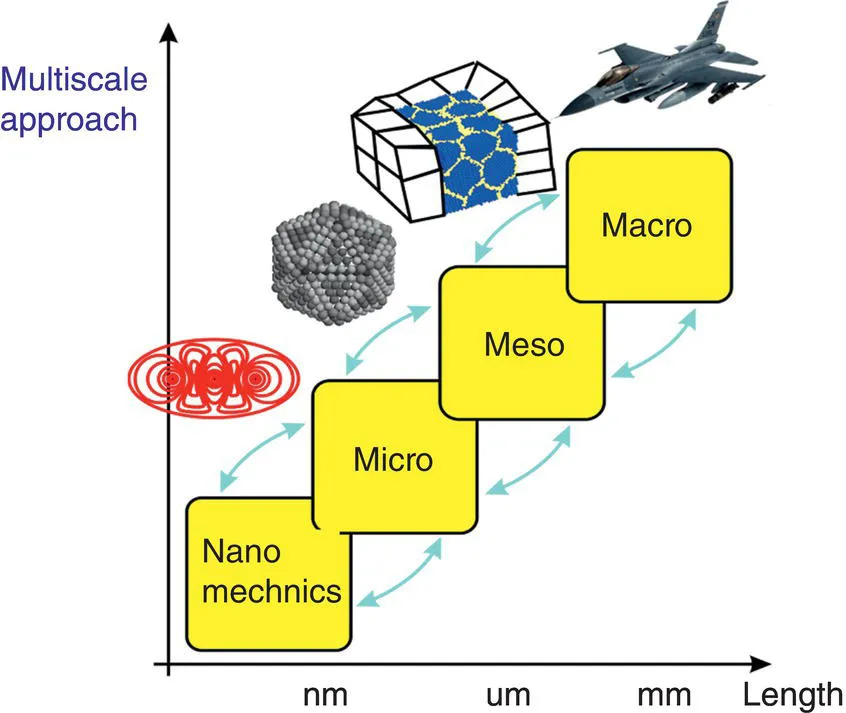
During the last years, numerical modelling became a widely used tool that successfully supports and comprehends experimental research on various modern materials. Basic principles of this modelling technique, as well as the classification of models, can be found in fundamental works of Allix [1] or Fish [4], and Horstemeyer and Wang [5] which discussed possible scopes of applications of multiscale modelling in the industry. However, within the last several years, various papers on multiscale modelling have been published in the scientific literature concerning both theoretical issues and practical applications. A variety of problems was raised in these papers, and several ambiguities connected with nomenclature and definitions can be found. The problem of naming various scales in multiscale modelling is an example of a lack of consistency in definitions. Commonly, ‘macro’, ‘meso’, ‘micro’, and ‘nano’ scales are mentioned (Figure 1.1).
Nevertheless, this nomenclature can be misleading and often not sufficient. The term ‘macroscale’ is used for different scales, from large structures to single crystals. Others describe the single‐crystal level as ‘microscale’. In many cases, the characteristic entities in the particular scale are important, not the characteristic length. For example the characteristic length of the scale, in which grains are distinguishable, can vary from nanometres to centimetres. Moreover, the same grain‐level scale can be applied as macroscale in connection with an atomistic scale model or as microscale with a macroscopic model of a large structure deformation. Therefore, this book uses the term ‘coarse’ scale for the scale with greater characteristic length and ‘fine’ scale for the scale with smaller characteristic length. It allows using the terms ‘coarser’ and ‘finer’ to describe relations between more than two scales. To keep the concept clear, the fine or coarse scales are usually related to the governing structures in particular cases (e.g. grains, atoms). Despite the length scale problem, there is also an issue with the time scale as many of the phenomena occur in significantly different time regimes. Usually, the temporal scale is unified across the different length scales to provide physically relevant results, which sometimes makes the computational model expensive.
Figure 1.1 Multiscale concept diagram which illustrates ‘macro’, ‘meso’, ‘micro’, and ‘nano’ scales.
The lack of a definition for the term multiscale in the numerical modelling community is another problem. The broad understanding of multiscale modelling includes all problems with important features in multiple scales (temporal and spatial) [15]. Stricter definitions are also used. In the narrow sense of the term, modelling is multiscale when the models at different scales are simultaneously considered [13]. There is a fundamental difference between these two definitions. Important features at more than one scale are present in almost all problems of material science. A microstructural base of work hardening is one of the most common examples. Hardening is a process at a clearly different scale than plastic deformation modelled with a continuity assumption. Hence we can describe the simulation of plastic deformation and work hardening as the multiscale model. One can also define the multiscale model as a system of submodels at two or more scales but not necessarily simultaneously computed. Some examples are discussed in the book. Two submodels must work simultaneously when both are dependent on results from the second one. Such models are two‐way coupled, contrary to one‐way coupling where one of the models is independent.
The range of possible applications of multiscale modelling is extensive. It includes such different topics as social issues, economy, ecosystems, weather forecast, and physical and chemical processes occurring in gases, fluids, and solids. Material models are an essential branch of multiscale modelling, combining physical and chemical processes, mainly in solids. Such a wide variety of topics makes revising all multiscale modelling applications impossible. Even in material science, several families of applications can be distinguished. The main areas are modelling of polymers, composites, solidification, thin layers, or polycrystalline materials. Each of these areas has its own characteristic features, distinguishing them from the others. While the bases are common for all areas, possible solutions to particular problems are different.
In this book, applications of multiscale modelling to processes occurring in polycrystalline materials, mainly metals and their alloys, are reviewed and addressed. The most distinguishing feature of metals and their alloys is their unrepeatable microstructure. However, the atomistic structure of crystals is regular, while properties of these materials depend mostly on imperfections of atomic structures (dislocations, solid solutions of atoms, grain boundaries, etc.). The mesoscale picture of the material structures includes disordered (usually) distribution of grain shapes, sizes and orientations, as well as strong anisotropy of single crystals and grain boundaries. It is a significant difference in comparison with composites and polymers (with its repeatable microstructure). Then, the difference between the modelling of crystallization and thin layers deposition lies within lack or a very small amount of fluids. It must be remembered that modelling of fluids flow is governed by different types of equations. Moreover, numerical techniques for microscale models and coupling of scales are different in the presence of fluids. Due to this diversity in materials and different techniques used for their description, the book focuses mostly on mentioned metals and their alloys to provide in‐depth information on the practical application of dedicated multiscale modelling and optimization techniques.
1.1.2 Review of Problems Connected with Multiscale Modelling Techniques
As mentioned, in the field of metallic materials, several ...
Table of contents
Cover
Table of Contents
Title Page
Copyright Page
Preface
Biography
1 Introduction to Multiscale Modelling and Optimization
2 Modelling of Phenomena
3 Computational Methods
4 Preparation of Material Representation
5 Examples of Multiscale Simulations
6 Optimization and Identification in Multiscale Modelling
7 Computer Implementation Issues
8 Concluding Remarks
Index
End User License Agreement
Trusted by 375,005 students
Access to over 1.5 million titles for a fair monthly price.
Study more efficiently using our study tools.
Frequently asked questions
Yes, you can cancel anytime from the Subscription tab in your account settings on the Perlego website. Your subscription will stay active until the end of your current billing period. Learn how to cancel your subscription
No, books cannot be downloaded as external files, such as PDFs, for use outside of Perlego. However, you can download books within the Perlego app for offline reading on mobile or tablet. Learn how to download books offline
Perlego offers two plans: Essential and Complete
Essential is ideal for learners and professionals who enjoy exploring a wide range of subjects. Access the Essential Library with 800,000+ trusted titles and best-sellers across business, personal growth, and the humanities. Includes unlimited reading time and Standard Read Aloud voice.
Complete: Perfect for advanced learners and researchers needing full, unrestricted access. Unlock 1.5M+ books across hundreds of subjects, including academic and specialized titles. The Complete Plan also includes advanced features like Premium Read Aloud and Research Assistant.
Both plans are available with monthly, semester, or annual billing cycles.
We are an online textbook subscription service, where you can get access to an entire online library for less than the price of a single book per month. With over 1.5 million books across 990+ topics, we’ve got you covered! Learn about our mission
Look out for the read-aloud symbol on your next book to see if you can listen to it. The read-aloud tool reads text aloud for you, highlighting the text as it is being read. You can pause it, speed it up and slow it down. Learn more about Read Aloud
Yes! You can use the Perlego app on both iOS and Android devices to read anytime, anywhere — even offline. Perfect for commutes or when you’re on the go. Please note we cannot support devices running on iOS 13 and Android 7 or earlier. Learn more about using the app
Yes, you can access Multiscale Modelling and Optimisation of Materials and Structures by Tadeusz Burczynski,Maciej Pietrzyk,Waclaw Kus,Lukasz Madej,Adam Mrozek,Lukasz Rauch in PDF and/or ePUB format, as well as other popular books in Technology & Engineering & Technology & Engineering Research & Skills. We have over 1.5 million books available in our catalogue for you to explore.