The reference work describes in its new edition still more up-to-date methods for the recycling and purifi cation processes of rare earth element analysis for industrial and scientific purposes alike. Due to their vast applications, from computer hardware to mobile phones and electric cars, REEs have become a valuable resource for our modern life. New topics: emission spectroscopy, analysis of environmental samples and pharmaceutical applications.
- 520 pages
- English
- ePUB (mobile friendly)
- Available on iOS & Android
eBook - ePub
About this book
Information
Topic
Sciences physiquesSubtopic
Chimie analytique1 Introduction
Alfred Golloch
Rare earth elements (REEs) are a group of chemical elements in the periodic table, including the 15 elements from lanthan (La,57) to lutetium (Lu, 71), scandium (Sc,21) and yttrium (Y,39). This grouping was agreed by IUPAC [1]. The elements scandium and yttrium differ in their atomic structure from the lanthanides but their chemical and physical properties are very similar.
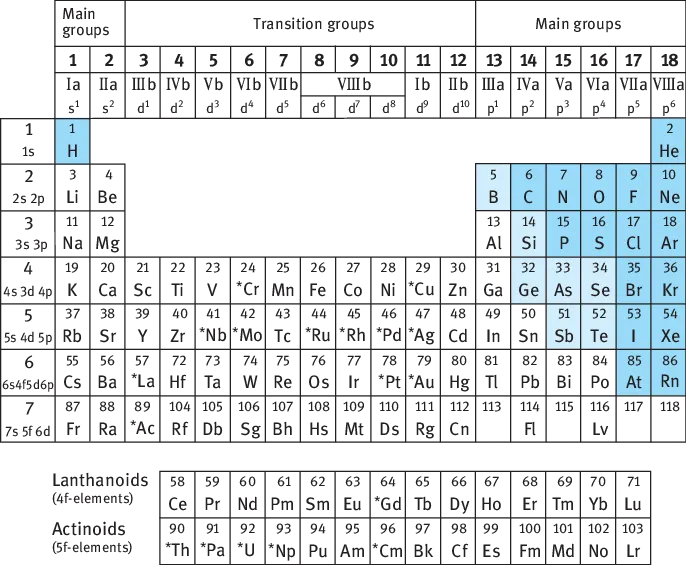
Figure 1.1: Periodic table of elements [2].
The abundance of the REEs in the earth’s crust follows a pattern in the periodic table. Lanthanides with even atomic numbers are more common in nature than lanthanides with odd atomic numbers.
Figure 1.2 shows the pattern of the REEs abundance in the earth’s crust and it can also be noted that the abundance of the REEs with lower atomic numbers is higher than the abundance of the REEs with higher atomic numbers. Regarding this scope the first group is called “Light REEs, LREEs” and the second one “Heavy REEs, HREEs” (See Table 1.1). Other attempts have been made to subdivide the REEs into groups.
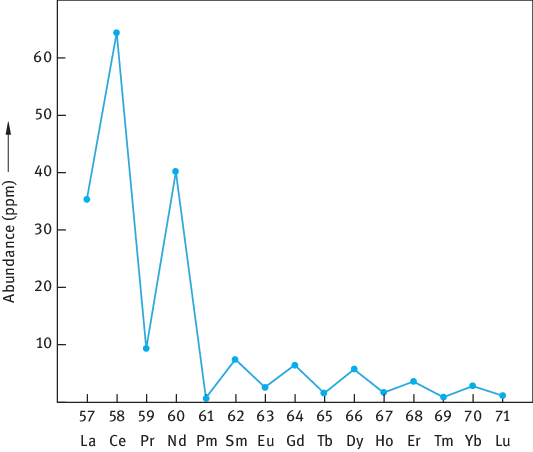
Figure 1.2: Abundance of the rare earth elements in the earth’s crust (Harkin rule) [2].
Table 1.1:Light and heavy REEs.
| LREE | atomic number | HREE | atomic number |
|---|---|---|---|
| Sc | 21 | Y | 30 |
| La | 57 | Gd | 64 |
| Ce | 58 | Tb | 65 |
| Pr | 59 | Dy | 66 |
| Nd | 60 | Ho | 67 |
| Pm | 61 | Er | 68 |
| Sm | 62 | Tm | 69 |
| Eu | 63 | Yb | 70 |
| Lu | 71 |
In most deposits of REEs the share in LREEs is higher than 90% and the percentage of HREEs 2–3%. For “High-Tech” applications mainly HREEs are used and the demand for these elements is obvious.
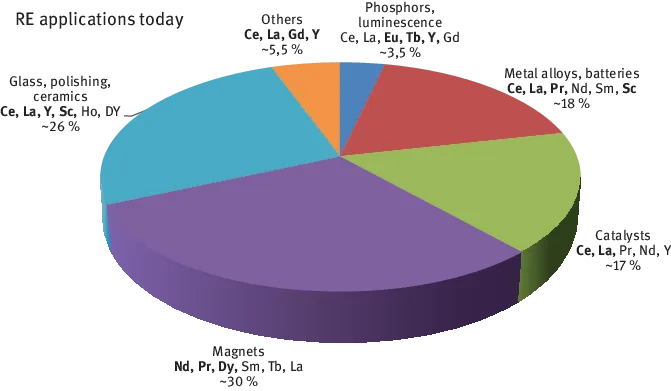
Figure 1.3: Main applications of rare earth elements [3].
References
[1]International Union of Pure and Applied Chemistry (IUPAC): Nomenclature of Inorganic Chemistry, Definition Rules 1970, Butterworths, London 1971. →
[2]Riedel E, Janiak C. Anorganische Chemie, Berlin/New York, DeGruyter, 2011. a, b
[3]Öko-Institut e.v. Hintergrundpapier Seltene Erden, Stand: Januar 2011, Seltene Erden-Daten und Fakten S. 5. →
2 Analytics of rare earth elements – basics and methods
Alfred Golloch
2.1 Electronic ...
Table of contents
- Title Page
- Copyright
- Contents
- dedication
- 1 Introduction
- 2 Analytics of rare earth elements – basics and methods
- Part I: Sample preparation
- Part II: Methods for the elemental analysis of rare earths and for the analysis of rare earth containing molecular compounds
- Part III: Application of rare earth elements analysis
- Index
Trusted by 375,005 students
Access to over 1.5 million titles for a fair monthly price.
Study more efficiently using our study tools.
Frequently asked questions
Yes, you can cancel anytime from the Subscription tab in your account settings on the Perlego website. Your subscription will stay active until the end of your current billing period. Learn how to cancel your subscription
No, books cannot be downloaded as external files, such as PDFs, for use outside of Perlego. However, you can download books within the Perlego app for offline reading on mobile or tablet. Learn how to download books offline
We are an online textbook subscription service, where you can get access to an entire online library for less than the price of a single book per month. With over 1.5 million books across 990+ topics, we’ve got you covered! Learn about our mission
Look out for the read-aloud symbol on your next book to see if you can listen to it. The read-aloud tool reads text aloud for you, highlighting the text as it is being read. You can pause it, speed it up and slow it down. Learn more about Read Aloud
Yes! You can use the Perlego app on both iOS and Android devices to read anytime, anywhere — even offline. Perfect for commutes or when you’re on the go.
Please note we cannot support devices running on iOS 13 and Android 7 or earlier. Learn more about using the app
Please note we cannot support devices running on iOS 13 and Android 7 or earlier. Learn more about using the app
Yes, you can access Handbook of Rare Earth Elements by Alfred Golloch in PDF and/or ePUB format, as well as other popular books in Sciences physiques & Chimie analytique. We have over 1.5 million books available in our catalogue for you to explore.