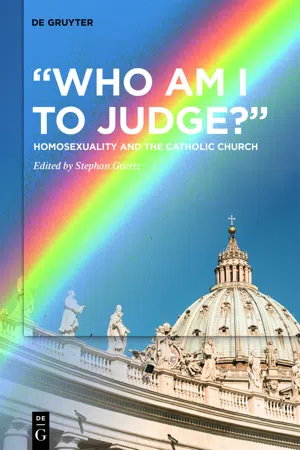
The Catholic Church still takes an ambivalent stance toward homosexuality, declaring that homosexuals should be respected and not discriminated against while morally condemning their intimate relationships. This volume presents exegetical, theological, and ethical arguments as well as evidence from the human sciences to advocate for the recognition of homosexuality as a natural variant of the human capacities to love and to form relationships.
- 292 pages
- English
- ePUB (mobile friendly)
- Available on iOS & Android
eBook - ePub
About this book
Information
Topic
Theology & ReligionSubtopic
Christian TheologyTheological and Ethical Debates
Creation Theology and Concepts of Homosexuality
Magnus Striet
Freiburg
1 The Current State of Affairs
There is hardly a more controversial topic in the religious arena than that of homosexuality. In contemporary liberal societies, one often has the impression that the normative exclusion of any sexual orientation that does not conform to a heteronormative pattern is a form of identity politics pursued by groups that are insecure in their own identities. This discourse of normality is an attempt to gain stability in the context of a sociocultural modernity that recognizes self-determined as opposed to essentialist identities. Thus religion – with its appealing offer of eternal truths –becomes an attractive option if one wants to lend one’s own concept of normality a veneer of legitimacy.
The following reflections focus on disputes around the topic of homosexuality in the Catholic tradition. Even today, it is extremely difficult to address the fact that homosexually oriented people exist within this tradition. However, one must differentiate. While significant revisions have been made (whether behind the scenes or in the open) in the academic theology evaluation of homosexuality, the Magisterium – and the theology it represents – still thinks it must insist that homosexual partnerships should not be accepted. It is true that the pastoral tone has changed. After all, one now encounters an insistence that homosexual people must be respected on the grounds of unconditional respect for human dignity. Nevertheless, homosexual domestic partnerships are still not accepted on the doctrinal level. At the same time, on the level of Church life, open clashes increasingly occur when active homosexuals who live in loving relationships and feel they are Christian believers claim the right to self-determination (which is granted in liberal societies) and also ask for God’s blessing on their relationship – that is, they want to place their relationship under the banner of God’s blessing within the context of Church fellowship, and thus with explicit reference to the God who, according to the Christian faith, made himself manifest in the life of the Jewish man Jesus of Nazareth.1 According to magisterial logic, while these people describe themselves as Christians, they are in fact living in grave sin, because a homosexual predisposition is considered “objectively disordered” and therefore may not be actively pursued. The Church may not bless that which cannot be consecrated.
The Congregation for the Doctrine of the Faith reaffirmed this teaching in a Responsum ad Dubium dated March 15, 2021.2 In response to the question of whether the Church has “the power to give the blessing to unions of persons of the same sex,” the apodictic answer is “no.” This “no” is justified by the fact that, “in addition to the right intention of those who participate” in a blessing, “it is necessary that what is blessed be objectively and positively ordered to receive and express grace, according to the designs of God inscribed in creation, and fully revealed by Christ the Lord.” Therefore no blessing should be given to any relationship or partnership “that involve[s] sexual activity outside of marriage (i. e., outside the indissoluble union of a man and a woman open in itself to the transmission of life), as is the case of the unions between persons of the same sex.” This has nothing to do with discrimination, because such blessings constitute only “a reminder of the truth of the liturgical rite,” and thus “the very nature of the sacramentals, as the Church understands them.”
The Responsum contains no new arguments in addition to those the Magisterium has previously presented. What is clear, however, is that the essence of the sacramentals – as recognized by the Magisterium and invoked by the Congregation – is no longer understood in certain segments of the Catholic Church, which is why the Congregation felt compelled to clarify the matter. This effort does not seem to have been very convincing. In any case, a storm of indignation and protest immediately arose, and open resistance in the form of a refusal to observe the ban on the blessing of same-sex couples was not only announced, but also practiced. Although this fact alone does not indicate that the acceptance and blessing of same-sex relationships and partnerships is possible, it nevertheless provides food for thought. The following considerations are intended to demonstrate that there is a fundamental shift in theological thinking on questions of sexual morality in the offing. This conflict is another instance of the fundamental theological disagreement – one which broke out immediately after the Second Vatican Council – over whether there is such a thing as a divinely established order (as identified by the ordinary and universal Magisterium) which is superior to humankind and to which humankind must obediently submit, or whether it is precisely the right to free self-determination which the free God desires to see realized as a human right in social relations.3
If we think strictly in terms of the theory of freedom, then the theological possibility of introducing the concept of sacramental partnership certainly opens up. This concept has an integrative effect insofar as it is not normatively bound to the criterion of heterosexuality. It theologically dignifies and legitimizes a relationship which a person attempts to practice in a committed, loving way – and this under the auspices of the God who is love, who loves freedom, and who places himself specifically on the side of those who are socially stigmatized, even for religious reasons. Partnered life would then no be longer subject to gradations of value by being calibrated against the a priori norm of heterosexual partnership.
2 The Basis for Magisterial Theological Approaches to Homosexuality
Before I undertake this attempt at a systematic approach, we must examine the Magisterium’s theology more precisely, particularly with regard to its argumentative rigor. As I have already indicated, the magisterial statements on homosexual inclination have been modified since they were originally made. Since homosexuality began to be described as a variant of human sexuality in the nineteenth century, the magisterial tone has changed. However, the Magisterium has not become more favorable in its basic assessment of homosexual inclination. The persons – that is, the people who are homosexual – are to be respected, but their lifestyle is not valued with appreciation. Such lifestyles continue to be measured against an objective norm, which according to magisterial theology is the cohabitation of a man and a woman. Based on this logic, homosexual inclination is interpreted as unnatural. In contrast, that which is natural is that which is believed to be willed and established by God himself. One cannot overlook the fact that this constitutes not only a naturalistic fallacy, but also tautological reasoning.
It would be interesting to know the basis on which the Magisterium has established that people who “have deep-seated homosexual tendencies” do in fact exist.4 When something is not only described but also judged as “objectively disordere...
Table of contents
- Title Page
- Copyright
- Contents
- “Who Am I to Judge?” An Overview of the Context and the Themes of the Contributions
- Exegetical Substantiation
- Insights from the Human and Social Sciences
- Theological and Ethical Debates
- Socio-Ethical Challenges
- List of Contributors
Trusted by 375,005 students
Access to over 1.5 million titles for a fair monthly price.
Study more efficiently using our study tools.
Frequently asked questions
Yes, you can cancel anytime from the Subscription tab in your account settings on the Perlego website. Your subscription will stay active until the end of your current billing period. Learn how to cancel your subscription
No, books cannot be downloaded as external files, such as PDFs, for use outside of Perlego. However, you can download books within the Perlego app for offline reading on mobile or tablet. Learn how to download books offline
Perlego offers two plans: Essential and Complete
- Essential is ideal for learners and professionals who enjoy exploring a wide range of subjects. Access the Essential Library with 800,000+ trusted titles and best-sellers across business, personal growth, and the humanities. Includes unlimited reading time and Standard Read Aloud voice.
- Complete: Perfect for advanced learners and researchers needing full, unrestricted access. Unlock 1.5M+ books across hundreds of subjects, including academic and specialized titles. The Complete Plan also includes advanced features like Premium Read Aloud and Research Assistant.
We are an online textbook subscription service, where you can get access to an entire online library for less than the price of a single book per month. With over 1.5 million books across 990+ topics, we’ve got you covered! Learn about our mission
Look out for the read-aloud symbol on your next book to see if you can listen to it. The read-aloud tool reads text aloud for you, highlighting the text as it is being read. You can pause it, speed it up and slow it down. Learn more about Read Aloud
Yes! You can use the Perlego app on both iOS and Android devices to read anytime, anywhere — even offline. Perfect for commutes or when you’re on the go.
Please note we cannot support devices running on iOS 13 and Android 7 or earlier. Learn more about using the app
Please note we cannot support devices running on iOS 13 and Android 7 or earlier. Learn more about using the app
Yes, you can access “Who Am I to Judge?” by Stephan Goertz in PDF and/or ePUB format, as well as other popular books in Theology & Religion & Christian Theology. We have over 1.5 million books available in our catalogue for you to explore.