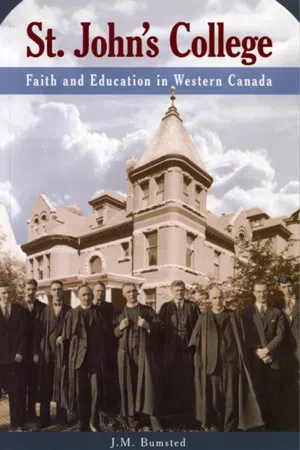
With roots going back to the Red River Settlement in the 1850s, Winnipeg's St. John's College is the oldest Anglophone educational institution in Western Canada. First founded as a school for the children of the employees of the Hudson's Bay Company, over the decades the college has re-invented itself many times. When it was established as St. John's College in 1866 by bishop Robert Machray, the college was intended primarily to provide theological training for young men going into the Anglican church. By 1900, the college had become a coeducational liberal arts college and was one of the four founding colleges of the University of Manitoba. Throughout the twentieth century, the college would continue to evolve, and would need skill and tenacity to meet the challenges of financial disaster, two world wars, and rapidly changing social values.Distinguished historian J.M. Bumsted presents a lively look at the people and events at the heart of the history of St. John's College. While relatively small in size, the college has played an important role in the educational and social life of Western Canada. Its early leaders, such as Robert Machray and Samuel Matheson, held positions of national importance in the Anglican church and lent their prestige and influence to the college. The college's changing fortunes also paralleled those of the Anglican church and Winnipeg's Anglo-Celtic elite. Throughout the 1930s and 1940s, it would struggle financially as both of these institutions went through major changes. By the 1950s and 1960s, the college would re-emerge with a revitalized presence, using its traditions to meet new educational and social challenges.
- 224 pages
- English
- ePUB (mobile friendly)
- Available on iOS & Android
eBook - ePub
About this book
Information
Chapter Four
A Coeducational College, 1892-1910

WINDS OF CHANGE BLEW OVER THE PRAIRIES in the late 1880s and 1890s. One of the main currents was the emergence of a new status for women, who in this period ceased to be the property of their husbands and became instead independent legal entities. Women began to agitate for political rights and to organize movements of social reform, particularly in the still expanding city of Winnipeg. Reform—of public health, of overindulgence in alcoholic beverages, of prostitution, of political corruption—became the watchword of the day among the middle classes. The province’s farm communities came increasingly to view Winnipeg as Sodom and Gomorrah, and sought to insulate their children from the evils of the city. St. John’s College shared in the new currents. It admitted women to undergraduate education in 1892, and in the new century found itself caught up in the protracted political battle over higher education in the province. The struggle over higher education involved many issues, but a major one centred on an effort both to protect the sons and daughters of farmers from the terrible city and to provide them with a practical education that would fit them to return to their agricultural communities as leaders. Other questions concerned the increasing secularism of modern society and the place of science in the new order.
Even after the appearance of the first women in the college in 1892, the ambiance of the place continued to be very much male-dominated. The ethos was that of the English public school or university—a sort of honourable and somewhat juvenile masculinity came to involve the development of character and the playing of the game—although it must be remembered as far as the juvenile nature was concerned that the college school was regarded by its administrators as the most important part of the institution. Charles Camsell, who enrolled in St. John’s College School in 1884, would later describe its life at the time, at least in the old building, as “pretty rugged.” Boarders were returned temporarily from the new building to the old building in that year as an economy measure.
In the winter, there was no central heating. The classrooms on the first floor were heated by woodstoves that were not fed at night. On the upper storeys there were a few coal-burning stoves in the main halls, but none anywhere near the rooms of the students. There was no plumbing, running water, or electricity. Water froze in the morning in the jugs and basins used for washing up. His fellow students, Camsell added, were “a primitive lot of young rascals many of whom had not acquired any habits of self discipline and undoubtedly gave the authorities a great deal of trouble.” In a reminiscence published in the college magazine in 1912, the archbishop’s nephew Robert Machray substantiated Camsell’s account, adding that on cold winter mornings the boarders thrust red-hot pokers heated in the coal stoves into the icy water in the basins in order to break the ice.
Women were considerably disadvantaged in at least three senses in the period before 1910. First, they could not live in the residence of the college. Secondly, they could not participate on the college sports teams. And finally, they could not look forward to ordination, and thus were not able to be “theologues,” the college students always preferred by the administration. On the other hand, because women could not be ordained, they were unlikely to study arts and theology simultaneously, and females constituted a substantial proportion of the arts and sciences student body of the years between 1892 and 1910.
Robert Machray observed in 1912 that in these early days, “the College and the School were inextricably mixed.” It was “not till after the University was established that much of a distinction was made between them.” A secret society called “Protatin,” modelled on Greek letter societies, flourished among the boys, meeting in the library “at a late hour when the warden slumbered peacefully.” It engaged in what one of its members called “harmless ritual.” Starting fires in the old building was not uncommon and at least two major ones were caused by arson that occurred in this period. A good deal of prank-playing also occurred. Some of the pranks could be malicious, and generally targeted teachers not respected by the students. On one occasion, four senior students hid Mr. Kenrick’s bicycle, damaging it in the process. When the machine was repaired, the students repeated their offence. The culprits were caught, threatened with expulsion, and forced both to pay the costs of repair and to write an apology to the victim.
Discipline was much harsher for boys under sixteen, most of the population of the collegiate school. They were subject to flogging by Bishop Machray himself, who meted out such punishments in ritual form once a week in his rooms, using a Scottish instrument called the tawse, “a leather strap cut in strips and knotted.” Those thus punished universally testified that they had deserved it and were better for it. Residential life had other problems as well, including periodic outbreaks of contagious diseases. A scarlet fever epidemic in the college in 1893, for example, forced the closure of the residence and ultimately the entire operation of the school, costing the college a term’s income.
In 1890, partly in another economical move and partly because of the obvious deficiencies in the “old building,” the entire boarding population of the college and school had been moved to the new building. More than fifty-five boarders crowded into a space originally designed for twenty. The facilities remained in use as such for twenty-two years, and not until 1900 were “modern conveniences” installed in the building. The old building was subsequently abandoned. The ethos, especially among the older boys, included a good bit of pipe-smoking, a bit of hazing, the custom of “fagging” (younger boys acting as gofers for their elders), and a lot of active sports. This and a series of residency regulations taken from Westminster School in England were virtually all that St. John’s inherited from its British roots, apart from the fascinating set of architectural drawings already mentioned that showed a proposed new college building looking very much like a Cambridge college. Although many authorities refer to the English colleges as models for St. John’s College, certainly St. John’s did not attempt after 1900 to replicate either the Cambridge tripos or, in detailed practice, the Oxbridge system of seminars and tutorials.
Perhaps not surprisingly, the first public debate recorded in the college magazine, held in November 1891, was focussed on the resolution “that the mental capacities of the female sex are equal to those of the male.” Soon after the appearance of the first woman a year later, the college magazine announced the formation of “The St. John’s Ladies’ Students Aid Society,” devoted to assisting students “in the needle-and-thread department,” especially in the repair of sundry gowns. The female students were particularly active in the literary and dramatic societies, where their achievements could be properly appreciated. From its foundation in 1884 the St. John’s College Choral Society featured many young women from the ladies’ school. Women were often involved in the St. John’s College Literary Society, especially at the frequent society evenings that turned into performance free-for-alls. Women were also part of the St. John’s Operatic Society, which debuted on 11 and 12 December 1903 with a performance of Housley’s operetta, Love and Whist.
The intellectual atmosphere in the college was not in general very highly elevated. One of the continual complaints of the college magazine in these years was the difficulty of gaining access to the college library, a two-storey room in the college building. It was open only a few minutes every week, the key was almost impossible to find—the college authorities would not distribute keys to students—and the books were badly shelved, making it almost impossible to locate anything. An additional problem was an absence of a cataloguing system, leading the magazine to observe that “hundreds of valuable books have become assimilated into the libraries of men from Halifax to Dawson City.” Furthermore, the library was not properly heated.
A number of substantial donations were made over the years to the library. Former student Alexander K. Isbister (Red River Academy, 18331837) at his death in 1883 left a bequest to the college of $83,000 plus a library of over 4000 volumes. There being no proper place in the college to house the books, they were initially kept in rooms rented from the Historical and Scientific Society of Manitoba. From 1890 to 1898 they were kept at the McIntyre Block and were destroyed by fire in 1898. A major collection of rare early Bibles and Anglican religious books was contributed in 1897 by the Vicar of St. Paul’s, Whitechapel, the Reverend Daniel Greatorex. The library also received copies of most of the many books being translated into First Nations languages by Anglican missionaries. But there was no collection policy and little money for the purchase of new books. Regrettably, many of these early donations have been destroyed or dispersed, although the Greatorex Collection was deposited by St. John’s College in the Rare Book Room of Dafoe Library in February 1979.
If students were not to be found in the library, however, they were to be found in student organizations and especially on the playing fields. The participation rate in sports and other student activities was remarkably high, although of course this was an era in which people were accustomed to making their own amusements and entertainment. Rugby football was the leading college sport, with a five-team league organized in 1888 consisting of Manitoba College, St. John’s College, the medical college, the normal school, and the graduates. St. John’s College won the first cup. Track and field went intercollegiate about the same time, and was followed in the early 1890s by hockey, curling, and basketball. Non-competitive (i.e., not part of intercollegiate) sports included cricket, tennis, and snowshoeing. All the sports contests were well attended by students, who cheered their teams and athletes on to victory. A college “athletic sports” day was held every year in late May for both the school and the college. The events consisted mainly of track and field competitions, although such unorthodox tests of strength as “throwing cricket ball” were also on the program.
Two St. John’s College rugby cheers of the 1890s, as reported in the college literary magazine, were:
Che-He, Che-Ha, Che-Ha-Ha-Ha,
St. John’s, St. John’s,—Rah! Rah! Rah!
Rickedydick, Rickedydick, Rickedydick Rue
We are St. John’s College—Who are You?
Athletic championships were routinely factored together with student academic medals as ways of measuring the comparative achievements of the colleges. Manitoba College and St. John’s College were the most frequent winners and were bitter rivals. A return rugby match between St. John’s College and Manitoba College in 1889 had turned particularly nasty. Sometime before the turn of the century, reported one observer, the popular conception of a “college man” shifted from one of a near-sighted individual carrying a load of books to “a husky fellow in a padded suit with a rugby ball under his arm.” The shift was part of the emergence of the ideal of “muscular Christianity,” with its emphasis on the cultivation of character, fair play, and “honest, manly sport.” No Canadian was more responsible for this image than Winnipeg’s Rev. C.W. Gordon, who as “Ralph Connor” wrote a series of best-selling novels in the early years of the century that fully illustrated it. Gordon was a Presbyterian rather than an Anglican, a Manitoba College rather than a St. John’s College man, but the pre-war world he documented encompassed both institutions.
In 1893 Bishop Machray was honoured by his church by becoming elevated as primate of all Canada and archbishop of Rupert’s Land. The increased responsibilities contributed to health problems beginning in 1894, which led him to withdraw somewhat from the daily hands-on administration of St. John’s College he had carried on since 1866. In early May 1898 a special meeting of St. John’s College council was held to “consider the attitude of the College in regards to the establishment of a University Faculty of Science & questions related thereto.” Archbishop Machray was not present. Dean O’Meara explained that the Dominion had offered a site at the driving park, a prominent open space on Broadway in downtown Winnipeg, for a university building. After much discussion the council agreed that the location of such a building would lead to material suffering on the part of the college, but it could not bring itself to oppose directly such a gift. A few weeks later a much better attended meeting, with the chancellor in the chair, agreed to address a protest to the chancellor and council of the university, which complained that the proposed site was five kilometres distant from St. John’s College. The acceptance of this free gift would “disturb the harmony & break up the unity of the University.” The college council added that it had supported the establishment of a professoriate in the university, both for its general advantages and for its special advantages to St. John’s College “in being set free from an effort for a full staff in Arts, which has weighed heavily on other Church of England Colleges in Canada having University powers.” But to locate the campus downtown would negate these advantages by forcing St. John’s to duplicate the university lectures.
Despite the objections by St. John’s College (and St. Boniface College), construction was begun on the science building in 1899, and it was completed in 1901. Located near the York Avenue end of the site, the building was made of brick and four storeys high. The ground floor contained two lecture theatres capable of holding 150 students each, plus laboratories. The second floor had more classrooms, a conservatory, a library, and a council chamber seating 100. The basement had six more rooms, and a room for bicycles. The top floor was not initially utilized. During construction, the big question revolved around when the province would allow the university to take over teaching from the colleges. A collateral question was whether all the colleges would actually stop teaching in arts and sciences when the university had its own faculty and curriculum. The ultimate fading away of the colleges, at least the Protestant ones, had been implicit in the early years. But more than a generation of being expected, virtually required, to mount a university-level program, gave the colleges a vested interest in higher education that some would find difficult to surrender totally.
The complaints from St. John’s College about the science building’s location were met by allowing St. John’s students tram fare from Main Street to downtown, a practice that would continue for over twenty years. Why this building was more difficult for Johnians to reach than the earlier rental rooms is not clear. Almost everybody (except St. Boniface College) agreed that a single university on a single site was the eventual goal, but by the turn of the century that goal was becoming increasingly abstract and difficult to achieve. In practical terms, within the colleges there was considerable disagreement over the question of location, over the method of administration, and over the division of teaching faculties, all of which would hold matters up for years. During the protracted period of uncertainty, it was difficult for the colleges to raise money or to pl...
Table of contents
- Cover
- Half Title Page
- Title Page
- Copyright Page
- Table of Contents
- Dedication
- Preface
- The Precursors, 1820-1866
- A Theological College, 1866-1876
- Adding Liberal Arts, 1877-1892
- A Coeducational College, 1892-1910
- Learning to Live with the University, 1910-1922
- An All-Male College and a Return to Coeducation, 1923-1932
- More Financial Trouble, 1932-1945
- On Broadway, 1945-1958
- On Campus, 1958-1970
- Seeking a New Identity, 1970-1980
- Epilogue, 1980-2005
- A Note on Sources
- Photograph credits
Trusted by 375,005 students
Access to over 1.5 million titles for a fair monthly price.
Study more efficiently using our study tools.
Frequently asked questions
Yes, you can cancel anytime from the Subscription tab in your account settings on the Perlego website. Your subscription will stay active until the end of your current billing period. Learn how to cancel your subscription
No, books cannot be downloaded as external files, such as PDFs, for use outside of Perlego. However, you can download books within the Perlego app for offline reading on mobile or tablet. Learn how to download books offline
Perlego offers two plans: Essential and Complete
- Essential is ideal for learners and professionals who enjoy exploring a wide range of subjects. Access the Essential Library with 800,000+ trusted titles and best-sellers across business, personal growth, and the humanities. Includes unlimited reading time and Standard Read Aloud voice.
- Complete: Perfect for advanced learners and researchers needing full, unrestricted access. Unlock 1.5M+ books across hundreds of subjects, including academic and specialized titles. The Complete Plan also includes advanced features like Premium Read Aloud and Research Assistant.
We are an online textbook subscription service, where you can get access to an entire online library for less than the price of a single book per month. With over 1.5 million books across 990+ topics, we’ve got you covered! Learn about our mission
Look out for the read-aloud symbol on your next book to see if you can listen to it. The read-aloud tool reads text aloud for you, highlighting the text as it is being read. You can pause it, speed it up and slow it down. Learn more about Read Aloud
Yes! You can use the Perlego app on both iOS and Android devices to read anytime, anywhere — even offline. Perfect for commutes or when you’re on the go.
Please note we cannot support devices running on iOS 13 and Android 7 or earlier. Learn more about using the app
Please note we cannot support devices running on iOS 13 and Android 7 or earlier. Learn more about using the app
Yes, you can access St. John's College by J.M. Bumsted in PDF and/or ePUB format, as well as other popular books in History & History of Education. We have over 1.5 million books available in our catalogue for you to explore.