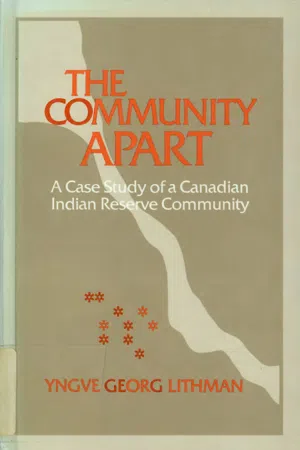
A thoughtful account of life on a reserve and of the interaction of Native people with White society, this volume is based on the author's three years' experience with one Indian band on the prairie, during a period in which there were intense negotiations between the band and the federal government. Lithman's analysis of the political manoeuvring of both sides makes this a rare contemporary account.
eBook - ePub
The Community Apart
A Case Study of a Canadian Indian Reserve Community
- 192 pages
- English
- ePUB (mobile friendly)
- Available on iOS & Android
eBook - ePub
About this book
Information
Subtopic
North American HistoryIndex
HistoryThe issue and its frames
1
A famous statement about Canada is that it resembles a vertical mosaic, where according to socioeconomic criteria the various ethnic groups can be seen as placed in a hierarchical order (Porter 1965). At the botton of this order are the native peoples: the Indians, the Metis (descendants from unions between Indians and Whites), and Inuit (Eskimos). This book deals with one particular issue concerning the Indians, the continued existence of the impoverished, all-Indian rural reserve communities. Why, for instance, have not the Indians become part of suburbia?
"Indian" is not only a folk category of self-ascription and ascription by others, as are all ethnic categories, but it is also a legal concept. There are now more than 320,000 officially recognized "registered" Indians in Canada. This means that their names are entered on a "band list," which the Indian Affairs Branch (IAB) of the Canadian federal government maintains for each of the 565 bands into which the Canadian Indians are divided. Eligible to be entered on a band list are, in short, descendants of women already on the band list, and women who marry men entered on the band list. One can also be deleted from a band list and thus lose the officially recognized Indian status, either through petitioning the government, which today is extremely rare, or in the case of women, by marrying a non-Indian.1
The most significant feature of a band is that it is a "body of Indians … for whose use and benefit in common, lands, the legal title to which is vested in Her Majesty, have been set apart" (Indian Act 2 [1]). These lands, called Indian reserves, which usually are quite small compared with the Indian reservations in the United States, are where, with few exceptions, a very large majority of the band members reside. When referring to these communities, I use the term "reserve community."
Although the Indians constitute only a little more than one percent of Canada's 24 million people, their social and economic distress is one of the most intensely discussed social problems in Canada. The life expectancy for Indians is 36 years, compared with 62 years for Canadians generally (Canadian Senate 1976:35). As a rule, less than one-third of the labour force in the reserve communities is gainfully employed (cf. MIB 1971:151), a situation which will be exemplified in a later chapter. The failure rate of Indian children in the formal school system is staggering. Alcoholism and crime rates are considerably higher for Indians than they are for Canadians in general. In short, the Indians find themselves in a state of poverty which is in glaring contrast to that of most other Canadians.
It is against this background that the main issue of this work, the permanency of the reserve communities, presents itself.
The Structure of the Presentation
The reader might welcome some initial comments on the logic of the perhaps somewhat unorthodox organization of the material presented in this work.
In this chapter I discuss a variety of items, theoretical, historical methodological, and I also introduce some empirical material. My intention is to provide a foundation upon which the subsequent discussion can rest. In the next section of this chapter I treat some of the previous efforts to account for the permanency of the Indian reserve communities. The present work is thus considered within its thematic tradition. Thereafter, I relate more specifically to the Indian reserve community where my fieldwork was done, Maple River, in the province of Manitoba. Later in the chapter I briefly describe the community, and thereupon I discuss a number of issues relating to the execution of fieldwork in an Indian reserve community.
Towards the end of chapter I draw particular attention to the history of the relationship between Indians and Whites2 and the Indians' involvement in the economy of the larger society. Almost as an appendix to the history section follows "The Tutelages," which gives a brief presentation of some of the institutions of the larger society which have most deeply affected the Indian reserve communities, viz., the Indian Affairs Branch of the federal government, the churches and the provincial governments. This first chapter ends with a discussion of whether the Indian reserve communities are becoming depopulated as a result of migration. In the section called "Indian Mobility," this question is answered in the negative.
Upon the foundation laid in the first chapter, the presentation proceeds on the assumption that in order to account for the permanency of the impoverished Indian reserve communities, two questions have to be answered: Why do the Indians want to remain in their reserve communities? And how is it possible for them to remain in their reserve communities?
The first of these questions is dealt with in chapter 2, "Inter-Ethnic Interaction." The chapter demonstrates the mechanisms whereby the Indians are excluded from such activities as work and formal education and made to realize that they cannot achieve their desired standard of living through participation in duo-ethnic interactive events. However, all types of inter-ethnic interaction contribute to the development of the Indians' strategy for inter-ethnic relationships. Therefore, at the same time as they withdraw from the above-mentioned activites, they concentrate their attention on the rewards to be found in the interaction between the local political leaderships and the employees of the developmental bureaucracies. All in all, the result of the various types of inter-ethnic interaction in which Indians participate is a desire on the part of the Indians to maintain and develop the reserve communities.
In the third chapter, "The Politicized Community," the focus is on the Indians' ability to remain in the reserve community. This clearly entails two things, a sufficient material provisioning and a distribution of the resources to those who reside in the community. A source-by-source approach has been used in the section entitled "The Material Provisioning of Maple River." The subsequent section deals with the distribution of common resources. A significant part of the material resources come from the larger society as various transfer payments, and these are distributed through the local-level polity. In order to understand the mechanisms whereby the common resources are distributed, one has to examine the political processes in the community. This is done in the following section, "The Politicized Community."
In the final chapter, "Towards the Future," an attempt is made to see in what directions the relationship between Indians and Whites will develop. This is also where the themes from the two preceding chapters are joined. In the section on "The Emerging Community," the focus is on present-day processes at work in the reserve community, and whether these will tend to increase the separateness between Indians and Whites or the contrary. It is noted that an "opposition ideology" provides a forceful reason that Indians in the future will probably decrease their contacts with the White society. In the second section, "The Non-mediation of Conflict," it is argued that present-day efforts by members of the larger society do not address themselves to the causes of the Indians' situation, so that no substantial reasons for change can be seen in the foreseeable future.
1.2 THE ISSUE
Although this book certainly makes a claim to help alleviate "the notorious paucity of detailed anthropological and sociological studies of Canadian Indian communities" (Carstens 1971:129), there is one particular issue to which it addresses itself: Why do Indians live in "their" reserve communities, often characterized by abject poverty, in the midst of a wealthy, industrial, affluent, western country?
The answer to this question is sought primarily through the standard social anthropological method: the collection and analysis of data from prolonged fieldwork, where participation in and observation of various social events (in the broadest sense of the term) are the most prominent features. When undertaking this study, however, I soon found that the basically synchronic picture with which the researcher is presented during fieldwork had to be supplemented by some insight into the historical processes that "set the stage" for the present-day situation.
The focus is on one particular Indian reserve community, Maple River, Manitoba, and the bulk of the data derives from the years of the fieldwork between 1971 and 1974. However, virtually all contemporary serious writers about the Canadian Indians stress the similarities between various reserve communities, although some distinctions such as between "northern" and "southern" are usually made.3 Likewise, some reference to varying "traditional" or "tribal" cultures is often included. Nevertheless, to paraphrase an infamous statement, if you have seen one reserve community, you have certainly not seen them all. In the case of Maple River, there are some features which make this community somewhat different from those described in available scholarly presentations in Indian reserve communities. Here, only some initial comments on this issue are necessary.
Dunning's (1964) division of Indian reserve communities into two main classes has become widely accepted, and it does not take extensive familiarity with the Canadian Indian scene to appreciate the significance of his distinction between the "northern, type A," and the "southern, type B" reserve communities. Type A reserve communities are characterized as remote and isolated, and while in a multitude of ways affected by the Euro-Canadian society, "social norms" would appear to be significantly based on "indigenous patterns." Type B communities are characterized by long contact with the national economy and way of life, and their institutions are patterned rather after outside models than after native traditions. Dunning himself has provided a classical text concerning each of the types, the monograph about Pekangekum (1959a) and the article about Pine Tree (1964).
Maple River is almost the archetypical B reserve community. It is close to urban centers and White settlements. Its history reflects an intensive involvement in the various phases through which the economy of the surrounding society has passed. Members of the community have fought in the two world wars. Many community residents have lived in the provincial capital, Winnipeg, for long or short periods. Virtually everyone speaks English. Indeed, many children speak no Saulteaux, the native language, at all.4 Television, radio and newspapers reach effectively into the community.
Much of what will be said in the following about Maple River holds true for a very large number of type B reserve communities. Even those features which will strike some readers familiar with the Canadian Indian literature as unusual will, however, serve to raise more general questions. For example, the fact that a large number of Indians were steadily employed for a substantial period in a paper mill close to the reserve forces a re-examination of the generally held assumption that the Indians have shiftless work habits, usually seen as the result of cultural unpreparedness on the part of the Indians. If this was the case in Maple River, why should it be any more true with respect to other Indian communities? Indeed, Knight (1978) has made a similar observation for British Columbia.
Another noteworthy feature, rarely mentioned in the literature, was that the community leadership in Maple River had very substantial funds at its disposal (approximately a million dollars per annum), as a result of fairly recently introduced programs in the Indian Affairs Branch of the federal government. The same situation now exists in many Indian reserve communities, although Maple River was in the forefront in taking advantage of these programs, designed to promote local government in Indian reserve communities.
As exemplified above, the features which might appear specific to Maple River, be they historical or contemporary, are not seen to undermine the external validity of the argument that will be presented in this work - instead, they serve to highlight the general.
Several authors have already dealt with the questions at issue in this study, that is, why the Indian reserve communities continue to exist. A few words about their approaches will be appropriate here, in order to give the reader some indication of previous efforts. They will be described only briefly, with detailed attention given only to the writings that have been most germane to this work.
In the Canadian mass media, political assemblies, and writings by Indians and by many scholars, the notion of "Indian culture" is made a basic premise to the understanding of the apartness of Indians and their continued residence in the reserve communities. The content of this Indian culture is referred to in terms of an emphasis on cooperation as opposed to conflict, a special relationship to "the land," lack of future orientation, and so forth. Individual comportments, physical prowess, dignity, and silence are given as prominent features.
In scholarly writings about Indians, Indian culture has often been used as a baseline from which the authors have proceeded to document transition and change (Mead 1932). Also, more recent studies usually have a firm focus in the native entity (cf. Inglis's [1971] discussion). The problem with this approach is that it cannot explain such prominent features of the contemporary Indian situation as exploitation, the persistent poverty or the dynamics of racism. These issues certainly require an examination of the relationship between the Indian reserve communities and the surrounding society and, to use Stavenhagen's (1971:333) phrase, "the system of domination itself."
Still keeping the aboriginal community as a (sometimes implicit) element in the analysis, one attempt to account for the present-day situation is represented by the "disintegration" approach. The features of the disintegrated community are, among others: (1) in many homes, one parent or both are frequently absent or changed, or (2) the relationships between family members are hostile, (3) there are few or no associations centred around work, religion or other common interests, (4) the community has weak leadership, (5) modes of recreation are short-lived, consisting mainly of (6) drinking and (7) sexual promiscuity; furthermore, there is (8) hostility towards in-group members and (9) outsiders, (10) frequent law-breaking and (11) negative and resentful attitudes towards authority (Honigman 1966, cf. Hawthorne 1965:127 ff). Social disintegration "implies a breakdown in the operation of social relationships from one point in time to another" (Honigmann 1966:200), in the case of the Indians as the result of overwhelming cultural influences from Euro-Canadian society.
When analyzing what is meant by social disintegration, one immediately runs into trouble. Not only are the categories aften vague and imprecise (surely drinking and sexual promiscuity do not need to take place in a socially disintegrated community in order to be a favourite mode of short-lived recreation), but the whole perspective of disintegration would seem to confuse the crucial issues at hand. For example, Dunning (1959b: 122) has pointed out that the traders, Indian agents, school teachers and RCMP officers are often removed from the larger society's sanctions in their dealings with the Indian reserve communities and Inuit settlements, and that their behaviour in these circumstances is not "representative of or compatible with the social ethics of the national society." So when, as a result, policemen manhandle Indians with iron knuckles, traders "skin" the Indians, courts intimidate them, etc., certainly Indian hostility toward outsiders and negative and resentful attitudes toward authority can be seen as an effect of disintegration in the larger society rather than in the Indian communities.
In investigating the contemporary Indian situation, a number of authors have focused on the effects of the involvement of the Indian Affairs Branch in the Indian communities. Dunning states that with respect to the type B reserve communities, that the consequences of their permanent and secure legal and political position might be a negative incentive to those Indians who would desire the benefits of increased economic participation in the outside world. Also, the Indian reserve resident would have to subject himself to a patron/client relationship with the I AB personnel in order to take advantage of whatever welfare or other benefits that are available. As a result, Dunning (1964:35) sees this "governmental recognition and control (as the) essential basis of community for the people, rather than any internal organization or indigenous expression of ethnic unity." Inglis (1971:34), who rejects the notion that the reserve communites can be called communities, and whose main concern is to find a way of conceptualizing what kind of social entity that they represent, goes even further than Dunning. Indeed, he states that "with the formal structure of the IAB as a base-line, transactional chains can be followed out into virtually all aspects of reserve life." It should be added that Inglis's concern...
Table of contents
- Cover
- Title Page
- Copyright Page
- Contents
- Acknowledgements
- Half Title Page
- 1 The issue and its frames
- 2 Inter-ethnic interaction
- 3 The politicized community
- 4 Towards the future
- Notes
- References
- Back Cover
Trusted by 375,005 students
Access to over 1.5 million titles for a fair monthly price.
Study more efficiently using our study tools.
Frequently asked questions
Yes, you can cancel anytime from the Subscription tab in your account settings on the Perlego website. Your subscription will stay active until the end of your current billing period. Learn how to cancel your subscription
No, books cannot be downloaded as external files, such as PDFs, for use outside of Perlego. However, you can download books within the Perlego app for offline reading on mobile or tablet. Learn how to download books offline
We are an online textbook subscription service, where you can get access to an entire online library for less than the price of a single book per month. With over 1.5 million books across 990+ topics, we’ve got you covered! Learn about our mission
Look out for the read-aloud symbol on your next book to see if you can listen to it. The read-aloud tool reads text aloud for you, highlighting the text as it is being read. You can pause it, speed it up and slow it down. Learn more about Read Aloud
Yes! You can use the Perlego app on both iOS and Android devices to read anytime, anywhere — even offline. Perfect for commutes or when you’re on the go.
Please note we cannot support devices running on iOS 13 and Android 7 or earlier. Learn more about using the app
Please note we cannot support devices running on iOS 13 and Android 7 or earlier. Learn more about using the app
Yes, you can access The Community Apart by Yngve Georg Lithman in PDF and/or ePUB format, as well as other popular books in History & North American History. We have over 1.5 million books available in our catalogue for you to explore.