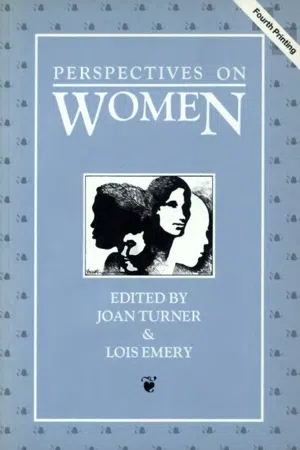
We are now fifteen years into the second wave of feminism, and public opinion polls show majority support for all the basic issues raised by the women's movement. This collection of articles focuses on strategies and directions for the movement that will enable all women to benefit from changing attitudes in the 1980s.
- 200 pages
- English
- ePUB (mobile friendly)
- Available on iOS & Android
eBook - ePub
Perspectives on Women in the 1980s
About this book
Information
Subtopic
Women in HistoryIndex
Social Sciences4
Poverty: The Feminine Complaint
The title of this presentation, “Poverty: The Feminine Complaint,” may cause some of you to think I am going to talk about whining poor women, and perhaps others will think I am implying that women are always complaining. But I am using the word complaint meaning, “a statement of wrong, grievance or injury.” And it is as a wrong, a grievance, and an injury to women that I wish to discuss poverty today.
The next question that may come to mind is, “Why women?” Surely poverty is a human condition which is nonsexist and nonracist. Right? Wrong. In much of the world today, it is both sexist and racist. It is noticeably so here, in North America.
Ian Adams writes of this in his book, The Poverty Wall, published in 1970. Since then, the numbers have grown, not shrunk: “Imagine a city, a walled city of 350,000 adults and 1.1 million children. A city larger than Winnipeg, as big as Vancouver, but different. The weird thing about this city is that it is without men: there are only women. If you can see such a city in your mind’s eye, then you are looking at the real and enormous number of abandoned and forgotten people who live silently among us. Because, you see, there are that many women in this country, bringing up their children on marginal incomes and the subsistence that is welfare…because the truth is that the poor in Canada are not only the Metis, the Indians and the blacks, but women, and in the most overwhelming numbers.”1
The next questions are obvious: Why are women poor? Why so many? Are they lazier? Weaker? Less ambitious? Sicker? What are some of the causes of poverty? Who are the women who are poor?
Is it the women who only have a grade four education? Is it the ones who quit school to become hairdressers? Some of them are. Others are women with university degrees who married someone who left them or inconveniently died, leaving them with young children. Others were business women who worked until they had a nervous breakdown, or they have epilepsy, or diabetes, or they got hit by a car. Some are ordinary women, from middle-class back-grounds, who achieved what they thought was a respectable marriage, only to find that the man of their dreams was an alcoholic, or beat them, or went crazy, or went to jail.
Any woman can be deprived of money any time, if she is not independently wealthy. Granted, under the new family laws, if she worked and contributed money to the home, she is entitled to half. But if all she did was keep the home fires burning, she can forget a pension.2 But she can keep the kids, usually. And it could happen to anyone: if not you, your mother, or your sister, or your daughter, or your friend.
As Adams points out, if you add all the poor women together, including those working for low wages and the elderly, “then you have a group five times the size of all the poverty-stricken racial groups put together. The majority of the poor in this country are women: it is as simple as that. By conservative addition, there are some three million of them in Canada, almost one-half the number of women over sixteen.”3
But why us? There must be one main reason so many women are poor. There is, and I think I have found it. If you take an historical perspective on poverty, it is easy to see that it has always been women and children who were poor. Why? Because women and children are considered expendable.
Historically, women have always been expendable. Girl children were exposed to die, or sold for a pittance. They were regarded as worthless. They would not grow up to run the family farm. In fact, the parents would have to scrape up enough money to pay someone else to take them off their hands, eventually. In India today, brides are still being burned by their mothers-in-law if they do not come accompanied by a big enough dowry. Consider this quotation by Robert Mueller: “I asked a Burmese why women, after centuries of walking behind their men, now walk ahead. He said there were many unexploded land mines since the war.”4
Except in certain circumstances, women have always been expendable. “Surely not here,” one might exclaim. In the early years of this continent’s European settlement, women, that is, European women, were scarce, and thus valuable. Indian women, on the other hand, were fairly plentiful, and they were still expendable. Western novels are full of the reverence for women folk. This actually lasted only a short time, and even when it existed, it was reverence for some women folk, namely white women. It soon wore off, and women continued to be worked and bred to death. Men may have died by violence in the Old West, by gunshot and storm and stampede, but women tended to die at home, in childbirth, or of old age at fifty. Pioneer graveyards are an excellent place to find out how women were living and dying then.
The legend, of course, is otherwise. “Women and children first,” is the rule, supposedly, for lifeboats. But it was always only certain women and children, not the ones in steerage.
With the arrival of more immigrants, many poor women from Europe came as bonded servants, general household slaves. Then, of course, there were the black slaves. After emancipation, there were still some women condemned to do household work for nothing for others, these were generally the women who did not marry, or who had not entered one of the very few occupations open to women, chief of which was becoming a nun and slaving for God.
Then came the machine age, with factories and sweatshops: still not a pleasant existence for the majority of women, although seen through a haze of romanticism now. Always there were certain women who had it better. But let us remember that even queens were usually sold off to the highest bidder. Elizabeth I was the exception, not the rule.
We tend, however, to see history in the light of exceptional women, those who were lucky enough to come of well-to-do parents, marry well-to-do men, and produce well-to-do children. After all, those were the ones who could write, so the history passed down by those women is a history of themselves, not of women generally.
For most women, life was unending drudgery. For every Scarlett O’Hara there were thousands of women married to nobodies, working out in the fields from dawn to dark. We hear a lot about General Washington’s wooden false teeth. How much do you want to bet Martha had no teeth at all?
Here are the words of “A Housewife’s Lament” written by a Mrs. Sara Price of Illinois (one of the privileged women who could write) at some time around the the time of the American civil war. Presumably, since the nuclear family was not fashionable then, she had some household help:
One day I was walking, I heard a complaining, and saw an old woman the picture of gloom She gazed at the mud on her doorstep (‘twas raining) and this was her song as she wielded her broom:Oh, life is a toil, and love is a trouble, beauty will fade, and riches will flee,Pleasures they dwindle, and prices they double, and nothing is as I would wish it to be.There’s too much of worriment goes to a bonnet, there’s too much of ironing goes to a shirtThere’s nothing that pays for the time you waste on it, there’s nothing that lasts us but trouble and dirt.In March it is mud, ‘tis slush in December, the midsummer breezes are loaded with dustIn fall, the leaves litter, in muddy September the wallpaper rots and the candlesticks rust…There are worms on the cherries, and slugs on the roses, and ants in the sugar, and mice in the pies,The rubbish of spiders no mortal supposes, and ravaging roaches and damaging flies.It’s sweeping at six, and it’s dusting at seven, it’s victuals at eight, and it’s dishes at nine,It’s potting and panning from ten to eleven, we scarce break our fast till we plan how to dine.With grease and with grime from corner to center, forever at war and forever alertNo rest for a day lest the enemy enter, I spend my whole day in a struggle with dirt.Last night in my dreams I was stationed forever on a far little rock in the midst of the seaMy one chance of life was a ceaseless endeavour to sweep off the waves as they swept over me.Alas: ‘twas no dream, ahead I behold it, I see I am helpless my fete to avert.She lay down her broom, her apron she folded, she lay down and died and was buried in dirt.Oh, life is a toil, and love is a trouble, beauty will fade, and riches will fleePleasures they dwindle and prices they double and nothing is as I would wish it to be.5
But why were women considered expendable? Because, as Sir Thomas Beecham remarked, “There are no women composers, never have been, and possibly never will be.”6 Widening that, of course, to include all the other things women have never done, where are all the women geniuses to compare with William Shakespeare, Francis Bacon, and so on? Most of them, obviously, were being buried in dirt, buried at an early age. When little boys were out playing, little girls were learning how to deal with housework and nursing and child-raising and child-bearing and other nurturing duties.
But surely now that we have vacuum cleaners and washing machines and dryers and dishwashers and electric can openers, we have been emancipated. Not really. Robert Heinlein, in The Door into Summer, remarks that, “amazingly little thought had been given to housework, even though it is at least 50 percent of all the work in the world…the horse to jet plane revolution had not reached the home…housekeeping is repetitious and unnecessary drudgery; as an engineer it offended me.”7 But supposing all women were released from the drudgery of housework, would they be welcome in the work force? You know the answer to that. Speaking of expendability, who is it that is last hired and first fired? Who is paid the lowest wages? A pamphlet from the feminise action collective in Ottawa says: “The employer can say he doesn’t need us because there are lots of women out there looking for work. But he does need women workers as a pool of cheap labour. Our husbands and society say we don’t do real work; they say their work supports our leisure…but we know that we work hard and that it is our housework that supports their leisure. Society needs the free work we do taking care of children because otherwise enormous amounts of money would have to be spent to replace our contribution.”8
So we are regarded as expendable in the work force, expendable at home. How else are we expendable? Any reading of the newspapers will show the enormous numbers of women murdered every year. Think of famous murderers: Jack the Ripper, The Boston Strangler, The Zodiac Killer, Neill Cream, Dr. Crippen, The Yorkshire Ripper. These were all men who were mass murderers of women. But when retentionists talk about bringing back the death penalty, to whom do they want it applied? Do they want it applied to murderers of women and children? No, it is for killers of police officers and prison guards. If you assault a police officer, you go to jail. If you assault a woman, even a complete stranger, you might not. If you assault your wife, it is likely you will be able to walk around with impunity.
If we look at the rest of the animal kingdom, we see something curious. Other animals do not kill their females. In fact, humans do not generally kill female animals. In hunting season, you are allowed to kill stags, but not does. Farmers keep only one bull for a herd of cows. Bull calves get slaughtered for veal, but not heifers. In all nature, humankind values female animals, but this value does not seem to apply to human females.
So women are expendable. What can we do about it? For one thing, we can attach a value to ourselves. Most women put a value on our individual hides, but not on the collective, or, if on the collective, only within certain bounds. Those bounds generally do not include poor women. It is true that women are often the worst enemies of other women. All through history, while most women were dying in poverty and misery, some were not. But few of those women did much to help the others, seeing it as a matter of class, or caste. There were exceptions – Nellie McClung, Emily Murphy – but they were few. Most of them saw themselves as special people who deserved better, or they saw themselves as smarter or prettier, or abler in some fashion or another. They saw it as God’s will that there should always be poor women to visit with baskets, while they should thrive. They saw it as a good work to patronize the local widow by giving her the family laundry to do, or giving her worn-out clothes nobody else wanted, dividing in their minds the mass of women into “us” and “them.”
Much of the lady bountiful feeling is certainly gone. What remains, among many fairly successful women, is a feeling that poor women do not have to be poor, that if they were not inherently lazy or stupid, they coul...
Table of contents
- Cover
- Half Title Page
- Title Page
- Copyright Page
- Contents
- Foreword: Maysie Roger, A Memory
- Preface
- Acknowledgements
- There Comes a Time
- Perspectives on Women in the 1980s: The Baird Poskanzer Memorial Lecture
- The Power Politics of Motherhood
- Poverty: The Feminine Complaint
- Native Women and the State
- Feminist Counselling: Approach or Technique?
- Women as Providers and Consumers
- The Electronic Sweatshop
- Women, Families and the State
- Romantic Love and Reproductive Rights
- Strategies for the Eighties
- Change, Hope and Celebration
- Selected Readings and Resources
- Notes
- Contributors
- Back Cover
Trusted by 375,005 students
Access to over 1.5 million titles for a fair monthly price.
Study more efficiently using our study tools.
Frequently asked questions
Yes, you can cancel anytime from the Subscription tab in your account settings on the Perlego website. Your subscription will stay active until the end of your current billing period. Learn how to cancel your subscription
No, books cannot be downloaded as external files, such as PDFs, for use outside of Perlego. However, you can download books within the Perlego app for offline reading on mobile or tablet. Learn how to download books offline
Perlego offers two plans: Essential and Complete
- Essential is ideal for learners and professionals who enjoy exploring a wide range of subjects. Access the Essential Library with 800,000+ trusted titles and best-sellers across business, personal growth, and the humanities. Includes unlimited reading time and Standard Read Aloud voice.
- Complete: Perfect for advanced learners and researchers needing full, unrestricted access. Unlock 1.5M+ books across hundreds of subjects, including academic and specialized titles. The Complete Plan also includes advanced features like Premium Read Aloud and Research Assistant.
We are an online textbook subscription service, where you can get access to an entire online library for less than the price of a single book per month. With over 1.5 million books across 990+ topics, we’ve got you covered! Learn about our mission
Look out for the read-aloud symbol on your next book to see if you can listen to it. The read-aloud tool reads text aloud for you, highlighting the text as it is being read. You can pause it, speed it up and slow it down. Learn more about Read Aloud
Yes! You can use the Perlego app on both iOS and Android devices to read anytime, anywhere — even offline. Perfect for commutes or when you’re on the go.
Please note we cannot support devices running on iOS 13 and Android 7 or earlier. Learn more about using the app
Please note we cannot support devices running on iOS 13 and Android 7 or earlier. Learn more about using the app
Yes, you can access Perspectives on Women in the 1980s by Joan Turner, Lois Emery, Joan Turner,Lois Emery in PDF and/or ePUB format, as well as other popular books in Social Sciences & Women in History. We have over 1.5 million books available in our catalogue for you to explore.