eBook - ePub
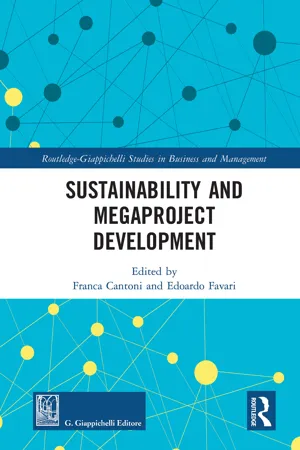
Sustainability and Megaproject Development
- 232 pages
- English
- ePUB (mobile friendly)
- Available on iOS & Android
eBook - ePub
Sustainability and Megaproject Development
About this book
Megaprojects, also referred to in the literature as Large Engineering Projects or Major Projects, are generally defined as large-scale investment initiatives worth 1b€/$ or more and, facing similar problems independent of the country where they are implemented and the industry they belong to. The common feature of most megaprojects is that they are difficult to design and manage so that their realization and completion is always extremely expensive, often over budget and delivery deadlines also are not met. In the worst-case scenario, they remain unfinished. This book, through its multidisciplinary approach, offers food for thought and alternative interpretations for the complex world of megaprojects. While much research has been conducted and differing approaches have been developed over the last 20 years, there is still a lot of debate surrounding the topic, and a holistic approach for effectively managing these initiatives is still missing. What is clear to all researchers and experts in the field is that a traditional-linear management approach is simply not sufficient, as at many stages of a megaproject, iterative and feedback effect occurs due to stakeholder involvement and increasing and continuous interaction between them. The book promotes the debate among all categories of stakeholders involved in the megaproject's supply chain, in order to increase the awareness of complex phenomena relating to the critical issues and common problems they face, all over the world, and to seek performance improvement across the whole life cycle of a megaproject, including the selection, design, construction, operation and de- commissioning.The multidisciplinary approach cultivated in the book conveys an innovative way to study megaprojects and their inherent complexities.
Part 1MAIN CHALLENGES
Chapter 1THE HUMAN SIDE OF MEGAPROJECTS: LEADERSHIP STYLE AND TRAITS TO FACE GROWING LEVELS OF COMPLEXITY AND UNCERTAINTY
Roberta Virtuani, Barbara Barabaschi, Franca Cantoni
ABSTRACT: Megaprojects, given their complexity, have a tendency to fail or at least not to achieve the objectives initially planned. The gross error committed consists in recognizing a marginal role to the management style of human resources and specifically in not giving adequate importance to some leadership traits which instead prove to be fundamental. Within this research work, a leadership style based on three characteristics is proposed: widespread, aware and sustainable (WAS leadership style). 12 leadership traits are analyzed through the life stories of megaproject leaders. Storytelling and narrative are proposed as a method of analysis as they are considered most suitable for bringing out the salient features we want to highlight. The aim is to identify the leadership strategies, vision, sense-making, style and leadership traits of megaprojects managers to train new leaders and improve the management of new megaprojects.
Summary
- 1.1. Introduction.
- 1.2. Organization and HR in megaprojects: the Human Side of Megaprojects.
- 1.3. The Six Paradoxes of Leadership Traits.
- 1.4. Methodology: Applying storytelling and the narrative approach to project management research and practice.
- 1.5. Stories and narratives.
- 1.5.1. The Managing Director of the Mediterranean Rail Freight Corridor (Med-RFC).
- 1.5.2. The Project Manager of a High-Speed Trains and Locomotives Company.
- 1.6. Findings.
- 1.7. Conclusions.
1.1. Introduction
The purpose of this chapter is to find out leadership lessons from megaproject through the life stories of two managers involved in managing teams in a megaprojects’ setting (Clegg et al., 2017) (Flyvbjerg, 2014). The focus of our analysis is to discover leadership traits and principles that the project leader applies to achieve his/her project and company’s aims.
Our approach is to analyze the two case studies through the method of collecting stories and storytelling. In organizational life stories have an important role. They are even essential as means of meaning making. In the context of organizational life, stories can concern specific events or people. They can also take the form of biographies. We are interested in gaining insights on how leadership is expressed by managers in a megaproject context through managers’ life journey taking place in an international scenario and in a multicultural and multistakeholders’ environment. In the chapter a narrative inquiry approach applying thematic analysis is followed to grab lessons learnt through the two managers’ experience in a megaproject context. Narratives are collected directly from megaprojects managers through interviews. Organization studies have used the narrative analysis and storytelling that a few authors started also to apply to project management research. The aim of the paper is to contribute to the growing literature on megaprojects using novel approaches of research and analysis (Sankaran, 2018) (Drouin et al., 2021).
Future research is being planned to expand the number of managers to interview to collect their life stories and lessons learnt on leadership in managing a project in a megaproject context (Ready, 2002). The analysis can be helpful to bring out leadership traits and attributes that a complex project requires considering the wide implications it has for the society, economy and environment. The stories analyzed show the human side of the megaproject managers in a multistakeholders’ perspective and with people related and societal issues implications.
With our analysis we would like to contribute to the megaproject management literature using the narrative approach. This perspective is quite new because instead of focusing on historical and classical projects it extracts lessons on leadership from life stories of managers. This should be helpful for leadership development and for managing change and innovation in megaproject contexts (Zhai, Xin and Cheng, 2009). The research question that this paper addresses is: “Does leaders in megaprojects follow the leadership style and own the leadership traits to face growing levels of complexity and uncertainty?”.
We are in the early years of the Fourth Industrial Revolution – the digital revolution. Digital technology is transforming our world into an interconnected one. The world is facing significant and increasingly urgent challenges accelerated by Covid-19. They are affecting individuals, organizations, governments and society alike. Organizations are presented not only with existential threats, due to technology and climate change, but also with extraordinary opportunities. With changed competition rules and the pace of business that seems to be accelerating the company’s success or failure depends on how they design their strategies and manage their organizations. A new model of value creation requires companies to reimagine their place in the world. A digital mindset is vital while leaders are called to face dilemmas in their behavior and actions to manage a growing complexity and uncertainty. We will analyze these dilemmas adopting a framework that recognizes twelve leadership traits in the form of six paradoxes (Leinwand and Matt Mani, 2021).
We start our analysis in Par. 1 considering the role recognized to HRs in megaprojects’ success/failure. In Par. 2 we present the theoretical framework we will use to bring out and identify the most important leadership traits through the life stories of the two managers interviewed. The model is based on Sheppard’s book: Ten Years to Midnight and focuses on 6 leadership paradoxes that characterize leadership in a post-pandemic world and in the digital age. In Par. 3 we outline our methodological approach focusing on the meaning of stories and storytelling in organizations. Organization studies focus on the role of stories and storytelling in constructing identities. Then we consider the literature on megaproject leadership which focuses on the role of stories and storytelling with a brief description of the selected megaprojects case studies. We add details on the data collection and analysis. We present the findings in the form of the life story interview with the two managers focusing on the insight that emerged. Then we discuss the findings following the reviewed literature to explain the empirical data. We conclude highlighting how these two cases allow us to gain insights on the main leadership traits and style that megaprojects managers own to face growing levels of complexity and uncertainty. We consider the managerial implication of our research to contribute to the education of new young leaders and to better understand the human and social side of megaprojects management.
1.2. Organization and HR in megaprojects: the Human Side of Megaprojects
Over the past century, megaprojects – defined as projects with a budget of more than 1 billion $/Euro – have encountered considerable difficulties in being able to produce the desired outcomes as defined in the planning phase while respecting costs, quality and schedule constraints. Indeed, in the face of greater investments and longer scheduling frames, benefits shortfalls often happen giving another strong signal of underperformance.
Currently, the success of a megaproject is measured through the wellknown Quality-Cost-Time “iron triangle”, meaning that it is well accomplished if stays within the planned level of quality, budgeted costs and time frame. About that, Flyvbjerg in his book “Iron Law of Megaprojects” highlighted how the trend to go “over budget, over time, over and over again” is present in most cases with a tendency therefore not to respect the triple constraint (also known as “iron law”) in megaproject management. This trend has been pointed out by several other analysis and investigations conducted by the most relevant authors in the field (Lessard and Miller, 2001; Flyvbjerg, 2003; Invernizzi et al., 2018) proving how costs and schedule overruns are the most relevant criticalities in megaprojects.
It is however evident that when it comes to respecting budget and schedule constraints, megaprojects are affected by several variables and behaviors, which affect the performances. Despite the spread of new technologies making software and tools available for setting and reviewing budgets, non-compliance with costs is an extremely recurring problem. The tendency to exceed costs is typically due on the one hand to external events that the project manager is not able to control and can be included in the concept of EEF Enterprise Environmental Factors (i.e. technical aspects, economic or political variables) on the other, the cause can be found in the so-called “optimism bias” phenomenon according to which project managers underestimate costs because of a “cognitive predisposition” to orient their analysis of the project results towards a more optimistic than probable vision (Flyvbjerg et al., 2003). Benefit shortfalls are another perspective of underperformance, given the impact that these endeavors have on communities and groups of interest.
Atkinson (1999) recognizes it as a limited view and affirms "it is time to accept other success criteria” as today – more than in the past – the complexity of megaprojects is increasing due to several phenomena, such as globalization, I...
Table of contents
- Cover
- Half Title
- Title
- Copyright
- Contents
- List of Figures and Tables
- Dedication
- Introduction
- Part I: Main Challenges
- Part 2: Cases
- Index
Trusted by 375,005 students
Access to over 1.5 million titles for a fair monthly price.
Study more efficiently using our study tools.
Frequently asked questions
Yes, you can cancel anytime from the Subscription tab in your account settings on the Perlego website. Your subscription will stay active until the end of your current billing period. Learn how to cancel your subscription
No, books cannot be downloaded as external files, such as PDFs, for use outside of Perlego. However, you can download books within the Perlego app for offline reading on mobile or tablet. Learn how to download books offline
Perlego offers two plans: Essential and Complete
- Essential is ideal for learners and professionals who enjoy exploring a wide range of subjects. Access the Essential Library with 800,000+ trusted titles and best-sellers across business, personal growth, and the humanities. Includes unlimited reading time and Standard Read Aloud voice.
- Complete: Perfect for advanced learners and researchers needing full, unrestricted access. Unlock 1.5M+ books across hundreds of subjects, including academic and specialized titles. The Complete Plan also includes advanced features like Premium Read Aloud and Research Assistant.
We are an online textbook subscription service, where you can get access to an entire online library for less than the price of a single book per month. With over 1.5 million books across 990+ topics, we’ve got you covered! Learn about our mission
Look out for the read-aloud symbol on your next book to see if you can listen to it. The read-aloud tool reads text aloud for you, highlighting the text as it is being read. You can pause it, speed it up and slow it down. Learn more about Read Aloud
Yes! You can use the Perlego app on both iOS and Android devices to read anytime, anywhere — even offline. Perfect for commutes or when you’re on the go.
Please note we cannot support devices running on iOS 13 and Android 7 or earlier. Learn more about using the app
Please note we cannot support devices running on iOS 13 and Android 7 or earlier. Learn more about using the app
Yes, you can access Sustainability and Megaproject Development by Franca Cantoni, Edoardo Favari, Franca Cantoni,Edoardo Favari in PDF and/or ePUB format, as well as other popular books in Business & Business General. We have over 1.5 million books available in our catalogue for you to explore.