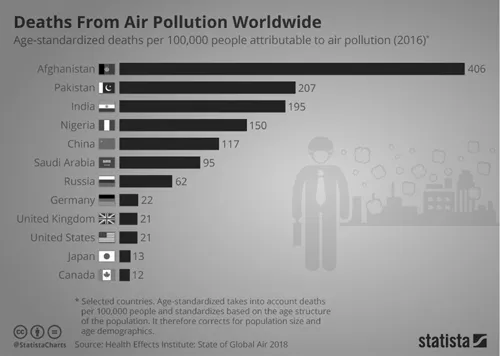
The World Health Organization (WHO) reports that approximately 90% of people breathe unhealthy air. Air pollution is the predominant cause of early death. Research indicates that as high as 5 million premature deaths each year occur from air pollution-related heart attacks, strokes, diabetes, and respiratory diseases. This number is more than the deaths from AIDS, tuberculosis, and malaria combined. It is reported that children, the elderly, people with existing diseases, and minority and low-income communities are particularly vulnerable to adverse health outcomes. Research further suggests that long-term exposure to some pollutants increases the risk of emphysema, mental health issues, low worker productivity, and even negative stock market performance. Diseases caused by pollution lead to the chronic illness and deaths of about 8.4 million people each year. Figure 1.1 shows worldwide deaths from air pollution by country per 100,000 people. Currently, nations with developing economies such as Afghanistan, Pakistan, and India have some of the highest death rates due to pollution, while nations with established economies and stricter regulations now report lower numbers of deaths. This trend is discussed further in Chapter 10.
Air Pollutants of Human Health Concern
The World Health Organization (WHO) recognizes six air pollutants as the top contaminants for human health concerns. They are particulate matter (PM), ground-level ozone (O3), carbon monoxide (CO), sulfur dioxides (SO2), nitrogen oxides (NOx), and lead (Pb). These pollutants cause harm to human health as well as the ecosystem.
Particle pollution, or particulate matter (PM), is the contaminant predominately linked with most cardiac-related deaths from air pollution. PM is air pollution comprising solid particles and liquid droplets that range in size (10 µm to 2.5 µm) and chemical composition. While some PM like dust and dirt are emitted directly from known sources like construction sites or smokestacks (chimneys), other forms of PM are created as a result of chemical reactions and are emitted from sources like automobiles or industrial sources and power plants. Inhalation of PM poses the greatest health risk to humans, especially the inhalation of fine particulate matter less than 2.5 µm, which can enter the lungs and potentially infiltrate the bloodstream. PM inhalation has been known to cause premature death in those already suffering from heart disease or lung disease as well as nonfatal heart attacks, irregular heartbeat, asthma, and other respiratory symptoms. Reduced life expectancy due to cardiopulmonary and lung cancer is another result of long-term PM exposure.
Ground-level ozone (O3) is a harmful contaminant formed when pollutants such as NOx, emitted from cars, factories, and other industrial sources react in the presence of sunlight. Exposure to ground-level ozone can cause severe respiratory symptoms, especially to those with asthma, children, older adults, and those who spend a large amount of time outside. Ground-level ozone exposure can cause issues such as difficulty in breathing, sore or scratchy throat, susceptibility to lung infections, and inflammation of airways.
Carbon monoxide (CO) is a toxic air pollutant that is colorless and odorless. It is formed by the incomplete combustion of coal, wood, and other carbon-containing fuel sources. Vehicle emission is the primary source of CO pollution. In concentrations over 2%, CO can begin to cause headaches, dizziness, nausea, and even unconsciousness. For people with heart disease, the risk of chest pain increases with CO exposure. While CO poisoning is unlikely to occur outdoors, exposure to high levels indoors can lead to asphyxia and death.
Sulfur dioxide (SO2) is a highly reactive air pollutant mainly caused by the consumption of fossil fuels and industrial activities. It has detrimental effects on plant and animal life as well as human health, particularly affecting the respiratory system. The human health impact of SO2 exposure is especially dangerous for those who already have existing respiratory conditions, older adults, and children. High concentrations of SO2 can also worsen asthma attacks and heart conditions.
Nitrogen oxides (NOx) are also reactive pollutants which are produced through fossil fuel consumption by vehicles, power plants, and other industrial sources. Inhalation of NOx-contaminated air can worsen respiratory symptoms like asthma and cause irritation in the lungs, eyes, and throat. Because NOx pollutants are deep lung irritants, inhaling them can cause a build-up of fluid in the lungs called pulmonary edema.
Lead (Pb) can enter the air through industrial sources such as metal processing or the use of leaded fuels. If exposed, lead can enter the body and affect the blood and bones. This can lead to numerous negative impacts on the nervous sy...