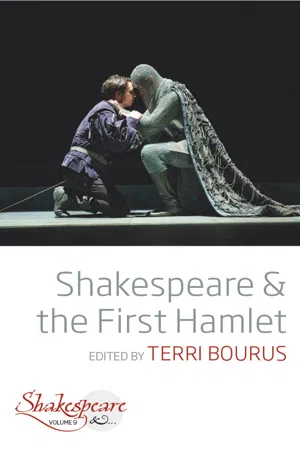
The first edition of Hamlet – often called 'Q1', shorthand for 'first quarto' – was published in 1603, in what we might regard as the early modern equivalent of a cheap paperback. Yet this early version of Shakespeare's classic tragedy is becoming increasingly canonical, not because there is universal agreement about what it is or what it means, but because more and more Shakespearians agree that it is worth arguing about. The essays in this collected volume explore the ways in which we might approach Q1's Hamlet, from performance to book history, from Shakespeare's relationships with his contemporaries to the shape of his whole career.
- 200 pages
- English
- ePUB (mobile friendly)
- Available on iOS & Android
eBook - ePub
Shakespeare and the First Hamlet
About this book
Trusted by 375,005 students
Access to over 1.5 million titles for a fair monthly price.
Study more efficiently using our study tools.
Information

Chapter 1
Shakespeare’s Early Gothic Hamlet
Gary Taylor
In the beginning was the Ghost.
In every text of Shakespeare’s Tragedy of Hamlet, Prince of Denmark we hear about, and see, the Ghost of Hamlet before we hear about, or see, Prince Hamlet.
The first known quotation from a play about Hamlet quotes the Ghost, and only the Ghost. Twenty-three seventeenth-century allusions to the play mention the Ghost.1 Theatrical tradition claims that ‘the top of [Shakespeare’s] Performance was the Ghost in his own Hamlet’.2 Shakespeare played the Ghost better than any other role.
Our assumptions about the literary, theatrical and textual history of Hamlet are quotations from the ghost of the eighteenth-century scholar Edmond Malone, telling us a story about a ghost play, an allegedly lost ‘Ur-Hamlet’ written in the 1580s.
The Ghost is male, Hamlet is male, the first Elizabethan writers to mention Hamlet are male. Shakespeare is male, Malone is male, Malone’s ghost play was allegedly written by the English male playwright Thomas Kyd, inspired by the Roman male playwright Seneca. Saxo Grammaticus (who Latinised the medieval Scandinavian myth) and François Belleforest (who translated that story into French) were male. Contemplating Hamlet, we seem to be trapped in a haunted men’s club, or a haunted all-male English grammar school, or a haunted all-male university, like Wittenberg – or like ‘the Universities of Cambridge and Oxford’, where Shakespeare’s Hamlet was performed in Shakespeare’s lifetime, according to the title page of the first edition.
But the ghost does not appear in the stories told by Saxo or Belleforest, and the ghost in the Elizabethan Hamlet fundamentally differs from all the ghosts dramatised by Seneca or Kyd. If you want to understand any of Hamlet’s ghosts, you would be better off paying attention to the words of six women: Belsey, Bourus, Gertred, Kristeva, Montagu and Radcliffe.
Women’s ghosts
The most important source of Shakespeare’s ghost, Catherine Belsey tells us, is not Seneca, not a writer, and almost certainly not a man. Hamlet’s first scene dramatises ‘a dark winter night’, Belsey reminds us, where ‘three seated figures are absorbed by a ghost story’, a story interrupted by the arrival of an actual ghost. That Ghost’s description of his torments owes something to Seneca and to medieval depictions of purgatory, but ‘the ghost lore and the storytelling skills that make the apparition in Hamlet chilling grow out of the conventions of popular narrative’, which Shakespeare would have learned from ‘the old wives’ tales and fireside stories of his Warwickshire childhood’.3 In Macbeth, Shakespeare acknowledges such sources: Banquo’s ghost is compared to something out of ‘A woman’s story at a winter’s fire, / Authorized by her grandam’ (Macbeth 3.4.63–64). Hamlet’s ghost rises from the same matriarchal font. More generally, Belsey argues that what most distinguishes Shakespeare from his contemporaries is his incorporation and transformation of the fundamentally oral, fundamentally rural and popular, tradition of fireside tales.4
In another essay, published in 2014, Belsey more explicitly and systematically contrasts Shakespeare’s populist Ghost in Hamlet to Kyd’s elite Ghost of Andrea in The Spanish Tragedy. Andrea ‘does not interact with the participants in the plot’ and ‘he is not uncanny’; the role of the former King of Denmark ‘is unlike Andrea’s in almost every way’. In particular, Kyd’s Andrea and other Elizabethan ghosts ‘may have frightened playgoers but, even when they participate in the action of the play, there is little evidence that they had the same effect on the fictional characters they haunted’.5 The Ghost in Hamlet represents not only a departure from the precedent created by Kyd, but an innovation in early modern drama. No stage ghost before Shakespeare resembles the ‘thing’ that walks the battlements of Elsinore.
Belsey sustains this argument across three different publications, not because she particularly cares about nailing down every possible ‘source’ for Shakespeare’s plays, but because she is challenging a long patriarchal scholarly tradition that emphasises Shakespeare’s connections to classical literature and the Protestant Reformation. Connecting Shakespeare to Seneca situates him as a ‘Renaissance’ superman, capable of leaping across centuries with a single bound, and worthy of comparison to the intellectual and aesthetic giants of the Roman Empire. Connecting Shakespeare to the Reformation endows him with the intellectual seriousness of theology, the moral authority of Christianity, and the imperial nationalism of an England independent of Rome or any other European obligations. Both connections link Shakespeare to the educated male elite that dominated the editing and interpretation of his work from the early eighteenth century to the end of the twentieth.
Belsey does not deny that Shakespeare owes something to Seneca. But she does make that Senecan connection secondary, and dissociates it from the most interesting features of King Hamlet’s Ghost. As A.J. Boyle observes, Seneca gave Renaissance dramatists, in and out of England, models for ‘vivid and powerful declamatory verse, psychological insight, highly effective staging, an intellectually demanding verbal and conceptual framework, and a precocious preoccupation with theatricality and theatricalization’.6 Seneca’s plays do contain ghosts, which did influence the drama of the European Renaissance, beginning with Gregorio Correr’s neo-Latin Procne in the 1420s.7 But only two of Seneca’s ghosts talk, and neither directly engages with the play’s ‘living’ characters.
All the features of the Ghost that Belsey describes occur in all three early versions of the play, and she does not commit herself to a particular textual hypothesis about the origins of Q1 Hamlet. Nevertheless, she makes a number of standard assumptions about Shakespeare’s play. ‘Hamlet must have been written between 1599 and 1601’, she states, without feeling the need to cite any evidence for this traditional date, which goes back to Malone; likewise, she suggests that Shakespeare’s Hamlet and Marston’s play Antonio’s Revenge may well draw on ‘a common source, probably Kyd’s lost Hamlet’ – thus assuming, like most scholars since Malone, that Shakespeare was influenced by a lost play about Hamlet, written in the late 1580s by Thomas Kyd.8
Belsey accepted those assumptions in 2014, but they were not important to her argument, and they were systematically demolished that same year. Terri Bourus, re-examining the long scholarly history of claims about the chronology of Shakespeare’s works, including all early references to ‘Hamlet’ in the theatre, demonstrated that ‘Malone’s insistence that the 1589 Hamlet cannot have been written by Shakespeare is unwarranted’.9 She also argued that Q1 Hamlet could be the tragedy about Hamlet that Thomas Nashe mocked in 1589, that the Chamberlain’s Men performed in 1594 and 1596, that Thomas Lodge mocked in 1596, that was performed in the City of London and the universities of Oxford and Cambridge in the late 1580s or early 1590s.
In 2014, Belsey had not read Bourus, and Bourus had not read Belsey. But their separate claims strengthen each other. Belsey’s evidence that the Ghost reflects provincial folk tales and Shakespeare’s own ‘Warwickshire childhood’ reinforces the evidence, marshalled by Bourus, that links Q1 Hamlet to events in Warwickshire between 1579 and 1585 (and to texts, political events and theatrical fashions of the 1570s and 1580s). Shakespeare’s best performance as an actor was a role inspired by stories that laid the first foundations of his imagination. Likewise, if Shakespeare wrote his first Hamlet in late 1588 or early 1589 (as Bourus argues), then ‘Shakespeare’s own first sad tale of and for winter’ (as Belsey calls Hamlet) is a defining ‘first’, an authorial signature, from the outset of his career.10
That authorial signature, in turn, explains the caustic tone of early references to Hamlet in the theatre. Bourus brilliantly and originally analyses Thomas Lodge’s 1596 pamphlet, which alludes to ‘the Vizard of the ghost which cried so miserally at the Theater like an oyster wife, Hamlet, revenge’.11 But if Bourus had read Belsey, she might also have recognised the particular resonance of Lodge’s otherwise superfluous ‘oyster wife’. Lodge associates the Ghost in Hamlet with a source, and a stereotype, that is female, oral and uneducated – just like the ‘old wives’ who were associated with the telling of ghost stories. University-educated critics like Lodge (in 1596) and Thomas Nashe (in 1589) mocked the early Hamlet play precisely because it did not uphold the elite male values of their own classical education. But Lodge specifically tells us that, in the original Hamlet performed at the Theatre, the Ghost spoke directly to Hamlet. It thus engaged directly with the play’s living characters – as Seneca’s ghosts do not, as Kyd’s ghost does not, but as the ghosts of traditional stories did. That early Hamlet ghost was typical not only of Shakespeare’s other ghosts, but of his many portrayals of other ‘ontological outliers’: weïrd sisters, fairies, a puck like Robin Goodfellow, a spirit like Ariel, a ‘monster’ like Caliban.12 These hybrid beings all draw upon medieval storytelling, and all initiate interaction and dialogue with humans. Lodge was mocking a characteristically Shakespearian ghost.
The mother’s scene
Like Belsey, Bourus challenged the patriarchal scholarly tradition that has governed interpretation of Hamlet; but unlike Belsey, Bourus was primarily interested in textual and theatrical issues. Young Shakespeare’s Young Hamlet seems to me the single most important book in Shakespearean textual criticism since The Division of the Kingdoms, published thirty years earlier – and it has provoked similarly hostile reactions from self-appointed guardians of Shakespeare’s reputation.13 But Bourus, in reframing the textual issues, also reinterprets t...
Table of contents
- Cover
- Title Page
- Copyright Page
- Contents
- List of Figures
- Introduction: Is Q1 Hamlet the First Hamlet?
- Chapter 1: Shakespeare’s Early Gothic Hamlet
- Chapter 2: The Hybrid Hamlet Player Tested, Shakespeare Approved
- Chapter 3: Ofelia’s Interruption of Ophelia in Hamlet
- Chapter 4: Beautified Q1 Hamlet
- Chapter 5: The Good Enough Quarto Hamlet as a Material Object
- Chapter 6: Harvey’s 1593 ‘To Be and Not To Be’ The Authorship and Date of the First Quarto of Hamlet
- Chapter 7: ‘To Be, or Not To Be’ Hamlet Q1, Q2 and Montaigne
- Chapter 8: Shakespeare, Virgil and the First Hamlet
- Chapter 9: Unique Lines and the Ambient Heart of Q1 Hamlet
- Chapter 10: ‘Brief Let Me Be’ Telescoped Action and Characters in Q1 and Q2 Hamlet
- Chapter 11: Q1 Hamlet The Sequence of Creation and Implications for the ‘Allowed Booke’
- Chapter 12: What Doesn’t Happen in Hamlet
- Afterword: Q1 Hamlet
- Index
Frequently asked questions
Yes, you can cancel anytime from the Subscription tab in your account settings on the Perlego website. Your subscription will stay active until the end of your current billing period. Learn how to cancel your subscription
No, books cannot be downloaded as external files, such as PDFs, for use outside of Perlego. However, you can download books within the Perlego app for offline reading on mobile or tablet. Learn how to download books offline
Perlego offers two plans: Essential and Complete
- Essential is ideal for learners and professionals who enjoy exploring a wide range of subjects. Access the Essential Library with 800,000+ trusted titles and best-sellers across business, personal growth, and the humanities. Includes unlimited reading time and Standard Read Aloud voice.
- Complete: Perfect for advanced learners and researchers needing full, unrestricted access. Unlock 1.5M+ books across hundreds of subjects, including academic and specialized titles. The Complete Plan also includes advanced features like Premium Read Aloud and Research Assistant.
We are an online textbook subscription service, where you can get access to an entire online library for less than the price of a single book per month. With over 1.5 million books across 990+ topics, we’ve got you covered! Learn about our mission
Look out for the read-aloud symbol on your next book to see if you can listen to it. The read-aloud tool reads text aloud for you, highlighting the text as it is being read. You can pause it, speed it up and slow it down. Learn more about Read Aloud
Yes! You can use the Perlego app on both iOS and Android devices to read anytime, anywhere — even offline. Perfect for commutes or when you’re on the go.
Please note we cannot support devices running on iOS 13 and Android 7 or earlier. Learn more about using the app
Please note we cannot support devices running on iOS 13 and Android 7 or earlier. Learn more about using the app
Yes, you can access Shakespeare and the First Hamlet by Terri Bourus in PDF and/or ePUB format, as well as other popular books in Literatur & Literarische Biographien. We have over 1.5 million books available in our catalogue for you to explore.