eBook - ePub
The New Gettysburg Campaign Handbook
Facts, Photos, and Artwork for Readers of All Ages, June 9–July 14, 1863
- 192 pages
- English
- ePUB (mobile friendly)
- Available on iOS & Android
eBook - ePub
The New Gettysburg Campaign Handbook
Facts, Photos, and Artwork for Readers of All Ages, June 9–July 14, 1863
About this book
The New Gettysburg Campaign Handbook is an informative full-color guide for American Civil War and Gettysburg enthusiasts of all ages. Authors J. David Petruzzi and Steven Stanley use clear and concise writing broken down into short and easy to understand chapters complete with original maps, modern and historic photographs, tables, charts, and artwork to narrate the history of the Gettysburg Campaign from the opening battle at Brandy Station in Virginia on June 9, 1863, to the escape of Gen. Robert E. Lee's Confederate Army of Northern Virginia across the Potomac River on July 14, 1863. Chapters include quotes of interest from participants, tables and charts of the ages and seniority ranking of the generals of both sides; weather observations during the battle; a stunning photographic study of the entire campaign; a discussion of the battle's myths and controversies; biographies of select officers, civilians, and battlefield photographers; trivia about the campaign; a comprehensive order of battle; a suggested reading list and websites; and much more. As enjoyable to look at as it is easy to use, every casual and serious student of the Civil War and Gettysburg will want a copy of The New Gettysburg Campaign Handbook as a constant companion while reading other books on the campaign—and even as a supplement and general field guide while walking the hallowed Pennsylvania ground. About the Authors: J. David Petruzzi is an award-winning Civil War cavalry historian. He is the author of many articles for a wide variety of publications, and has written or co-authored several books including: (with Eric Wittenberg) Plenty of Blame to Go Around: Jeb Stuart's Controversial Ride to Gettysburg (Savas Beatie, 2006); (with Wittenberg and Michael F. Nugent) One Continuous Fight: The Retreat from Gettysburg and the Pursuit of Lee's Army of Northern Virginia, July 4-14, 1863 (Savas Beatie, 2008); and (with Steven Stanley) The Complete Gettysburg Guide: Walking and Driving Tours of the Battlefield, Town, Cemeteries, Field Hospital Sites, and other Topics of Historical Interest (Savas Beatie, 2009), winner of the U.S. Army Historical Foundation's 2009 Distinguished Writing Award, Reference Category. With Stanley, he also produced The Complete Gettysburg Guide: Audio Driving and Walking Tour, Volume One: The Battlefield (Savas Beatie, 2010). Steven Stanley lives in Gettysburg and is a graphic artist specializing in historical map design and battlefield photography. His maps, considered among the best in historical cartography, have been a longtime staple of the Civil War Trust and have helped raise millions of dollars for the Trust through their preservation appeals and interpretation projects. Steve's maps have appeared in a wide variety of publications. Co-authored by J. David Petruzzi, Steve produced the maps and the complete design of The Complete Gettysburg Guide: Walking and Driving Tours of the Battlefield, Town, Cemeteries, Field Hospital Sites, and other Topics of Historical Interest (Savas Beatie, 2009), the winner of the U.S. Army Historical Foundation's 2009 Distinguished Writing Award, Reference Category, as well as The Complete Gettysburg Guide: Audio Driving and Walking Tour, Volume One: The Battlefield (Savas Beatie, 2010).
Information
Topic
HistoireGETTYS BURG CAMPAIGN
The Road to Gettysburg

The American Civil War was two years old in May of 1863. Although the Confederacy had suffered several significant setbacks in the Western Theater, Robert E. Lee’s Army of Northern Virginia established an impressive string of victories against its Federal opponents in the East. Lee’s success began against the Army of the Potomac in June 1862 outside the gates of Richmond in the Seven Days’ Battles, and continued farther north that August at Second Manassas. Although Lee’s Maryland Campaign stalled at Antietam (Sharpsburg) in September, he defeated the Federals soundly at Fredericksburg in December and once more at Chancellorsville in May 1863. After losing corps commander Lt. Gen. Thomas J. “Stonewall“ Jackson in the latter campaign, Lee reorganized his army from two corps to three. Lt. Gen. James Longstreet retained command of his First Corps, and Lt. Gens. Richard S. Ewell and Ambrose P. Hill were placed in command of the Second and Third Corps, respectively.
Lee determined to shift hostilities out of war-torn Virginia and onto Northern soil. His general plan was to operate in enemy territory as long as possible and, when opportunity presented itself, meet portions of the Federal army in Pennsylvania and defeat each in detail. If he moved north and threatened major northern cities such as Washington, Baltimore, Harrisburg, or Philadelphia, he could draw the Federals to him like prey to a spider’s web. Lee knew he was running an enormous risk by exposing the Southern capital at Richmond and moving so far from his base of supplies, but he believed a decisive victory on enemy soil might convince the North to end the war and grant the Confederacy its independence.
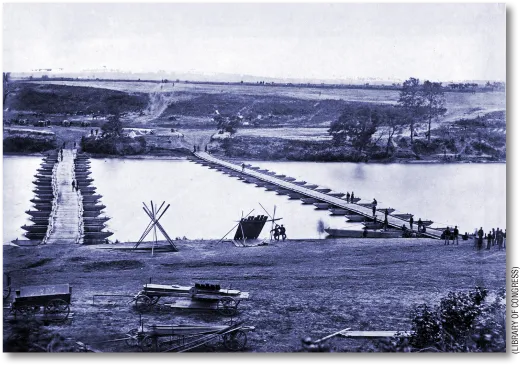
The photograph above, taken by Timothy O’Sullivan on June 3, 1863, has been recently identified as the first recorded image of the Gettysburg Campaign. Here, Federal army pontoon bridges span the Rappahannock River near Fredericksburg at the “Lower Crossing.” The view looks west toward the Confederate position on the heights in the background. Pontoon bridges were constructed by lashing pontoon boats together in a line from shore to shore laying boards on top to create a surface over which troops could march and wagons and artillery could roll.
The map below shows the march routes of the various units of both armies through northern Virginia, Maryland, and Pennsylvania. Richard Ewell’s Corps led the Confederate army as it swung west and then north toward Culpepper Court House and then into the Shenandoah Valley, with James Longstreet’s Corps marching next in order. A. P. Hill’s Corps, which Lee left in place opposite Fredericksburg to divert attention from his initial movement toward the Valley, followed Ewell and Longstreet on June 10.
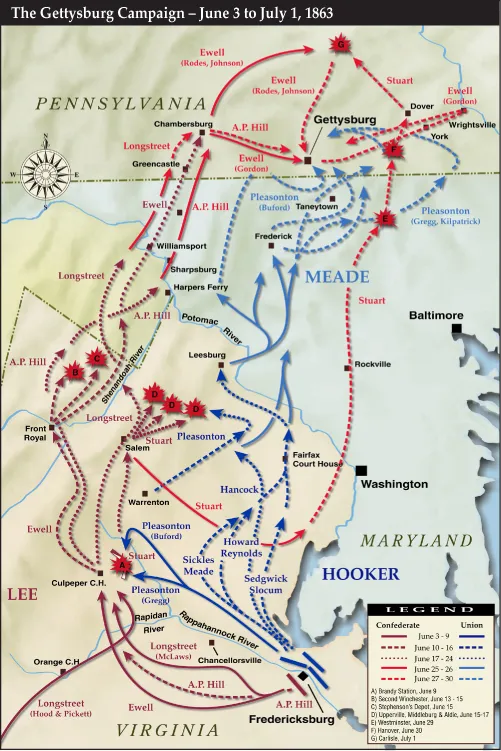
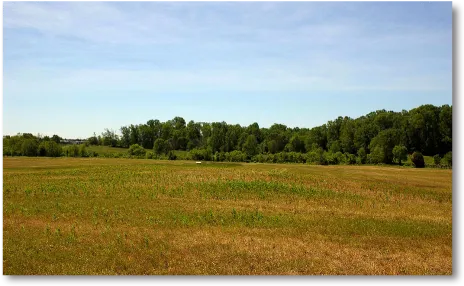
From June 9 through the start of the Gettysburg battle on July 1, opposing cavalry and infantry fought several skirmishes and pitched battles, including Brandy Station, Second Winchester, Stephenson’s Depot, Aldie, Middleburg, Upperville, and many more. The marches were long, difficult, and exhausting. No one knew where the fluid campaign would take them or what, exactly, Lee hoped to achieve once north of the Mason Dixon Line.
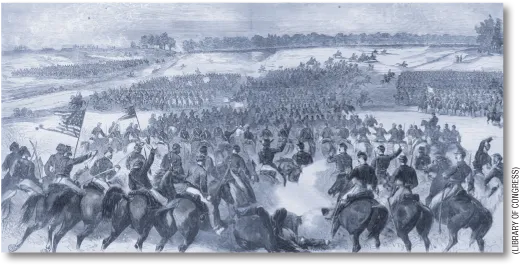
Before Lee’s army began its march north, the largest and bloodiest cavalry battle that would ever take place in North America unfolded on the rolling plains near Brandy Station, Virginia, on June 9, 1863 (above). Federal cavalry commanded by Brig. Gen. Alfred Pleasonton crossed the Rappahannock River early that morning to surprise and engage the Confederate cavalry under the vainglorious but skilled Maj. Gen. James Ewell Brown Stuart. Nearly 20,000 cavalrymen fought fitfully for fourteen hours (as represented below in a Harper’s Weekly engraving) resulting in more than 1,400 combined casualties and delaying Lee’s march north by one full day. Most significant, Union cavalry had finally come of age.
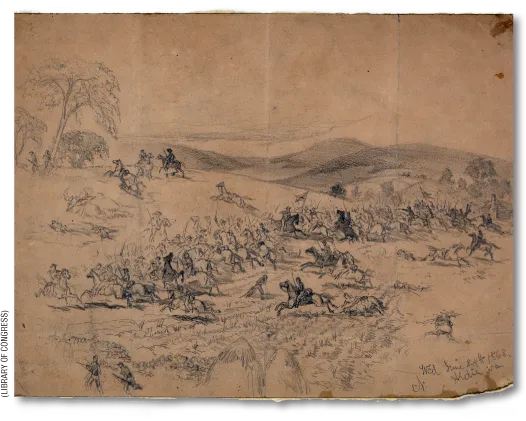
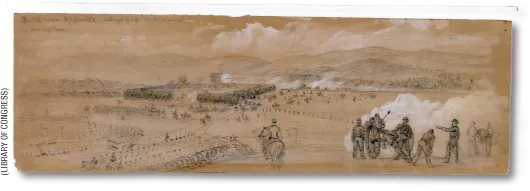
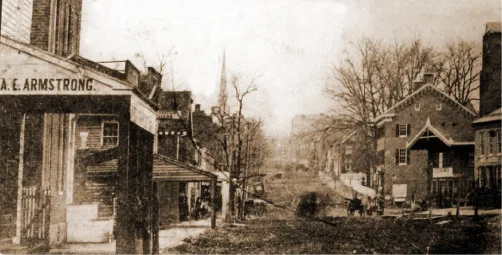
As the three Confederate corps marched north through the Shenandoah Valley toward Maryland, Stuart’s troopers screened the infantry by defending the mountain passes to the east to keep the Federal horsemen from tracking it. When the Federal troopers tried to break Stuart’s screen, pitched cavalry battles erupted near Virginia towns such as Aldie (below), Middleburg, and Upperville (second below)." Stuart was nearly defeated at the last fight, but the Union riders were kept at bay. Lee’s infantry was able to advance north virtually unmolested.
After the fights for the mountain passes, J.E.B. Stuart proposed a bold plan to Lee: make a ride around the Union army with his cavalry to get between the Federals and Washington, D.C., so he could threaten that city and others important to the North and cause havoc and panic in the Federal capital as Lee advanced into Pennsylvania. (Stuart had made a similar though shorter ride the previous year.)
When Lee approved, Stuart gathered just over one-half of his cavalry, rode east toward Washington, and then moved north to link up with the Southern army once in Pennsylvania. Once Stuart left on his ride, General Lee lost contact with his cavalry commander—the eyes and ears of his army.
Stuart’s grand plan went awry almost from the start. After a skirmish with Federal cavalry at F...
Table of contents
- Front Cover
- Title Page
- Copyright Page
- Contents
- Foreword
- Acknowledgements
- Did You Know?
- Gettysburg Voices
- The Gettysburg Campaign
- Images of Gettysburg
- Gettysburg Today
Trusted by 375,005 students
Access to over 1.5 million titles for a fair monthly price.
Study more efficiently using our study tools.
Frequently asked questions
Yes, you can cancel anytime from the Subscription tab in your account settings on the Perlego website. Your subscription will stay active until the end of your current billing period. Learn how to cancel your subscription
No, books cannot be downloaded as external files, such as PDFs, for use outside of Perlego. However, you can download books within the Perlego app for offline reading on mobile or tablet. Learn how to download books offline
Perlego offers two plans: Essential and Complete
- Essential is ideal for learners and professionals who enjoy exploring a wide range of subjects. Access the Essential Library with 800,000+ trusted titles and best-sellers across business, personal growth, and the humanities. Includes unlimited reading time and Standard Read Aloud voice.
- Complete: Perfect for advanced learners and researchers needing full, unrestricted access. Unlock 1.5M+ books across hundreds of subjects, including academic and specialized titles. The Complete Plan also includes advanced features like Premium Read Aloud and Research Assistant.
We are an online textbook subscription service, where you can get access to an entire online library for less than the price of a single book per month. With over 1.5 million books across 990+ topics, we’ve got you covered! Learn about our mission
Look out for the read-aloud symbol on your next book to see if you can listen to it. The read-aloud tool reads text aloud for you, highlighting the text as it is being read. You can pause it, speed it up and slow it down. Learn more about Read Aloud
Yes! You can use the Perlego app on both iOS and Android devices to read anytime, anywhere — even offline. Perfect for commutes or when you’re on the go.
Please note we cannot support devices running on iOS 13 and Android 7 or earlier. Learn more about using the app
Please note we cannot support devices running on iOS 13 and Android 7 or earlier. Learn more about using the app
Yes, you can access The New Gettysburg Campaign Handbook by J. David Petruzzi,Steven Stanley in PDF and/or ePUB format, as well as other popular books in Histoire & Histoire de la guerre de Sécession. We have over 1.5 million books available in our catalogue for you to explore.