eBook - ePub
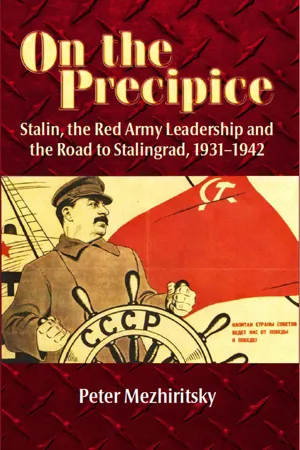
On the Precipice
Stalin, the Red Army Leadership and the Road to Stalingrad, 1931–1942
- 399 pages
- English
- ePUB (mobile friendly)
- Available on iOS & Android
eBook - ePub
On the Precipice
Stalin, the Red Army Leadership and the Road to Stalingrad, 1931–1942
About this book
Nominated for the 2013 PushkinHouse/Waterstone's Russian Book Prize. Like some astronomers, who discover cosmic objects not by direct observation, but by watching the deviations of known heavenly bodies from their calculated trajectories, Peter Mezhiritsky makes his findings in history through thoughtful reading and the comparison of historical sources. This book, a unique blend of prosaic literature and shrewd historic analysis, is dedicated to events in Soviet history in light of Marshal Zhukov's memoirs. Exhaustive knowledge of Soviet life, politics and censorship, including the phraseology in which Communist statesmen were allowed to narrate their biographical events, gave Peter Mezhiritsky sharp tools for the analysis of the Marshal's memoirs. The reader will learn about the abundance of awkward events that strangely and fortuitously occurred in good time for Stalin's rise to power, about the hidden connection between the purges, the Munich appeasement and the German occupation of Czechoslovakia, and about the real reason why it took so long to liquidate Paulus' Sixth Army at Stalingrad. The author presents a clear picture of the purges which promoted incompetent and poorly educated commanders (whose most prominent feature was their personal dedication to Stalin) to higher levels of command, leaving the Soviet Union poorly prepared for a war against the Wehrmacht military machine. The author offers alternative explanations for many prewar and wartime events. He was the first in Russia to acknowledge a German component to Zhukov's military education. The second part of the book is dedicated to the course of the Great Patriotic War, much of which is still little known to the vast majority of Western readers. While not fully justifying Zhukov's actions, the author also reveals the main reason for the bloody strategy chosen by Zhukov and the General Staff in the defensive period of the War. In general, the author shares and argues Marshal Vasilevsky's conviction - if there had been no purges, the war would not have occurred. The book became widely known to the Russian-reading public on both sides of the Atlantic, and in the last ten years its quotations have been used as an essential argument in almost all the debates about the WWII. The book is equally intended for scholars and regular readers, who are interested in Twentieth Century history.
Information
Part One
In memory of all those who fell in the Second World War.
In memory of all the martyrs, not yet deemed worthy of monuments and who didn’t survive to take part in the Second World War.
1
Interlude: Children …
… often died in families. Indeed, in his as well. Yet he, the third born, unfortunately survived in order to destroy tens of millions of people ruthlessly.
Of course, I’m not speaking about Zhukov. I’m talking about his patron, the Supreme High Commander and Generalissimo, Stalin.
Zhukov, though, survived – fortunately. (I anticipate that such an assertion will find many who oppose it. Considered among Russia’s national heroes, Zhukov nevertheless provokes the frenzied howling of neo-Stalinists, who strive to overturn the truth by praising Stalin for the Victory, and blaming Zhukov for the losses.) In the Marshal’s memoirs Vospominaniia i razmyshleniia (Remembrances and Reflections) he hardly touched upon the losses. As a professional, he didn’t even begin to try to exonerate himself: A commander’s duty is to avoid defeats and to conquer, while the cost is a secondary matter. The casualties – not Zhukov’s fault, but not without his participation – were countless, even in vain. However, they were not the victims of the repressions. The strong little boy would live a glorious life, and become a great commander and an idol to millions. In the pantheon of Russian military glory his name stands equal to the names of Peter Rumiantsev and Mikhail Kutuzov. His fame has not been besmirched by the disgrace of repression, like the fame of Suvorov, whose title of Field Marshal had been bestowed by Empress Catherine for the brutal suppression of the Warsaw uprising of 1794. At that time, the banks of the Vistula River had been covered by a medley of the remains of young ladies, children, Jews, Polish nobles and an assortment of random victims. “Speed, assessment, hitting power …”1
History is mocking and repeats itself in ways that are difficult to recognize. One hundred and fifty years later, our hero also faced the problem of a Warsaw uprising. The medley of corpses was now the Nazis’ doing, while Stalin kept watch from the Kremlin as his foes consumed each other. It was left for Zhukov to justify his inaction – and he did, thank you. Thanks for the humble admission of his guilt. Zhukov could hardly have been accused seriously; he was a weapon in someone else’s hands.
Indeed, he remained a weapon. The brilliant tactician never played any independent role in politics – fortunately so, I think.
Fate placed him in an exceptional situation. Stalin’s purges, directed at the liquidation of personalities, struck down more than a few strong-willed people even among those, who weren’t drawn into Stalin’s orbit. Zhukov was a strong-willed man – and would remain one. Happily for Zhukov. Happily for the country. He climbed the hierarchical staircase to the highest step not too soon, and so his head remained on his shoulders. With his character, that was a great fortune. In the eviscerated Red Army, he wound up in the necessary place at the necessary time – Chief of the General Staff of the Red Army on that fateful day 22 June 1941. At that time and in those conditions, the key talent was the ability and character to defend one’s opinions. Zhukov did this. He proposed singularly acceptable solutions, and insisted upon them. In that situation under Stalin, no one could have managed to do more.
A fulfilled life. A visible result. He never had the love of his superiors, but glory didn’t pass him by. His name has never disappeared and never will disappear from lips and printed pages.
The memoirs that Zhukov left behind are brief and distinguished.2 Though sparing in words, these memoirs are valuable. His omissions are, for the most part, compulsory. There are minimal excuses and none whatsoever regarding Zhukov’s personal decisions.
This book doesn’t aim to topple Zhukov from his rightful place on the pedestal. It has been written with respect for the great commander, for his role in the war, and for the personal courage he demonstrated. At his post as Chief of the General Staff at the start of the war, his courage was topped only by a senselessness and selflessness of the highest order – of the same sort that gripped those heroes who hurled themselves beneath enemy tanks with grenade bundles.
After all, this book is not about Zhukov …
1 Editor’s note: Field Marshal Suvorov was famous for his military aphorisms, such as “Train hard, fight easy” and “Perish yourself, but save your comrade.” This is another of Suvorov’s sayings, a well-known, succinct distillation of Suvorov’s philosophy of war.
2 We, the war’s contemporaries, waited a long time for them – the memoirs of the saviors of the Fatherland. The memoirs of all the main military commanders were ghost-written, and in the special case of a particularly prominent individual, the memoirist was assigned journalists by the Party apparatus. Typically in such cases, friendly relations developed between the man dictating his memoirs and the scribes, and the journalists would affably explain to the veterans how to avoid censorship and how to present the material connected with mistakes, defeats, and heavy losses. Exceptions are not only rare, but singular. Only Marshal A. M. Vasilevsky wrote his own memoirs by himself, with the same censorship limitations, certainly. They were not published by Voenizdat [the Soviet military publisher], but by Politizdat [the Soviet political publisher]. Zhukov’s memoirs were also not published by Voenizdat, as would have been natural. They came out from the APN [Agenstvo pechati “Novosti” – “Novost” Press Agency]. Through my friend, a laureate of international competitions, the violinist Rafail Sobolevsky, who was a friend of the Marshal’s family, I became aware of the pressure on the Marshal from the Party clique while the memoirs were being written. They demanded silence first and foremost from the Marshal, the omission of unpleasant facts and out of favor heroes, and instructed him to replace them with the glorification of trifles.
2
His origin, according to Zhukov
The childless widow Annushka Zhukov adopted an infant boy, the future father of Georgii Konstantinovich, from a children’s shelter. It is known only that a woman had left the infant on the doorstep of the orphanage with a note: “My son’s name is Konstantin.”1
His father’s own biography has been shaped and crafted so as to make him out to be a Gavroche of the First Russian Revolution.2 Soviet power, presumed to remain proletarian forever, prompted such a story in order to give an appropriate revolutionary stamp to Zhukov’s background. Zhukov dedicated his life and sword to this power. An interpretation of his father’s biography beneficial to it ideologically was a small sacrifice.
The later photographs of the Marshal are remarkable. Of course, the years of power have given rise to an imperious expression on his face. With the years, even ordinary faces acquire significance. The features of the commander, however, suggest portraits of grandees. Although his mother was a simple peasant, perhaps Marshal of the Soviet Union Georgii Konstantinovich Zhukov was not.
It is easy to brush the thin coating of ideology from his memoirs – all these ritualistic dances around Marxism and around Lenin personally, which supposedly even country folk knew about back in 1905. We know, though: Lenin attached himself to the villagers, but the villagers – not to Lenin.
1 Although I am not an expert in 19th century mode of life, I do know that there were no orphanages in Russian villages. So, if there was no chance to get an abortion, it was normal practice to hire a cabman to take an illegitimate child of unlawful love to an orphanage. Konstantin by no means could be a name for a country boy of peasant origin. Thus we must assume that Konstantin’s mother was a city woman, and that naturally his father was as well. From which it is clear that we can only guess at the genes of the future commander.
2 Editor’s note: Gavroche is an impoverished character in Victor Hugo’s Les Miserables, who as a lad joins the Paris uprising of 1834 and is killed while carrying supplies to those manning the street barricades.
3
Interlude: A fixed interest …
… in such insignificant details can prompt bewilderment. However, more significant incongruities will appear ahead, and they have a direct relationship to our theme.
From Zhukov’s childhood, his apprenticeship in Moscow, the First World War and the Russian Civil War, I won’t single out any facts or character aspect, other than to say that the young Georgii was just like the mother, and Ustin’ia Artem’evna was a strong woman, easily able to lift full bags of grain. Zhukov was of medium height. He comported himself just like his character, and what a character he turned out to be! His pugnaciousness showed on his face. There was hardly anyone prepared to offend this young boy, lad, soldier, and unteroffizier1
1 Editor’s note: An unteroffizier is an old German rank, also used by the Tsarist Russian Army, which is very roughly comparable to “junior non-commissioned officer”. In World War II, an unteroffizier in the German Wehrmacht was comparable to the American rank of sergeant.
4
Military Education 1
The year is 1916. The place is an unteroffizier training detachment in the city of Izium, Khar’kov Guberniia. The trainees were unlucky with their commanding unteroffizier. He turned out to be a brawler, who liked to knock his subordinates off their feet. The unteroffizier particularly disliked Zhukov, but for some reason avoided striking him. For some reason …
Looking back now on the old [Tsarist] army’s training detachment in general I must say that they taught us well, particularly with respect to formation drills. Every graduate fully mastered equestrian skills, weaponry, and methods to train soldiers. It is not a coincident that many unteroffiziers of the old army … became skilled military commanders in the Red Army.
“Many” … “Skilled” … Not Budenny; this swashbuckler, a full Cavalier of St. George1, hadn’t even learned how to read a map. This merits a mention here, because he with his squadron baggage was entrusted with the command of fronts in the Great Patriotic War.
Where did Georgii Konstantinovich acquire his skill? Not in the unteroffizier training detachment. They didn’t teach strategy there. Topography and maps – perhaps, I don’t know; but reserves, logistics, the ability to maneuver troops and to organize the rear? Whatever, let’s proceed.
The year is 1924. Division commander Gai is asking the young regiment commander how he works to better himself. Zhukov replies that he reads a lot and analyzes operations of the First World War. Gai observed that this wasn’t much, and sent Zhukov to the Higher Cavalry School in Leningrad.
Division commander Gai didn’t overlook the young regiment commander. He didn’t allow Zhukov to linger too long in one place, and gave him a boost upward. G. D. Gai was one of the first commanders of proletarian origin to be arrested (if not the very first). I note this, because it directly touches upon the future leader and his actions …
Zhukov was considered among the best young officers at the school: the exams turned out to be easy, even formal. How else could they have been for such graduates? Had they been any more demanding, guys like Eremenko definitely wouldn’t have passed them, and Eremenko was not one of the worst to survive the purges intact. His sense of optimism nicely served the Stalingrad defense. Of course, had there been no purges, which boosted Eremenko to such a high rank, matters might have never reached the need for a defense of Stalingrad.
V. M. Primakov was commanding the Higher Cavalry School, and Zhukov observes that he (Primakov) “was the product of an intellectual family.” The orphan Vitalii Primakov was adopted by the great Ukrainian writer Kotsiubinsky and later married his daughter. During his final year of study in high school, Primakov was arrested for revolutionary propaganda. The student later proved to be a gifted military man. A legendary commander of the Chervonnyi Cossacks and a man of letters, who had mastered the spoken and written word, Primakov, of course, made quite an impression on his tongue-tied and inelegantly-writing peers.
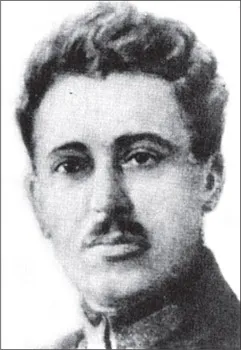
G.D.Gai
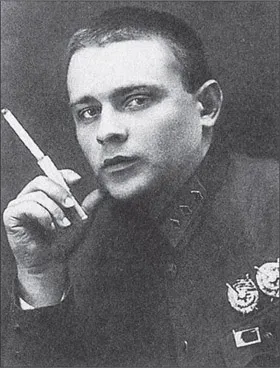
V.M. Primakov (courtesy of Nina Young)
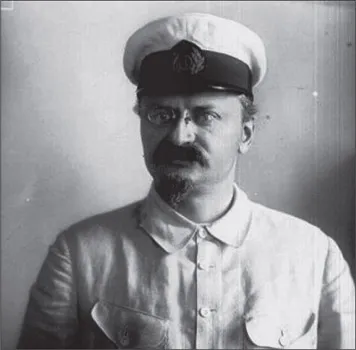
L.D. Trotsky
The Higher Cavalry School was re-formed into the Cavalry Courses for Improving the Command Staff (Kavaleriiskie kursy dlya usovershenstvovania komandnogo sostava – KKUKS). The period of training was reduced from two years to one year. Their haste was due to a shortage of commanders.
Significantly, though the First World War and Civil Wars are over, the country’s army continues to grow, at a time when its government is proposing a program of complete disarmament to the entire world. Increasing arms, while agitating for disarmament … What is that – counting upon gullibility? Then all these talks about disarmament are just a propaganda stunt? The army is growing, and there aren’t enough officers … Incidentally, there are plenty of officers available, with requisite education, though they had received their commissions in the Tsarist era. But Trotsky had been removed, and Stalin doesn’t like the officers of the former Tsarist army: they do not have the proper mindset or they have preconceptions … It is the same sort of problem that Hitler faces with his officers, with their preconceptions, with their consciences… Yet the Red Army is still growing, and more proletarian commanders have to be graduated from the Courses. We, at our Polytechnic Institute, were stuffed with military education for five years2, going over some material repeatedly. A total of four hours a week, but then we had already acquired the general concepts. Even those of us who were on the verge of failing academically didn’t need to learn the difference between degrees of temperature and degrees of angles, or to study the concept of scale, the foundations of physics, descriptive geometry, or the distinction between acid and alkaline. Teach those who have no spatial awareness how to read a map. It isn’t easy for an untrained person to read a map and see the terrain in his mind’s eye. Yet what if the commander is located far from the battlefield, and has no other way to see the theater of combat operations? I’m not even speaking of the planning of offensive operations based on the terrain, occupied by the enemy’s forces.
That’s just a map; and what about the rest of what a commander needs to know? What about chemical warfare, and as part of it the analysis of the difference between decontamination and de-activation? Airplanes, tanks … They guzzle fuel, so you’d better stockpile it. What about many other things? Lubricants? Transportation? Communications?
Oh, one year is not enough! Even just to train a good regiment commander, not to mention a commander like Zhukov. Moreover, at the Courses the main subject of study remained the cavalry sortie. Zhukov writes: “Training at the KKUKS concluded with a forced march to the Volkhov River. Here we learned how to swim with the horse and how to force a crossing of a water barrier.”
The training regimen wasn’t dense with the learning the tasks that a Chief of the General Staff or a Deputy Supreme Commander would have to face. Clearly, the main subject matter still lies ahead. Well then, let’s proceed.
In 1927 Zhukov is commanding the 39th Regiment of the 7th Cavalry Division. The division commander is Dmitrii Arkad’evich Shmidt, formerly known as David Aronovich Gutman. (“A clever man” – the Marshal has to say about his commander at the time). Unexpectedly, Egorov, Chief of Staff of the RKKA [Workers’ and Peasants’ Red Army, known familiarly as the Red Army] and a former colonel in the Tsarist army, arrives at the regiment. The meeting became an event. There was a discussion about forming a second echelon of forces. Zhukov complained about the shortage of personnel in his regiment, and asked how they were to form a second echelon with the available men… Egorov replied, “But we have no other way out. One mustn’t underestimate the foe. We need to prepare seriously...
Table of contents
- Cover
- Title
- Copyright
- Contents
- List of Photographs
- List of Maps
- Translator’s Notes
- Preface to the English Edition
- Abbreviations
- Part One
- Part Two
- Instead of an Epilogue
- Appendix: The German Declaration of War on the Soviet Union
- Selected Bibliography
- Index
- eBooks Published by Helion & Company
Trusted by 375,005 students
Access to over 1.5 million titles for a fair monthly price.
Study more efficiently using our study tools.
Frequently asked questions
Yes, you can cancel anytime from the Subscription tab in your account settings on the Perlego website. Your subscription will stay active until the end of your current billing period. Learn how to cancel your subscription
No, books cannot be downloaded as external files, such as PDFs, for use outside of Perlego. However, you can download books within the Perlego app for offline reading on mobile or tablet. Learn how to download books offline
Perlego offers two plans: Essential and Complete
- Essential is ideal for learners and professionals who enjoy exploring a wide range of subjects. Access the Essential Library with 800,000+ trusted titles and best-sellers across business, personal growth, and the humanities. Includes unlimited reading time and Standard Read Aloud voice.
- Complete: Perfect for advanced learners and researchers needing full, unrestricted access. Unlock 1.5M+ books across hundreds of subjects, including academic and specialized titles. The Complete Plan also includes advanced features like Premium Read Aloud and Research Assistant.
We are an online textbook subscription service, where you can get access to an entire online library for less than the price of a single book per month. With over 1.5 million books across 990+ topics, we’ve got you covered! Learn about our mission
Look out for the read-aloud symbol on your next book to see if you can listen to it. The read-aloud tool reads text aloud for you, highlighting the text as it is being read. You can pause it, speed it up and slow it down. Learn more about Read Aloud
Yes! You can use the Perlego app on both iOS and Android devices to read anytime, anywhere — even offline. Perfect for commutes or when you’re on the go.
Please note we cannot support devices running on iOS 13 and Android 7 or earlier. Learn more about using the app
Please note we cannot support devices running on iOS 13 and Android 7 or earlier. Learn more about using the app
Yes, you can access On the Precipice by Peter Mezhiritsky in PDF and/or ePUB format, as well as other popular books in History & 20th Century History. We have over 1.5 million books available in our catalogue for you to explore.