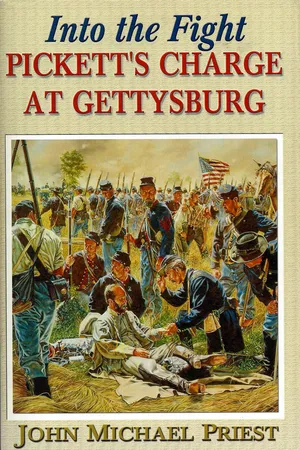
A fresh examination of Pickett's Charge, drawing from numerous soldiers' accounts—includes maps and illustrations.
Both a scholarly and a revisionist interpretation of the most famous charge in American history,
Into the Fight uses a wide array of sources, ranging from the monuments on the Gettysburg battlefield to the accounts of the participants themselves, to rewrite the conventional thinking about this unusually emotional, yet serious, moment in our Civil War. Starting with a fresh point of view, and with no axes to grind,
Into the Fight challenges all interested in that stunning moment in history to rethink their assumptions.
Praise for the work of John Michael Priest
"[A] stirring narrative of the common soldier's experiences on the southern end of the battlefield on the second day of fighting at Gettysburg." —
Civil War News
"Priest's distinctive style is rife with anecdotes, many drawn from obscure diaries and letters, artfully stitched together in an original manner." —David G. Martin, author of
The Shiloh Campaign
- 292 pages
- English
- ePUB (mobile friendly)
- Available on iOS & Android
eBook - ePub
About this book
Information
Subtopic
American Civil War HistoryIndex
History1 Predawn through 1:00 p.m.
July 3, 1863—Predawn Hours
The Southern End of the Confederate Lines
Captain Merritt Miller’s Third Company of the Washington Artillery (three 12-pounder Napoleons) was roused with the rest of Major Benjamin F. Eshleman’s Battalion at 2:00 a.m. In the darkness, artilleryman Napier Bartlett heard the human wreckage of the previous day’s battle moaning loudly enough, he thought, to awaken the bloating corpses around the guns. He could not forget the ghastly dry rattles of the dying as they rasped out their last breaths. His lieutenant, Andrew Hero, Jr., felt just as uneasy. During the night, having had no blanket, he did what most veterans in his condition had done before; he snuggled up next to a sleeping man to share body warmth until daylight. He awoke briefly while it was still dark to tell the fellow how cold blooded he had become. When Hero arose in the morning, in the shadows, he took a closer look at the other soldier’s still face only to discover that he had slept with a corpse.1
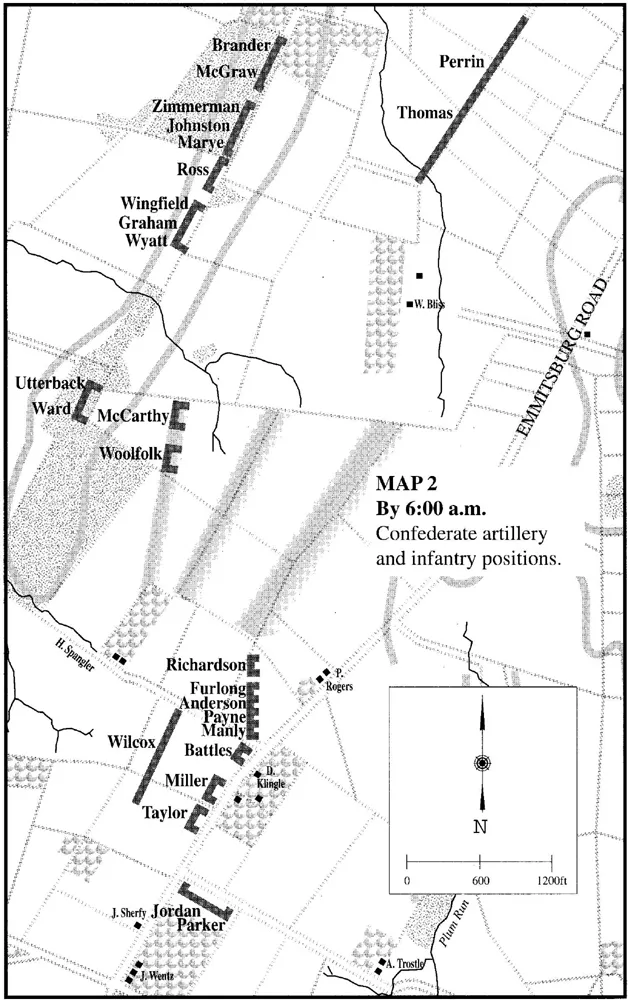
Colonel E. Porter Alexander, whom Lieutenant General James Longstreet had appointed Chief of Artillery for the Army of Northern Virginia’s First Corps for the duration of the battle, was busily rearranging his forty-eight field pieces to support the impending infantry attack against Cemetery Ridge. He kept Major Mathias W. Henry’s battalion of eighteen guns on the extreme right, south of the Peach Orchard along the Emmitsburg Road facing east toward Little Round Top.2
The artillery line which he intended to use to support the impending assault began at Trostle’s lane with his battalion under the direct command of his good friend, Major Frank Huger. At that point, on the rise south of the lane, Captains Tyler C. Jordan’s and William W. Parker’s Virginia batteries held the right of the line, facing north. Captain Osmond B. Taylor’s Virginia Artillery was in battery on the western side of the Emmitsburg Road, across from them, with his guns facing northeast. Parts of Colonel Henry C. Cabell’s Battalion and what was left of Eshleman’s Louisiana Battalion would occupy the line from the Sherfy house to the small knoll north of Spangler’s lane on the southwestern and southern side of the Rogers house.3
Alexander expected Major James Dearing’s eighteen field pieces to further supplement the corps’ offensive ability between Eshleman’s left flank and the first ridge east of Spangler’s Woods, which would bring his total armament to eighty-five pieces.4 Rather than risk wasting ammunition which he could not spare, Alexander specifically forbade his battalion commanders to engage in any artillery duels. They could, if necessary, send one or two rounds at the Yankees, if the situation necessitated it, but no more than that. With his guns exposed to the Federal rifled pieces on Little Round Top, he did not want to be enfiladed before the assault began.5 To safeguard against an infantry attack, he sent Brigadier General Cadmus Wilcox’s bloodied Alabama Brigade to Eshleman’s and Cabell’s support. Wilcox, with his left flank on the south side of Spangler’s lane, put his regiments in the hollow 200 yards west of the road. As the men went prone, their officers passed among them, telling them they were going to remain there during the bombardment which would occur sometime later in the day.6
Nevertheless, just past first light, the Yankees dropped a few 20-pounder shells among Alexander’s crews while they maneuvered their guns into formation. A pair of them screamed into Eshleman’s Washington Artillery Battalion while the four batteries wheeled into front along the Emmitsburg Road north of the Sherfy house. One of them burst over the Fourth Company, Captain Joe Norcom’s Napoleon section. It knocked the captain down, slightly wounding him and killing one of the drivers and two of the horses from the Third Company.7 Lieutenant Henry A. Battles replaced him on the field.8
Federal Lines—Cemetery Hill
Stannard’s Brigade, I Corps
Lieutenant George G. Benedict (A.D.C. to Stannard) and his orderly, under Brigadier General George J. Stannard’s directive, had spent the entire evening and early hours of July 2–3, 1863, meandering from campfire to campfire along the back roads east of Cemetery Ridge, looking for the I Corps ammunition trains. In the pitch darkness they stumbled across several large Pennsylvania stone and brick barns, which were serving the Army of the Potomac as rear line hospitals. The lieutenant grimaced at the memory of one of those makeshift hospitals. The recollections of the unattended casualties which filled the surrounding yard and of a bloody pile of amputated arms and legs next to the door flashed through his mind. He could still see the disabled men lying all about, wrapped in their blankets, stoically waiting for their time upon the surgeons’ tables. He later wrote, “It seemed to me as if every square yard of the ground, for many square miles, must have its blood stain.” After being stopped repeatedly by wounded men asking for directions to their division hospitals, he finally realized that the bloodletting of the previous day had reached monstrous proportions.9
Unable to find the ammunition wagons, he glanced into the sky, noted that the moon was setting, and decided to forget about them altogether. Abandoning his orderly, who was meandering about somewhere in the night, he decided it was time to return to headquarters. The lieutenant quietly spurred his horse onto a road which he supposed led toward Rock Creek Church. A short time later, he passed under what appeared to be an arch. Two field pieces stood silently in the road in front of him pointing in the direction he was heading. While working his horse between them, Benedict was startled by someone standing up in the shadows next to one of the guns and asking where he was going. The lieutenant told him he was looking for Headquarters, Third Brigade, Third Division, I Corps. The artilleryman bluntly told him he was only going to find the Rebels if he kept his present bearing. Benedict quietly turned his horse about and rode under the arch of the cemetery gate house.10
Troop Dispositions—Army of the Potomac
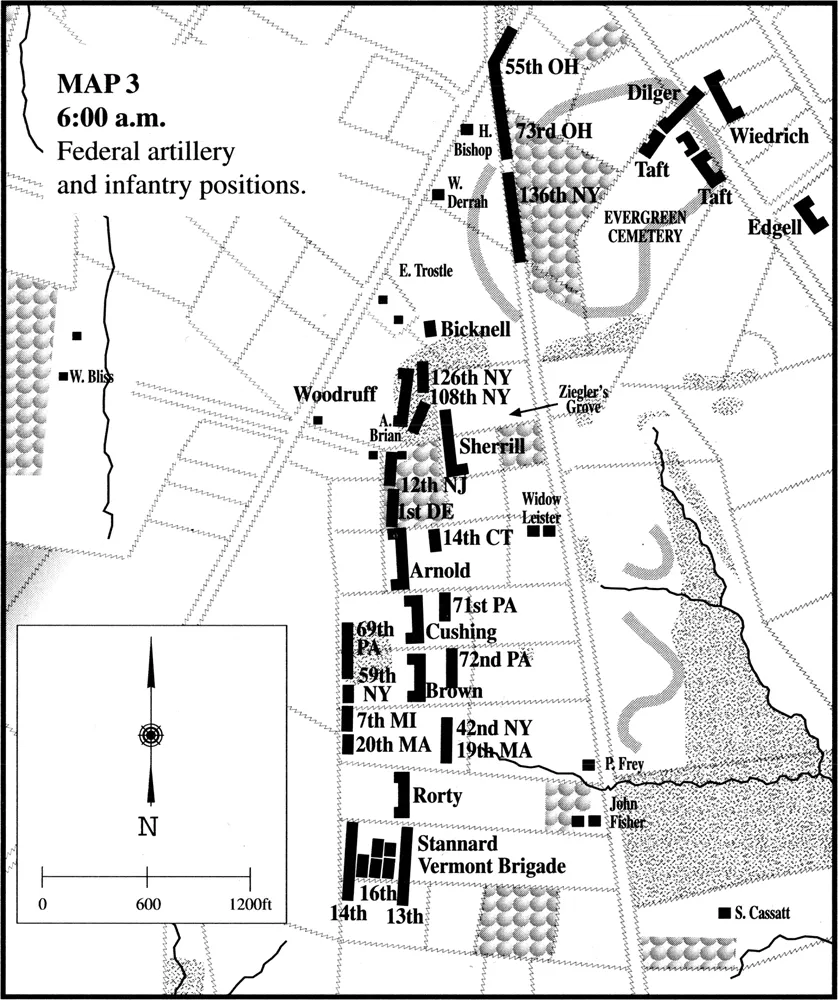
In the dark, the exhausted lieutenant had meandered into Battery I, 1st Ohio Light Artillery, Captain Hubert Dilger’s command, which belonged to Major Thomas Osborn’s XI Corps artillery brigade. This day marked the brigade’s second morning on Cemetery Hill, the most critical, yet the weakest point of the Federal line. Captain Michael Wiedrich’s bloodied Battery I, 1st New York (six Ordnance Rifles) still occupied the earthen lunettes on the northeast side of the Baltimore Pike, facing Benner’s Hill and the Confederate left flank. His position formed the northeastern side of the bend in what later became the “fish hook” of the Federal line.
To Wiedrich’s left rear Dilger’s Ohioans formed the westerly bend in the hook. With his right flank on the eastern side of the Baltimore Pike, he placed his guns along the crest of Cemetery Hill north of the gate house with their muzzles aimed toward Gettysburg and the railroad cut on the high ground northwest of the town.11 Forty-four-year-old Captain Elijah Taft with his six 20-pounder Parrotts (5th New York Independent Battery) were deployed as they had been during the previous afternoon. Two sections were on the western side of the Baltimore Pike south of the gate house well below Wiedrich’s right flank. Facing northeast, they would counter any fire from Benner’s Hill. Captain Frederick M. Edgell’s Battery A, 1st New Hampshire Artillery (four 3-inch rifles) were in a cornfield to his right front on the eastern side of the Baltimore Pike. Taft’s remaining two rifled guns were in battery to the left rear of Dilger, facing west.12
The shank of the hook began at the intersection of the Emmitsburg Road and the Taneytown Road. The 55th Ohio on the right of Colonel Orland Smith’s three regiments lay down with its colors at the intersection. The right wing, taking cover in the Emmitsburg Road, faced northwest toward the town along about a 200-foot front. The left wing went prone behind the stone wall along the western side of the Taneytown Road. The 73rd Ohio with the 136th New York on its left occupied about another nine hundred feet of the line.13
A two hundred yard gap separated the left flank of the 136th New York from the right rear of Lieutenant Emerson L. Bicknell and his twenty men from the 1st Company of Massachusetts Sharpshooters on the western edge of Ziegler’s Grove.14 They and the 126th New York on their left were the right flank of a line which extended for about three fourths of a mile to the south. The New Yorkers lay on the eastern slope of the ridge, supporting Lieutenant George A. Woodruff’s six Napoleons (Battery I, 1st U.S. Artillery), which had rolled into battery on the top of the ridge to the regiment’s left front.15 The remaining three regiments of Colonel Eliakim Sherrill’s small brigade were on line to its left below the line of sight of the Confederate skirmishers in the fields to the west. Colonel Thomas A. Smyth’s brigade continued the formation on the crest to the south until it contacted Captain William A. Arnold’s six Ordnance Rifles (Battery A, 1st Rhode Island Artillery). His left flank ended where the stone wall turned west.
To Arnold’s left, Battery A, 4th U.S. Artillery, Lieutenant Alonzo H. Cushing, commanding, added another six 3-inch rifles to the line. A copse of trees separated Cushing from Lieutenant T. Fred Brown’s Battery B, 1st Rhode Island Artillery (four 12-pounder Napoleons). The 69th Pennsylvania held the wall immediately west of the trees in the area later known as “The Angle.” They were the only infantry in front of the guns from Arnold’s left to Brown’s left. The 71st Pennsylvania was lying among Cushing’s limbers on the eastern side of the ridge with their right flank to the left of Arnold’s limbers. The 72nd Pennsylvania were prone to their left rear.16 The rest of Brigadier General John Gibbon’s division filled out the line to the south of the 69th Pennsylvania with assorted regiments from the I Corps on their left. Those infantry regiments were behind a low earthwork which they constructed as an extension of the wall in front of the Pennsylvanians.
Captain James Rorty’s Battery B, 1st New York Artillery, consisting of four 10-pounder Parrotts was in battery about one hundred yards south of Brown. For the next mile there were no other artillery on line from his left to the northern base of Little Round Top. In that area, battered I, II, and III Corps troops and a division of the VI Corps held the woods east of Cemetery Ridge, but they were not going to do anything to precipitate an engagement. Daylight would find the Union position along Cemetery Ridge looking less than formidable to their Confederate opponents on Seminary Ridge to the west of them.17
Chambersburg Pike—South Side of Marsh Creek
Major General George E. Pickett’s Confederate division awoke at 3:00 a.m.18 The men stirred the coals of their old coffee fires and prepared what Second Lieutenant W. Nathaniel Wood (Company A, 19th Virginia) called their “...
Table of contents
- Front Cover
- Title Page
- Copyright Page
- Contents
- List of Illustrations
- List of Maps
- Acknowledgements
- Chapter 1 Predawn through 1:00 p.m
- Chapter 2 1:00 p.m. through 2:00 p.m
- Chapter 3 2:00 p.m. through 2:45 p.m
- Chapter 4 2:45 p.m. through 3:00 p.m
- Chapter 5 3:00 p.m. through 5:00 p.m
- Appendix A The Confederate Artillery Placement
- Appendix B The Confederate Infantry Strengths and Casualties
- Notes
- Bibliography
Trusted by 375,005 students
Access to over 1.5 million titles for a fair monthly price.
Study more efficiently using our study tools.
Frequently asked questions
Yes, you can cancel anytime from the Subscription tab in your account settings on the Perlego website. Your subscription will stay active until the end of your current billing period. Learn how to cancel your subscription
No, books cannot be downloaded as external files, such as PDFs, for use outside of Perlego. However, you can download books within the Perlego app for offline reading on mobile or tablet. Learn how to download books offline
Perlego offers two plans: Essential and Complete
- Essential is ideal for learners and professionals who enjoy exploring a wide range of subjects. Access the Essential Library with 800,000+ trusted titles and best-sellers across business, personal growth, and the humanities. Includes unlimited reading time and Standard Read Aloud voice.
- Complete: Perfect for advanced learners and researchers needing full, unrestricted access. Unlock 1.5M+ books across hundreds of subjects, including academic and specialized titles. The Complete Plan also includes advanced features like Premium Read Aloud and Research Assistant.
We are an online textbook subscription service, where you can get access to an entire online library for less than the price of a single book per month. With over 1.5 million books across 990+ topics, we’ve got you covered! Learn about our mission
Look out for the read-aloud symbol on your next book to see if you can listen to it. The read-aloud tool reads text aloud for you, highlighting the text as it is being read. You can pause it, speed it up and slow it down. Learn more about Read Aloud
Yes! You can use the Perlego app on both iOS and Android devices to read anytime, anywhere — even offline. Perfect for commutes or when you’re on the go.
Please note we cannot support devices running on iOS 13 and Android 7 or earlier. Learn more about using the app
Please note we cannot support devices running on iOS 13 and Android 7 or earlier. Learn more about using the app
Yes, you can access Into the Fight by John Michael Priest in PDF and/or ePUB format, as well as other popular books in History & American Civil War History. We have over 1.5 million books available in our catalogue for you to explore.