An insider's account of the South Vietnamese elites who strove to carry on the war against the Communists during the U.S. Army's withdrawal.
The book is a personal memoir of the author's service as a U.S. Army advisor during the end-stages of America's involvement in Vietnam. During the period 1970–71, the U.S. was beginning to draw down its combat forces, and the new watchword was Vietnamization. It was the period when the will of the U.S. to prosecute the war had slipped, and transferring responsibility to the South Vietnamese was the only remaining hope for victory.
The author served as a U.S. Army advisor to South Vietnamese Ranger and Airborne units during this critical period. The units that the author advised spearheaded several campaigns in South Vietnam, Cambodia, and Laos, as the U.S. combat units withdrew. Often outnumbered and outgunned, the elite ranger and airborne units fought Viet Cong and North Vietnamese units in some of the most difficult terrain in Southeast Asia, ranging from the legendary U Minh forest and Mo So mountains in the Mekong Delta, to the rugged hills of southern Laos.
The role of the small U.S. advisory teams is fully explained in the narrative. With little support from higher headquarters, these teams accompanied the Vietnamese units on highly dangerous combat operations over which they had no command or control authority. When U.S. advisors were restricted from accompanying South Vietnamese forces on cross-border operations in Cambodia and especially Laos, the South Vietnamese forces were badly mauled, raising concerns about their readiness and training, and their ability to operate without their U.S. advisors. As a result, a major effort was placed on training these forces while the clock continued to run on the U.S. withdrawal.
Having served with a U.S. infantry battalion during the peak years of the U.S. involvement in Vietnam, Robert Tonsetic—the acclaimed author of
Days of Valor—is able to view the war through two different prisms and offer criticisms and an awareness of why the South Vietnamese armed forces were ultimately defeated.
"An exciting account of Robert Tonsetic's combat tours during the final stages of our long involvement in the Vietnam War. Soldiers & Marines training for advisory duty in Iraq or Afghanistan would do well to read this excellent work." —
Proceedings
"Of special interest is the way [Tonsetic] recounts the dynamics of personalities & their effect on indigenous commanders & units. A must read for any soldiers likely to conduct partnering activities in the future." —
Soldier Magazine
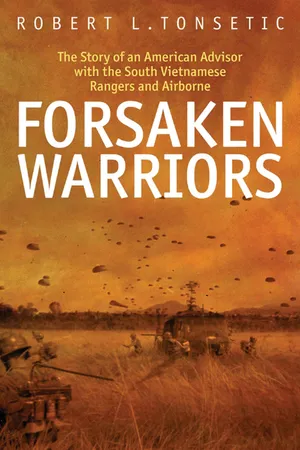
eBook - ePub
Forsaken Warriors
The Story of an American Advisor with the South Vietnamese Rangers and Airborne
- 256 pages
- English
- ePUB (mobile friendly)
- Available on iOS & Android
eBook - ePub
Forsaken Warriors
The Story of an American Advisor with the South Vietnamese Rangers and Airborne
About this book
Information
Topic
GeschichteSubtopic
Militärische BiographienCHAPTER 1
A FORTUNATE SON
Fort Benning, Georgia, 1969
Nine months earlier, I was living my dream. I’d had my fill of war in 1968 and never intended to return to Vietnam. The Army did not press the issue in my case. I was sent to Fort Benning near Columbus, Georgia, for the Infantry Officers Advanced Course in 1969. My course began in January of that year. That same month, American and North Vietnamese delegates squared off in Paris, arguing over the shape of the table to be used for their negotiations. It was also the month that Richard Nixon was inaugurated for his first term in office. I sat transfixed in front of my TV on 20 January, watching as 300–400 demonstrators hurled rocks and bottles at our new commander in chief’s limousine as it drove down Pennsylvania Avenue. We led a life sheltered from politics in Columbus. It was a typical southern army town that supported the military, and was proud to be “the home of the U.S. Army Infantry.”
On the same day that our course began, I submitted my application for a Regular Army commission. At the time, the Army had two main categories of professional officers: Regular Army and Reserve officers on indefinite active duty. West Point graduates were commissioned directly into the Regular Army, while most ROTC and OCS graduates were commissioned as Reserve officers. I was commissioned through the ROTC program at the University of Pittsburgh, and entered the Army with a Reserve commission. There were advantages and disadvantages to serving as a Regular. Regular Army officers usually received more consideration for career enhancing assignments and selection for attendance at Army schools, such as the Command and General Staff College and the Army War College.
Regular Army officers could also serve for 30 years before retirement, while Reserve officers usually served for 20 years. It was almost impossible for an officer to be promoted to full colonel or general officer in less than 20 years. However, Regular officers had to compete for promotion in two systems in order to remain on active duty. First, there was the Army of the United States (AUS) promotion system. All officers on active duty competed for promotion in this system. It was an “up or out” system, but each officer had two opportunities to compete for advancement to the next higher grade. Regular Army officers also had to compete for promotion before Regular Army promotion boards. Consideration came along only once for each rank. If a Regular officer was not selected for advancement to the next higher rank, the officer was forced to leave the Army. The only exception came at the rank of Regular Army major. Once an officer was promoted to this rank, he was tenured until retirement. Thus, it was sort of a double jeopardy system for Regulars. Since I planned to make the Army my career, I wanted to be a Regular Army officer. Why not “go for the gold,” I thought. As it turned out, I made the right decision. Ten thousand captains who held Reserve commissions were forced to leave the Army in the early 1970s as part of a Reduction in Force (RIF).
Along with 150 other captains, I sat through countless lectures on tactics, logistics, intelligence, and other military subjects that were meant to prepare us for future command and staff assignments. Surprisingly, the Army remained focused on a possible war with the Soviets in Europe throughout the Vietnam War. Most of the tactics instruction and map exercises were built around a European scenario, such as a defense of the Fulda Gap, with armor and mechanized infantry formations. Counter-insurgency warfare had a lower priority in the Infantry School’s Program of Instruction (POI) at that time. It was as if the Army had already written off the war in Vietnam, and was ready to take on the Red Army on the plains of Central Europe. Given the Soviet invasion of Czechoslovakia in August 1968, this line of thinking was not entirely out of touch with reality.
Every officer in the class had at least one tour in Vietnam under their belts, and that nine-month course was a breather. I lived in a nicely furnished, off-post apartment with all the amenities, including a swimming pool and clubhouse. Most of us frequented the Custer Terrance Officer’s Club at the end of each day’s instruction for happy hour. Friday night happy hours often lasted past midnight, and after that there was always a party at a classmate’s off-post apartment. As a 27-year-old bachelor, I was an eager participant in the social activities.
Weather permitting, I spent my weekends playing golf, lounging at the pool, and water skiing with a couple of buddies on the muddy Chattahoochee River. Other than a plethora of liquor stores, pawnshops, bars, and strip clubs that catered to drunken GIs, Columbus had little else to offer. For me, it was just a temporary stop leading to my next assignment.

When we submitted our assignment preferences—“dream sheets”—midway during the course, and I selected Germany as my first choice. I’d had my fill of Asia after a tour in Thailand and Vietnam, and I’d become ambivalent about the war. U.S. casualties continued to mount as the Paris peace talks dragged on. Moreover, I’d always dreamt of seeing Europe. Most of my buddies scoffed at me, believing that we were all headed back to Vietnam; they were about 98 percent correct.
A few days before we received our reassignment orders, we learned that Lieutenant William Calley was to be prosecuted for war crimes committed at My Lai. It was the worst stain on the Army’s reputation since the massacre of Native Americans at Wounded Knee. My Lai did irreparable harm to both the Army and the war effort.
I had absolutely no empathy for Calley, and was disgusted and abhorred by what happened there. Most of my classmates were of the same mind, with one possible exception: Captain Ernie Medina, Lieutenant Calley’s company commander. When Calley was charged, Medina dropped out of the course and retained F. Lee Bailey as his attorney.
I knew Ernie pretty well. In fact, we often sat next to each other during classes in Infantry Hall, and I was invited to Thanksgiving dinner at his family quarters. It was hard to believe that Ernie was involved in the massacre at My Lai, but he was in fact the company commander and senior officer on the ground. Captain Medina was eventually court-martialed, but not convicted. Nonetheless, realizing his career was over, he resigned his commission and left the Army. He later took a job at an aviation company owned by his lawyer, F. Lee Bailey.
The My Lai affair had badly tarnished the image of the Army, especially the officer corps, and I thought that was unfair, as did almost all of my contemporaries. During my tour with the 199th Infantry Brigade, we operated in the heavily populated III Corps area and came in contact with civilians on an almost daily basis. To my knowledge, there were no atrocities ever committed by members our brigade, and I’m sure that held true for the vast majority of U.S. units.
It was July, the same month that Neil Armstrong and “Buzz” Aldrin landed on the moon, when we received our orders for our follow-on tours. I was one of three officers in our class who received orders to Germany. Most everyone else was assigned to second, or in some cases third, tours in Vietnam. Needless to say, most of my buddies assumed I had friends in high places in the Army. They were wrong.
Actually, I received orders for Germany because I’d served back-to-back 12-month tours in Thailand and Vietnam, and apparently the Army thought that I needed a break. My Special Forces assignment in Thailand was not considered a combat tour, but the Army did consider it a hardship tour. In many ways it was a prequel to my Vietnam assignment, since it provided me with valuable experience in counter-insurgency warfare and training.
I deployed with Company D of the 1st Special Forces Group from Fort Bragg in October of 1966. The company was redesignated as the 46th Special Forces Company during my tour. In partnership with the Thai Special Forces, our detachments spread throughout the large country to quell a growing threat from Communist insurgents in the northeastern and southern regions of the country.
My “A” Detachment was part of Detachment B-430, commanded by Lieutenant Colonel Zoltan Kollat. In November of 1966, Detachment B-430 and its A Detachments made a parachute jump into southern Thailand to establish a counter-insurgency training camp about 12 miles from Trang. The camp that was built with the assistance of an Army engineer construction platoon was located about 60 air miles from the Malaysian border.
At the time, there was an on-going Communist Terrorist (CT) insurgency on both sides of the border. Along with our Thai Special Forces counterparts, we trained regular Thai Army units before they were sent after the elusive CT units that roamed the mountainous border area. Heavy emphasis was placed on live-fire training, so we built several quick-reaction type jungle ranges to support this training.
The U.S. ambassador at the time decreed that we could not carry our weapons, and we were ordered not to participate in combat operations. A Thai security platoon was assigned to protect the camp, but we had little confidence in them, so we worked out our own emergency defense plan. It is noteworthy that every Thai company we trained was later successful in tracking down Communist insurgents in the region. With the exception of one rather young CIA type and a few missionaries, we were the only Americans in southern Thailand.
Our B Detachment Camp was later named after one of our own, Sergeant First Class Billy Carrow, who died in an accidental shooting incident. Billy jumped with the 503d Parachute Regiment on Corregidor, “The Rock,” in 1945, during the liberation of the Philippines, and he was an irreverent character who looked like he just stepped out of a World War II Bill Mauldin cartoon. We all loved him.
We had more than one member of our Detachment who wore gold stars on their parachutist wings for WWII combat jumps. It was a very professional team. In early 1967, Lieutenant Colonel Kollat was assigned to lead a Task Force that would train the first Thai unit to deploy to Vietnam, the “Queen’s Cobras” Regiment. LTC Kollat, the Task Force Slick Commander, selected me to become a member of the Task Force Infantry Training Committee. The Regiment received its initial training at Chon Buri, south of Bangkok, and completed predeployment training at Kanchanaburi, the site of the famous Bridge over the River Kwai.
I did not accompany the Queen’s Cobras to Vietnam, opting instead for an assignment with the U.S. 199th Light Infantry Brigade in Vietnam. At that time, Special Forces was not a separate branch for officers, and in order to remain competitive for promotion, you had to have command assignments in regular infantry units.
Prior to my Vietnam assignment, I was provided an opportunity to complete a six-week course in jungle warfare at the British Jungle Warfare School in Malaysia. I had to get a civilian passport because the Malaysian government did not want it known that U.S. military personnel were being trained in their country, especially those who were headed for Vietnam.
I flew to Singapore and spent the night at the hotel Singapura, since the Raffles Hotel was out of my price range. The following day I took a taxi to the Malaysian border and entered the country. From the border, I took a bus to the school that was just outside Jahore Bahru. In order to keep a low profile, Americans attending the school were issued British field uniforms. That took some getting used to since the Brits wore woolen uniform shirts and heavy trousers, despite the fact that the school was only three degrees of latitude from the equator.
Cadre assigned to the school were from elite British regiments, such as the Parachute Regiment, the Special Air Services (SAS) Regiment, or one of the Gurka battalions. The officers and their sergeants had all seen action during the Malaysian insurgency, or in Borneo, where the Brits and Australians fought a bloody little war with Indonesian forces who were trying to seize control of the whole island.
The jungle warfare course was the best training experience I had as a junior officer, bar none. The only thing I didn’t like about the school was the dress code in the officers’ mess. The prescribed dress was dark civilian trousers, long-sleeve white shirt, and a necktie; a dinner jacket was optional. Tradition is important in the British Army, even in the tropics. On our free weekends, I played poker and made the rounds of the bars in Jahore Bahru with the British officers. It was an interesting experience, and I’ve been an anglophile ever since.
Frankfurt Germany, 1970
My assignment orders to Germany specified that I was to report to V Corps headquarters in Frankfurt on 10 January 1970. The orders also indicated that I was to attend the Army’s five-week Pathfinder Course at Fort Benning before heading for Europe. The Army’s Pathfinders parachuted in to mark drop zones for airborne drops by larger units on major airborne operations. They also organized helicopter landing zones, and served as air traffic controllers at forward Army airstrips. There was one catch: the highest rank in a Pathfinder Detachment at that time was a lieutenant. Perhaps the Army just wanted to keep me busy until my January reporting date in Germany. Nonetheless it was good training, and I learned a few things that came in handy later on. It also gave me the chance to make a few more parachute jumps.
After graduating from Pathfinder School, I spent two weeks in Pittsburgh with my family over Christmas before flying to Europe, where I spent the remainder of my leave in Paris and London. During those two weeks, I lived it up. I booked myself into the Paris Hilton near the base of the Eiffel Tower. The Hilton Hotel chain offered a 50 percent discount to military personnel. Quite a nice gesture I thought. During the day I toured the city, and at night I sampled the Paris nightlife, hitting the dives on Pigalle before taking in the late show at the Moulin Rouge.
The following week, I hopped a train that took me to Cherbourg, where I caught a ferry to Dover. It was January and the Channel was rough, but nevertheless I enjoyed the crossing. I arrived in London by train and took a taxi to the Hilton Hotel that overlooked Hyde Park. It was freezing cold and foggy during my week in London, but I had a blast blowing most of the money I’d saved while I was in Vietnam.
My assignment within V Corps was a disappointment because I thought that they would further assign me to one of its divisions, the 3d Infantry or the 8th Infantry—that’s where most infantry captains were assigned. Instead, the corps adjutant general assigned me to the G-3 Staff section of the V Corps headquarters. It was housed in Frankfurt’s I.G. Farbin building that served as General Eisenhower’s headquarters right after World War II. Later it became the headquarters of the U.S. V Corps.
The I.G. Farbin building is located in Frankfurt’s Westend Nord district, and it is one of the few buildings in the city that survived the intense Allied bombing raids during WWII. There were several other U.S. facilities located nearby, including a family housing area, PX, and bachelor officer quarters. As far as Frankfurt is concerned, the district surrounding the V Corps was one of the better areas of an otherwise drab city that reminded me more of New York than Germany.
Colonel Jack Gaustad, a crusty old Armor officer and World War II veteran, was the G-3. During my arrival interview with the colonel, he picked up immediately on the fact that I was a bachelor, and made a point of telling me that his daughter, who was attending college in the States, was going to spend the summer in Frankfurt. Nice, I thought, she must be a real loser if her father has to set her up with one of his bachelor officers. Well, as I found out later, I was dead wrong. The colonel’s daughter was a real knockout, but by that time I was in the process of leaving Germany.
Most of my abbreviated tour in Germany was spent shuffling papers in the I.G Farbin building. Since all the other officers in the G-3 section were majors or lieutenant colonels, I caught all the projects and duties no one else wanted. I worked force structure issues; prepared the FORSTAT readiness-briefing report; signed for all the G-3 vehicles and tents; and wrote the corps annual historical report. Instead of patrolling the Fulda Gap and training with the troops in the snow at Hohenfeld and Grafoenwoehr, I was stuck in Frankfurt, completely bored with the tedium of staff work.
Fortunately, I had an able assistant, Specialist Peter Flood, who could have done both our jobs standing on his head. Peter had a master’s degree from Columbia and had started his own movie company prior to being drafted. He actually sold a couple of his films to a major company. I was a bit surprised, however, when he walked into the office one day and said he needed a day off, as he was picking up his new Porsche that he’d purchased. When I queried him how he could afford it on a Specialist Fourth Class pay, he said he was paying cash for it. I was still making payments on a ‘69 Pontiac at the time. That’s what I liked about draftee army, it was an amazing mix of characters and ...
Table of contents
- Cover page
- Title Page
- Copyright
- Contents
- Dedication
- Introduction
- Prologue
- 1 A FORTUNATE SON
- 2 ASSIGNMENT: DELTA RANGERS
- 3 “MOUNTAINS WERE BROUGHT FORTH”
- 4 “GO TELL IT ON THE MOUNTAIN”
- 5 “DON’T LET THE SUN CATCH YOU CRYING”
- 6 “WE’VE ONLY JUST BEGUN”
- 7 “INTO THE FOREST PRIMEVAL”
- 8 “THE LONG AND WINDING ROAD”
- 9 “ANCHORS AWAY”
- 10 “JEREMIAH WAS A BULLFROG”
- 11 “INTO THE MIDST OF BATTLE”
- 12 “FIGHTING SOLDIERS FROM THE SKY”
- 13 CLOSING THE CIRCLE
- 14 REFLECTIONS
- Epilogue
- Glossary
- Notes
- Bibliography
Trusted by 375,005 students
Access to over 1.5 million titles for a fair monthly price.
Study more efficiently using our study tools.
Frequently asked questions
Yes, you can cancel anytime from the Subscription tab in your account settings on the Perlego website. Your subscription will stay active until the end of your current billing period. Learn how to cancel your subscription
No, books cannot be downloaded as external files, such as PDFs, for use outside of Perlego. However, you can download books within the Perlego app for offline reading on mobile or tablet. Learn how to download books offline
Perlego offers two plans: Essential and Complete
- Essential is ideal for learners and professionals who enjoy exploring a wide range of subjects. Access the Essential Library with 800,000+ trusted titles and best-sellers across business, personal growth, and the humanities. Includes unlimited reading time and Standard Read Aloud voice.
- Complete: Perfect for advanced learners and researchers needing full, unrestricted access. Unlock 1.5M+ books across hundreds of subjects, including academic and specialized titles. The Complete Plan also includes advanced features like Premium Read Aloud and Research Assistant.
We are an online textbook subscription service, where you can get access to an entire online library for less than the price of a single book per month. With over 1.5 million books across 990+ topics, we’ve got you covered! Learn about our mission
Look out for the read-aloud symbol on your next book to see if you can listen to it. The read-aloud tool reads text aloud for you, highlighting the text as it is being read. You can pause it, speed it up and slow it down. Learn more about Read Aloud
Yes! You can use the Perlego app on both iOS and Android devices to read anytime, anywhere — even offline. Perfect for commutes or when you’re on the go.
Please note we cannot support devices running on iOS 13 and Android 7 or earlier. Learn more about using the app
Please note we cannot support devices running on iOS 13 and Android 7 or earlier. Learn more about using the app
Yes, you can access Forsaken Warriors by Robert L. Tonsetic in PDF and/or ePUB format, as well as other popular books in Geschichte & Militärische Biographien. We have over 1.5 million books available in our catalogue for you to explore.