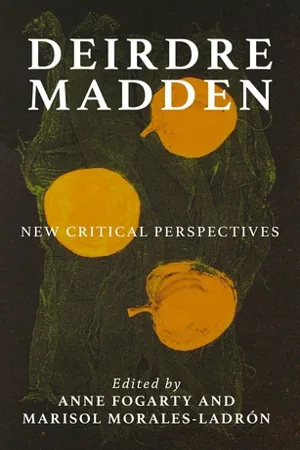
eBook - ePub
Deirdre Madden
New critical perspectives
- 264 pages
- English
- ePUB (mobile friendly)
- Available on iOS & Android
eBook - ePub
Deirdre Madden
New critical perspectives
About this book
The Irish writer, Deirdre Madden, has written key novels about the Northern Irish Troubles and about contemporary Ireland. In these works, she weighs up the aftermath of violence and the impact of the shift to a more open but materialist society in the country overall. Memory, trauma, and the abiding but elusive links between the past and the present are central concerns of her fiction. This pioneering set of essays by leading experts in Irish Studies explores the many dimensions of her novels from a wide variety of perspectives. Madden's skill at interweaving novels of ideas with artist novels that draw out the complex inner predicaments of her characters is highlighted. States of dislocation are concentrated on in her texts, but also the quest for a home in the world and a lasting set of values that allows for personal integrity and authenticity. These multifaceted explorations bear out the compelling and enduring aspects of Madden's highly regarded novels.
Information
Part I
Memory, trauma, and the Troubles
1
‘Images … at the absolute edge of memory’: memory and temporality in Hidden Symptoms, One by One in the Darkness, and Time Present and Time Past
Stefanie Lehner
As Helen Dunmore astutely observes in her review of Time Present and Time Past (2013), Deirdre Madden’s works ‘have long been saturated with ideas of memory’s relationship to time’ (Dunmore, 2013). Akin to T. S. Eliot, in the fragment from ‘Burnt Norton’ that Madden uses as the epigraph to this novel, her fiction offers ‘a world of speculation’ to explore memory’s relationship to the past and the present as well as the future:
Time present and time past
Are both perhaps present in time future,
And time future contained in time past. (Eliot, 1979: 13)
Her exploration of the impact of the past on the present is exemplified in her two ‘Troubles’ novels – Hidden Symptoms (1986) and One by One in the Darkness (1996) – both of which explore the haunting legacies of the Northern Irish political conflict on families and individuals and may be considered trauma narratives (Kennedy-Andrews, 2003: 145–61; Dawson, 2012: 139–58). However, memory and temporality are also major concerns of her last work, set at the height of the Celtic Tiger’s economic success, which is likewise imbued with a strong sense of the future. In all three novels, characters are faced with a past which intrudes into the present in quasi-traumatic form and has notable visual qualities. At the same time, the narrator drives these narratives forward and, especially in Time Present, towards the future. An apt correlative for the way in which the dialectic between the form and subject matter of these novels is captured by Madden in visual images is Walter Benjamin’s thought-image of the ‘Angel of History’, whose ‘face is turned towards the past’, while a storm ‘irresistibly propels him into the future to which his back is turned’. For Benjamin, ‘[t]his storm is what we call progress’ (Benjamin, 1999a: 249). Benjamin’s image constructs a notion of history ‘that looks backwards, rather than forward’, Susan Buck-Morss notes, which ‘provides dialectical contrast to the futurist myth of historical progress (which can be only sustained by forgetting what has happened)’ (Buck-Morss, 1989: 95).
Benjamin’s concern with the past is echoed in the focus on past memories in Madden’s work, which can be understood as part of a wider shift in the structure of Western understandings of temporality (see Huyssen, 2000: 21–38). Aleida Assmann suggests that this turn towards the past should be seen as a reaction to the modern ‘idea of irreversible progress and future-oriented action’ (Assmann, 2013: 43–4). In this regard, it is significant that the recent historical developments in both parts of Ireland, with which these three novels are concerned, have been repeatedly characterised as progress narratives: the Republic’s economic boom has been credited with ‘re-inventing’ the twenty-six counties, changing the country from an economic casualty to ‘a shining light and beacon to the world’ (Kirby et al., 2002; MacSharry and White, 2000: 360), whereas the Northern Irish Peace Process, in particular the signing of the 1998 Good Friday Agreement, was seen to herald ‘the end of a long, dark period in Irish history, and the beginning of something completely new’ (Ruane, 1999: 146). I want to suggest that there is thus a specific ethical impulse behind Madden’s exploration of temporalities and memory: the novels under consideration here create memory images that challenge or arrest the irreversible ‘storm of progress’, and thereby also the conventional narrative structure of chronological development, in a manner comparable to Benjamin’s notion of the ‘dialectical image’, ‘wherein what has been comes together in a flash with the now to form a constellation’ (Benjamin, 1999b: 463).
When confronted with the notion of ‘inexorable time’, the protagonist of Hidden Symptoms queries, ‘But what can we do?’ (Madden, 1986: 19). I propose that the memory images in Madden’s work stand as memorials against the act of forgetting and serve to reconcile the past with the present and future. Therein, they can be related to what Pierre Nora calls lieux de mémoire, sites of memory, that are characterised by ‘a will to remember’ (Nora, 1989: 19). In Family Frames, Marianne Hirsch relates the way in which Nora’s concept maps the spatiality of memory on to temporality, combining visual and verbal dimensions, to W. J. T. Mitchell’s notion of the ‘imagetext, a double-coded system of mental storage and retrieval’ (Hirsch, 1997: 22).1 I argue that Madden’s three novels stylistically compose such imagetexts, attesting to Benjamin’s notion that ‘history decays into images, not into stories’ (Benjamin, 1999b: 476). In these works, memories are embodied in physical spaces, especially domestic interiors, but most notably crystallise in images, in particular photographs, that are translated into ‘prose pictures’, above all in Time Present. Capturing the dialectic between presence and absence, photographs, as Hirsch suggests with reference to Roland Barthes’s theories, ‘affirm the past’s existence and, in their flat two-dimensionality, they signal its unbridgeable distance’ (Hirsch, 1997: 23).
In her lecture ‘Looking for Home’, Madden deploys spatial metaphors to describe her writing as an uncovering of images that are poised at the edge between memory and forgetting through an attentive process of listening and interpretation:
For me, writing is a way not just of getting at something, but of getting back to something. It is like images that play at the absolute edge of memory. It is like hearing someone speaking on the other side of a wall and listening carefully, trying to make out what is being said. (Madden, 2001: 30)
Madden admits the influence on her work of Marcel Proust, whom she calls ‘that great artist of time and memory’ (Madden, 2001: 32). Like Proust, she is aware that she cannot restore the past through what he calls intellect, but only glimpse it through instinct and imagination, which are often imbued with nostalgia and mourning. According to Svetlana Boym, nostalgia is not so much a longing for a past home, real or imaginary, but ‘actually a yearning for a different time – the time of our childhood, the slower rhythms of our dreams. In a broader sense, nostalgia is a rebellion against the modern idea of time, the time of history and progress’ (Boym, 2007: 7–8). For Aleida Assmann, nostalgia and trauma are two antithetical but related reasons ‘for the recent interest in the past and the various attempts to reinsert it into the present’ (Assmann, 2013: 53). Despite their differences, trauma and nostalgia are linked in representing problematic engagements with the past (Legg, 2004: 103), and, in their refusal to let the past be completely past, they combat the narrative of irreversible time and progress. This reading suggests that the memory images in Madden’s three works oscillate between the traumatic and the nostalgic, yet ultimately help to reconcile the past and the present.
Hidden Symptoms, like One by One, opens with memory images that are pervaded with a sense of ‘absolute loneliness’ (Madden, 1986: 33). Both works are concerned with how to cope with the haunting legacy of the recent loss of a close family member two years prior to the setting of the narrative; in Hidden Symptoms the trauma concerns the brutal sectarian murder of Theresa’s twin brother, Francis, while the latter deals with the assassination of the father of the Quinn siblings. Hidden Symptoms opens with Theresa’s childhood memory of ‘a Bavarian barometer’: ‘It was so sad that always when Hans was out Heidi was in and vice versa: never together, always alone, so near, so far, so lonely’ (Madden, 1986: 9). This image of isolation and loneliness comes to represent an ‘undeniable truth’ for her, cross-connecting her past, present, and future in anticipating her condition after her brother’s death (Madden, 1986: 10).
The novel centres on Theresa, who is currently studying English at Queen’s University, Belfast, and parallels her attempts to come to terms with her loss with those of her recent acquaintance, Robert, an English graduate and aspiring writer. Theresa and Robert lost their fathers when they were very young. While Robert has only very ‘faint’ memories of his, Theresa has recourse to ‘an eclectic array of photographs of her father’ (Madden, 1986: 38, 68). ‘A black-and-white photograph of her parents’ wedding’ only stresses for Theresa ‘how far in the past the event had been’, offering her ‘no satisfactory substitute for experience’ (Madden, 1986: 67, 68). This image of her parents’ past happiness does not allow her access to the past but, instead, affirms its irreversible pastness, as Barthes suggests: ‘Not only is the Photograph never, in essence, a memory … but it actually blocks memory, quickly becomes a counter-memory’ (Barthes, 2000: 91). But while photographs emphasise the irretrievability of the past, they also challenge that temporality by their capacity to ‘bring the past back in form of a ghostly revenant’, and to reaffirm the presence of what is now absent (Hirsch, 1997: 20). Her favourite picture of her father shows him ‘so young and happy, as unaware of death as he was of the eye of the camera’ (Madden, 1986: 68). Contemplating it, Theresa notices
a cigarette between his fingers; moments later he would have extinguished it … moving away from the moment of the photograph and towards his own death. … She would have given a year of her life to know the day and hour at which that photograph had been taken. She felt such knowledge would have given her the power to pluck and save her father from the flux of time. (Madden, 1986: 69)
The cigarette in the picture becomes a Barthesian punctum.2 What ‘pricks’ Theresa’s interest, in Barthes’s words, is not a mere affective detail of the photograph but time itself (Barthes, 2000: 96). Barthes’s experience of observing in a photograph of a young man, about to be hanged, ‘death in the future’ is echoed in Theresa’s reaction. Theresa’s desire ‘to pluck and save her father from the flux of time’ seeks to affirm the significance of this punctum, which, in combining the past and the future, challenges and, in a way, dialectically arrests the inexorable narrative of death. Invested with a ‘symbolic aura’, the photograph of her father becomes a lieu de mémoire, which functions for her as a means of blocking ‘the work of forgetting’ (Nora, 1989: 19). Theresa recognises that this desire to preserve memory against forgetting and annihilation also underpins her mother’s tendency to romanticise the past in her recollections of her honeymoon in Clifden (Madden, 1986: 70). This nostalgic yearning for a different era is, as Boym argues, also a refusal ‘to surrender to the irreversibility of time’ (Boym, 2007: 8) and the inexorable reality of death.
In the novel, Theresa is time and again both haunted and somewhat consoled by memories of her twin, Francis, in particular their trip to Italy two summers earlier. These recollections are often triggered by sensory stimuli, such as ‘the smell of sandalwood’ (Madden, 1986: 83), and take the form of quasi-Proustian mémoires involontaires. The immediacy and authenticity of these past memories are at one point expressed through the sudden switch to the present tense and a shift in narrative perspective to an omniscient, distant narrative voice notably different to the usual focalisation from the point of view of the main characters:
As one walks across St Peter’s Square in Rome, the four rows of Doric pillars which form Bernini’s Colonnade merge and shift so that they seem to increase then decrease in number and their colour changes from golden-grey to deepest black. There are, however, two small stones in the vast, cobbled square … and, when one stands upon these stones, all four rows fall into order, so that one sees only a row of pillars. (Madden, 1986: 52–3; my emphasis)
While this experience triggered theological reflections for Francis and Theresa, the description may also be read as a commentary on memory. As Theresa has experienced several times, there is a certain instability and indeterminacy about memories, which can change over time; for instance, when she recovered her ugly, old doll that she remembered as beautiful (Madden, 1986: 10), or when she realises that she has forgotten what her old school had really looked like (Madden, 1986: 23). However, from a certain (nostalgic) perspective, the different versions of the past may often merge into one overarching image, which, as Theresa knows from her mother’s nostalgic reconstructions, only offer a ‘partial’ truth (Madden, 1986: 70).3
Nonetheless, some of her other memory images are able to fuse ‘the past and the present’ and make them into ‘a timeless perfection’, in a manner that seems to provide an auratic experience of time itself. This is the case when Theresa remembers her experience of St Mark’s Square in Venice, where she was to meet Francis (Madden, 1986: 85). Theresa’s recollection fuses the more distant and the recent past, zooming in on Francis’s face. Her experience evokes Benjamin’s notion of the aura as ‘a strange weave of space and time: the unique appearance or semblance of a distance, no matter how close it may be’ (Benjamin, 2005: 518). For Benjamin, the human face in photographs is the last residuum of the aura. As Kathrin Yacavone notes, it is through his emphasis on ‘the viewer’s relation to the … referent’ that the aura becomes bound to what Benjamin describes as the ‘cult of remembrance of dead or absent loved ones’ (Yacavone, 2012: 67; Benjamin, 2003: 258). Similar to the conjuring up of the barometer at the beginning of the novel, Theresa’s memory image fuses different emotions about time, merging past(s) with the present as well as anticipating her condition, when she is confronted with the loss of her brother, in the future perfect:
As she watched him move across the damp marble towards her, she felt a sweep of love which was the sole complement to the loneliness she would feel before the statue in Rome, and this loneliness and love would be fused together in the black moment of grief when she learnt he was dead. (Madden, 1986: 85)
These memories stand as memorials to Francis and allow Theresa to challenge the irreversible, inexorable passage of time imposed by the narrative that, despite these recurrent flashbacks, propels itself forward in time: in a way, her memories ‘do’ something, namely they preserve the love she feels for him, protecting it from danger and her own ‘capacity for fo...
Table of contents
- Cover
- Half-Title
- Title
- Copyright
- Contents
- List of contributors
- Preface: Deirdre Madden: a jagged symmetry
- Acknowledgements
- Introduction
- Part I Memory, trauma, and the Troubles
- Part II Art and objects
- Part III Home and place
- Bibliography
- Index
Trusted by 375,005 students
Access to over 1.5 million titles for a fair monthly price.
Study more efficiently using our study tools.
Frequently asked questions
Yes, you can cancel anytime from the Subscription tab in your account settings on the Perlego website. Your subscription will stay active until the end of your current billing period. Learn how to cancel your subscription
No, books cannot be downloaded as external files, such as PDFs, for use outside of Perlego. However, you can download books within the Perlego app for offline reading on mobile or tablet. Learn how to download books offline
Perlego offers two plans: Essential and Complete
- Essential is ideal for learners and professionals who enjoy exploring a wide range of subjects. Access the Essential Library with 800,000+ trusted titles and best-sellers across business, personal growth, and the humanities. Includes unlimited reading time and Standard Read Aloud voice.
- Complete: Perfect for advanced learners and researchers needing full, unrestricted access. Unlock 1.5M+ books across hundreds of subjects, including academic and specialized titles. The Complete Plan also includes advanced features like Premium Read Aloud and Research Assistant.
We are an online textbook subscription service, where you can get access to an entire online library for less than the price of a single book per month. With over 1.5 million books across 990+ topics, we’ve got you covered! Learn about our mission
Look out for the read-aloud symbol on your next book to see if you can listen to it. The read-aloud tool reads text aloud for you, highlighting the text as it is being read. You can pause it, speed it up and slow it down. Learn more about Read Aloud
Yes! You can use the Perlego app on both iOS and Android devices to read anytime, anywhere — even offline. Perfect for commutes or when you’re on the go.
Please note we cannot support devices running on iOS 13 and Android 7 or earlier. Learn more about using the app
Please note we cannot support devices running on iOS 13 and Android 7 or earlier. Learn more about using the app
Yes, you can access Deirdre Madden by Anne Fogarty, Marisol Morales-Ladrón, Anne Fogarty,Marisol Morales-Ladrón in PDF and/or ePUB format, as well as other popular books in Literature & English Literary Criticism. We have over 1.5 million books available in our catalogue for you to explore.