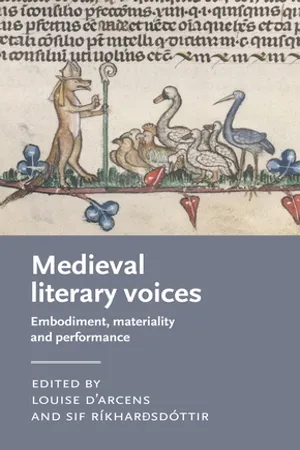
eBook - ePub
Medieval literary voices
Embodiment, materiality and performance
- 302 pages
- English
- ePUB (mobile friendly)
- Available on iOS & Android
eBook - ePub
Medieval literary voices
Embodiment, materiality and performance
About this book
Voice is a fleeting physical phenomenon that leaves behind traces of its existence. Medieval literary voices offers a wide-reaching approach to the concept of literary voices, both the vanished authorial ones and the implicit textual ones. Its impressive lineup deepens our understanding of how literary voices evoke the elusive voices lurking beyond the text, capturing the absent authorial voice, the traces of scribal voices and the soundscape of the uttered text. It explores multiple dimensions of medieval voice and vocalisations, and the interactions between literary voices and their authorial, scribal and socio-political settings. It contends that through the theorizing of literary voices we can begin to understand the ways in which medieval voices mediate or proclaim an embodied selfhood or material presence, how they dictate or contest moral conventions, and how they create and sustain narrative soundscapes.
Information
1
Articulate voices
Ruth Evans*
My Voice, My Rights, My Freedom, My Life.
‘I can’t breathe.’
‘Poetry has its roots in human breath and what would become of us if this breath diminished?’
Giorgos Seferis1
When we think of racial difference today, we think of visual markers: skin colour, facial features, eye colour, hair. But race is also something that we hear. As the musicologist Nina Sun Eidsheim observes, if the colour of one’s skin is a visible marker of race, ‘voice is equally objectified, entrained, and used as a “measure” of race’.2 When the co-prosecutor in the 1995 O. J. Simpson murder trial asked a witness ‘The second voice that you heard sounded like the voice of a black man; is that correct?’, the assumption behind his question was that all African American voices possess a unique vocal quality.3 That question, as Eidsheim notes, rests on two further assumptions, namely that racial – and gendered – identity is essential and inherent, and that this identity is expressed in the voice. Drawing on the insights of the French composer Pierre Schaeffer, Eidsheim argues that the question ‘Who, or what, made that sound?’ assumes that listeners hear voices in terms of ‘preconceived essence and meaning’.4 Schaeffer turns that question – ‘Who, or what, made that sound?’ – back on the listener to ask what he calls ‘the acousmatic question’. Referring to the Larousse dictionary definition of an ‘acousmatic’ sound as ‘un bruit que l’on entend sans voir les causes dont il provient’ (‘a sound that one hears without seeing the causes behind it’), Schaeffer asks listeners to disregard the source and intentions of a musical sound and to analyse only ‘the perceptual reality’ of that sound.5
For Eidsheim, the acousmatic question – not ‘Who made that sound?’ but ‘What do I hear?’ – asks us to be aware of our propensity to hear race as an essence in Black voices and thus to fail to recognise that the distinctive tonality, pitch and timbre of those voices is not an essence but the product of specific histories and experiences: ‘enculturation, technique and style, and an infinity of unrealized manifestations’.6 What we hear is an effect of our preconceptions. We racialise Black voices.
In this chapter I argue that the racialisation of voices has a long history, which can be traced back to antiquity and the European Middle Ages and which still shapes the way that we hear a supposed ‘essence’ of race in voices today. By ‘racialisation’ I mean those practices and processes of race-making that belong to a time before the ‘invention’ of race as a concept and through which, in Geraldine Heng’s words, ‘essentialisms are posited and assigned … so as to construct a hierarchy of peoples for differential treatment’.7 Heng argues that by intentionally deploying the vocabulary of ‘race’ before the invention of race we will be able to bear witness to ‘the impacts and consequences of certain laws, acts, practices and institutions in the medieval period’ that would not otherwise be recognised as part of the history of race and racism.8 But I include more than the sound of race in that history. Judgements about whether a voice sounds ‘like the voice of a black man’ are also aesthetic judgements. At the end of this chapter I ask what it means to put race and poetics together at a moment in US history when Black people are struggling to breathe or are dying because the breath has been choked out of them.9
Heng’s metaphor – ‘the invention of race’ – turns on the double meaning of ‘invention’ that was common in medieval Latin and European vernaculars, as well as in antique and premodern rhetorical theory, namely the finding of something (an object; material for the composition of a text) and the act of reinvention that transforms that material into something new.10 The fifteenth-century poet John Lydgate, for example, remarked on the pleasure that poets take in ‘this the sotil fourme [skilful manner], / Be [By] newe invencioun thynges to transfourme’.11 Poetic creation is not ex nihilo but is combinatory. It takes things that are known and turns them into a new object. Rhetorical invention traces a paradoxical movement of finding and repurposing, a movement that works both backwards and forwards in time. If the past furnishes material for the present, then the past is always in some sense intelligible to, and contemporaneous with, the present. Yet the transformational nature of invention means that neither the past nor the present is identical to each other or to themselves. Heng says that ‘the story of race … re-begins again and again’, as if that story were condemned to repeat itself in the same way that trauma repeats the past, but the repeated history of race does not mean that scholars today must always repeat the same story about it.12
One way to change that story is for academics to attune themselves to race’s social and institutional forms. Wan-Chuan Kao has recently called for white scholars in the field of medieval studies to ‘recognize’ medievalists of colour, intellectually, culturally and professionally – that is, to acknowledge them and their work, to cite them, to centre them, to honour them. He has also called for ‘a practice of … attunement that moves us from fragility to engagement, intention to investment, and identity to action’.13 Kao’s call to move the field in a direction that is ‘attuned’ to race is by no means an exclusively US issue. Britons played a major part in the history of US racism and are only now beginning in appreciable numbers to come to terms with their involvement in that history. As the US historian Annette Gordon-Reed observes, ‘American-style racism has a British pedigree’, one based in ‘English attitudes to race, particularly the negative views about blackness that Englishmen brought with them when they crossed the Atlantic to the New World’.14 Although I am still learning what it means to practise ‘a scholarship or pedagogy of recognition’ that does not replicate, in Kao’s words, ‘the blind spots’ of the past – the ‘governance of difference’, the political and institutional failure to address structures of inequality – I want to suggest that Schaeffer’s acousmatic question, which Eidsheim inflects in relation to Black voices, might be a metaphor for practising a pedagogy of recognition and attunement. When we hear race in Black voices as an essence, we either tune out the individual history and culture of Black people, or we tune them in only to misrecognise them as cultural stereotypes. The acousmatic question demands a listening that is engaged and intentional. It asks white people to listen better.
The racialisation of voices precedes the invention of race in the fifteenth century.15 The most salient form of that racialisation within late medieval western Europe is the characterisation by Christians of the voices of non-Christian peoples as inarticulate, and the comparison of their voices to those of nonhuman animals.16 The Dominican friar Simon of Saint-Quentin, a white, European Christian who accompanied Ascelin of Lombardy’s mission to the Mongol (Tatar) empire in central Asia in 1247 and who wrote an eyewitness account of that mission, compared the voices of non-Christian Mongols to the voices of bulls and wolves: ‘The Tartars [sic] speak in an argumentative and noisy manner from a fierce and horrible gullet; singing they bellow like bulls or howl like wolves, issuing forth inarticulate vocalisations in their singing.’17 As the musicologist Justin Stoessel notes, Simon’s dehumanising rhetoric is an instance of the ‘discourse of animality’, Cary Wolfe’s term for ‘the use of that constellation of signifiers to structure how we address others of whatever sort (not just nonhuman animals) … [which] has historically served as a crucial strategy in the oppression of humans by other humans – a strategy whose legitimacy and force depend, however, on the prior taking for granted of the traditional ontological distinction, and consequent ethical divide, between human and nonhuman animals’.18 In medieval Christendom, the discourse of animality operated as a racialising strategy, seeking (in Stoessel’s words) ‘through a process of alienation to define morally or theologically the Latin West’s place in the world’ – that is, its pre-eminent place.19 Mel Chen addresses the racialising process within this discourse more directly than Wolfe, borrowing and adapting a linguistic term of ‘political grammar’ called an ‘animacy hierarchy’, a model that ‘conceptually arranges human life, disabled life, animal life, plant life, and forms of nonliving material in orders of value and priority’.20 Chen is concerned with the degrees of ‘liveness’ that these categories may be said to display, but uses ‘animacy’ rather than ‘life’, not only in order to undo binaries but also to trouble the distinctions between perceived degrees of animacy/intimacy within the genus homo, distinctions that sort human subjects into the human and the less than human.
As Stoessel notes, Simon of Saint-Quentin’s characterisation of the voices of his Tatar hosts as ‘inarticulate vocalisations’ had a precise meaning in thirteenth-century Latin Europe, one derived from the definitions of spoken utterances by late antique grammarians, including Donatus (fl. mid-fourth century CE) and Priscian (fl. 500 CE), who was, incidentally, from Caesarea, a Roman colony in Roman-Berber north Africa, now modern Algeria.21 In his taxonomy of vocal utterances (voces), Priscian sorts those vocalisations into a fourfold hierarchy according to their intelligibility: vox articulata (articul...
Table of contents
- Cover
- Half Title
- Series Information
- Title Page
- Copyright Page
- Dedication
- Contents
- List of figures and tables
- List of contributors
- Preface
- List of abbreviations
- Introduction
- 1 Articulate voices
- Part I: Narrative embodiment and voicing
- Part II: Authoritative, ethical and orthodox voices
- Part III: Materiality and textual voices
- Part IV: Performative voices and medieval aurality
- Afterword: medieval voice – a tribute to David Lawton
- Bibliography
- Index
Trusted by 375,005 students
Access to over 1.5 million titles for a fair monthly price.
Study more efficiently using our study tools.
Frequently asked questions
Yes, you can cancel anytime from the Subscription tab in your account settings on the Perlego website. Your subscription will stay active until the end of your current billing period. Learn how to cancel your subscription
No, books cannot be downloaded as external files, such as PDFs, for use outside of Perlego. However, you can download books within the Perlego app for offline reading on mobile or tablet. Learn how to download books offline
Perlego offers two plans: Essential and Complete
- Essential is ideal for learners and professionals who enjoy exploring a wide range of subjects. Access the Essential Library with 800,000+ trusted titles and best-sellers across business, personal growth, and the humanities. Includes unlimited reading time and Standard Read Aloud voice.
- Complete: Perfect for advanced learners and researchers needing full, unrestricted access. Unlock 1.5M+ books across hundreds of subjects, including academic and specialized titles. The Complete Plan also includes advanced features like Premium Read Aloud and Research Assistant.
We are an online textbook subscription service, where you can get access to an entire online library for less than the price of a single book per month. With over 1.5 million books across 990+ topics, we’ve got you covered! Learn about our mission
Look out for the read-aloud symbol on your next book to see if you can listen to it. The read-aloud tool reads text aloud for you, highlighting the text as it is being read. You can pause it, speed it up and slow it down. Learn more about Read Aloud
Yes! You can use the Perlego app on both iOS and Android devices to read anytime, anywhere — even offline. Perfect for commutes or when you’re on the go.
Please note we cannot support devices running on iOS 13 and Android 7 or earlier. Learn more about using the app
Please note we cannot support devices running on iOS 13 and Android 7 or earlier. Learn more about using the app
Yes, you can access Medieval literary voices by Louise D'Arcens, Sif Ríkharðsdóttir, Louise D'Arcens,Sif Ríkharðsdóttir,Louise D’Arcens in PDF and/or ePUB format, as well as other popular books in Literature & European Medieval History. We have over 1.5 million books available in our catalogue for you to explore.