A romantic melodrama set in rural Ireland in the early 19th century, this complex story of love, rivalry, secrecy, and betrayal, based on a real case of 1829, was one of the most successful thrillers of its day
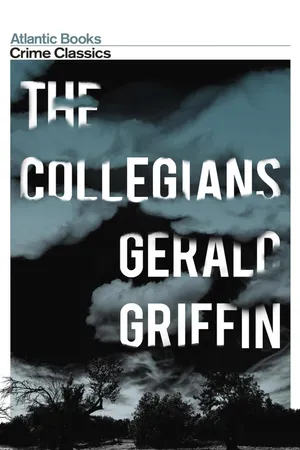
Young Hardress Cregan is a collegian and a rogue, with a wicked, roving eye. Although he is courting his wealthy cousin Anne, he has also embarked on a passionate love affair with the lowly—but very beautiful—Eily O'Connor. Hardress knows that his family would never approve of this match and he should abandon his new fancy, but his lust overwhelms his conscience and he embarks on a fatal deception—secretly marrying Eily, while succumbing to his mother's machinations and becoming engaged to Anne. How will Hardress extricate himself from this dilemma? Together with his hunchback half-brother, Danny Mann, he hatches a deadly conspiracy. Originally published in 1829, and inspired by a celebrated criminal case, this novel was a sensation in its day, making Killarney a tourist attraction, and its thrilling plot—involving love, rivalry, secrecy, and betrayal—inspiring many imitations.
- 480 pages
- English
- ePUB (mobile friendly)
- Available on iOS & Android
eBook - ePub
The Collegians
About this book
Trusted by 375,005 students
Access to over 1.5 million titles for a fair monthly price.
Study more efficiently using our study tools.
Information
Contents
1. | How Garryowen Rose, and How it Fell |
2. | How Eily O’Connor Puzzled All the Inhabitants of Garryowen |
3. | How Mr Daly the Middleman Sat Down to Breakfast |
4. | How Mr Daly the Middleman Rose Up from Breakfast |
5. | How Kyrle Daly Rode Out to Woo, and How Lowry Looby Told Him Some Stories on the Way |
6. | How Kyrle Daly was More Puzzled by a Piece of Paper, than the Abolishers of the Small-note Currency Themselves |
7. | How Kyrle Daly Discovers That All the Sorrow Under the Sun Does Not Rest Upon His Shoulders Alone |
8. | How the Reader, Contrary to the Declared Intention of the Historian, Obtains a Description of Castle Chute |
9. | How Myles Murphy is Heard on Behalf of His Ponies |
10. | How Kyrle Daly Sped in His Wooing |
11. | How Kyrle Daly Has the Good Luck to See a Staggeen-Race |
12. | How Fortune Brings Two Old Friends Together |
13. | How the Two Friends Hold a Longer Conversation Together than the Reader May Probably Approve |
14. | How Lowry Becomes Philosophical |
15. | How Hardress Spent His Time While Kyrle Daly was Asleep |
16. | How the Friends Parted |
17. | How Hardress Learned a Little Secret from a Dying Huntsman |
18. | How the Gentlemen Spent the Evening, Which Proved Rather Warmer than Hardress Expected |
19. | How Hardress Met an Old Friend and Made a New One |
20. | How Hardress Had a Strange Dream of Eily |
21. | How Hardress Met a Strange Trial |
22. | How the Temptation of Hardress Proceeded |
23. | How an Unexpected Visitor Arrived in Eily’s Cottage |
24. | How Eily Undertakes a Journey in the Absence of Her Husband |
25. | How Eily Fared in her Expedition |
26. | How Hardress Consoled Himself During His Separation from Eily |
27. | How Hardress Answered the Letter of Eily |
28. | How the Little Lord Put His Master’s Wishes into Action |
29. | How Hardress Lost an Old Acquaintance |
30. | How Hardress Got His Hair Dressed in Listowel, and Heard a Little News |
31. | How Kyrle Daly Hears of the Handsome Conduct of his Friend Hardress |
32. | How Kyrle Daly’s Warlike Ardour was Checked by an Untoward Incident |
33. | How Hardress Met a Friend of Eily’s at the Wake |
34. | How the Wake Concluded |
35. | How Hardress at Length Received Some News of Eily |
36. | How Hardress Made a Confidant |
37. | How Hardress Found that Conscience is the Sworn Foe of Valour |
38. | How the Situation of Hardress Became More Critical |
39. | How the Danger to the Secret of Hardress was Averted by the Ingenuity of Irish Witnesses |
40. | How Hardress Took a Decisive Step for His Own Security |
41. | How the Ill-Temper of Hardress Again Brought Back His Perils |
42. | How Mr Warner Was Fortunate Enough to Find a Man That Could and Would Speak English |
43. | How the Bride was Startled by an Unexpected Guest |
44. | How More Guests Appeared at the Wedding Than Had Been Invited |
45. | How the Story Ended |
Case Notes | |
Chapter 1

How Garryowen Rose, and How it Fell
THE little ruined outlet, which gives its name to one of the most popular national songs of Erin, is situate on the acclivity of a hill near the city of Limerick, commanding a not uninteresting view of that fine old town, with the noble stream that washes its battered towers, and a richly cultivated surrounding country. Tradition has preserved the occasion of its celebrity, and the origin of its name, which appears to be compounded of two Irish words signifying ‘Owen’s garden.’ A person so called was the owner, about half a century since, of a cottage and plot of ground on this spot, which from its contiguity to the town, became a favourite holiday resort with the young citizens of both sexes – a lounge presenting accommodations somewhat similar to those which are offered to the London mechanic by the Battersea tea-gardens. Owen’s garden was the general rendezvous for those who sought for simple amusement or for dissipation. The old people drank together under the shade of trees – the young played at ball, goal, or other athletic exercises on the green; while a few lingering by the hedge-rows with their fair acquaintances, cheating the time with sounds less boisterous, indeed, but yet possessing their fascination also.
The festivities of our fathers, however, were frequently distinguished by so fierce a character of mirth, that, for any difference in the result of their convivial meetings, they might as well have been pitched encounters. Owen’s garden was soon as famous for scenes of strife, as it was for mirth and humour; and broken heads became a staple article of manufacture in the neighbourhood.
This new feature in the diversions of the place, was encouraged by a number of young persons of a rank somewhat superior to that of the usual frequenters of the garden. They were the sons of the more respectable citizens, the merchants and wholesale traders of the city, just turned loose from school with a greater supply of animal spirits than they had wisdom to govern. Those young gentlemen, being fond of wit, amused themselves by forming parties at night, to wring the heads off all the geese, and the knockers off all the hall doors in the neighbourhood. They sometimes suffered their genius to soar as high as the breaking of a lamp, and even the demolition of a watchman; but perhaps this species of joking was found a little too serious to be repeated over frequently, for few achievements of so daring a violence are found amongst their records. They were obliged to content themselves with the less ambitious distinction of destroying the knockers and store-locks, annoying the peaceable inmates of the neighbouring houses with long continued assaults on the front doors, terrifying the quiet passengers with every species of insult and provocation, and indulging their fratricidal propensities against all the geese in Garryowen.
The fame of the ‘Garryowen boys’ soon spread far and wide. Their deeds were celebrated by some inglorious minstrel of the day in that air which has since resounded over every quarter of the world; and even disputed the palm of national popularity with ‘Patrick’s day.’ A string of jolly verses were appended to the tune which soon enjoyed a notoriety similar to that of the famous ‘Lilli-burlero, bullen-a-la’ which sung King James out of his three kingdoms. The name of Garryowen was as well known as that of the Irish Numantium, Limerick, itself, and Owen’s little garden became almost a synonym for Ireland.
But that principle of existence which assigns to the life of man its periods of youth, maturity, and decay, has its analogy in the fate of villages, as in that of empires. Assyria fell, and so did Garryowen! Rome had its decline, and Garryowen was not immortal. Both are now an idle sound, with nothing but the recollections of old tradition to invest them with an interest. The still notorious suburb is little better than a heap of rubbish, where a number of smoked and mouldering walls, standing out from the masses of stone and mortar, indicate the position of a once populous row of dwelling houses. A few roofs yet remain unshaken, under which some impoverished families endeavour to work out a wretched subsistence by maintaining a species of huckster trade, by cobbling old shoes, and manufacturing ropes. A small rookery wearies the ears of the inhabitants at one end of the outlet, and a rope-walk which extends along the adjacent slope of Gallows Green (so called for certain reasons) brings to the mind of the conscious spectator associations that are not calculated to enliven the prospect. Neither is he thrown into a more jocular frame of mind as he picks his steps over the insulated paving stones that appear amid the green slough with which the street is deluged, and encounters at the other end an alley of coffin-makers’ shops, with a fever hospital on one side, and a churchyard on the other. A person who was bent on a journey to the other world could not desire a more expeditious outfit than Garryowen could now afford him: nor a more commodious choice of conveyances, from the machine on the slope above glanced at, to the pest-house at the farther end.
But it is ill talking lightly on a serious subject. The days of Garryowen are gone, like those of ancient Erin; and the feats of her once formidable heroes are nothing more than a winter’s evening tale. Owen is in his grave, and his garden looks dreary as a ruined church-yard. The greater number of his merry customers have followed him to a narrower play-ground, which, though not less crowded, affords less room for fun, and less opportunity for contention. The worm is here the reveller, the owl whoops out his defiance without an answer (save the echo’s), the best whiskey in Munster would not now ‘drive the cold out of their hearts;’ and the withered old sexton is able to knock the bravest of them over the pate with impunity. A few perhaps may still remain to look back with a fond shame to the scene of their early follies, and to smile at the page in which those follies are recorded.
Still, however, there is something to keep the memory alive of those unruly days, and to preserve the name of Garryowen from utter extinction. The annual fair which is held on the spot presents a spectacle of gaiety and uproar which might rival its most boisterous days; and strangers still enquire for the place with a curiosity which its appearance seldom fails to disappoint. Our national lyrist has immortalized the air by adapting to it one of the liveliest of his melodies; the adventures, of which it was once the scene, constitute a fund of standing joke and anecdote which are not neglected by the neighbouring story-tellers; and a rough voice may still occasionally be heard by the traveller who passes near its ruined dwellings at evening, to chaunt a stanza of the chorus which was once in the mouth of every individual in the kingdom: –
‘’Tis there we’ll drink the nut-brown ale
An pay the reck’nin’ on the nail
No man for debt shall go to jail
From Garryowen a gloria.’
Chapter 2
How Eily O’Connor Puzzled All the Inhabitants of Garryowen
BUT while Owen lived, and while his garden flourished, he and his neighbours were as merry together as if death could never reach the one, nor desolation waste the other. Among those frequenters of his little retreat whom he distinguished with an especial favour and attention, the foremost was the handsome daughter of an old man who conducted the business of a rope-walk in his neighbourhood, and who was accustomed on a fine Saturday evening to sit under the shade of a yellow osier that stood by his door, and discourse of the politics of the day – of Lord Halifax’s administration – of the promising young patriot Mr Henry Grattan – and of the famous Catholic concession of 1773. Owen, like all Irishmen, even of the humblest rank, was an acute critic in female proportions, and although time had blown away the thatching from his head, and by far the greater portion of blood that remained in his frame had colonized about his nose, yet the manner in which he held forth on the praises of his old friend’s daughter was such as put to shame her younger and less eloquent admirers. It is true, indeed, that the origin of the suburban beauty was one which, in a troubled country like Ireland, had little of agreeable association to recommend it; but few even of those to whom twisted hemp was an object of secret terror, could look on the exquisitely beautiful face of Eily O’Connor, and remember that she was a rope-maker’s daughter; few could detect beneath the timid, hesitating, downcast gentleness of manner, which shed an interest over all her motions, the traces of a harsh and vulgar education. It was true that she sometimes purloined a final letter from the King’s adjectives, and prolonged the utterance of a vowel beyond the term of prosodaical orthodoxy, but the tongue that did so seemed to move on silver wires, and the lip on which the sound delayed
‘long murmuring, loth to part’
imparted to its own accents an association of sweetness and grace that made the defect an additional allurement. Her education in the outskirts of a city had not impaired the natural tenderness of her character; for her father, who all rude as he was, knew how to value his daughter’s softness of mind, endeavoured to foster it by every indulgence in his power. Her uncle, too, who was now a country parish priest, was well qualified to draw forth any natural talent with which she had been originally endowed. He had completed his theological education in the famous university of Salamanca, where he was distinguished as a youth of much quietness of temper and literary application, rather than as one of those furious gesticulators, those ‘figures Hibernoises,’ amongst whom Gil Blas, in his fit of logical lunacy, could meet his only equals. At his little lodging, while he was yet a curate at St John’s, Eily O’Connor was accustomed to spend a considerable portion of her time, and in return for her kindness in presiding at his simple tea-table, Father Edward undertook to bestow a degree of attention on her education, which rendered her, in a little time, as superior in knowledge as she was in beauty to her female associates. She was remarked likewise at this time as a little devotee, very regular in her attendance at chapel, constant in all the observances of her religion, and grave in her attire and discourse. On the coldest and dreariest morning in winter, she might be seen gliding along by the unopened shop-windows to the nearest chapel, where she was accustomed to hear an early mass, and return in time to set everything in order for her father’s breakfas...
Table of contents
- Cover
- Half-title Page
- Other titles in the Crime Classics series
- Title Page
- Contents
Frequently asked questions
Yes, you can cancel anytime from the Subscription tab in your account settings on the Perlego website. Your subscription will stay active until the end of your current billing period. Learn how to cancel your subscription
No, books cannot be downloaded as external files, such as PDFs, for use outside of Perlego. However, you can download books within the Perlego app for offline reading on mobile or tablet. Learn how to download books offline
Perlego offers two plans: Essential and Complete
- Essential is ideal for learners and professionals who enjoy exploring a wide range of subjects. Access the Essential Library with 800,000+ trusted titles and best-sellers across business, personal growth, and the humanities. Includes unlimited reading time and Standard Read Aloud voice.
- Complete: Perfect for advanced learners and researchers needing full, unrestricted access. Unlock 1.5M+ books across hundreds of subjects, including academic and specialized titles. The Complete Plan also includes advanced features like Premium Read Aloud and Research Assistant.
We are an online textbook subscription service, where you can get access to an entire online library for less than the price of a single book per month. With over 1.5 million books across 990+ topics, we’ve got you covered! Learn about our mission
Look out for the read-aloud symbol on your next book to see if you can listen to it. The read-aloud tool reads text aloud for you, highlighting the text as it is being read. You can pause it, speed it up and slow it down. Learn more about Read Aloud
Yes! You can use the Perlego app on both iOS and Android devices to read anytime, anywhere — even offline. Perfect for commutes or when you’re on the go.
Please note we cannot support devices running on iOS 13 and Android 7 or earlier. Learn more about using the app
Please note we cannot support devices running on iOS 13 and Android 7 or earlier. Learn more about using the app
Yes, you can access The Collegians by Gerald Griffin in PDF and/or ePUB format, as well as other popular books in Literature & Classics. We have over 1.5 million books available in our catalogue for you to explore.