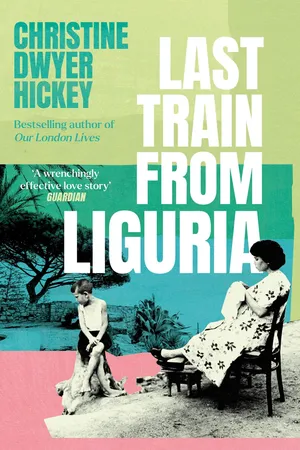
In 1933, Bella Stuart leaves her quiet London life to move to Italy to tutor the child of a beautiful Jewish heiress and an elderly Italian aristocrat. Living at the family's summer home, Bella's reserve softens as she comes to love her young charge, and find friendship with Maestro Edward, his enigmatic music teacher.
But as the decade draws to an end and fascism tightens its grip on Europe, the fact that Alec is Jewish places his life in grave danger. Bella and Edward take the boy on a terrifying train journey out of Italy - one they have no reason to believe any of them will survive...
- English
- ePUB (mobile friendly)
- Available on iOS & Android
eBook - ePub
Last Train from Liguria
About this book
Information
Contents
PART ONE: Edward
DUBLIN, 1924 - August
Bella
GENOA, 1933 - June
SICILY, 1933
Edward
BORDIGHERA, 1933 June
PART TWO: Anna
DUBLIN, 1995 - April
PART THREE: Bella
BORDIGHERA, 1933 - July
PART FOUR: Anna
DUBLIN, 1995 - May
PART FIVE: Bella
BORDIGHERA, 1936 - May–October
PART SIX: Anna
DUBLIN, 1995 - June
PART SEVEN: Bella
BORDIGHERA, 1938 - September
LONDON
DUBLIN, 1940 - June
Edward’s Letter
PART EIGHT: Anna
1995 - August
PART ONE

Edward
DUBLIN, 1924
August
EVEN BEFORE I CAME to my senses, I knew my sister was dead. In there, face down on the sawdust, behind the back bar counter. I was out here meanwhile at the bottom of the stairs, passed out on a mangy carpet. Our father’s house. At least, this time, I knew where I was.
The carpet – piss, grease and stale ale – had been luring me home with its stench and after a while I persuaded myself to open my eyes. Into the darkness and the ticking of a distant clock, I managed to haul myself onto my feet. Remarkably steady. I noticed this immediately, how steady I was on my pins. And no hangover. Where was my hangover?
I tried to remember. For a long time nothing. Then the sound of a pot-boy wandered into my memory. Banging on the door of some room I’d been in. Calling time maybe, or reciting a message – singing it more like. The pot-boy’s song ran so clear in my head, nasal and sweet, innocent and sinister, all at once. I could see bits from Harrison’s pub, then Slattery’s snug, and all the other dives and kips where I may have been over the past two days or more. Marble and wood; foot rails and slimy spittoons; a murmur of light; a hand made of jelly; the jabber of mouths through a gilt-edged mirror. Wherever I’d been, I was back here now anyway crossing over the hall to the door of the public lounge. Crumpled light on the glass. I stood for a while listening to silence, then, with a wary foot, pushed the door open. The house had been cleared; shutters down, night lights up, the oulfella asleep up in bed – I could hear through the layers of ceilings and floors, the growl of his snore dragging itself backwards and forwards.
Through to the back bar, I switched on the sidelights, then stepped behind the counter. And there she was. Dead as meat.
I tested the air with her name. ‘Louise?’
The sight of her blood. That so much could be contained in one body. Even a body as big as Louise’s. An outrageous amount. Long splats across the bar counter, dots on the backdrop mirrors. A velvety puddle lay at my feet and from the corner of a ledge one flimsy string of it dangled in and out of a shadow. I looked at my hands and knew that they had done it.
How long I stayed there or what was going through my mind during that time I couldn’t say, but the next thing I remember is kangarooing from my knees and making a dart for the far end of the bar. There, diving under the sink to unhook a bunch of keys, now scratching and poking through locks and bolts until I was in the oulfella’s office standing before his safety box, one last long key in my hand.
My mind wouldn’t budge. Three clanking sounds from upstairs got it going again; two short, one long. A crash of water, next a flushing chain – the oulfella. I knew his form: sleep for a couple of hours, then piss like a dog for a couple more. Finally he’d get fed up hoisting himself in and out of the scratcher and begin his nightly prowl. There was only one thing to do and that was get the hell out of there. I said it to myself as I opened the safe and stuffed a large manila envelope full of notes down the front of my trousers. Get out. I continued to say it as I stumbled back through the bar. I was saying it still as I lifted the bolt off the scullery door, cut through the backyard, skirted the barrels and crates, ducked under the clothes line taking a cold wet lick from a bar-towel across my face. Get out, get out, keep going. Then I was clawing up the back wall on all fours; grunting and groaning like a wounded pig, knees and elbows knocking off brick, thighs grinding, squirming, struggling. And at last, I was over.
I picked my moment to drop. A spray of hot needles from the soles of my feet rushed into my head, blurring my eyes. I looked up at the back of the house and waited for everything to settle. Now I could see the various shapes of the windows, the slant of pipes and guttering, the sill that was beginning to loosen from the gable end. And a sudden bud of light, breaking softly into the oulfella’s window.
Behind me a sound. I spun round and there was Mackey. Rising like a cobra rises out of his coils of cast-off coats, unwinding himself from a dirt-thick muffler and stretching out to me a long silvery tongue that was sticky with sleep. I nearly died at the sight of him. He stepped away from his filthy nest in the alcove of Quinlan’s old coach house. Then, lifting his tilly lamp, pinned me to the limelight.
‘Put that down,’ I said.
A moment of mutual inspection followed under the piss-pale light. His overlit eyes glaring into me, and his head – oozing with long matted curls – for all the big size of him, still managed to look like an exaggeration.
‘Mackey – put down the lamp.’
‘Pleathe?’ he said girlishly.
‘Please.’
‘Who put blood on you?’ he asked me then.
I thought for a moment before answering, ‘That’s not blood, that’s paint. Now put down the lamp.’
‘Whatpaintwhypaint?’
‘The cellar. I was painting the cellar. Keeps the rats away, you know yourself.’
Mackey squeezed his eyes up and gave one of his silent laughs. He lowered the lamp. By now the light in the oulfella’s bedroom window was burning a hole in the back of my head.
‘Here, Mack,’ I began, ‘you wouldn’t lend us one of those old coats there for a few minutes?’
‘No!’
‘Ah go on, just for a minute. It’s bloody freezing.’
‘No! No no no no no,’ he said, the massive curls shaking with his head from side to side.
I knew he wouldn’t be quick enough for me. I was over to the coats, and had one dragged out of the stinking pile, before Mackey had time to think. I threw a ‘So long, Mack,’ back over my shoulder, as I ran to the top of the lane.
‘Fuckarse!’ he shouted when I was halfway there.
I turned into Church Street and daybreak was sniggering at me. It was jigging all over the orphanage brickwork and spinning a glint on the backs of seagulls making their way down to the river. I ducked into a tenement doorway to consider my options. There was only the one: the mailboat train. Somehow I would have to get myself to the station without being spotted, rat-scurrying from shadow to shadow.
By now the city was edging towards Sunday; church bells trapezing across the sky. Soon first worshippers would be crawling out of their holes. In any case what was I thinking of, hanging around here, blood on my hands and smeared into my shirt, the Bridewell prison only down the road? A child barked like a young dog in the tenement above. A woman’s voice called, ‘Ahhshh sleepsleep.’ A milk cart rolled into a nearby street. The seagulls flew faster and lower to the ground. I looked up the broad long back of Church Street where a figure on a bicycle was taking shape. A shift-worker maybe, or the lamplighter getting ready to turn off the city. As the bicycle glided towards me, I pulled back into the doorway and waited for it to pass. When it didn’t, I looked out again. There it was, a few yards away, coquettishly leaning against a wall.
The child barked again. This time a man let such a roar at it. The milk cart so close now, I could hear its every chime. I stepped out from the doorway and took a few long strides as far as the bicycle. Keeping my movements steady and smooth, I put one hand on the saddle and turned it onto the road. I cocked my leg over and pushed into the decline, through the ranting of gulls and the bells at full heckle; the sound of voices that could be inside or outside my head.
*
I kept my nerve well enough, until I got to the train station. There, standing before a heavy brown door, everything seemed to fall away, and I had no idea who I was, or where I was, or why I should be standing here in the first place. I could see abstracts of myself on the door’s brass fittings and in the doorknob a round miniature of my face was lurking. Yet for the life of me I couldn’t give that face a name. Across the brow of the door the word WASHROOM was painted, and over the coinbox a small sign said VACANT.
There was a rat-a-tat noise. By now it was so sharp and insistent that it seemed to be pecking right into my skull and I wanted it to stop, even for a few short seconds – just stop. I had the feeling then that I was an old man, perhaps confused, and easily irritated. I told myself, ‘Relax, old man, wait, everything will come back in time.’ Yet, when I looked at my right hand it was young. My other hand had gone beyond a tremble, jumping about of its own accord. I could see a coin in the pinch of its fingertips. Both hands were stained and heavily cut, which would at least explain why I was standing outside a washroom. I realized then that the rat-a-tat noise was the coin clacking off the door as my hand tried to get it into the brass penny slot.
Behind me an increased tempo of footsteps and a movement of slender shadows twitched like fish underwater. I thought that’s what I was doing, standing underwater. I heard a whistle slash the air, another, and another. A long nasal voice began to call out. Numbers, I heard first. Then names. Names of towns. Destinations. A train station. Yes, yes, Amiens Street. The mailboat train. The mailboat.
Something tugged on the hem of my coat, and I froze all over, except for my left hand which continued to rattle away on the door. I looked down to find the ugliest child I had ever seen.
‘What?’ I snapped. ‘Get lost, go on. Get.’
‘It’s only me, Mister. Me. ’Member me?’
‘From where?’
‘Only a little minute ago.’
I looked down at his bare feet, and he came back to me then as the scabby-toed paperboy. I remembered then, dumping the bicycle outside the station and edging my way through the usual hawkers and brassers, picking this lad out of the bunch with a tap on the shoulder as I passed him. I had crossed the road and slipped into Portland Lane where he had followed me like a lamb. When we got to the end of the lane, I told him I needed a service. He nodded. I began to open the top button of my flies and saw a sort of resigned dread come into his eye. Yet he still hadn’t run, this ugly child, so scrawny he was held together by his own skin. ‘For Christ’s sake, it’s not what you think,’ I had snarled, pulling out the envelope of money.
Yes, that was it. The boy had bought me a passage and had found me a coin for the washroom. I had paid him an outrageous price. But then who was I to quibble or judge?
The paperboy reached up and grabbed me by the wrist, holding it steady, taming it. Then he plucked the coin from my fingers.
‘Why are you still here?’ I said to him. ‘I thought I told you to go home.’
He fed the coin into the slot, and we both listened to it slide down the gullet and click. The boy held the door open with his foot. ‘Your tickeh is in dah pocka,’ he said, poking his finger to show, ‘don’t forgeh now. Platform wan. Five minutes.’ I nodded, and he gripped my elbow. ‘Stay steady,’ he whispered. ‘Steady.’ Then he handed me a newspaper. ‘For you, mister. For to cover your face.’
I was inside. White tiles and a rust-streaked sink. The echo of a slow-drip tap. There was a lump of soap and a thin, hard towel, shaving equipment I decided it might be best to ignore. There was a clothes brush and a nailbrush I could definitely put to use. And there was something in the mirror; but I didn’t dare to look.
*
Before I knew it I was on the train, headed for Kingstown and the boat that would take me to Holyhead. I had made an effort to rinse the blood stains from my shirt in the washroom, and it felt like a cold second skin on my chest now. I could taste the dust that had risen off Mackey’s coat since taking a brush to it.
As soon as I settled into the carriage, the missing hangover decided to return, making up for lost time with its full devotion. It caught me by the scruff of the neck and dragged me through fire and ice, fire and ice. It sucked every drop of spit from my mouth and then sucked the bones out of my fingers. It sat on my chest and gnawed at my stomach, it raged through every nook and cranny of me. Even my earlobes felt hot and sore. And I hadn’t so much as a drop of whiskey. Why had I not thought to ask the paperboy? Usually whiskey would have been the first thought to come into my head. Now I would have to wait till God knows when and what state I’d be in by then.
It dawned on me, and with no small degree of shock, that I could forget about whiskey from now on. If I was to have any chance of surviving this thing, I would have to live the rest of my life on full and sober alert.
The door to the carriage snapped open and a blind woman was ushered in and introduced by a porter. She barely said good morning when he placed her opposite me, and I barely replied. A certain turn of her head implied conversation would be neither available nor welcome. This suited me fine. I would have preferred to have the carriage completely to myself, but I wasn’t doing too badly, considering. Besides, the blind woman seemed to serve as a deterrent to other passengers. A face would come to the carriage window, beam when it spotted the vacant seats, take one look at my lady opposite, and push off again down the corridor. And at least she couldn’t see me. Yet there was something unnerving about her marble eyes. Her straight, thin body. Those long, still hands so patient on her lap.
I looked out the window. The skeleton of an umbrella, caught between railings, was gallantly flapping one wing of black cloth. I kept my eye on it until the train heaved and began sho...
Table of contents
- Cover
- Title
- Copyright
- Part One: Edward
- Part Two: Anna
- Part Three: Bella
- Part Four: Anna
- Part Five: Bella
- Part six: Anna
- Part seven: Bella
- Part seven: Bella
Trusted by 375,005 students
Access to over 1.5 million titles for a fair monthly price.
Study more efficiently using our study tools.
Frequently asked questions
Yes, you can cancel anytime from the Subscription tab in your account settings on the Perlego website. Your subscription will stay active until the end of your current billing period. Learn how to cancel your subscription
No, books cannot be downloaded as external files, such as PDFs, for use outside of Perlego. However, you can download books within the Perlego app for offline reading on mobile or tablet. Learn how to download books offline
Perlego offers two plans: Essential and Complete
- Essential is ideal for learners and professionals who enjoy exploring a wide range of subjects. Access the Essential Library with 800,000+ trusted titles and best-sellers across business, personal growth, and the humanities. Includes unlimited reading time and Standard Read Aloud voice.
- Complete: Perfect for advanced learners and researchers needing full, unrestricted access. Unlock 1.5M+ books across hundreds of subjects, including academic and specialized titles. The Complete Plan also includes advanced features like Premium Read Aloud and Research Assistant.
We are an online textbook subscription service, where you can get access to an entire online library for less than the price of a single book per month. With over 1.5 million books across 990+ topics, we’ve got you covered! Learn about our mission
Look out for the read-aloud symbol on your next book to see if you can listen to it. The read-aloud tool reads text aloud for you, highlighting the text as it is being read. You can pause it, speed it up and slow it down. Learn more about Read Aloud
Yes! You can use the Perlego app on both iOS and Android devices to read anytime, anywhere — even offline. Perfect for commutes or when you’re on the go.
Please note we cannot support devices running on iOS 13 and Android 7 or earlier. Learn more about using the app
Please note we cannot support devices running on iOS 13 and Android 7 or earlier. Learn more about using the app
Yes, you can access Last Train from Liguria by Christine Dwyer Hickey in PDF and/or ePUB format, as well as other popular books in Literature & Literature General. We have over 1.5 million books available in our catalogue for you to explore.