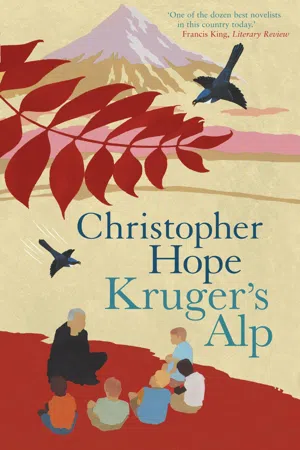
Theodore Blanchaille is searching for the missing millions of the Boer leader Paul Kruger, and his lost city of gold. As a child he had heard tales of Kruger from a wayward priest; what follows is an astonishing journey that takes Blanchaille through a landscape peopled with spies, visionaries, terrorists, traitors, patriots and exiled presidents.
From huge transit camps on the veld to a notorious prison block, from a township in the bloody aftermath of 'pacification' to a secret travellers' rest for fleeing pilgrims, and from the streets and cellars of Soho to paradise at last on a Swiss mountainside,
Kruger's Alp is a fantastical political satire of extraordinary invention.
eBook - ePub
Kruger's Alp
About this book
Information
Contents
Also by Christopher Hope
Chapter 1
Chapter 2
Chapter 3
Chapter 4
Chapter 5
Chapter 6
Chapter 7
Chapter 8
Chapter 9
Chapter 10
Chapter 11
Chapter 12
Chapter 13
Chapter 14
Chapter 15
Chapter 16
Chapter 17
Chapter 18
Chapter 19
Chapter 20
Chapter 21
Chapter 22
Chapter 23
Chapter 24
Chapter 25
CHAPTER 1
As I walked through the wilderness of what remained of the world of Father Lynch and his ‘little guild’, I saw much to disturb me. Here was the last vestige of the parish garden where the bulldozers, earth-movers, grabbers and cranes had frozen into that peculiar menacing immobility giant machines assume when switched off; left as if stunned, open-mouthed, gaping at the human foolishness of wishing to stop work when they are strong and willing to continue. They stood silent, it being Sunday, resting from their merciless preparation of this new site for one of the enormous hostels of the huge University of National Christian Education, widely declared to be the largest in the southern hemisphere. I looked around me and found the work nearly complete. However, the machines had stopped eating for the moment; ours is a holy land and even the destruction of redundant churches halts on the Sabbath.
The advance of the university over the years had been slow but inexorable; at first, parcels of the extensive grounds of St Jude’s had gone and, wisely, Lynch had not fought against this but had preserved his energies for guarding the church itself and his garden. His community of priests and lay brothers had been whittled away one by one. Bishop Blashford had conducted negotiations with the university so as to safeguard what he called ‘an orderly withdrawal’, with a skill which had won him the admiration of municipal councils across the country – and the commendation of the Papal Nuncio, Agnelli.
I stood in the destroyed church with the gaping roof. All religious ornaments had been removed, the sentimental paintings of lambs in emerald meadows, the wooden stations of the cross, the stained-glass windows of obscure martyrs, the baptismal font, the giant crucifix which had swung above the altar, the doors of the confessionals torn off so that now the little chambers gaped like disused lavatories. All gone – the golden tabernacle, the candles, the altar stone, the plaster Virgin in her sky-blue drapery and her brass circlet of stars, the wooden St Joseph with his surprising paunch, his bluff good looks and his blue sea-captain’s eyes; all the gaudy, inappropriate prints of Italianate saints, all gone; the ruby glass altar lamps in which the tiny flame glowed perpetually, the wooden altar rail at which Blanchaille had stood with his boat boy, Mickey the Poet, beside him, fumigating the first few rows of the congregation with pungent incense, the sacred cardboard hosts that stuck to the roof of the mouth for half an hour after Communion, the chalices, the sweet and rather yeasty smell of the cheap Jewish wine Lynch favoured for the Mass, the ciborium, the copes and chasubles stiff with gold thread, all the intoxicating plumage by which ordinary, irritable, balding men transformed themselves into birds of paradise and paraded to the strangely comforting sound of brass bells; all the absurdly delightful foreign paraphernalia with which a diminishing band of Catholics in a not very notable parish chimed, chanted, blessed and perfumed the start of each bright indifferent African morning. Only the pews remained now, the dark, polished mahogany pews, on the last two of which, at the rear of the church, I could make out still, small oblong patches of lighter wood where the brass plates had been; they were marked RESERVED, thus delicately designating the seats for the handful of black servants who used this church until Father Lynch had the plates removed, in the face of considerable opposition, in the days when these things were regarded as perfectly normal and fully in accord with the will of God and the customs of the country.
I saw that only Father Lynch’s favourite tree, from beneath which the dying master of altar boys once conducted his famous picnics, was still standing. The Tree of Heaven, we called it, or Ailanthus altissima Father Lynch taught with desperate pedantry. Like Buddha, beneath the sacred Bo tree, Father Lynch sat – though there had been nothing Eastern about Father Lynch, who was small, thin and elfish and who told his boys that the name of the tree was highly misleading since its male flowers smelt pretty damn awful and its roots were a threat to the foundations of the church. It was beneath this Tree of Heaven that I lay down around noon and slept. And while I slept I dreamed.
In my dream I saw Theodore Blanchaille and he was not particularly well-dressed. But then he’d always been rather a sloppy character, old Blanchie, or Father Theodore Blanchaille as we learnt to refer to him, or Father Theo of the Camps, as he was known in the old days, or plain Mr Blanchaille as we must refer to him now, I suppose. He was wearing an old pair of khaki shorts, baggy, creased and much too big for him, and a weird kind of sailor’s top of jagged dark blue stripes, squared at the neck. He was barefoot and sat in an empty room on a plastic chair. He was a big fellow carrying too much weight, but then he’d always been heavy, and I could see his belly pushing at the thin cotton shirt, and the plastic bands of the garden chair he sat in pressed against his lower back and made rolls of flesh protrude, meaty and tubular, stacked one above the other like bales of cloth. He was leaning forward with his elbows on his knees and reading a paper which was on the floor in front of him and turning the pages with his bare toes. He was holding a can of beans and occasionally he’d spoon a few of these into his mouth. No ordinary spoon this, but a square-tongued sugar spoon, silver-plated and made for the last visit of their Royal Majesties, King George VI and Queen Elizabeth, whose crowned heads in blue enamel tilted lovingly together above their coat of arms. As he read he wept and the tears landed on his knees and ran down the thick hair of his legs and stained the newspaper.
This struck me as extraordinary. A fellow who had been educated by the Margaret Brethren did not weep easily. But he was crying. Great shuddering sobs made the sailor shirt ripple and the tears glittered upon the thick hairs of his legs. His rather pear-shaped face wore a crumpled hopeless look, the big forehead creased. He bent his chin closer to his knees and with his free hand he clutched his hair which was dark and full of curls and strongly suggested his French blood given him by a Mauritian sailor father who left home shortly after his birth and never returned.
I saw the headline of the paper he held: FISCAL OFFICIAL IN MYSTERY SLAYING.
I knew he was reading about the death of Tony Ferreira who had been his friend in the old days when they were altar boys together under Father Lynch. This was to say in the time before Ferreira showed the signs of mathematical and financial abilities which were to carry him into the Civil Service and then to a high position in the Auditor General’s office. It was extraordinary, given the advanced political education these boys received from Father Lynch, that any of them should ever go to work for the Regime, and yet two of them had done so. This boy whom Father Lynch in one of his wild prophesies had seen as a future visionary. Instead he became a Government accountant, of a very special and rarefied sort, but an accountant all the same. Someone had once asked Ferreira how he found it in him to go and work for the Regime and he simply shrugged and replied that he followed figures wherever they led. Figures were value free, they kept him out of politics and he found that a tremendous relief. Naturally his answer was received with considerable disgust by those who knew him in the old days. Of course this was before an even more shocking betrayal when Trevor Van Vuuren joined the police.
The altar boys of Father Lynch were Theodore Blanchaille, Tony Ferreira, Trevor Van Vuuren, Roberto Giuseppe Zandrotti, Ronald Kipsel and little Michael Yates, afterwards Mickey the Poet. And I saw in my dream how in the old days they would occupy this very garden while Father Lynch sat beneath the Tree of Heaven; beside him on the picnic blanket two black boys, Gabriel and his brother Looksmart, the children of Grace Dladla, his housekeeper. I saw how Father Lynch reclined on an elbow and sipped a drink from a flask while he and the two black boys watched the white boys slaving in the sun, pulling up weeds, cutting back the bushes, raking, watering and desnailing Father Lynch’s impossible parish garden. Gabriel and Looksmart Dladla were given bottles of fizzy orange to drink while Father Lynch leaned at his leisure, sipping iced cocktails from an aquamarine thermos flask. It did black boys good to sit in the shade and watch white boys work. It did white boys good to be watched. The mutual educational advantages of the experience should not be underestimated. This was among the many principles enunciated at Father Lynch’s famous picnics.
Another was that it was given to each of us to discover the secrets of our own particular universe – but we should expect to be punished for it.
Another, that President Paul Kruger when he fled into exile at the end of the Boer War had taken large amounts of money with him – the missing Kruger millions. A glimpse of the purpose to which he had put these millions would be like a view of paradise – or at least as close to it as we were ever likely to get.
Another, that the Regime was corrupt, weak and dying from within – this at a time when our country was regarded as being as powerful as either Israel or Taiwan, had invaded almost every country along our border and even a number across the sea, some several times, always with crushing military victories.
Another, that destruction threatened everyone – this at a time when President Adolph Gerhardus Bubé had just returned from his extensive foreign tour of European capitals and initiated a new diplomatic policy of open relations with foreign countries which was said to have gained us many friends abroad and continued support in the world at large.
Father Ignatius Lynch, transplanted Irish hothead who never understood Africa, or perhaps understood it too well, had been sent into this wilderness, he would say, indicating with a gesture of his small shapely hand the entire southern sub-continent of Africa, by error, misdirected by his boneheaded supervisors in Eire. A man with his gifts for the analysis of power, and the disguises which it took on, should have been retained at home as one who would recognise and appreciate the close bonds between clergy and rulers in his own country, or should have been posted to some superior European Catholic parish in Spain, or Portugal, or even to Rome, where his gifts might have been acknowledged. Being deprived of an adult, mature European culture where even babes and sucklings understood that the desirability of morality could never replace the necessities of power, and despite the realisation that Africa was not going to live up to his expectations, he worked hard at giving his boys a lively political sense.
Then, too, Father Lynch had alarming gifts for prophecy; he prophesied often, with tremendous conviction, of the future which lay ahead for his boys; prophecies truly imaginative, but magnificently inaccurate.
There was, too, this strange addiction to South African history, or at least to one of its distant and probably mythical sub-themes, the question of the missing Kruger millions, the great pile of gold which according to some legends Paul Kruger, President of the Transvaal Republic and leader of the Boer nation in the great war of freedom against the British imperialists at the turn of the century, had taken with him when he fled into exile as the victorious English Rooineks marched into the capital. This must have begun as a faint interest, a hobby perhaps, back in the mists of time, but what had been once a gentle historical investigation into a legend, which was very widely discounted by authorities, academic and political, became a passionate investigation into something which would supply the answer to the mystery of ‘life as we know it’, and was absolutely vital to their salvation, he told his boys – ‘at least in so far as salvation could be defined or hoped for in this God-forsaken Calvinist African wilderness’. Father Lynch would express his belief with great finality, reclining on his elbow and sipping from his iced thermos beneath the Tree of Heaven as he watched his boys dragging at the leathery weeds.
I saw in my dream how Blanchaille sat in an empty room, with its bare parquet flooring and a few bad pieces of orange Rhodesian copper hanging on the walls, kudu drinking at a waterhole, and similar trifles, weeping as he read of the death of Ferreira, shaking his head and muttering. From somewhere outside the house, perhaps in the garden, I could hear angry voices raised, baying as if demanding to be let in and in my dream I saw who these angry ones were – they were Blanchaille’s parishioners demonstrating against their priest.
Clearly unable to contain himself any longer, Blanchaille burst out with a choked cry: ‘What shall I do? What the hell shall I do?’
And I saw in my dream four lines in small smudgy newsprint from the Press Association which reported that Dr Anthony Ferreira had been found dead in his ranch-style home in the Northern Suburbs. Police were investigating. Dr Ferreira had been his country’s representative with various international monetary organisations abroad. Certain messages had been found written on the wall near the body.
It was possible to date this newspaper to the final days before the Onslaught because on the opposite page was a huge photograph of a darkened car window in which could be glimpsed the white blur of a man’s face, and I knew at once that this was the picture of our President (our ex-President as he became), Adolph Gerhardus Bubé, on his celebrated foreign tour, the one which opened a new chapter in our international relations with the outside world. Ten countries in six days. It had been hailed at the time as a diplomatic triumph as well as a speed record. Photographs had appeared in the press: a man shielding his face outside the Louvre; an elderly gentleman in a hat on a bridge in Berne, a shadowy figure, back turned, feeding the pigeons in Trafalgar Square; a dim white face peering from the darkened windows of a black limousine speeding past the Colosseum . . . proofs of a triumph. It was the first time a president had been abroad since President Kruger fled to Switzerland in 1902. But Bubé’s tour, alas, did not open the new chapter in foreign relations which the Government promised. He came home and we began digging in for the long siege. The Total Onslaught had begun.
Blanchaille had heard from Ferreira very shortly before his death. Of course his line had been tapped. The call had come out of the blue, but he knew instantly the familiar flat vowels and the unemotional voice: ‘I’m sending you some money, Blanchie.’
‘I don’t need your money.’
‘Oh, come on, of course you need money. I don’t care what you use it for. Say some masses for my soul if you like, but I’m off. I’m through. Lynch was right, Blanchie. Something has been going on all these years. I’ve seen the books.’
Blanchaille did not wish to talk to Ferreira. He didn’t like Ferreira. Ferreira had gone to work for the other side. He’d represented the country at the International Monetary Fund, he’d been co-opted into the office of the Auditor General. His speciality was currency movements, exchange control and foreign banking.
‘You’ll need this money, you’ll need it to get where you’re going. Don’t be stubborn, Blanchie.’
‘I’m not going anywhere.’
The eavesdroppers bugging the call handled their appliances in the customarily inept way. So many telephones, so many listeners needed. It was rumoured they took on students wishing to earn cash in their vacations. An unpleasant hum increasing in pitch and volume covered their piping exchanges. Ferreira’s voice shrilled tinnily through the growing fog of interference. He was probably yelling his head off. ‘I’ve had a revelation, Blanchie! I’ve found it – I’ve found the City of God!’
‘Of what?’ Blanchaille shrieked.
It was hopeless, the humming noise made the ear quiver. He knew then that the line had not merely been tapped, their conversation had been jammed.
The money came. The...
Table of contents
- Cover
- Also by Christopher Hope
- Title Page
- Copyright Page
- Contents
Trusted by 375,005 students
Access to over 1.5 million titles for a fair monthly price.
Study more efficiently using our study tools.
Frequently asked questions
Yes, you can cancel anytime from the Subscription tab in your account settings on the Perlego website. Your subscription will stay active until the end of your current billing period. Learn how to cancel your subscription
No, books cannot be downloaded as external files, such as PDFs, for use outside of Perlego. However, you can download books within the Perlego app for offline reading on mobile or tablet. Learn how to download books offline
Perlego offers two plans: Essential and Complete
- Essential is ideal for learners and professionals who enjoy exploring a wide range of subjects. Access the Essential Library with 800,000+ trusted titles and best-sellers across business, personal growth, and the humanities. Includes unlimited reading time and Standard Read Aloud voice.
- Complete: Perfect for advanced learners and researchers needing full, unrestricted access. Unlock 1.5M+ books across hundreds of subjects, including academic and specialized titles. The Complete Plan also includes advanced features like Premium Read Aloud and Research Assistant.
We are an online textbook subscription service, where you can get access to an entire online library for less than the price of a single book per month. With over 1.5 million books across 990+ topics, we’ve got you covered! Learn about our mission
Look out for the read-aloud symbol on your next book to see if you can listen to it. The read-aloud tool reads text aloud for you, highlighting the text as it is being read. You can pause it, speed it up and slow it down. Learn more about Read Aloud
Yes! You can use the Perlego app on both iOS and Android devices to read anytime, anywhere — even offline. Perfect for commutes or when you’re on the go.
Please note we cannot support devices running on iOS 13 and Android 7 or earlier. Learn more about using the app
Please note we cannot support devices running on iOS 13 and Android 7 or earlier. Learn more about using the app
Yes, you can access Kruger's Alp by Christopher Hope in PDF and/or ePUB format, as well as other popular books in Literature & Literature General. We have over 1.5 million books available in our catalogue for you to explore.