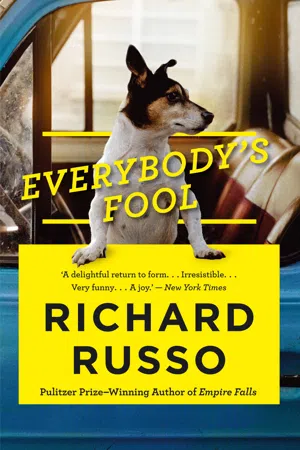
The great American master Richard Russo, at the very top of his game, returns to the characters who made
Nobody's Fool (1993) a contemporary classic.
Richard Russo's new novel takes place in the decaying American town of North Bath over the course of a very busy weekend, ten years after the events of
Nobody's Fool. Donald 'Sully' Sullivan is trying to ignore his cardiologist's estimate that he has only a year or two left. Ruth, his long-time lover, is increasingly distracted by her former son-in-law, fresh out of prison and intent on making trouble. Police chief Doug Raymer is tormented by the improbable death of his wife, while local wiseguy Carl Roebuck might finally be running out of luck.
Filled with humour, heart and hard-luck characters you can't help but love,
Everybody's Fool is a crowning achievement from one of the great storytellers of our time.
eBook - ePub
Everybody's Fool
About this book
Information
Grave Doings
WHEN SULLY ARRIVED HOME, a car he didn’t recognize was parked at the curb. There were no lights on in Miss Beryl’s house, at least none that was visible from the street. Standing on the front seat, his paws on the dash, Rub had also noted the unfamiliar vehicle, barked at it, then turned to regard Sully. “I see it,” Sully told him. “Shut up before I whack you one.” The dog cocked his head, puzzled. Sully’d never laid a hand on him, but his threats, always delivered with conviction, were hard to ignore completely. The strain of not barking caused him to let loose a short burst of urine on the glove box.
“Let’s go,” Sully said, getting out, but Rub had already scrabbled past him.
Strange that after so many years Sully still thought of the house as Miss Beryl’s. He’d lived in the apartment upstairs so long that he still forgot sometimes and went up the back stairs only to find the door locked. If Carl, who lived there now, was home and heard his approach, he’d holler, You don’t fucking live up here, you idiot. And though Peter and Will had been living in the downstairs flat for the last seven years, at times Sully was still surprised to see one of them emerge instead of his former landlady. Lately, the house filled him with unease, and that was even stranger. It was a fine property, one of the best on the street, which in turn was one of the best streets in Bath. Had he any wish to sell it, the place was worth a small fortune. This was in part due to his grandson, who kept the lawn mowed and edged, the hedges neatly trimmed. Since moving in, he and his father had painted the place twice and undertaken repairs and improvements in return for reduced rent. Sully hadn’t wanted to charge them anything at all, but Peter wouldn’t hear of it. As a result, the house looked better now than when Miss Beryl was alive and depending on Sully to keep it spruced up.
If he’d had any inkling of her intention to leave him the house, he’d have done his best to talk her out of it. He’d never before owned anything more valuable than a motor vehicle, and that suited him to a T. The old woman must’ve known he had little desire to become a property owner so late in the overall scheme of things, that it might well prove a burden. Had she hoped it would force him to accept a long-overdue and entirely unwelcome new role as a responsible adult? Possibly. More likely, though, she’d just meant to thank him for the moral support he’d offered when her son, Clive Jr., skipped town in the wake of the Ultimate Escape Fun Park fiasco. His unseemly departure, together with the small strokes she was suffering, had left her fragile, ashamed and disengaged, as well as increasingly housebound. Hearing Sully’s footfalls upstairs had comforted her. She also knew Sully’s son and grandson had unexpectedly returned to his life and that down the road the house might provide them with a place to live. Which meant that in due course the house would become Peter’s. It probably pleased her to think that Sully, who would have had nothing to leave his son, now had something tangible to pass on. She could never have predicted Peter’s disinterest in any such inheritance or that eventually Sully would see her gift as a regrettable psychic turning point.
Though to be fair, Sully’s luck had already begun to turn before this inheritance. It was Peter who bet that first winning triple. Until his son’s arrival, things had been going more or less according to form. Badly, in other words. In fact, Sully had been in the middle of one of those exhilarating stupid streaks that had characterized so much of his adult life. This one had culminated with a straight right hand, delivered right on the button, to then officer Raymer’s nose, dropping him like a sack of potatoes in the middle of Main Street and resulting in a warrant for Sully’s arrest. He’d spent most of that holiday season in jail. While he was incarcerated, the 1-2-3 trifecta he’d been playing every day for decades—what Carl Roebuck called his bonehead triple—had finally run. Missing out on it would have been about par for Sully’s course, but Peter, on Sully’s drunken instructions, had continued to make the wager at the OTB, so the winnings were waiting for him when he got out. Not exactly a fortune, but enough to return him to the economic knife edge he’d been teetering on for as long as he could remember, the most he could reasonably hope for. But then a month later the same trifecta hit again, its payoff even bigger, and at age sixty-one Sully had done something so completely out of character that he’d wondered, even at the time, if cosmic repercussions might follow: he’d opened a savings account. After all, he had a grandson now (three, actually, though the other two lived with their mother, Peter’s ex-wife, in West Virginia), and one day Will would need money for college. Sully hadn’t contributed a penny to Peter’s own education, so this was the least he could do.
Even after that second windfall, he’d continued to cling stubbornly to his conviction that his newfound luck couldn’t last. After all, his stupid streaks had always run with the regularity of European trains. Another was bound to heave into view momentarily, after which he’d be back in the soup, broke and busted up and without prospects, his natural condition. But no. Later that year, his landlady died and left him the house.
Nor was even this the end. The final stroke of good fortune—or at least Sully had hoped it would be—was more unnerving than all the others combined, because its ultimate source was Big Jim Sullivan, Sully’s drunk, abusive, long-dead father. As a final fuck you to the old man, Sully had intentionally let the family house on Bowdon Street, the scene of so many painful memories, fall into ruin until the town finally had no choice but to condemn and raze it; that, Sully had imagined, would finish things off. He’d given exactly no thought to the weedy, unattractive half acre the house sat on, assuming the land itself, awkwardly situated, would be next to worthless. But one of Gus Moynihan’s campaign promises had been to build a bike path through the town of Bath and out through sprawling Sans Souci Park, on the other side of which it would hook up with the Schuyler Springs path, the idea being to link their unlucky community to Schuyler’s historically more fortunate one. The proposed route, the only one that made any sense, ran straight through Sully’s half acre, which the town planned to spruce up with park benches and a marble water fountain. Sensing Sully’s reluctance to sell, but not its source, the mayor had sweetened the deal by promising Rub Squeers a custodial job out at Hilldale. And when even that didn’t produce the desired effect, he offered to void all of Sully’s parking violations, which he’d been collecting for years and which were now the equivalent of a small line item in the town’s annual budget.
“Raymer’ll have a cow,” the mayor confided smugly, confident that Sully wouldn’t be able to resist putting it to his old nemesis, whose first investment as chief of police had been a wheel boot that he’d used on Sully’s car the same day it was delivered. Later, after Sully and Carl Roebuck figured out how to unlock and steal the boot, he’d purchased two more, only to have these stolen as well. So despite his misgivings, Sully had sold the town his father’s land and put the money into his savings account, the balance of which had now swollen to the point where, despite heroic resolve, he couldn’t possibly hope to drink it up at the Horse during what remained of his life.
What all this amounted to, in Sully’s estimation, was a cosmic joke. As a poor man he’d always suspected that life’s deck was stacked in favor of those with means. Was it possible that, without intending to, he’d actually become one of them? Was he now and forevermore insulated against adversity? How, exactly, should he feel about that? Other people rose to the challenge and learned to live with good fortune. Why not him?
The problem was that from the moment that first bonehead triple ran, bad things started happening to people in his immediate circle. First, Miss Beryl had been felled by that final stroke she’d known was coming, and then a year later Wirf had succumbed to renal failure, no surprise there, either. It wasn’t like Sully felt responsible for these sad events, but he’d have gladly returned the money for the pleasure of their continued company, and so a false equivalency was established in his mind between their loss and his gain. Since then, his ex-wife had come loose from her moorings and been institutionalized, and Carl Roebuck, so long a symbol of undeserved good fortune, had lost his wife, his house and, most recently, his prostate gland. If Carl was to be believed, Tip Top Construction had about one swirl around the drain left, after which he’d be officially wiped out. The more bad things that happened to people in Sully’s inner orbit, the more karmically responsible he felt. There was never a causal linkage, of course, but that didn’t alter his sense of complicity. He couldn’t help thinking that he wasn’t meant to have money, that when his luck changed some invisible mechanism of destiny had been knocked out of alignment.
At least until he’d gone to the VA and gotten his two years, but probably one diagnosis, which had restored order with a vengeance.
As he and Rub started down the dark driveway, the dog began to emit a low growl that probably meant the neighborhood raccoon was back. Sully’d been meaning to put some skirting around the base of the trailer, knowing how much the creature liked it under there, but when it rained Rub was partial to the space as well, so he’d let it go. “You better come inside tonight,” he said, and Rub, somehow understanding this, trotted up the steps in front of him, still grumbling.
Inside, Sully turned on the kitchen light and tossed his keys onto the dinette next to the stopwatch Will had returned to him before leaving. It had belonged to Miss Beryl’s husband, the high school’s longtime football and track coach. Sully had given it to the boy when he and his father first arrived in Bath over a decade ago. Poor kid. For months he’d been listening to his parents’ bitter quarrels. Peter’s affair with an academic colleague back home had recently come to light and turned everything in the marriage toxic. Will had understood just enough about what was going on to be terrified about what came next. Having no idea what that might be, he’d become frightened of everything, including his own little brother. With the watch, Sully told him, he could time himself being brave. A minute today, a minute and a half tomorrow and so on. This would make him braver all the time, with the proof right there in the palm of his hand. For some reason it worked. For years the boy took the watch with him everywhere and slept with it on his nightstand. Sully had forgotten all about it. “So what’s this, then?” he asked his grandson, amazed, as he often was in the boy’s presence, at how big he’d grown while somehow remaining the boy he’d been.
Will had shrugged, embarrassed. “I don’t really need it anymore, I guess.”
“Nothing scares you these days?”
“Girls,” he’d admitted.
“Yeah, but that’s because you’re smart.”
Another shrug, this time accompanied by a grin. “I thought maybe you could use it.”
Sully was moved by the gift, but also curious. “What do I have to be scared about?” After his visit to the VA, had his behavior betrayed something? Did his grandson have an inkling of his illness?
“I guess I just thought it was time to give it back,” Will said, with shrug number three.
When Sully depressed the watch’s stem, the second hand lurched into motion, still anxious to perform after so many y...
Table of contents
- Cover
- Praise for Everybody’s Fool
- Richard Russo bio
- Titles by Richard Russo
- Title Page
- Copyright
- Dedication
- Contents
- Triangle
- Wishes
- Karma
- Slinky
- Exit Strategies
- Suppositories
- Dump
- Not Happy
- Impulse
- Boogie
- The Two Rubs
- Sock Drawer
- Spinmatics
- Embers
- Rub’s Penis
- A Sundering
- Reincarnation
- Hill Comes to Dale
- Grave Doings
- Complicity
- Electricity
- Secrets
- The Tree You Can’t Predict
- Gert Gives the Matter Some Thought
- Words to Die By
- Home
- Dougie Reneges
- Charade
- Crazy Like a Fox
- Something with No Name
- Motion
- Normal
- Cured
- Acknowledgments
- Praise for Richard Russo
- Also by Richard Russo
Trusted by 375,005 students
Access to over 1.5 million titles for a fair monthly price.
Study more efficiently using our study tools.
Frequently asked questions
Yes, you can cancel anytime from the Subscription tab in your account settings on the Perlego website. Your subscription will stay active until the end of your current billing period. Learn how to cancel your subscription
No, books cannot be downloaded as external files, such as PDFs, for use outside of Perlego. However, you can download books within the Perlego app for offline reading on mobile or tablet. Learn how to download books offline
Perlego offers two plans: Essential and Complete
- Essential is ideal for learners and professionals who enjoy exploring a wide range of subjects. Access the Essential Library with 800,000+ trusted titles and best-sellers across business, personal growth, and the humanities. Includes unlimited reading time and Standard Read Aloud voice.
- Complete: Perfect for advanced learners and researchers needing full, unrestricted access. Unlock 1.5M+ books across hundreds of subjects, including academic and specialized titles. The Complete Plan also includes advanced features like Premium Read Aloud and Research Assistant.
We are an online textbook subscription service, where you can get access to an entire online library for less than the price of a single book per month. With over 1.5 million books across 990+ topics, we’ve got you covered! Learn about our mission
Look out for the read-aloud symbol on your next book to see if you can listen to it. The read-aloud tool reads text aloud for you, highlighting the text as it is being read. You can pause it, speed it up and slow it down. Learn more about Read Aloud
Yes! You can use the Perlego app on both iOS and Android devices to read anytime, anywhere — even offline. Perfect for commutes or when you’re on the go.
Please note we cannot support devices running on iOS 13 and Android 7 or earlier. Learn more about using the app
Please note we cannot support devices running on iOS 13 and Android 7 or earlier. Learn more about using the app
Yes, you can access Everybody's Fool by Richard Russo in PDF and/or ePUB format, as well as other popular books in Literature & Literature General. We have over 1.5 million books available in our catalogue for you to explore.