LONGLISTED FOR THEAKSTONS OLD PECULIER CRIME NOVEL OF THE YEAR
SHORTLISTED FOR CRIME READERS ASSOCIATION DAGGER IN THE LIBRARY AWARD
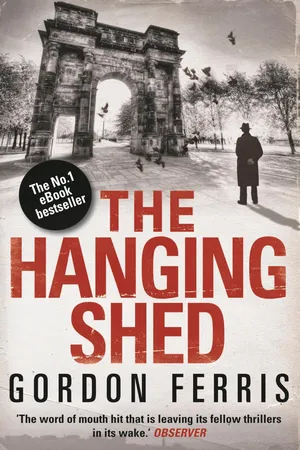
A fast-paced, gritty and atmospheric crime novel set on the tough streets of Glasgow, 1946.
Glasgow, 1946. The last time Douglas Brodie came home it was 1942 and he was a dashing young warrior in a kilt. Now, the war is over but victory's wine has soured and Brodie's back in Scotland to try and save childhood friend Hugh Donovan from the gallows.
Everyone thought Hugh was dead, shot down in the war. Perhaps it would have been kinder if he had been killed. The man who returns from the war is unrecognizable: mutilated, horribly burned. Hugh keeps his own company, only venturing out for heroin to deaden the pain of his wounds. When a local boy is found raped and murdered, there is only one suspect.
Hugh claims he's innocent but a mountain of evidence says otherwise. Despite the hideousness of the crime, ex-policeman Brodie feels compelled to try and help his one-time friend. Working with advocate Samantha Campbell, Brodie trawls the mean streets of the Gorbals and the green hills of western Scotland in their search for the truth. What they find is an unholy alliance of troublesome priests, corrupt coppers and Glasgow's deadliest razor gang, happy to slaughter to protect their dark and dirty secrets. As time runs out for the condemned man, the murder tally of innocents starts to climb. When Sam Campbell disappears, it's the last straw for Brodie, and he reverts to his wartime role as a trained killer. It's them or him...
The Hanging Shed is the word-of-mouth hit that is leaving its fellow thrillers in its wake. -
Guardian
- 314 pages
- English
- ePUB (mobile friendly)
- Available on iOS & Android
eBook - ePub
The Hanging Shed
About this book
Information
ONE
There are no windows in a hanging shed. Only a sadistic architect would provide a last glimpse of the fair green hills. The same goes for paintings or potted plants. You’re unlikely to divert the condemned man from the business in hand with a nice framed ‘Monarch of the Glen’ or a genteel aspidistra. Besides, he’ll only visit once. Wearing a hood.
Before the war I was taken to the hanging shed of His Majesty’s Prison Barlinnie. Years after, I can close my eyes and recite every dismal detail and dimension as though they were tattooed on my eyelids.
Think of a clutch of grey monoliths scarring the countryside on the outskirts of Glasgow. Each solid rectangle studded with tiny barred windows, the roofs festooned with Victorian chimneys. Like houses drawn by an obsessive child. The whole ugly mass surrounded by a tall grey wall. Focus in on the central courtyard and the building known as D Hall. Inside is a standard prison set-up: a high vaulted chamber with galleries facing each other across a gulf. Cells stud the walls on each level. Metal decks bridge the galleries. Metal staircases connect the levels.
There is one special cell on the third floor. Its occupant has nowhere to go except across the short bridge and through the plain wooden door on the other side. Take the walk. Go through the door. Eyes open.
Inside, the air is inert and the white walls press inwards. In the centre, set in the floor, is a trapdoor. Alongside, and surely connected, stands a lever. There are three square holes in the ceiling directly above the trapdoor. You can see the long retaining beam in the room above. A noosed rope dangles from the beam through the central hole. The two other holes gape invitingly, ready for rush hour in the hanging shed, three at once. Jostling for position on the trapdoor.
Today a lone figure stands on a chalked T in the centre of the trap. A broad leather strap binds the upper body. A hood covers the head. The noose is draped over the hood and round the neck. Soft leather coats the noose. No abrasions here for a tender neck. The noose is held in place by a brass slip to make sure it tightens quickly and efficiently. To snap rather than throttle. The mark of a civilised society.
A man in a blue uniform walks across the echoing floor-boards. He grips the lever and grins. There is a shocking clang and thud and the trapdoor falls open. The joist in the room above gives out a tortured creak as it takes the weight. The figure plunges into the void of the floor below where a slab waits. The rope hardens and trembles like a plucked guitar string. The guard sneers at the white faces of the four new constables being shown round for their edification. He signals to the guard below to take down the dummy.
I can conjure it now, lying on my back, rocking in the top bunk of the overnight train to Glasgow. But this time the dummy has a face. Beneath me and all around me I feel the Royal Scot hurtling through the night, steel wheels clacking remorselessly on the rails. Occasionally the great beast splits the tomb-black landscape with a midnight shriek and I listen for an answering call that never comes. I’m going home for the first time in two and half years, and the thought of what I have to face there fills me with a hot mix of anger and dread. I take another pull at my cigarette and watch the tip glow and die, and the smoke drift and swirl away.
Four carefree days ago I was sitting in my wee attic room in South London. I was having a good spell. Almost a week of sleeping better and drinking less. Maybe the two were connected. My newly polished shoes – army indoctrination – were sitting by the door ready for their sprint to Fleet Street. The spring sun was already banking through the skylight window. I was hunched over the table nursing a second mug of tea while reading yesterday’s Times and my own paper the London Bugle. Know your enemy, my old drill sergeant used to say. Besides, I enjoy the adverts on the front of the Times. In their way they give as clear a picture of Britain as the inside news pages. Stories of a hard-up country where gentlemen were selling their fine leather gloves, or where an ex-officer, RAF, DFC would make excellent private secretary. Where trained mechanics were searching for work as drivers, and war heroes were on the lookout for gardening jobs or other manual exercise. The fruits of victory were bitter enough for some.
I supped my tea and counted my blessings. In the last month I’d started to get a steady trickle of freelance assignments from the Bugle and there was a chance of a full-time job. I was making enough money to afford food, fags and Scotch, not necessarily in that order. But at least I would no longer simply be drinking away the last of my demob money. Two weeks ago I’d dragged my flabby body round to Les’s Boxing Academy on the Old Kent Road and – aching limbs apart – I was already getting back a sense of physical well-being. Something I hadn’t felt since the build-up and hard training for D Day. After a few days of the glums last week I was daring to hope that I was nearing the end of the tunnel. Sunshine on my face would be good. Such was my upbeat mood that I’d been crooning along with Lena Horne and whistling a tuneless descant to Artie Shaw on the Light Programme. Even my first fag tasted sweet instead of just satisfying a craving.
Then the phone rang down in the shared entry.
I glanced at my watch. It was just after seven-fifteen. Someone was starting early. I knew Mrs Jackson wouldn’t answer it unless she’d cranked up her hearing aid; I wondered why her daughters had bothered getting the phone installed. Her voice was so loud it made the device redundant. The other three households in our entry rarely got calls, but we were all happy to chip in to pay for the rental. I sprang to my door, still in my slippers and collarless. I could have done with another fifteen minutes of paper-reading and crossword-filling, but maybe the Bugle was calling. I dived down the three flights of stairs and grabbed the shiny black set.
‘Yes, hello? Brodie here,’ I gasped.
‘Is that Mr Douglas Brodie?’ A posh voice. A professional voice. An operator’s voice.
I got my breath back. ‘Yes, that’s me. Doug Brodie.’
‘Please hold the line, I have a call for you. Go ahead, caller, please put your money in now.’
I heard the clank and rattle of coins going in. Several. At least a bob’s worth, which meant long distance. My mother using her neighbour’s phone? An accident? Bad news comes early. A man’s voice started up. Scottish accent, West of Scotland. Like mine. Like mine used to be.
‘Is that you, Dougie boy?’
A bucket of ice splashed down my neck. No one called me Dougie now. It had been Brodie for a decade. The voice scratched at my memory, but I couldn’t put a face to it. Wouldn’t. My mind simply rejected the likelihood. For it was an impossible voice from the days of bows and arrows, spots and whispering girls. Of fist fights that ended in bloody lips and trembling anger. Of a great betrayal that gnawed at me still.
‘Who’s this? What’s happened?’ I pressed my palm against the wall for support, feeling the cool plaster suck at the heat of my hand.
‘That’s a big question,’ said the voice.
My mind was fumbling with memories. The timbre and cadence were heavier and slower but, oh, so disturbingly familiar. I knew who this was, but didn’t, couldn’t believe it. How could it be him?
‘Let’s keep it simple, then. Who … are … you?’
With new strength: ‘Don’t tell me you don’t know me, ya Proddy sod?’
That did it. The mocking West of Scotland greeting. I saw his face, a wee boy’s face. Pawky, we called it, cheeky, with his big silly grin and his fringe of black hair. We played soldiers back then, erupting from our trenches against the machine guns of the Boches. Seeing who could die on the barbed wire with the greatest panache. Shug Donovan – or Hugh, when we started going out with girls – beat us all. He’d fall in a cartwheel of melodrama, great anguished cries and flailing arms. He grew tall and handsome, black hair and blue eyes, like an advert for a Celtic bard. The girls loved him and his easy smile. I hated him for the same reasons, especially for the one girl that fell for him.
I hadn’t seen him since I left Kilmarnock for Glasgow University back in ’29. I heard odd snatches about him from my mother down the years, though she knew I hated every mention. He was a journeyman cooper at Johnnie Walker’s at the same time I was making my way in the Glasgow police force. In ’39 I went into the army, the Seaforth Highlanders, my dad’s old regiment, though I was a lowlander. Donovan ended up in the RAF, Bomber Command. A tail gunner. A guaranteed way of getting yourself killed for real. Which was exactly what happened.
In a letter from my mother in 1943 I was told that Hugh Donovan had died in his bomber in the flames of Dresden. My first ungracious thought was: Serves you right, you sod. Then remorse made my cheeks burn. It prompted me to write to his mother saying how sorry I was to hear the news. But the guilt of that instant wasn’t so easily erased.
‘Shug? Is it you?’
‘Aye, Dougie, it is.’
‘But how, what the hell? I thought you were dead!’ My voice cracked and echoed round the empty entry.
‘So did I, old pal. So did I.’
‘But this is great! Just fantastic!’ I could stop feeling bad about him, about how we’d left things. Time to move on.
He cut in. ‘Dougie. It’s no’ … It’s no’ great at all …’
TWO
The train roared through a station, lights flickering briefly before we plunged back into the dark. The sour scent of cheap Scotch tinged the air. The bloke in the bunk below had sucked patiently on a half-bottle to get to sleep. Mother’s milk where he came from; we came from, I reminded myself. I’d resolutely declined when he’d passed the bottle up to me. To prove I could. Now I wish I’d taken a slug or two. My brain was fidgeting. I lay in the dark and lit another fag and thought about going home, and what I meant by that.
There was Kilmarnock, the place where I was born and grew up. And there was Glasgow, where I’d gone to university, studied languages and, in a fit of rebellion, joined the police. A town and a city a mere twenty miles apart, but they might as well have been on different continents. It wasn’t just that I left my boyhood behind on the short train journey from Kilmarnock. It was as though someone had carelessly spliced two strips of films together from entirely different movies. The lead character had changed, as had the supporting cast and the entire plot and arc of the film. The one connecting thread between the two places was the language of the script and the sharp-edged humour and brashness of the West Central Lowlands. Where no German spy could mimic the tortured accents. His request for a pie and a pint in any of the hard pubs that littered the slummy landscape would have earned him a good kicking before being handed over to the comparative safety of the polis.
I’d last been in Kilmarnock in late ’43, on leave from my regiment, proud to bursting of the 2nd lieutenant’s pips on my epaulettes and the North Africa ribbon on my chest. The dull khaki of my battledress tunic was outshone by the strong blues and greens of the MacKenzie tartan in my Seaforth kilt. I rolled off the train with my kitbag over my shoulder and my tam-o’-shanter pitched at a suitably jaunty angle on my head. I was the picture of health. My leg had healed. Army training and the residue of the desert sun had honed me into a lean brown warrior. I bounded down the steps of the station and out into Kilmarnock’s high street. The heavy swing of the kilt made me lift up my head and push out my chest as if I was on parade. I marched down King Street with its stout Victorian façade, and strolled nonchalantly one full time round the cross – the town centre, with its statue of James Shaw in the middle of it.
I caught the smiles on girls’ faces: See you at the Palais on Saturday, then? And the nods of welcome from the old men: You’ve done your time now, laddie, just like us in the last one. When I thought I’d earned enough silent plaudits, I sauntered back up the Foregate and up the Gas Brae. I was held up briefly at Barclay’s yard as they trundled a new locomotive across the main street and on into the run of rail tracks that would channel it into service. The driver nodded and winked at me and I was eight again and enthralled by the giant metal wheels and the massive boiler.
I was marching into my own past, shedding the years with every step, casting off the veneer of learning, city airs and cynicism, and three years of hard fighting. On up to Bonnyton. On the left, climbing up the hill, smart rows of smoke-black sandstone terraces. Opposite, on the right, a clutch of older, sorrier tenements where the mining community clustered and from where, each day, the buses picked up the lines of men and ferried them off to dig the black seams below the fertile Ayrshire hills. I turned right and marched through the rows of grey tenements and across the drying greens. Washing flapped on the lines strung between the communal poles. The smell of washed linen anywhere in the world would take me back to that spot in a heartbeat.
She was there behind the net curtains, looking for me. I saw the twitch. Sure enough, she was out in a moment, her tiny frame all mobile and flapping, and her white hair shining and lifting in the warm breeze. A lifetime ago it had been red as rowan berries. For a while it seemed I’d inherited her wild colour. But as I grew my father’s black bristles counterattacked and turned mine to a compromise shade of dried blood. Only my morning stubble held the memory of her oriflamme. And his dark eyes, his height and miner’s shoulders won out against her grey eyes and elfin figure.
‘Hello, Mum,’ I called, and waved. I dropped my bag and held out my arms.
She scooted towards me, not sure where to put her hands, on her face, outstretched in front of her, or clasped in some inner prayer. The hero’s return.
‘Oh, Douglas, Douglas. Look at you! Ma wee boy!’
The tears were already coursing on her cheeks. And my eyes were wet by the time she clasped me to her. She felt like a bird, so light and bony. She smelt as she always did, a mix of coal-tar soap that she scrubbed her face with, and lavender from the sachets she hung on her handful of clothes. The very essence of home. I breathed it in, and was a child again. Some of the neighbour women poked their heads out, just by accident of course. But they were all beaming, glad to see one of their sons returned in one piece. Though most of their menfolk had been in reserved service down the pits, there were enough that hadn’t come back or had come back maimed.
The one black mark on the day, on all my days now, was the absence of the big man with the coal dust stamped in his hands and on his forehead in a line below his helmet. My father. Three years after his death her red had turned to snow as though she had no further need of it. My mother and I would visit his grave in the afternoon with flowers. Me in my uniform still, to show him what I’d become. What he’d made me. But unable now to delight in the banter over our shared uniform. No chance now of him saluting me with an insolent grin to show that a sergeant could honour a son even though he was now a bloody officer.
This homecoming would be different. I’d lost that bounce and sense of invulnerability that had swept me home two and a half long years ago. My skin had a London pallor and my shock of mud-red hair bore stubs of grey on my sideburns. Only thirty-four, one year short of the biblical halfway mark, and already on the downward slope.
This summons was too soon. It felt like I was rushing pellmell towards a nexus in my life of dark threads spewing from my past. I wouldn’t have been surprised if the conductor had appeared with red-hot coals for eyes and an announcement that the next stop was purgatory.
Hugh Donovan had survived the war and was calling from a pay phone in the visitor section of Barlinnie Prison, Glasgow. The Bar–L, the Big Mansion House, as we used to call it. Thanks to my own problems I’d missed all the furore north of the border. Certainl...
Table of contents
- Cover
- Title Page
- Copyright
- Table of Contents
- Dedication
- Chapter One
- Chapter Two
- Chapter Three
- Chapter Four
- Chapter Five
- Chapter Six
- Chapter Seven
- Chapter Eight
- Chapter Nine
- Chapter Ten
- Chapter Eleven
- Chapter Twelve
- Chapter Thirteen
- Chapter Fourteen
- Chapter Fifteen
- Chapter Sixteen
- Chapter Seventeen
- Chapter Eighteen
- Chapter Nineteen
- Chapter Twenty
- Chapter Twenty-One
- Chapter Twenty-Two
- Chapter Twenty-Three
- Chapter Twenty-Four
- Chapter Twenty-Five
- Chapter Twenty-Six
- Chapter Twenty-Seven
- Chapter Twenty-Eight
- Chapter Twenty-Nine
- Chapter Thirty
- Chapter Thirty-One
- Chapter Thirty-Two
- Chapter Thirty-Three
- Chapter Thirty-Four
- Chapter Thirty-Five
- Chapter Thirty-Six
- Chapter Thirty-Seven
- Chapter Thirty-Eight
- Chapter Thirty-Nine
- Chapter Forty
- Chapter Forty-One
- Chapter Forty-Two
- Chapter Forty-Three
- Chapter Forty-Four
- Chapter Forty-Five
- Chapter Forty-Six
- Chapter Forty-Seven
- Chapter Forty-Eight
Trusted by 375,005 students
Access to over 1.5 million titles for a fair monthly price.
Study more efficiently using our study tools.
Frequently asked questions
Yes, you can cancel anytime from the Subscription tab in your account settings on the Perlego website. Your subscription will stay active until the end of your current billing period. Learn how to cancel your subscription
No, books cannot be downloaded as external files, such as PDFs, for use outside of Perlego. However, you can download books within the Perlego app for offline reading on mobile or tablet. Learn how to download books offline
Perlego offers two plans: Essential and Complete
- Essential is ideal for learners and professionals who enjoy exploring a wide range of subjects. Access the Essential Library with 800,000+ trusted titles and best-sellers across business, personal growth, and the humanities. Includes unlimited reading time and Standard Read Aloud voice.
- Complete: Perfect for advanced learners and researchers needing full, unrestricted access. Unlock 1.5M+ books across hundreds of subjects, including academic and specialized titles. The Complete Plan also includes advanced features like Premium Read Aloud and Research Assistant.
We are an online textbook subscription service, where you can get access to an entire online library for less than the price of a single book per month. With over 1.5 million books across 990+ topics, we’ve got you covered! Learn about our mission
Look out for the read-aloud symbol on your next book to see if you can listen to it. The read-aloud tool reads text aloud for you, highlighting the text as it is being read. You can pause it, speed it up and slow it down. Learn more about Read Aloud
Yes! You can use the Perlego app on both iOS and Android devices to read anytime, anywhere — even offline. Perfect for commutes or when you’re on the go.
Please note we cannot support devices running on iOS 13 and Android 7 or earlier. Learn more about using the app
Please note we cannot support devices running on iOS 13 and Android 7 or earlier. Learn more about using the app
Yes, you can access The Hanging Shed by Gordon Ferris in PDF and/or ePUB format, as well as other popular books in Literature & Crime & Mystery Literature. We have over 1.5 million books available in our catalogue for you to explore.