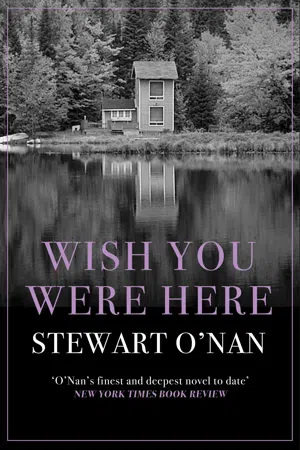
A year after the death of her husband, Emily Maxwell gathers her family at Lake Chautauqua for what will be a last holiday at their summer cottage. Joining her is her sister-in-law Arlene, silently mourning both the loss of the lake house and a bygone love affair. Emily's firebrand daughter Meg, a recovering alcoholic recently separated from her husband, brings her children from Detroit. Emily's son Ken, who has quit his job and mortgaged his future to pursue his art, comes accompanied by his children and his wife, who is secretly heartened to be visiting the house for the last time.
Memories of past summers resurface, old rivalries flare up and love is rekindled and born anew, resulting in a timeless novel that 'succeeds beautifully [and] showcases some of the finest character studies a contemporary reader could ask for' (
Boston Globe).
eBook - ePub
Wish You Were Here
About this book
Information
Sunday

1
Sam was the first one up, even before Justin, sleeping right beside him. The room was gray like when it rained and there was no clock, just the mirror on the dresser throwing back the dull squares of the windows, the leaves of a tree. Someone had turned off the fan. The air outside his sleeping bag was cold on his arms. Sarah was there, and he watched her breathing, her hair covering one cheek. He wanted to brush it away and touch her face.
He wanted them all to wake up and play with him—croquet maybe, that wasn’t too loud—but he knew Ella would be angry and then his mother would yell at him for getting up too early. The room was too dark for his Game Boy and he didn’t feel like reading. He stepped over Justin and went into the bathroom and closed the door. He didn’t hear anything as he peed, so he turned his hips to change his aim and the water drummed until he was done. He didn’t flush because that would wake people up; he just put the seat down, and the lid, so no one would see it. The window by the sink was frosty with water; he swiped at it to see if it was on the inside, and his fingers came away dripping. The world blurred, turned runny. In the side yard, a blackbird was hunting, poking his bill into the grass. At least someone was up.
Aunt Margaret was in the other bed next to his parents, wearing a T-shirt, her arms over her head like she was giving up. She was pretty like Sarah, with the same red hair that looked fake, and he made sure not to go too close. On the cedar chest next to the bed she’d left some money by a glass of water—change on top of a lot of bills—and he thought they would probably have to go to the stupid flea market like every Sunday. All he wanted to do was ride the inner tube. His mother wouldn’t let him go for a plane ride, and they never let him buy any decent Hot Wheels. It was just old screwdrivers and stuff, ugly plates and rusty frying pans. It would take all morning—and watch, it would be raining by the time they got back.
He went to get some pants and discovered another pile of change on top of the dresser. It was probably Sarah’s, since her pocket watch was in the middle of it. It was almost six. He pretended not to look at the money while he zipped up and pulled on a shirt. There were a lot of quarters. He got his socks on and then searched the floor for his shoes. When he found them he brought them back to the dresser.
He liked the watch, how small it was. There wasn’t room for all the numbers. It had a strap you snapped around your belt loop so you could pull it out of your pocket easier. He imagined whipping it out at recess and Travis Martin wanting to take a look at it. But he couldn’t take it. Sarah would miss it.
She might miss one of the quarters. A nickel would be easy, but a dime was worth twice that, even if he didn’t like dimes. He checked his parents and Aunt Margaret on one side, Ella and Sarah and Justin on the other, and then, with a finger, as if by accident, knocked a dime over the side.
He knelt down to put his shoes on and pinched the dime up out of the carpeting and secretly slipped it into the pocket of his shorts. Tying his shoes, he checked everyone again. No one had seen him, he was sure. He found his Game Boy and headed for the stairs, stopping at the top to look at them all one last time. He could’ve gotten a nickel too.
Downstairs, Grandma was up, making coffee at the stove. Rufus left her to come over and sniff him, and Sam had to push his head away.
“Look who it is,” she said. “Sam Sam the Dinosaur Man, all bright-eyed and bushy-tailed. Are you ready for a Grandma breakfast?”
“Okay.”
“What kind of toast do you want with your eggs? We have a choice this morning.”
He waited at the kitchen table while she soft-boiled the eggs, the steam rising up over the stove. At home he’d watch TV now, hoping for the Red Sox score so he could tell his father when he came down, but the TV here didn’t get ESPN, and Grandma didn’t like them watching it anyway. He turned on his Game Boy and waited for Pokémon Red to load.
“You’re not planning on playing that thing the whole time you’re here,” she asked.
“No.” He’d wanted to take it out on the porch and play with the sound down so it wouldn’t count against his hour; now that was impossible. He turned it off.
“Thank you. I’m sure you can find plenty of other things to do. Your mother tells me you’re a reader.” She looked to him as if she expected an answer.
“Yes.”
“What kinds of books do you like to read?”
“Matt Christopher.”
“And what does Matt Christopher write about?”
“Baseball.”
“Am I to take it there’s a whole series of these books?”
“Yes.”
“Have you read them all?”
“I’ve only read the first three. The library has like fifteen.”
“Would you be interested in these books as a Christmas present?”
“Sure.”
“What else are you up to? What was the beach like? Your father said you took the ferry to Block Island.”
“Yeah,” he said, “we rode bikes out to this cool lighthouse,” wondering if his father had told her about him getting caught taking the Butterfinger from the snack bar. His mother slapped his hands and he cried, then his father hugged him and told him they still loved him and it was all right.
“What’s Block Island like? I’ve never been myself.”
While he told her, she served him his eggs and toast and poured him a glass of orange juice even though he was supposed to have a glass of milk first. He crumbled the toast into the soupy yolk and started eating, and she came and sat down across from him, moving the flowers his mother bought out of the way so she could see. Rufus lay down facing him in case he dropped anything.
Grandma asked about Ella’s braces and their school, what teachers they would have this year. She asked if his mother was working, and who watched them after school. She asked if his father liked his work. Sam said he didn’t know a lot about his new job.
“Really,” she said, “your father has a new job?”
“Yeah. He develops pictures. At a lab, I don’t know where.”
“I guess I’ll just have to ask him then. How are your eggs?”
“Great.”
“Do you want some more juice?”
“Yes, please.”
She poured him another glass and came back. She asked him about Grammy and Grampa Sanner and how they were doing, and whether or not they might be coming for Thanksgiving. What about Christmas? She asked if Ella had any boyfriends yet or, slyly, if he had any girlfriends.
The whole time she was talking to him, Sam felt special, singled out, so when his father came downstairs with his camera bag and said good morning, it felt like a spell had been broken. Rufus got up to sniff him, and Sam covered his Game Boy with a magazine. He remembered the dime in his pocket, and the ferry, how his mother had asked if he knew what happened to thieves. They go to prison, she said. Do you want to go to prison?
His father said he didn’t want any breakfast. “Not yet. I’m going to try to catch some of that light.”
“Sam and I were just discussing your new job.”
“Is that right?” his father said, and looked at Sam like he was surprised, and he wondered if he was in trouble.
“It’s the first I’ve heard of it. You’ll have to fill me in later.”
“I will. Right now I’ve got to go get that light.”
“I understand,” Grandma said, and let him go. Rufus stood at the door, wagging his tail as he watched him cross the yard.
She turned back to Sam and smiled, and Sam smiled too, happy to have her all to himself again.
“Now,” she said, “tell me what else is new with you.”
2
He expected getting out of the house would feel like a jailbreak, but walking down the road in the cool, heavy air, Ken thought it was the opposite; he knew that this escape was temporary, that he’d have to come back and tell his mother everything.
It wasn’t Sam’s fault, and he hoped he wouldn’t hold it against him. Sam had enough troubles.
She would accuse him of shutting her out or, worse, of misleading her, letting her believe he was teaching at B.U. (when in fact he’d only filled in for Morgan the week he was out in Berkeley for the opening of his show). He’d have to admit he wasn’t working part-time at Merck either, that that had just been an old project they needed him to reconstruct, and not because he was indispensable but because he’d mislabeled his negatives. Instead of the twin professional and academic successes he knew she wanted from him, he’d have to admit that he was making $8.50 an hour developing overexposed birthday party and graduation photos.
After that, the conversation would spread and accelerate, sweep like an avalanche across his life, dredging up the ridiculous choices he’d made and their consequences—for the children, she’d say, as if he’d let Ella and Sam down, doomed them to shame and starvation. He knew she thought he was a fool and feared the world would crush him, and yet her worry never felt protective, more like a lack of faith in him. He’d just have to sit there and listen to her tear him down, without his father to soften the blows, to reassure him that she was only concerned about him, that they all knew what a tough profession he was in.
Crows called, mocking. The canopy of trees blocked out the sky so only a low band of white light filtered in from the lake, sneaking between the houses. Squirrels were out. One froze, then skittered up the far side of a tree as if Ken were a hunter. In the driveways, the Volvo wagons and Cadillacs sat with rocklike patience, windshields beaded with dew, and he remembered the ludicrous bulk of his father’s 98, waiting, he supposed, in their dim garage in Pittsburgh, the concrete beneath it stained with the blood of its predecessors. He saw the backyard with its old basketball pole, and the steel garbage cans tucked under the porch stairs. That’s what he should be shooting—their dented, mottled sides and knocking handles, the porch rail his father fashioned from pipe. He’d have to visit before his mother sold the house.
He had the Holga and a small tripod in his bag. The light was grainy, too much water in the air, as if it might rain. He’d do a few rolls of black and white. Already the prospect bored him. The Holga was too simple, took too many tools out of his hands. Morgan had made Ken promise to leave it alone, not swaddle the box in black gaffer’s tape to stop the light leaks. The plastic lenses were notorious for their distortion. Even if you thought you had a shot, you had no idea how the prints would come out. “That’s the whole idea,” Morgan said.
He knew how it was supposed to work, he just didn’t think it would. But he agreed that he had to do something. Looking over Morgan’s shoulder as he picked through his portfolio (rejected, again), he saw how polished and mediocre he’d become. The images told him nothing. Anyone could have taken these stark trees and benches and street signs—an undergrad or retiree with an eye for light—and anyone could have printed them so crisply they would look striking on a wall, but they were empty, all composition; as Morgan said, no gut.
“Talent is great,” Morgan said. “Talent and technique are absolutely necessary, but they’re not enough. At some point you’re going to have to fish or cut bait.”
It seemed to Ken an ultimatum, a test of their student-mentor friendship, and so here he was, creeping between the sleeping cottages at first light, hoping to save himself with what was meant to be a child’s toy, heading for the fishery. It was no comfort that ar...
Table of contents
- Cover
- Title Page
- Dedication
- Contents
- Saturday
- Sunday
- Monday
- Tuesday
- Wednesday
- Thursday
- Friday
- Saturday
- Praise for Wish You Were Here
- Also by Stewart O’nan
- Copyright
Trusted by 375,005 students
Access to over 1.5 million titles for a fair monthly price.
Study more efficiently using our study tools.
Frequently asked questions
Yes, you can cancel anytime from the Subscription tab in your account settings on the Perlego website. Your subscription will stay active until the end of your current billing period. Learn how to cancel your subscription
No, books cannot be downloaded as external files, such as PDFs, for use outside of Perlego. However, you can download books within the Perlego app for offline reading on mobile or tablet. Learn how to download books offline
Perlego offers two plans: Essential and Complete
- Essential is ideal for learners and professionals who enjoy exploring a wide range of subjects. Access the Essential Library with 800,000+ trusted titles and best-sellers across business, personal growth, and the humanities. Includes unlimited reading time and Standard Read Aloud voice.
- Complete: Perfect for advanced learners and researchers needing full, unrestricted access. Unlock 1.5M+ books across hundreds of subjects, including academic and specialized titles. The Complete Plan also includes advanced features like Premium Read Aloud and Research Assistant.
We are an online textbook subscription service, where you can get access to an entire online library for less than the price of a single book per month. With over 1.5 million books across 990+ topics, we’ve got you covered! Learn about our mission
Look out for the read-aloud symbol on your next book to see if you can listen to it. The read-aloud tool reads text aloud for you, highlighting the text as it is being read. You can pause it, speed it up and slow it down. Learn more about Read Aloud
Yes! You can use the Perlego app on both iOS and Android devices to read anytime, anywhere — even offline. Perfect for commutes or when you’re on the go.
Please note we cannot support devices running on iOS 13 and Android 7 or earlier. Learn more about using the app
Please note we cannot support devices running on iOS 13 and Android 7 or earlier. Learn more about using the app
Yes, you can access Wish You Were Here by Stewart O'Nan in PDF and/or ePUB format, as well as other popular books in Literature & Literature General. We have over 1.5 million books available in our catalogue for you to explore.