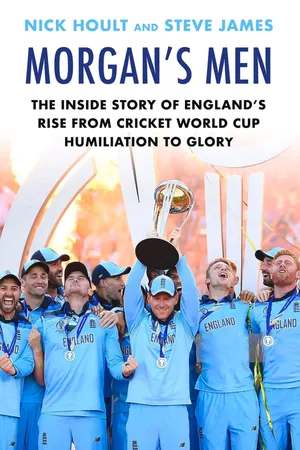
From English cricket's embarrassing failure at the 2015 World Cup to their heart-stopping victory four years later, Nick Hoult and Steve James vividly describe the team's dramatic journey from abject disappointment to finally lifting the trophy.
Morgan's Men reveals how the team became the most aggressive limited-overs side in the world, led by their inspirational captain Eoin Morgan, whose vision and determination to succeed captured the imagination of the nation.
Hoult and James follow England's journey from Bangladesh to Barbados, from Melbourne to Manchester, to present the inside story of the team's rebirth. They tell us how players dealt with the Ben Stokes court case, the sacking of Alex Hales for a drugs ban, and reveal the innovative new strategies and tactics that helped them become the best in the world, culminating in a World Cup final that was arguably the greatest one-day match of all time.
eBook - ePub
Morgan's Men
The Inside Story of England's Rise from Cricket World Cup Humiliation to Glory
- 328 pages
- English
- ePUB (mobile friendly)
- Available on iOS & Android
eBook - ePub
Morgan's Men
The Inside Story of England's Rise from Cricket World Cup Humiliation to Glory
About this book
Information
Print ISBN
9781911630937
Subtopic
Modern British HistoryONE
FINE MARGINS
THE WORLD CUP FINAL – ENGLAND V. NEW ZEALAND
LORD’S, LONDON
14 July 2019
Sunday, 14 July 2019 dawned grey and overcast in north-west London. Umbrellas were required for those arriving early at Lord’s for this the 12th Cricket World Cup final, the fifth at the grand old ground and the first there since 1999. But the forecast promised ever better weather throughout the day, and there was going to be a new name on the trophy by its end, with England in their fourth final and their first since 1992. New Zealand were beaten by Australia in their one final appearance in the previous tournament in 2015.
So, the frisson was understandable, but nobody could ever have envisaged what levels of excitement would be seen before that trophy finally was presented just after 8pm.
Because of the dampness, with the rain having only just stopped, the start was delayed by 15 minutes from its scheduled 10.30am slot. Once the covers had been removed, a green-looking pitch was revealed, although England captain Eoin Morgan, a Lord’s veteran, having only played his county cricket for Middlesex, had said the day before that its looks could be deceiving. ‘From afar, it looks greener than it is,’ he said. ‘There isn’t a lot of grass on it.’ He knew that would be bad news for his big hitters and good for New Zealand. It levelled the playing field between the two sides. Home advantage was significantly reduced now.
Speaking on the popular BBC Tailenders podcast, broadcast live from the ground that morning, England Test bowler James Anderson was adamant that it was a morning on which to bowl first.
The old adage at Lord’s when assessing what to do at the toss has always been to look up rather than down – in other words, take more notice of the skies above (it was still cloudy when Sky Sports’ Nasser Hussain gathered Morgan and Kane Williamson, the New Zealand captain, together with Sri Lankan match referee Ranjan Madugalle for the toss) than the pitch down below.
The further complication was that England had built a reputation in the previous four years for being supreme chasers. But this tournament had challenged that thinking considerably. A combination of the slow pitches and the pressures of the tournament meant that batting first had become ever more fashionable.
What to do? There was much to consider. The decision at the toss here at Lord’s was always going to be tricky.
Morgan tossed the coin, and Williamson called tails. It fell as tails. Williamson elected to bat, but he admitted some ‘confusion’.
‘It was a tough decision,’ he said. ‘If you look at the surface, I think it is a bat-first surface, but then you look up above and that brings in a bit of confusion.’
England were going to bowl. Just. Asked if he was disappointed to lose the toss, Morgan said: ‘No, not at all. It was a bit of a 50–50 call. It is always difficult here at Lord’s with the overheads.’
In the England dressing room, team performance analyst Nathan Leamon was happy. ‘Oh, thank God,’ he said. England had got what they wanted without the pressures of inserting the opposition.
‘We thought the wicket would get stodgier as the game went on, and we also knew that the first ten overs were going to be very difficult, so we were trying to make a decision that took New Zealand’s easiest routes to victory off the table,’ said Leamon to The Times after the final. ‘But we were on a knife edge. If the sun was shining, we were going to bat, and if it was cloudy, we were going to bowl. So, it was almost the perfect outcome. We didn’t have to decide, and we got to do what we wanted to do anyway. The idea of having got the decision wrong in a World Cup final and that affecting how the game went was not something I wanted to have to go through.’
And Morgan admitted afterwards to Sky Sports that it was a decision that took up too much of his time on that morning. ‘It took up so much of my head space,’ he said. ‘And it normally doesn’t.’
The first ten overs were going to be crucial. New Zealand’s openers had had a poor tournament up until that point. Martin Guptill was the leading run scorer at the 2015 tournament but was having a shocker here, while the left-handed Henry Nicholls had only been brought into the side after Colin Munro had failed to deliver and was dropped.
When in the third over Nicholls was adjudged lbw to Chris Woakes without scoring, it could have been a rather predictable tale. But Nicholls reviewed the decision by the Sri Lankan Kumar Dharmasena, who was not exactly the most reliable of the umpires in the tournament, and the ball was shown to be going over the top of the stumps.
Guptill, having survived a vociferous caught behind appeal off Jofra Archer in the second over – a brilliant piece of umpiring from South African Marais Erasmus, who saw that the ball had brushed the batsman’s back trouser pocket rather than bat – began to show signs of his aggressive best with an uppercut six over third man off Archer and then a drive down the ground for four in the fourth over after advancing down the pitch to the same bowler. It felt as though the first wheel was coming off.
At this moment Andrew Strauss, the director of England cricket at the start of this England team’s four-year plan in 2015 but now at the game working for Sky Sports, arrived in the writers’ section of the Lord’s press box. ‘Just hope that this is not the day Guptill comes off,’ remarked a member of the media to him in a moment when making conversation prompted a departure from impartiality to patriotism.
Calm as anything Strauss replied: ‘Just relax, there is nothing we can do about it up here.’ It was a fair point. It was also why he was such a fine captain of England, although even the excitement must have got to him by the day’s end.
Guptill soon went for 19, leg-before to Woakes, who bowled yet another probing opening spell, in a tournament full of them from him, of seven overs for just 19 runs. Guptill then wasted his side’s only review by referring his decision upstairs. It was plumb.
As Guptill walked off up the stairs into the Lord’s pavilion, Hussain remarked on the television commentary: ‘His tournament with the bat comes to an end.’ Nobody in his or her right mind could ever have thought that that statement would then be proved wrong later in the day. But then this was not going to be any normal day.
For New Zealand to end the opening powerplay of ten overs at 33 for one represented something of a triumph for them, though. Nicholls and Williamson, who took 12 balls to get off the mark, slowly and carefully built an important partnership.
In pulling Liam Plunkett for four, Nicholls moved to 31 and to his highest score of the tournament. His tenacity and grit epitomised the Kiwi spirit in these most high-pressured of circumstances. Plunkett, such an important bowler for Morgan, struggled in his opening spell as nerves looked to be taking hold.
The outfield might have been lightning fast, but this was not a belter of a pitch. Like so many in this tournament, it was a little too slow and a little too easy for the ball to linger in the surface rather longer than any batsman wishing to drive through the line of the ball would ever want.
The New Zealand score passed 100 in the 22nd over, and England desperately needed a wicket. Step forward Plunkett, who had swapped ends after his first three overs from the Pavilion End had gone for 19.
‘As soon as I came up the hill [from the Nursery End] I felt comfortable attacking the crease, it felt a lot better,’ Plunkett said afterwards.
Plunkett’s fourth ball was to Williamson and, as is so often his style, was held across the seam. It was pitched on a good length, but Williamson viewed it as being fuller than that and drove at it. It went through to wicketkeeper Jos Buttler, and, as he took it, Plunkett and the rest of the England team appealed demandingly. Umpire Dharmasena was unmoved.
Not out, he decided.
England reviewed immediately.
The edge seemed obvious and was soon proven as much. Williamson, a rock amongst Kiwi batting sandcastles for so much of the tournament (he was the fourth-highest run scorer overall with 578 runs at an average of 82.57 and had scored a staggering 30 per cent of New Zealand’s runs before the final), was gone for 30 from 53 balls. It was a huge wicket for England, and a huge moment.
‘Kane is a massive player, and to get a crucial wicket is what I do pride myself on. So, it was nice to get that,’ said Plunkett. ‘I tried to get as much out of the pitch with my variations as I could. That’s my role. I use the cross-seam ball more than the seam-up.’
Nicholls passed his half-century off 71 balls in the 26th over, with a single off the leg spin of Adil Rashid, who was bowling a decent spell from the Pavilion End. Indeed, in eight overs Rashid conceded just one boundary, a heave over wide mid-on for four by Williamson.
But Plunkett soon snared Nicholls as well with another cross-seamed delivery, with Nicholls bowled off the inside edge for 55 from 77 balls, so that the bowler had taken two for five in 14 balls, and the New Zealand innings suddenly took on a very different look.
This was gripping stuff. Lord’s was rapt. Trafalgar Square was too, with a big screen being watched by many thousands of fans. It was a wonderful advertisement for cricket, with the final also being shown on UK free-to-air television, after Sky, whose considerable investment in the game had contributed in no small way to England reaching this final, had allowed Channel 4 to screen it, the first time a live England international had been on that platform since the 2005 Ashes. And it attracted a peak viewership of 8.3 million. What a match this was for this expansion of the game’s audience to see.
It was a remarkable sporting day in general, with the men’s tennis final also taking place at Wimbledon, where Novak Djokovic eventually beat Roger Federer in what would turn out to be the longest final in the tournament’s history. Meanwhile, Lewis Hamilton was also winning a record sixth British Grand Prix at Silverstone.
Back at the cricket, by the time 30 overs had been bowled, New Zealand had reached 126 for three. It did not look an especially threatening platform from which to launch their push for a big score, but this was classic New Zealand: workmanlike and unfussy, crafting and grafting their way to a workable total. It was what they had done to India when shocking them in the semi-final at Old Trafford. There they had made just 239 for eight after electing to bat first, and then India had failed by 18 runs.
New Zealand were not going to break any run-scoring records again here, but they were damned determined to make a score that would test England. That has always been New Zealand cricket’s way: to make the very most of what they have, however unflashy it might appear.
Chasing in a World Cup final on a sticky pitch is the ultimate test of a one-day-international side. More so for a team at home that had entered the tournament as favourites, courtesy of their no. 1 world ranking. New Zealand were really going to investigate the true extent of England’s mettle here.
‘We sort of wanted 250, 260. We knew that it wasn’t easy,’ said Williamson afterwards. Given that totals of over 250 had only been successfully chased down twice in the tournament before this final (Bangladesh in making 322 for three to beat West Indies and India in surpassing Sri Lanka’s 264 for seven), it was not a bad aim.
Ross Taylor, in at no. 4, did not last long, however. The 35-year-old veteran, in his fourth World Cup, had made a vital 74 in the semi-final but scored just 15 here, adjudged leg-before to Mark Wood, who, though expensive in conceding 23 runs from his four overs, had bowled like the wind in his first spell from the Nursery End. He had hit 95mph at one stage and equalled (at 95.69mph to be exact) the fastest ball of the tournament, alongside Jofra Archer and Australia’s Mitchell Starc, and had swung the ball sharply.
Now Wood returned from the Pavilion End. As with Plunkett swapping ends earlier, this was more shrewd captaincy from Morgan. Wood’s first ball was again fast – 90mph – and nipped back into the right-handed Taylor down the slope.
Wood often falls over after delivering the ball, but not this time. Instead he was soon squatting with arms in the air pleading for the leg-before decision. Umpire Erasmus granted him his wish, but for once – he was the umpire of the tournament in many observers’ eyes – he was wrong. It looked high upon first viewing, and this was proven to be the case by subsequent replays, but because Guptill had already burned New Zealand’s only review, Taylor did not have the opportunity to use them. He walked off ruefully, but without any histrionics or any words of anger. He took it remarkably well.
To rub salt into the wound, Wood then changed to around the wicket to the new batsman, the left-handed Jimmy Neesham, and proceeded to bowl five dot balls. He had bowled a wicket maiden in the 34th over! It ended up as the only maiden of the innings.
Along with another southpaw, the wicketkeeper Tom Latham, Neesham set about guiding New Zealand towards that competitive total that they so desired. Neesham is strong on the leg side and was soon launching Ben Stokes for two fours in the 35th over to that side of the field.
Latham, a good enough batsman to have made 264 not out in a Test match, was another to have had a poor tournament up to this point, with his only score above 13 being the 57 he had made against England at Durham in the group stage. But he was another to rise to this grandest of occasions. He was especially quick onto the short ball, pulling Plunkett for a four that was so nearly a six and then later going the whole hog with a six off Wood over straightish deep mid-wicket, which, following Guptill’s earlier effort, was the second maximum of the innings.
Latham also played one glorious extra-cover drive for four off Wood, and Neesham had just cut Plunkett for four when, from the very next ball, he tried...
Table of contents
- Cover
- Title
- Copyright
- Contents
- 1 Fine Margins
- 2 From Rock Bottom to Revolution
- 3 Courage, Unity, Respect
- 4 Pushing the Boundaries
- 5 Enter Jofra
- 6 Fumbles, Fines and Frustration
- 7 Roy Lays His Ghosts to Rest
- 8 Root, the Walking Gluestick
- 9 Morgan Senses His Destiny
- 10 Crashing Back Down to Earth
- 11 Squeaky Bum Time
- 12 Bulletproof Bairstow
- 13 Fate Plays Its Hand
- 14 You English Have Won Nothing Yet
- 15 Ecstasy by the Barest of Margins
- 16 The Celebrations
- Statistics
- Acknowledgements
- Index
Trusted by 375,005 students
Access to over 1.5 million titles for a fair monthly price.
Study more efficiently using our study tools.
Frequently asked questions
Yes, you can cancel anytime from the Subscription tab in your account settings on the Perlego website. Your subscription will stay active until the end of your current billing period. Learn how to cancel your subscription
No, books cannot be downloaded as external files, such as PDFs, for use outside of Perlego. However, you can download books within the Perlego app for offline reading on mobile or tablet. Learn how to download books offline
Perlego offers two plans: Essential and Complete
- Essential is ideal for learners and professionals who enjoy exploring a wide range of subjects. Access the Essential Library with 800,000+ trusted titles and best-sellers across business, personal growth, and the humanities. Includes unlimited reading time and Standard Read Aloud voice.
- Complete: Perfect for advanced learners and researchers needing full, unrestricted access. Unlock 1.5M+ books across hundreds of subjects, including academic and specialized titles. The Complete Plan also includes advanced features like Premium Read Aloud and Research Assistant.
We are an online textbook subscription service, where you can get access to an entire online library for less than the price of a single book per month. With over 1.5 million books across 990+ topics, we’ve got you covered! Learn about our mission
Look out for the read-aloud symbol on your next book to see if you can listen to it. The read-aloud tool reads text aloud for you, highlighting the text as it is being read. You can pause it, speed it up and slow it down. Learn more about Read Aloud
Yes! You can use the Perlego app on both iOS and Android devices to read anytime, anywhere — even offline. Perfect for commutes or when you’re on the go.
Please note we cannot support devices running on iOS 13 and Android 7 or earlier. Learn more about using the app
Please note we cannot support devices running on iOS 13 and Android 7 or earlier. Learn more about using the app
Yes, you can access Morgan's Men by Nick Hoult,Steve James in PDF and/or ePUB format. We have over 1.5 million books available in our catalogue for you to explore.