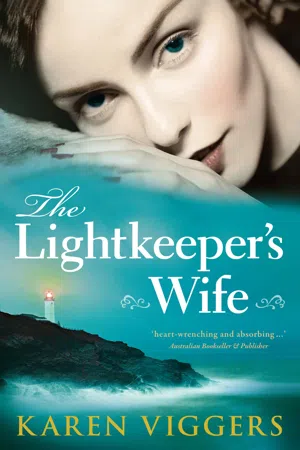
Elderly and in poor health, Mary has lived in Hobart a long time. But when a letter is delivered to her house by someone she hoped never to see again, she knows she must return to Bruny Island to live out her last days with only her regrets and memories for company.
Years before, her husband was the lighthouse keeper on Bruny and she raised her family on the windswept island, until terrible circumstances forced them back to civilisation. Now, the secret that has haunted her for decades threatens to break free and she is desperate to banish it before her time is up. But secrets have a life of their own and, as Mary relives the events of her life, she realises her power over the future may be limited.
Back in Hobart, Mary's adult children are respectively outraged, non-committal and sympathetic about her escape from their care. But no amount of coaxing will shake her resolve. Her youngest son Tom loves Bruny, and can understand her connection to that wild island, a place of solitude, healing and redemption for them both.
As Mary's secret threatens to tear her apart, both she and Tom must face their pasts in ways they couldn't even begin to imagine. Mary finds that the script she's written to the end of her life has taken a few twists of its own.
- English
- ePUB (mobile friendly)
- Available on iOS & Android
eBook - ePub
The Lightkeeper's Wife
About this book
Information
PART I
Origins
1
For three days, the letter stayed on the table untouched. Every time Mary looked at it her heart thrashed like a wild bird in a cage. She bent her life around it, trying to avoid the kitchen, eating in the lounge room with a plate perched awkwardly on her lap, drinking tea hurriedly at the sink, and taking the phone out of the room whenever anyone rang. It was ridiculous and she knew it, but the handwriting on the front of the envelope made her nervous. God knows why she couldn’t dispose of the thing; she ought to toss it in the bin or burn it in the fireplace, but she couldn’t quite bring herself to do it.
She lived with a heightened sense of panic, sleeping fitfully. What if the letter bearer returned? She had to act. But what to do? The letter was a burden—the past and the future rolled into one. She became grumpy and irritable. This ought to be a time of peace, with Jack gone and her own health declining. But the letter was projecting her back into life. It insisted she take control.
On the third night, she found a feasible idea among her restless thoughts, and the next morning she shuffled into the study and riffled through a pile of papers on the desk, seeking the brochure someone had given her months ago. She’d been keeping it, waiting. The letter was the catalyst. It was time to go back. Her hand had been forced and she must address the past before she could decide what to do.
She found the brochure beneath an old electricity bill and called the number printed on it; then she opened the phone book on the kitchen bench and made another call. Afterwards, she pulled out a suitcase, folding into it neat stacks of underwear, poloneck sweaters, jumpers, woollen trousers, a coat, a thick scarf and a hat.
When her clothes were packed she went to fetch the letter. Her hand hovered over it and a wry smile twisted her face: she was behaving as if the letter might explode. And in a sense she supposed this was true. It had erupted into her life and could well blow apart what time she had left. Finally she picked it up, feeling the smooth texture of the paper with her thumb as she carried it to the bedroom and slipped it into a side pocket of the suitcase. Then she turned to the bookshelf and grasped an old photo album which she placed in the case on top of the clothes. Now she was ready.
In the quiet of the room, she gazed at the dark shadows that angled across the bed and lingered in the corners. She had lived here, in this old Hobart house, for twenty-five years, sharing her husband’s retirement and decline—the terrible process of watching someone you love retreating from life.
Twenty-five years: a large portion of their lives together. Much had happened—ageing, a grandchild. Even so, she’d never really thought of Hobart as home. For her, it would always be Bruny Island. The light reflecting on the shifting water. The hollow voice of the wind. The lighthouse. The wide southern stretch of Cloudy Bay . . . It was right she should go there now, to the place she first met Jack, where she first came alive. And more than that; she owed it to Jack. On Bruny, she would remember him more clearly. Somehow, there she would reunite with him, relive the good times—those early days when the foundation of their love was shaped and their commitment was sealed.
She also owed it to herself to return. Time was running out, and there were old emotional wounds she needed to attend to before she died—matters neglected amid the soothing monotony of daily life. She needed to find peace and inner calm. To settle into self-acceptance. To grant herself release from guilt. Only on Bruny Island could she achieve these things.
And she must decide how to deal with the letter.
On Sunday morning, Mary sat on the couch in the lounge room. Half an hour ago, she had finished her final cup of tea then washed and dried the mug and replaced it in the cupboard. Now she was stiff after sitting still for so long, listening to the clock on the mantelpiece ticking into emptiness. Normally she’d be tuned in to ABC radio, the news and current affairs. But this morning she needed to sit quietly. There was too much ahead. Too much to contemplate. The clean air of Bruny was beckoning. The smell of wet trees. Salt on the wind. She wanted to be gone from here.
She heard a car pull up and the dull thud of a door closing. Jacinta at last.
Her granddaughter entered the room with the breeziness of the young, all brown eyes and smiles and long loose limbs. At twenty-five, physically, she was her mother all over again, although she’d hate to hear it. She bent for a hug and Mary clung to her, enjoying the feel of young wiriness, the tautness of unblemished skin. How sadly Mary had mourned the loss of her own youth, the decay to wrinkles and sagginess and waistline spread. Her strong wavy hair reduced to flimsy wisps. Over time, she’d learned to accept it and she’d embraced other things: simple pleasures, like bird calls, a good roast, familiar company, a favourite novel, the comfort of words unspoken but understood.
‘Are you sure you’re up to this, Nana?’ Jacinta was regarding her assessingly. She’d always had an uncanny instinct for gauging Mary’s physical and emotional health. It was part of what made their relationship special, and so different (thank goodness) from Mary’s constant tussle with Jacinta’s mother. With Jan there was always that particular tension belonging to interactions between mothers and daughters.
During her fortnightly visits, Jan had recently stepped up her comments about nursing homes; she’d even offered to organise a tour of suitable places that Mary might consider. But Mary would have none of it. She didn’t want to die in a hospital bed with tubes sticking out of her like spaghetti. Nursing homes were expensive too. And she didn’t want to be a burden on her children. She knew what it was to care for a dying person; she’d done it for Jack. Her family might not like it when they realised what she had chosen, but this option was better. It was her option. Her decision. She was doing this for herself.
‘Of course I’m up to it,’ she said quickly. ‘This is my last chance.’ She reached for her stick. ‘Shall we get going, then?’ She waved an arm towards her luggage near the door, attempting nonchalance, although this was difficult, knowing the letter was tucked inside. ‘There’s my case. And I’ve packed some things in the basket for a picnic.’
‘A suitcase!’ Jacinta laughed. ‘We’re only going for the day.’
They drove south out of Hobart in the sullen early light. The purple shadow of Mount Wellington loomed above them with caterpillars of mist clinging just below the summit. Low clouds sat close over the morning and it seemed the day was already weary. Through the dark cleft of the cutting, ravens picked at possum carcases squashed on the wet road.
At the roundabout in Kingston, Jacinta glanced at her watch. ‘Have you checked the ferry times?’
‘There’s one at nine thirty. We can get a cup of tea while we wait.’
‘What about breakfast? Have you had any?’
‘Yes, of course. I’ve been up since five.’ It had taken her a long time to shower and get ready.
Jacinta groaned. ‘I wish I could bounce out that early.’
Mary recalled the shrill of the alarm and the breathlessness that followed. ‘I certainly didn’t bounce,’ she said.
Jacinta smiled. ‘I didn’t shower. I hope I don’t smell.’
‘Only of vegemite toast.’
‘But vegemite smells awful.’
‘I can think of worse.’
They laughed.
When Jacinta was small, Mary had cared for her while Jan was teaching. They’d had fun together, and she’d taken immense satisfaction in the task: after the lighthouse, it had provided her with a focus without which she’d have withered. Mary knew Jacinta liked her, whereas Jan had always been disapproving. Somehow Mary hadn’t been quite the mother Jan wanted—although Mary wasn’t sure anyone could have lived up to Jan’s expectations. Jan resented the years they’d lived at the light station. She claimed the place had curtailed her childhood and that she’d missed out on opportunities—whatever that meant. Mary couldn’t imagine what great things Jan envisaged would have come her way in suburban Hobart.
It was true their lives hadn’t been easy at the light station. Challenges came with isolation. There’d been no other children on the cape. Dim lighting for schoolwork in the kitchen. Limited fresh food. No visitors in winter. Poor weather. But what they lacked in convenience, they had gained in simplicity and proximity to nature. Skies and sea stretching forever. Fishing. Exploring. Picnics on the beach. Space to roam. Mary’s heart still settled to think of it. Even so, Jan was convinced she’d been denied the important things, society and friendships and culture. Ever since, she’d run herself ragged trying to create this life she believed she’d been deprived of. It had driven her husband away; of that Mary was sure.
And yet, Mary could still remember how Jan loved to ride the pony along Lighthouse Beach. How she and Gary had run across the hills with bed sheets over their heads pretending to be ghosts. The bonfires, and the glorious Christmases, making decorations and presents. Then, it was just the four of them— Mary, Jack and the two children—wandering on moonlit nights with the flash of the light slicing the dark. Mary remembered those jewels of Jan’s childhood, even if Jan chose to forget them.
She remembered less of Gary, her second child. He was more often with his father working in the shed, or kicking a ball among the tussocks, chasing chickens, sprinting to the beach. Not long after the youngest child, Tom, came along, Jan and Gary went to boarding school in Hobart. Tom grew up on the cape alone, roaming wild. He was the only one who spoke of the light station with affection. By the time they went to school, Gary and Jan couldn’t wait to escape it.
Parents weren’t supposed to have favourites, but Mary had always felt protective of Tom. He was her sensitive child, the one susceptible to deep passion and grinding hurt. She loved them all, of course she did. But Tom was special. He needed her more than the others. Or was it that she needed him?
Now she thought of the letter and shuddered. It could ruin everything. Her family life. Her children’s beliefs. She must make sure it wasn’t discovered. Ridiculous that she hadn’t destroyed it already. What was holding her back?
She sighed and struggled to suppress tears. Soon she would be on Bruny. With Jack. And everything would be clearer.
At Kettering, they waited in line with a small number of cars and an empty cattle truck. Jacinta disappeared into the ferry terminal while Mary stayed in the car watching ruffles of wind skip over the water. The skies had lifted a little but still reflected the steely grey of the sea. Across the D’Entrecasteaux Channel, Mary could see the gentle hills of North Bruny. Not far out, the ferry had rounded the headland and was coming towards them.
It had been many years since she first crossed to Bruny Island, taking the ferry from further south at Middleton to the southern part of the island. She had made that unhappy passage alone, leaving her p...
Table of contents
- COVER PAGE
- TITLE PAGE
- COPYRIGHT PAGE
- DEDICATION
- CONTENTS
- PROLOGUE
- PART I: ORIGINS
- PART II: EVOLUTION
- PART III: DISINTEGRATION
- PART IV: RESURRECTION
- ACKNOWLEDGEMENTS
Trusted by 375,005 students
Access to over 1.5 million titles for a fair monthly price.
Study more efficiently using our study tools.
Frequently asked questions
Yes, you can cancel anytime from the Subscription tab in your account settings on the Perlego website. Your subscription will stay active until the end of your current billing period. Learn how to cancel your subscription
No, books cannot be downloaded as external files, such as PDFs, for use outside of Perlego. However, you can download books within the Perlego app for offline reading on mobile or tablet. Learn how to download books offline
Perlego offers two plans: Essential and Complete
- Essential is ideal for learners and professionals who enjoy exploring a wide range of subjects. Access the Essential Library with 800,000+ trusted titles and best-sellers across business, personal growth, and the humanities. Includes unlimited reading time and Standard Read Aloud voice.
- Complete: Perfect for advanced learners and researchers needing full, unrestricted access. Unlock 1.5M+ books across hundreds of subjects, including academic and specialized titles. The Complete Plan also includes advanced features like Premium Read Aloud and Research Assistant.
We are an online textbook subscription service, where you can get access to an entire online library for less than the price of a single book per month. With over 1.5 million books across 990+ topics, we’ve got you covered! Learn about our mission
Look out for the read-aloud symbol on your next book to see if you can listen to it. The read-aloud tool reads text aloud for you, highlighting the text as it is being read. You can pause it, speed it up and slow it down. Learn more about Read Aloud
Yes! You can use the Perlego app on both iOS and Android devices to read anytime, anywhere — even offline. Perfect for commutes or when you’re on the go.
Please note we cannot support devices running on iOS 13 and Android 7 or earlier. Learn more about using the app
Please note we cannot support devices running on iOS 13 and Android 7 or earlier. Learn more about using the app
Yes, you can access The Lightkeeper's Wife by Karen Viggers in PDF and/or ePUB format, as well as other popular books in Literature & Women in Fiction. We have over 1.5 million books available in our catalogue for you to explore.