- English
- ePUB (mobile friendly)
- Available on iOS & Android
eBook - ePub
About this book
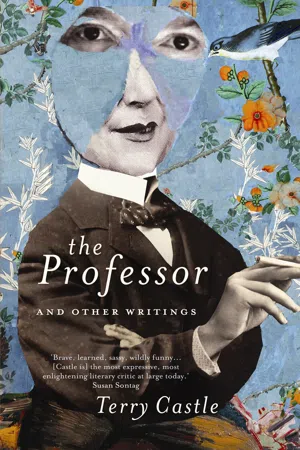
At the heart of this striking collection is the title work: a candid and wrenching exploration of Castle's relationship, during her graduate school years, with a female professor. At once hilarious and rueful, it is a pitch-perfect recollection of the fiascos of youth: how we come to own (or disown) our sexuality; how we understand (or fail to) the emotional needs and wishes of others; how the ordeals of desire can prompt a lifelong search for self-understanding. With
The Professor: And Other Writings Terry Castle cements her reputation as a truly remarkable writer: distinctive, wise, frank, incredibly funny and utterly fearless.
Information
The Professor
Proglomena

B. is the Chosen One in another sense, too: we are getting married this month at San Francisco City Hall. Our nupitals—or so our pot-smoking mountain-mama dog-sitter mistakenly refers to them—have both a true-love and a civic-duty dimension. (They’ve also prompted the latest bout of fitness training.) It is time to share the love, with various Castles and Vermeules in attendance. But we also want to pile on before the November election: in an effort to overturn the recent California law legalizing same-sex marriage, dull hordes of the pious and cretinous have managed to stick an antigay referendum on the ballot. Yet even if the wretched thing passes, we figure, the more couples who marry before Election Day, the harder it will be for the courts to nullify the marriages later. So order in those crates of confetti! It’s like the Enlightenment all over again.
And so too, historically speaking, the time seems right to begin this piece: a wee reminiscence of my Sapphic salad days (the 1970s) and dire yet life-shaping acquaintance with the Professor. I’ve had it in mind to write about the Professor for a while, but as B. can attest, have had to do a fair amount of emotionally taxing research first. Some of this research has been archival in nature: a matter of digging through Old Journals of the Time. (These will figure prominently later.) Ghastly to admit it, but I’ve got a huge groaning boxful of them, the earliest and scruffiest dating back to 1972, several years before the Professor and I met. One of my undergraduate English teachers had made us keep one—a little vade mecum, he called it—in which, Montaigne-like, we were to preserve our thoughts about the books we were assigned that term. It being the “liberated” 1970s, we were free—indeed encouraged—to incorporate personal material into our responses. Alas, reviewing this virgin effusion now, I am embarrassed to see just how obsessively, if also coyly, I managed to relate whatever great work I perused (everything from Homer’s Iliad to Rosa Luxembourg on the Revolution of Rising Expectations) to the tormented crush I had at the time on Phoebe, the straight hippy-girl roommate with whom I had been painfully infatuated since our freshman year.
—Saw P. this afternoon with her ceramics teacher in the cafeteria. They didn’t see me. Not again. Felt just like the narrator in Notes from Underground when he has to step into the dirty snow on the Nevsky to let the Cossack officer go by. Indeed: “I could not even become an insect.”
Unfortunately for me, the professor in question, a somewhat dissolute character with a beret and a foot-long Mr. Natural Keep-on-Truckin’ beard, seemed to intuit the nature of the attraction to P. and relished all the suppressed girl-on-girl hysteria. (My journal always came back with approving “yes’s” and “good’s”—sometimes even a tiny “whoa”—next to the more suggestive entries.) Thus was a habit ingrained: I kept journals religiously for the next ten years. And no, it hasn’t been fun confronting them again; when I finally dragged them down a few weeks ago from the top shelf in the coat closet—the place where they’ve been lying, dusty and unregarded, all this time, I felt more than a spasm of foreboding. There they all were, in their neat, puerile, incriminating stacks, patiently awaiting some sadder-but-wiser postmodern rediscovery. Reading them through for the first time in twenty-five years was not going to be easy—nor was it.
Along with the journal dredging, however, some serious musical research has also been necessary. Folk music, after all (especially folk music of the more dismal, depraved, and gallows-ridden sort), was a central element in my relationship with the Professor. We had bonded (if ever so briefly) over elf-knights and demon lovers, silver daggers and Little Sir Hugh, the chatty ghosts of maidens drowned at sea—even the odd croaking corbie or twa. To get into just the right mind-set, therefore—the proper mood for maundering—it has been necessary to immerse myself once more in great aural tidal waves of Joan Baez, Pentangle, Peter, Paul and Mary, Buffy Sainte-Marie, Ewan MacColl, Judy Collins, Fairport Convention, Incredible String Band, John Renbourn, Ian and Sylvia, and countless other folkie-tinged worthies of the late sixties–early seventies era. Dylan too, of course: the Professor claimed to have known him in the fabled days in the Village. Blood on the Tracks, possibly my favorite Dylan album ever, came out just pre-Professor, I recall, during my last year in college. When I met her a short time later, a few months into my new Ph.D. program, it was strange to find that despite the putative Bob connection, not only had the Professor not yet heard it, she had not even heard of it.
And thus it was the other day—as B. and I bowled along on the now-obligatory Power Walk (me lollygagging a bit, I confess)—that I found, through the music, this essay’s starting point: my donnée. I had been listening on my iPod to a true musical relic, a collector’s item of such rarified loopiness I had not thought to hear it again, as they say in the Aeneid, this side of the Styx. The rara avis in question was Alix Dobkin’s 1973 album Lavender Jane Loves Women, an eccentric self-produced paean to Sapphism—at once noodly, maudlin, and curiously rousing—that I had recently rediscovered online. Warmed-over folkie, loosely speaking, was indeed the mode: American-lady-singer-with-acoustic-guitar-and-fake-Scottish-accent-croons-archaic-sounding-pseudoballads. The record even included a feminist update of Child ballad No. 223—about a pistol-packing gal named Eppie who “wadna be a bride, a bride.” But Lavender Jane’s overriding message, strictly women-only, was 100 percent of its historical moment: Destroy the Patriarchy! Dykes Rule! Adam was a Rough Draft! Mother Nature Is a Lesbian! Radical lesbian propaganda in folk-song guise, in other words—enough to make an erstwhile Mytilinean proud.
Now, it’s true I still owned my original Lavender Jane LP. It’s in the garage even now—complete with worn yet striking hand-drawn purple cover, vaguely floral in design, with an arabesque blob meant (I think) to look like the mons veneris. Along with its handsome sister album from 1975, Living with Lesbians—the latter graced by a picture of crop-headed Alix and some hard-boiled mates hoeing dirt in a communal field and glowering suspiciously at the camera—I’ve hung on to it for decades, hoping that it might one day become valuable. (Note to Smithsonian: I also have a pristine Patty Hearst “Wanted” poster from the same era, deftly snatched off the wall of a post office in Tacoma, Washington during my SLA-wannabe phase.) But I hadn’t actually heard any of Dobkin’s music for a long time; I’d jettisoned my last turntable ages ago and no longer had the equipment to play it on.
Thus when the morbid desire to listen to her again came over me recently—for hadn’t Dobkin’s deep singing voice, though plusher, borne an uncanny similarity to the Professor’s?—I found myself Googling her. I doubted I would unearth much, though; given the esoteric nature of her recording career, I assumed Dobkin had been sucked down a cultural memory hole more abyssal even than the one that had engulfed the ukulele-strumming Tiny Tim—the dim falsetto-voiced singer (purportedly male yet oddly reminiscent in looks of the older Vita Sackville-West) who had once been a regular on Rowan and Martin’s Laugh-In. Yet such was not the case. Not only did I find Alix’s Wikipedia entry in a nanosecond, I soon hit upon Lavender Jane itself, freshly pirated and all ready for clicking and downloading at ten cents a song (!), on—of all things—a dodgy Russian Web site specializing in Beatles and Bee Gees bootlegs. Now, how exactly had the digital entrepreneurs of Smolensk and Novgorod obtained this freakish memento of 1970s radical lesbian feminism? Had the globe-trotting Condoleezza Rice had something to do with it? I didn’t know. It was definitely iffy, even sinister. But I went ahead and clicked away anyway. Here’s hoping that Ludmilla and Svetlana -—or indeed any other lesbo-Russki cybergangsters who may now be using my credit card number—got a chance to play some of the songs while they hacked into my account; I suspect they might have enjoyed them.
So what was Lavender Jane like after thirty years? It has a claim, after all, to a certain minor historical importance: it was one of the first-ever recordings of what subsequently came to be known as “women’s music”—music written by or performed by lesbians, usually exclusively for other lesbians. In the 1970s the sanitary euphemism seemed necessary: many of the form’s early proponents were closeted, or half-closeted, and still hoping, one presumes, for mainstream careers. (Perhaps on some distant purple planet: except for maybe Melissa Etheridge or k.d. lang, few such careers ever materialized.) Nor could you find an album like Lavender Jane in a record store: I had to order my copy through the mail, like contraband plutonium, after seeing a tiny ad for it in the classified ads section of Ms. magazine. All this, in the end, for a fairly anodyne (and soon-to-become formulaic) product. Hard to believe in an era of Chicks on Speed, Vaginal Cream Davis, and Le Tigre, but “women’s music” disks are still occasionally manufactured, like reproduction Bakelite rotary-dial telephones, with all the time-honored generic features preserved intact: plaintive warbling on the part of the female singer-songwriter, ultrasaccharine lyrics about waterfalls, women’s hair, and kindly gym teachers—the occasional quasi-clitoral image or (gasp) female pronoun folded in here and there to insinuate, ever so delicately, the same-sex erotic setup. Funkadelic and potty-mouthed it is not.
And indeed, as soon as the first notes of “The Woman in Your Life”—the lead-off cut and Dobkin’s signature piece—came plink-plonking over my headphones the other day, I was immediately reminded of the genre’s gauzy inanities. The lyrics—a paean to a sort of Our Bodies, Ourselves–like self-concern—would no doubt work well in a sales pitch for vibrators:
The Woman in Your Life [plink]
Will do what she must do [plonk]
To comfort you and calm you down
And let you rest now; [plink plonk]
The Woman in Your Life, [plink]
She can re-e-e-st so easily— [plonk]
[decisive STRUM and dramatic pause—]
She knows everything you do, [plink]
Because the Woman in Your Life is You. [plonk]
The basic conceit established, it doesn’t take long for the creamy goo to start seeping in—not least because The Woman in Your Life (aka You) knows a “way to touch” to make you, um, whole:
She can t-o-o—u-ch so easily—
She knows everything you do,
Because the Woman in Your Life is You.
Ladies, start your labia!
Other songs broached similarly delicious themes. In “A Woman’s Love”—a slightly boomy treaclefest (apparently recorded inside a cistern) in which Alix was accompanied, uncertainly, by an (alas) fairly pitch-impaired cellist and flute player—she celebrated her discovery of her passion for, yes, a Woman. Why had she been attracted to her? Because said woman—or so one learned amid gallons of sloshy reverb—was a Woman. Ah, mystery solved!
Elsewhere, in a fatally perky folk-song medley of “Handsome Molly,” “Sweet Betsy from Pike,” “Goodnight, Irene,” and “Darling Clementine,” the singer offered a down-home dollop of Sapphic Americana. Such songs—she explained in her chatty liner notes (so glad I kept that LP)—were part of “Lavender Jane’s great Dyke HERitage”: lesbian love songs that needed reclaiming as such. And sure enough, as Alix jogged brightly from one tune to the next, the kinky world of one’s pioneer foremothers—of gal–gal bundling, quilting bees, and little women-only houses on the prairie—came vividly to mind.
All easy enough to lampoon, of course, and I hadn’t even gotten yet to the album’s blockbuster final number—one that I fully expected, based on what I could remember of it, to reveal itself definitively, now and for the ages, as The Worst Song Ever Written. To borrow a canny phrase from a hipster colleague: seemed like Alix was about to rip Nana Mouskouri a new one. Indeed, when the ditty in question, the unfortunately named “View from Gay Head,” started coming in over the ’phones, I was already tittering quietly in cynical forepleasure.
As the first couple of verses unfurled I felt a malicious urge to share the merriment. Blakey, it’s true, was about ten or twelve paces ahead of me, but I’d been managing quite nicely (I thought) cardio-wise, and had even surmounted my bête noire, the infarction-inducing Sanchez Hill, in fairly good time. Surely Blakey wouldn’t object to stopping the onerous Power Walk for just a sec to exchange headphones and exult in the ludicrousness of it all? Nor did she. After I had explained who Alix Dobkin was—B. having been maybe six or seven, I guess, when the original Lavender Jane Loves Women album came out—she listened in wide-eyed horror and disbelief, then began emitting great girlish war-whoops of laughter. These eructations became so insistent that she was soon quite breathless with guffawing and had to bend over at the waist, hands on hips, gasping all the while, like someone who had just finished running the 400-meter high hurdles at the Olympics.
Reasons for mirth—as I well knew myself—were not hard to find. According to Dobkin’s liner notes, the song had apparently had a kind of mystical, magical, jubilant birthing, its chorus having come to its creator, “Ode to Joy”–like, while she was driving with her girlfriend to Gay Head on Martha’s Vineyard in the summer of 1973. (Wow, 1973 ! They could have seen Lillian Hellman! Maybe even’ve run her over!) Pretty great, too, some of the other compositional details. “After we arrived,” Dobkin explained, “I wrote the verses and very carefully lifted the tune from the Balkan song, ‘Savo Vodo,’ which I had recently learned at my Balkan singing class.” Ah, yes: how well we remember rocking out to “Savo Vodo”—not to mention those air-guitar favorites “Pobjednicki Cocek” and “Vai, Ce Rau Ma Simi Acuma.”
And from one angle, the lyrics of “View from Gay Head” no doubt offered glorious satiric fodder. Each verse was a potted parable of sorts, designed to expose the vileness with which the greedy patriarchal brutes who ruled the world (men) drove women, shrieking and tremulous, into the arms of their own sex. Luckily for the poor battered gals, though, this abrupt exit from the not-so Edenic Garden of Heterosexuality was really a Fortunate Fall: once one lady-refugee met up with another, awesome dyke-dacious ecstasy ensued, accompanied by huge bursts of shared cleansing revolutionary anger. Thus in the song’s opening verses—oddly ornamented with wobbly little eighteenth-century trills by the flute-cello backup team—Alix sang of one “Cheryl” and new squeeze “Molly,” the blissful beneficiaries of just such an eroto-political awakening. “There are two kinds of people in the world today,” the pair had realized:
One or the other, a Person must be;
The Men are Them and the Women are WEEE—EEEE!
This key insight, laid bare with the analytic clarity of Marx and Engels, led ineluctably to boogie-oogie-oogie Woman-Love. Now “both agree-ee-ee-ee-ee-ee,” crowed Alix, “It’s a pleasure to bee-ee a LES-BEE-ENNE!”
Cue loud and lusty chorus, sung by Dobkin and ragtag but euphoric female choir, several of whose members sounded as if they might be age six or under:
LES-BEE-ENNE! LES-BEE-ENNE!
LES-BEE-ENNE in No Man’s Land!
LES-BEE-ENNE! LES-BEE-ENNE!
ANY WOMAN CAN BE A LES-BEE-ENNE!
[dainty flourish by flute player]
And so it went: the incendiary Cheryl and Molly succeeded by literary-lez “Liza,” who “wishes the librar-eee/Had men and women placed separate-leee”—all the way to “Louise” (grousing at “a million second places in the Master’s Games”) and right-on Alix herself, who in the course of decrying the sexual warfare waged on women by men, absolutely nails my favorite internal rhyme in all of English poetry:
I’ll return to the bosom,
Where my journey ends—
Where there’s no penis
Between us friends!
I feel faint just typing it.
But faint—whether with joy, pleasure, or involuntary glandular stimulation—was hardly the state in which I found myself as I continued to observe the rippling laugh-bomb “View from Gay Head” had set off in Blakey. Quite the opposite: I suddenly felt uneasy, a little spooked, as if I’d had a scary dream the night before—some grisly vision crowded with frights—but now couldn’t remember anything about it. A chill passed over me and I smiled wanly even as B. launched into some of her cherished satiric themes: the idiocies of the old hard-line feminism, the embarrassing travesty that Women’s Studies had become in American universities, the aggravating failure of our lesbian friends to acknowledge the sheer hottitude of Daniel Craig, Cristiano Ronaldo, or various other brawny baby-daddies now gracing the covers of People magazine and the National Enquirer.
Ordinarily I would have been seconding these delightful sentiments, even suggesting other neglected hotties from history. (I know Rupert Brooke is dead, but—o-h-h, what a studmuffin . . . Did you know that he and Virginia Woolf went nude swimming in a Sussex duck pond in 1913?) But today something was different. Suddenly conscious—somewhat painfully—of the age difference between myself and my boisterous bride-to-be, I felt a stab of pure seventies-nostalgia, at once perverse, plaintive, and self-righteous. You have no idea what it was like to be gay then. Nobody ever talked about it. There weren’t any other lesbians. At least where I was. It wasn’t like being at Yale with Maia and Sylvia and Jodie Foster in 1987. Did I actually say such dreary things? Something along these lines, I confess, even as B. pulled a droopy-sad Pagliaccio-face—her usual gambit during my more pathetic sermons—and pretended to play an invisible two-inch violin, holding it delicately bet...
Table of contents
- Cover
- Title page
- Copyright page
- Dedication
- Author's Note
- Contents
- COURAGE, MON AMIE
- MY HEROIN CHRISTMAS
- SICILY DIARY
- DESPERATELY SEEKING SUSAN
- HOME ALONE
- TRAVELS WITH MY MOTHER
- THE PROFESSOR
Trusted by 375,005 students
Access to over 1.5 million titles for a fair monthly price.
Study more efficiently using our study tools.
Frequently asked questions
Yes, you can cancel anytime from the Subscription tab in your account settings on the Perlego website. Your subscription will stay active until the end of your current billing period. Learn how to cancel your subscription
No, books cannot be downloaded as external files, such as PDFs, for use outside of Perlego. However, you can download books within the Perlego app for offline reading on mobile or tablet. Learn how to download books offline
Perlego offers two plans: Essential and Complete
- Essential is ideal for learners and professionals who enjoy exploring a wide range of subjects. Access the Essential Library with 800,000+ trusted titles and best-sellers across business, personal growth, and the humanities. Includes unlimited reading time and Standard Read Aloud voice.
- Complete: Perfect for advanced learners and researchers needing full, unrestricted access. Unlock 1.5M+ books across hundreds of subjects, including academic and specialized titles. The Complete Plan also includes advanced features like Premium Read Aloud and Research Assistant.
We are an online textbook subscription service, where you can get access to an entire online library for less than the price of a single book per month. With over 1.5 million books across 990+ topics, we’ve got you covered! Learn about our mission
Look out for the read-aloud symbol on your next book to see if you can listen to it. The read-aloud tool reads text aloud for you, highlighting the text as it is being read. You can pause it, speed it up and slow it down. Learn more about Read Aloud
Yes! You can use the Perlego app on both iOS and Android devices to read anytime, anywhere — even offline. Perfect for commutes or when you’re on the go.
Please note we cannot support devices running on iOS 13 and Android 7 or earlier. Learn more about using the app
Please note we cannot support devices running on iOS 13 and Android 7 or earlier. Learn more about using the app
Yes, you can access The Professor by Terry Castle in PDF and/or ePUB format, as well as other popular books in Literature & Literature General. We have over 1.5 million books available in our catalogue for you to explore.