Chosen as one of the best books of 2022 by the
Financial Times and the
Telegraph.
Longlisted for the Moore Prize for Human Rights Writing
'Compelling, powerful and necessary.' Shoshana Zuboff, author of
The Age of Surveillance Capitalism
'Fascinating'
Guardian
Without a moment's pause, we share our most intimate thoughts with trillion-dollar tech companies. Their algorithms categorize us and jump to troubling conclusions about who we are. They also shape our everyday thoughts, choices and actions - from who we date to whether we vote. But this is just the latest front in an age-old struggle.
Part history and part manifesto,
Freedom to Think explores how the powerful have always sought to influence how we think and what we buy. Connecting the dots from Galileo to Alexa, human rights lawyer Susie Alegre charts the history and fragility of our most important human right: freedom of thought.
Filled with shocking case-studies across politics, criminal justice, and everyday life, this ground-breaking book shows how our mental freedom is under threat like never before. Bold and radical, Alegre argues that only by recasting our human rights for the digital age can we safeguard our future.
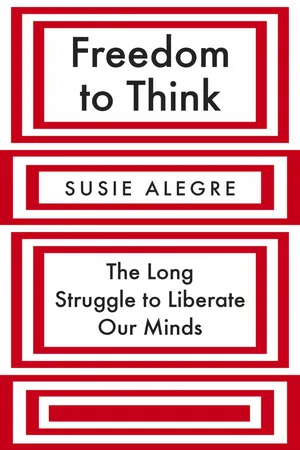
- 376 pages
- English
- ePUB (mobile friendly)
- Available on iOS & Android
eBook - ePub
About this book
Information
Part 1
______
THE ANALOGUE
CHAPTER 1
________
INNER FREEDOM
All human beings are born free and equal in dignity and rights. They are endowed with reason and conscience and should act towards one another in a spirit of brotherhood.
Article 1, Universal Declaration of Human Rights
In a dusty Ivy League law library, the walls lined with leather-bound books written by men who looked a lot like him, Zechariah Chafee came to understand, viscerally, that there was a gulf between the ideal of human freedom expounded by the Founding Fathers and what that freedom meant in practice in the United States in the early twentieth century. As he contemplated the dust motes dancing in the shafts of late-afternoon sunlight that penetrated the tall windows, waiting for the illustrious legal minds poring over his opinions to decide his fate, Chafee’s absolute dedication to making freedom of opinion a reality in law and in life crystallised around him.
An upper-middle-class East Coast lawyer who had specialised in contract law, and a professor of law at Harvard, Chafee could have chosen a comfortable and easy life in the ivory towers of the American establishment. But he had views. And he had very strong views on the right of everyone to hold and express their opinions, no matter how unpalatable those opinions might be. The First Amendment now seems like such a fundamental part of the American approach to civil liberties, but before 1919, the US courts had not even looked at it. In the aftermath of the First World War, as the American government used the 1917 Espionage Act and the 1918 Sedition Act to crack down on critics of its war effort and to combat the first ‘Red Scare’, provoked by the Bolshevik Revolution in Russia, Chafee’s was a rare voice speaking out for freedom of speech. But his voice had global reach and impact.
Chafee’s scholarship and activism around the First Amendment were said to have informed the first Supreme Court declaration on free speech, in Justice Oliver Wendell Holmes Jr’s dissenting judgment in the case of Abrams v. United States,1 in which immigrants were convicted for distributing leaflets condemning American intervention in Russia. While Chafee did not share their opinions, he could not step back from defending their rights both to hold and to share their views.
Academic freedom is fundamental to the development of human knowledge and wisdom. But far from finding a haven in academia, Chafee’s stance on freedom of opinion and expression threatened to undermine his academic career. He was effectively put on trial when Harvard Law School carried out an extraordinary investigation and hearings to determine whether his writing on free speech made him ‘unfit as a law school professor’.2 Although he ultimately survived this challenge and stayed on at Harvard, his opinions saw him dragged before the House Committee on Un-American Activities and listed by Senator Joe McCarthy as a person who was ‘dangerous to America’.3 Chafee knew only too well that ‘the inclination of men who obtain the power to govern is to use that power for the purpose of controlling not only the actions but the thoughts of men’.4
He understood the need to protect the right to hold opinions without interference, not because of an innate American respect for the principles enshrined in the First Amendment, but rather because he had direct experience of state suppression of unpopular opinions and the pressure of conformity of thought, even in the intellectual palace of Harvard. For Chafee, it was clear that freedom of opinion was not just an idea or a value; it was a necessity for human society, and one that was in urgent need of protection, in law and in practice, in the United States and around the world.
The right to freedom of thought, religion, conscience and belief along with the closely related right to freedom of opinion are fundamental but often overlooked pieces in the universal human rights jigsaw. They are the inner freedoms that allow scientific progress, artistic inspiration, emotional fulfilment, political engagement and spiritual enlightenment. For democratic elections to function, each of us needs to be able to freely form an opinion so we can contribute to decisions on the direction of our country. Without this freedom, democracy is meaningless. And these are freedoms that underpin our personhood and the way we see ourselves as human beings.
Ideas and values can help shift the way we approach and view our lives, but it is the translation of ideas and values into laws that really moulds our societies and gives ethics weight. Laws regulate human relationships. They set the limits on the way we interact and how we treat each other. And human rights laws have provided humanity with a moral compass after periods of turmoil when it became clear that we had lost our way. They are nuanced, profound, principled and fundamental to our individual and collective humanity, dignity and autonomy. We all need them, and if we want to keep them, we need to think about what our rights mean and defend them. To do that, we need freedom of thought.
The fight for rights
Human rights are not new. Over the centuries, human rights and fundamental freedoms were developed primarily to rein in state powers. The international human rights laws that emerged in the twentieth century were a response to the atrocities of the Holocaust and were designed to prevent our governments from harming us, but they also put obligations on states to protect us from each other and from the actions of private businesses. In recent years, as the line between the public and private spheres of life has blurred, the importance of human rights to restrain corporate reach into our lives has become increasingly important. They provide a bulwark against governmental or societal excess and a crucial foundation for democracy. Without human rights, democracy runs the risk of becoming a ‘tyranny of the masses’, as philosopher J. S. Mill once feared.
Understanding how the philosophical ideas of the Enlightenment were transformed into universal laws requires a brief introduction to where human rights come from and why they matter. Human rights are universal, indivisible, inviolable and interdependent, but, perhaps inevitably, there is some debate about who discovered them as legally recognised rights. In ancient Babylon, Hammurabi’s code, one of the earliest-known examples of a written legal code, recognised civil rights such as the presumption of innocence in criminal trials and economic rights including a minimum wage almost 4,000 years before such a radical law was passed in the United States in the 1930s. But alongside these progressive ideas, the ancient code included a litany of barbaric punishments and grisly ways to be put to death should anyone transgress. It is a far cry from the kind of human rights template we want to live by in the twenty-first century.
England, France and the United States scrap, rather predictably, over their relative importance in the origin story of modern human rights. The Magna Carta of 1215 is often cited (at least by the English) as evidence that Runnymede, a green field just outside London, was the true birthplace of human rights. But while the Magna Carta did serve to curtail the powers of the deeply unpopular King John by introducing important rights, such as access to due legal process, it was designed to protect the interests of the Church and the barons rather than those of ordinary people, who barely had any rights in law. For the serf in his field, it would have made very little difference, except perhaps to reduce the likelihood of being sent to war. In 1215, the idea that all men were born equal would have been not only ridiculous, but also a huge threat to the status quo – even expressing the idea would have been to risk serious punishment or death. No doubt that is why Robin Hood, King John’s legendary nemesis, who stole from the rich to give to the poor, has such an enduring appeal. The 1689 English Bill of Rights, which took a further step down the path to codifying civil and political rights, particularly freedom of elections and freedom of speech in Parliament, also did little to advance human rights or freedom for the average man or woman on the street or country lane. Most of them did not have a vote anyway. Civil and political rights, in England at least, were for the rich and powerful; they were not for the people.
Ironically, perhaps Britain’s most important contribution to the explosion of rights onto the eighteenth-century legal and political landscape was its oppressive rule in the Americas, which would go on to provoke one of the greatest leaps forward in the history of human rights as we know them today. Tired of the tyranny of the British Crown, the drafters of the American Declaration of Independence put the well-being of people as a primary purpose of governments (alongside a long list of complaints about the king) and set a template for the future of American democracy: ‘We hold these truths to be self-evident, that all men are created equal, that they are endowed by their Creator with certain unalienable Rights, that among these are Life, Liberty and the pursuit of Happiness. That to secure these rights, Governments are instituted among Men, deriving their just powers from the consent of the governed.’5
The first amendment to the American Bill of Rights from 1787 develops the theme of individual freedom as protected from state excess: ‘Congress shall make no law respecting an establishment of religion, or prohibiting the free exercise thereof; or abridging the freedom of speech, or of the press; or the right of the people peaceably to assemble, and to petition the government for a redress of grievances.’6
Finally, the governed had the right to take a view on their government. The focus on civil liberties reflected the history of the United States as a refuge for those escaping religious and ideological persecution in Europe. The primary place of freedom in the US constitution has made it a defining feature of the American approach to human rights, with a stronger focus on freedom of expression without limitation by the state than in many other countries, particularly in continental Europe. The American Founding Fathers, such as Benjamin Franklin, knew that ‘without freedom of thought, there can be no such thing as wisdom’,7 but they stopped short of setting down that freedom explicitly in law. However, the interpretation of the constitution, in particular the First Amendment, by the courts has underlined the fundamental importance of both freedom of thought and freedom of expression to the American model of democracy in the twentieth century. Justice Brandeis explained the importance of free thought in his concurring opinion in the 1927 US Supreme Court case of Whitney v. California, a case involving a woman who was convicted for her part in helping to establish the Communist Labor Party of America:
Those who won our independence believed that the final end of the State was to make men free to develop their faculties, and that, in its government, the deliberative forces should prevail over the arbitrary. They valued liberty both as an end, and as a means. They believed liberty to be the secret of happiness, and courage to be the secret of liberty. They believed that freedom to think as you will and to speak as you think are means indispensable to the discovery and spread of political truth … They recognized the risks to which all human institutions are subject. But they knew that order cannot be secured merely through fear of punishment for its infraction; that it is hazardous to discourage thought, hope and imagination; that fear breeds repression; that repression breeds hate; that hate menaces stable government; that the path of safety lies in the opportunity to discuss freely supposed grievances and proposed remedies, and that the fitting remedy for evil counsels is good ones. Believing in the power of reason as applied through public discussion, they eschewed silence coerced by law … the argument of force in its worst form.8
How far the Founding Fathers could have predicted the ways that their ideas about freedom would be developed in law is debatable. But it is clear that their work on the US constitution had a profound effect on the future of human rights far beyond their borders.
Liberté
The last two decades of the eighteenth century were a time of upheaval on both sides of the Atlantic, with radical ideas fuelling a desire to create a new world order that would overthrow the abusive privilege of monarchy and aristocracy. The radical thinkers of the time cross-pollinated their ideas as they swept away physical and intellectual borders, with the likes of Thomas Paine, Mary Wollstonecraft, Thomas Jefferson and Benjamin Franklin riding the waves across the Atlantic and the English Channel to share their ideas as effectively, if not as efficiently, as an undersea data cable. The revolutionary spirit of eighteenth-century France, inspired by the philosophers of the Enlightenment, saw the first comprehensive legal proclamation of human rights and democratic principles as we know them today. Unlike its British precursors, there was no doubt that the Declaration of the Rights of Man and of the Citizen, drafted by the French National Constituent Assembly in 1789, was for the people, not the ruling classes. It was the legal embodiment of the Enlightenment ideals of natural and civil rights.
In 17 clauses, it set out the principles that prescribe the way in which the sacred rights of men must be protected and respected to ensure the happiness of all. These were sweeping and basic principles that described the fundamental freedom and equality of all men (women still had a while to wait) and established the preservation of the natural rights of liberty, property, security and resistance to oppression as the necessary aim of all political associations. As a precursor to modern human rights laws, these clauses placed the rule of law at the heart of government, ensuring that any limitations on freedom must be set down in law and could only be justified to protect the good of others or to prohibit actions that were harmful to society. The rules of due process, including the right to be considered innocent until proven guilty, the principle of no punishment without law, and humane treatment for detainees, were also codified in the Declaration. Principles governing the military, taxation, rep...
Table of contents
- Cover
- Title
- Copyright
- Contents
- Introduction: The Best of All Possible Worlds
- Part 1: The Analogue
- Part 2: The Digital
- Part 3: The Possible
- Acknowledgements
- Endnotes
- Index
Trusted by 375,005 students
Access to over 1.5 million titles for a fair monthly price.
Study more efficiently using our study tools.
Frequently asked questions
Yes, you can cancel anytime from the Subscription tab in your account settings on the Perlego website. Your subscription will stay active until the end of your current billing period. Learn how to cancel your subscription
No, books cannot be downloaded as external files, such as PDFs, for use outside of Perlego. However, you can download books within the Perlego app for offline reading on mobile or tablet. Learn how to download books offline
Perlego offers two plans: Essential and Complete
- Essential is ideal for learners and professionals who enjoy exploring a wide range of subjects. Access the Essential Library with 800,000+ trusted titles and best-sellers across business, personal growth, and the humanities. Includes unlimited reading time and Standard Read Aloud voice.
- Complete: Perfect for advanced learners and researchers needing full, unrestricted access. Unlock 1.5M+ books across hundreds of subjects, including academic and specialized titles. The Complete Plan also includes advanced features like Premium Read Aloud and Research Assistant.
We are an online textbook subscription service, where you can get access to an entire online library for less than the price of a single book per month. With over 1.5 million books across 990+ topics, we’ve got you covered! Learn about our mission
Look out for the read-aloud symbol on your next book to see if you can listen to it. The read-aloud tool reads text aloud for you, highlighting the text as it is being read. You can pause it, speed it up and slow it down. Learn more about Read Aloud
Yes! You can use the Perlego app on both iOS and Android devices to read anytime, anywhere — even offline. Perfect for commutes or when you’re on the go.
Please note we cannot support devices running on iOS 13 and Android 7 or earlier. Learn more about using the app
Please note we cannot support devices running on iOS 13 and Android 7 or earlier. Learn more about using the app
Yes, you can access Freedom to Think by Susie Alegre in PDF and/or ePUB format, as well as other popular books in Social Sciences & Civil Rights in Politics. We have over 1.5 million books available in our catalogue for you to explore.