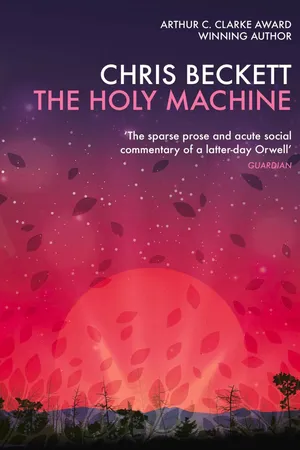
George Simling has grown up in the city-state of Illyria, an enclave of logic and reason founded as a refuge from the Reaction, a wave of religious fundamentalism that swept away the nations of the twenty-first century. Yet to George, Illyria's militant rationalism is as stifling as the faith-based superstition that dominates the world outside its walls.
For George has fallen in love with Lucy. A prostitute. A robot. She might be a machine, but the semblance of life is perfect. To the city authorities, robot sentience is a malfunction, curable by erasing and resetting silicon minds. But George knows that Lucy is something more.
His only alternative is to flee Illyria, taking Lucy deep into the religious Outlands where she must pass as human because robots are seen as mockeries of God, burned at the stake, dismembered, crucified. Their odyssey leads them through betrayal, war and madness, ending only at the monastery of the Holy Machine...
- 294 pages
- English
- ePUB (mobile friendly)
- Available on iOS & Android
eBook - ePub
The Holy Machine
About this book
Information
Subtopic
Literature GeneralIndex
Literature1
Perhaps I should start this story with my escape across the border in the company of a beautiful woman? Or I could begin with
the image of myself picking up pieces of human flesh in a small room in a Greek taverna, retching and gagging as I wrapped
them in a shirt and stuffed it into my suitcase. (That was a turning point. There’s no doubt about that.) Or, then again,
it might be better to begin with something more spectacular, more panoramic: the Machine itself perhaps, the robot Messiah,
preaching in Tirana to the faithful, tens of thousands of them clutching at its every word?
But I think I will begin with a summer night when I was twenty-two years old. (Here I am, look, at twenty-two, fumbling for
my key on the landing outside our Illyria City apartment, my briefcase tucked awkwardly under my arm… ) I didn’t know it at
the time but it was on this night that my strange journey began.
I had been working late in my office at a company called Word for Word. I was a translator and my job was to assist with the
language side of the various trade transactions that took place between our strange Balkan city-state and the hostile but
impoverished territories that surrounded us. (Seven different languages were by then spoken within a radius of two hundred
kilometres – and at least that many religions were fervently practised, each of them claiming to be the final and literal
truth about everything.) There were some rewards involved in working as long hours as I did but the real reason was that I
had nothing else to do, and even the office late at night felt more like home than the bleak apartment that I shared with
Ruth.
Ruth was my mother. I always called her Ruth. She never liked the idea of being mum. I was conceived quite accidentally in
a boat full of frightened refugees crossing Lake Michigan. My parents were complete strangers to one another, but just that
once they clung together for comfort. I believe it was the only sexual encounter of Ruth’s adult life.
‘Ruth?’ I called as I opened the door.
But as usual she didn’t answer because she was suspended in her SenSpace suit, jerking back and forth like a puppet as she
wandered in the electronic dreamworld. It was something she seemed to do now almost all the time except when she was sleeping
or at work She was getting very thin, I observed coldly as I glanced into the SenSpace room and saw her threshing around in
that lattice of wires. SenSpace food might look and even taste good – they had recently found ways of projecting olfactory
sensations – but it could never fill you up.
I ordered my own meal and a beer from the domestic, an old X3 called Charlie, which we’d owned since my childhood. He trundled
patiently off to the kitchen on his rubber tyres. (Getting him repaired was increasingly difficult, but we hung onto him anyway.
He was one of the family, perhaps even its best-loved member.) While the meal was heating up, I wandered out onto the balcony
with the beer. We were fifty floors up and it was a fine view. You could see the sea in one direction and glimpse the bare
mountains of Zagoria in the other. But all around us were towers of steel and glass. Our Illyria was a city of towers,
built by the best engineers and scientists on the planet as a homeland for themselves, and a refuge from the religious extremists
of the Reaction, from which Ruth and her generation had fled.
I was very lonely in those days. I spoke eight languages fluently, but I had no one to talk to and nothing to say. I didn’t
know how to be a part of the world. And as for Ruth, she didn’t even want to be. We were both of us creatures of fear. High
up there in the steel canyons of our city, I would even try to derive some sense of comfort and company from the little lights
of other apartments across the void, and try to persuade myself that the flashing signs in the commercial sector were speaking
personally to me.
DRINK COCA-COLA!
RELY ON MICROSOFT!
WATCH OUT FOR CHANNEL NINE!
Then Charlie called me in for my meal and I sat in front of the TV and flipped on the news. In Central Asia, new religious
wars were in the air and crowds were streaming round and round that hideous statue that bleeds real blood donated by the faithful,
chanting ‘death! death! death!’ In Holy America, where Ruth grew up, new laws had restricted the franchise to ‘God-fearing
male heads of Christian families’ and introduced the death penalty for promulgating the sinful doctrine of Evolution.
I flipped channels. Our TV held all programmes broadcast in the last twenty-four hours on its hard disc, so you could flip
backwards and forwards as well as sideways. I hopped to and fro: random moments from a movie, a documentary about discontinuous
motion, a sitcom…
Then I came to Channel Nine and was suddenly captivated
by the image of an amazingly pretty woman, with lovely gentle eyes.
I didn’t know it then of course, but it was Lucy.
It was actually a programme about syntecs, robots that were coated with a layer of living flesh. They were virtually identical to people, except in the one important
respect that, unlike the foreign ‘guestworkers’ who were the working class of our city, but like all other robots, they could
be programmed. They did not have a personal or a cultural history. They did not have the virus of irrationality and superstition
which seemed to have infected ordinary uneducated folk throughout the world.
The government’s long-term intention was to use robots to replace the guestworkers altogether, removing from our midst a dangerous
fifth column for the Reaction. Thousands of human workers – Greeks, Turks, Arabs, Albanians, Russians, Indians, Filipinos
– had already been sent away. Of course most of the robots who took over their jobs were fitted with plastic skins at best,
and many bore no serious resemblance to human beings. But syntecs had been specifically developed to provide those services
that were thought to require a ‘human’ touch. Wealthy people acquired syntec domestic servants, for example, and some prestigious
offices acquired beautiful syntec receptionists. They were a luxury item.
Inevitably there were also syntec sex workers. (Communication satellites, computers, the printing press: human beings always
find a sexual angle.) Lucy was a syntec prostitute, though they were known officially as Advanced Sensual Pleasure Units,
or ASPUs for short. The TV programme explained that ASPUs were entirely beneficial to society. They harmed no one, they could
not themselves experience suffering and there was no empirical
evidence to support the contention that their existence might encourage crimes against women. Quite the contrary was true,
apparently. They had reduced the incidence of rape and they also helped prevent the spread of venereal diseases. Only superstitious
notions of right and wrong could prevent anyone from seeing they were a thoroughly good and rational thing.
But never mind all that. The image of Lucy had touched me. It had touched a raw place inside me and I was suddenly disturbingly
aroused by the idea that she not only existed but was readily and easily available. I could hold her in my arms tomorrow…
And there could be no rejection, no complications, no one to disappoint…
I flipped back to see her again, curled up in her lacy negligee on the corner of a sofa. She might not really be alive, but the semblance of life was perfect. So was the sweetness and the softness and the grace.
Make allowances, if you can, for the fact that at that time I had never been held by another human being. As a child my main
companion was Charlie, our X3, with his rubber tyres and his vocabulary of fifty sentences. I used to have him ‘sleep’ by
my bed.
I let the programme run on again in real time. It was called NOW! and was a nightly current affairs round-up which gave the official government line. At the end of it Channel Nine shut down,
as it always did, with the image of President Ullman, the father of our state.
He was a giant of a man, a bleak man, a man of granite. Back in America, in the terrible early days of the Reaction, Christian
mobs publicly flogged him and his wife to unconsciousness for refusing to recant their work on in vitro fertilization. Mrs Ullman had died.
Now every night he was shown at close-down, grimly crumbling a clay figurine of a human form into dust. Look! There is no
soul, there is no spirit, there is no ghost inside the machine.
Of course I had seen it too many times for it to make any conscious impact on me. But on this particular night I thought I’d
take one more peek at the pretty robot before I went to bed and, for no particular reason, instead of just flipping back to
the previous programme I got the machine to run backwards.
I saw the dust streaming upwards from the table and assembling itself miraculously in Ullman’s hands, into a human form.
And the dour old rationalist was transformed into something like the Christian God.
2
Ruth had gone to sleep in SenSpace again. Her body dangled from its wires, her helmeted head slumped forward. She would get pressure sores if she wasn’t careful.
I called to her, then went over and shook her. I did it quite roughly. I resented having to look after her.
‘Oh George, it’s you,’ she said, lifting the face piece and blinking at me with her owlish eyes. ‘I must have gone to sleep. Can you get me out of here?’
I sighed, unzipped her and helped her out of the dangling suit. I hated this job because she always got in there naked in order to achieve maximum contact with the taxils.
She was so little and thin. She had no breasts and barely any pubic hair. When I lifted her down it was as if I was the parent and she was the child. And yet if you looked carefully at her belly you could see the traces of my Caesarian birth.
I looked away from her and wrapped her up quickly in the robe that she’d left lying on the floor.
‘You should eat more and spend less time in there, Ruth. You’re not doing yourself any good at all.’
‘Oh I’m so tired George, could you just take me through to my room?’
‘Carry you? Again?’
‘Please.’
‘Goddamit Ruth, you must eat! You’re wasting yourself away!’
But I carried her through anyway, tucked her in bed, sent Charlie through with her knockout pills, and stood and watched her while she curled up in a foetal position and began to sink back down towards sleep.
‘Please, please sleep,’ I whispered.
I was exhausted myself, and drained, and wretched. I longed for my own bed, my own oblivion…
‘Please, just sleep…’
And it really did begin to look as if for once she would do just that.
But then, no, it was not to be. My whole body clenched as I saw her shoulders beginning to shake.
‘Just sleep for fuck’s sake, Ruth!’ I wanted to scream at her, but I bit my tongue.
And as the little whimpering sobs began to come, I made myself cross the room again and sit down on her bed and hold her hand.
‘There, there,’ I repeated mechanically, ‘there, there, there…’
I don’t know much about her childhood. Something frightening must have happened to her I suppose, because I believe the reason she chose a career in science was that it was neutral, factual, safe – far away from the painful and messy business of human life. (That’s how science seemed to people in the days before the Reaction.)
She shut herself in her laboratory in Chicago with her robot assistant Joe and she worked and worked and worked, going home alone in the evenings to a neat little apartment where she tended her houseplants and her collection of Victorian china cups…
In India, the Hindu extremists massacred the industrial elite. In Israel, the ultra-Orthodox came to power in a coup, in Central Asia the vast statue of the Holy Martyr was constructed in Tashkent and every day thousands of pilgrims gave blood to keep its wounds eternally flowing… But Ruth came into work at eight every day and extracted DNA from genetically modified chicken embryos, hardly passing the time of day with anyone but Joe.
Then the Elect came to Chicago. They held mass prayer meetings at which thousands turned to Jesus and to their cause, they roamed the streets looking for the abortionists, the homosexuals, the unbelievers… Fired by fierce preachers, the ordinary people of America were rising up against the secular order that had taken meaning away from their lives. The police stood by. The authorities looked away. Everyone could see that a dam had broken. Even the President tried to make his peace with the Elect.
And Ruth had a cup of coffee at 11 a.m. and took ten minutes out to read her porcelain collectors’ magazine. She refused to hear the chanting in the street. She refused to notice the burning houses that could be clearly seen from her fourth-floor laboratory window. Until suddenly they were kicking open the door, flinging open the incubators, sweeping test tubes onto the floors…
Joe was smashed to pieces in front of her, his stalk eyes roll...
Table of contents
- Cover
- Copyright
- Dedication
- Chapter 1
- Chapter 2
- Chapter 3
- Chapter 4
- Chapter 5
- Chapter 6
- Chapter 7
- Chapter 8
- Chapter 9
- Chapter 10
- Chapter 11
- Chapter 12
- Chapter 13
- Chapter 14
- Chapter 15
- Chapter 16
- Chapter 17
- Chapter 18
- Chapter 19
- Chapter 20
- Chapter 21
- Chapter 22
- Chapter 23
- Chapter 24
- Chapter 25
- Chapter 26
- Chapter 27
- Chapter 28
- Chapter 29
- Chapter 30
- Chapter 31
- Chapter 32
- Chapter 33
- Chapter 34
- Chapter 35
- Chapter 36
- Chapter 37
- Chapter 38
- Chapter 39
- Chapter 40
- Chapter 41
- Chapter 42
- Chapter 43
- Chapter 44
- Chapter 45
- Chapter 46
- Chapter 47
- Chapter 48
- Chapter 49
- Chapter 50
- Chapter 51
- Chapter 52
- Chapter 53
- Chapter 54
- Chapter 55
- Chapter 56
- Chapter 57
- Chapter 58
- Chapter 59
- Chapter 60
- Chapter 61
- Chapter 62
- Chapter 63
- Chapter 64
- Chapter 65
- Chapter 66
- Chapter 67
- Chapter 68
- Chapter 69
- Chapter 70
- Chapter 71
- Chapter 72
- Chapter 73
- Chapter 74
- Chapter 75
- Chapter 76
Trusted by 375,005 students
Access to over 1.5 million titles for a fair monthly price.
Study more efficiently using our study tools.
Frequently asked questions
Yes, you can cancel anytime from the Subscription tab in your account settings on the Perlego website. Your subscription will stay active until the end of your current billing period. Learn how to cancel your subscription
No, books cannot be downloaded as external files, such as PDFs, for use outside of Perlego. However, you can download books within the Perlego app for offline reading on mobile or tablet. Learn how to download books offline
Perlego offers two plans: Essential and Complete
- Essential is ideal for learners and professionals who enjoy exploring a wide range of subjects. Access the Essential Library with 800,000+ trusted titles and best-sellers across business, personal growth, and the humanities. Includes unlimited reading time and Standard Read Aloud voice.
- Complete: Perfect for advanced learners and researchers needing full, unrestricted access. Unlock 1.5M+ books across hundreds of subjects, including academic and specialized titles. The Complete Plan also includes advanced features like Premium Read Aloud and Research Assistant.
We are an online textbook subscription service, where you can get access to an entire online library for less than the price of a single book per month. With over 1.5 million books across 990+ topics, we’ve got you covered! Learn about our mission
Look out for the read-aloud symbol on your next book to see if you can listen to it. The read-aloud tool reads text aloud for you, highlighting the text as it is being read. You can pause it, speed it up and slow it down. Learn more about Read Aloud
Yes! You can use the Perlego app on both iOS and Android devices to read anytime, anywhere — even offline. Perfect for commutes or when you’re on the go.
Please note we cannot support devices running on iOS 13 and Android 7 or earlier. Learn more about using the app
Please note we cannot support devices running on iOS 13 and Android 7 or earlier. Learn more about using the app
Yes, you can access The Holy Machine by Chris Beckett in PDF and/or ePUB format, as well as other popular books in Literature & Literature General. We have over 1.5 million books available in our catalogue for you to explore.