A penniless publisher teetering on the brink...
Hugh Emerson runs a glamorous upmarket publishing house. But literature doesn't pay the bills, and now his bestselling author is the subject of a tabloid scandal. Emerson Publishing needs cash, fast.
A newspaper dynasty struggling to survive...
Ned Macaulay, heir to a newspaper dynasty and Hugh's best friend, steps in to help. But Ned has problems of his own. The family firm is on the brink of bankruptcy, and to save it he must confront his despotic father and outsmart the self-serving sycophants at Waring's bank.
Ruthless bankers closing in for the kill...
Soon Hugh and Ned are dragged into a cut-throat world of devious investors and muck-raking journalists. It's darker and dirtier than they ever imagined - but if they want to succeed, they know they have to play dirty too.
In times like these, once you're in for a penny, you're in for a pound.
- English
- ePUB (mobile friendly)
- Available on iOS & Android
eBook - ePub
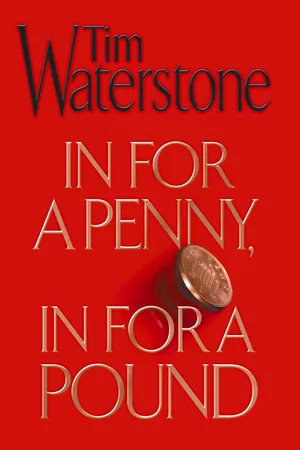
In For a Penny, In For a Pound
About this book
Information
Part One
1997
1
The Huber Publishers offices were tucked away in a dark, litter-strewn corner of Holborn, at the furthest end of what in its time had been a fashionable arcade. These days it was a desert of boarded-up shop fronts, among which were scattered two or three little newsagents, a charity shop, a bookmaker, and a Chinese restaurant, filthy, tiny, in its window the suspended carcasses of ducks, orange, naked, obscene. Then, beside a chiropodist, was the Huber office.
In Huber’s window, propped up on plastic supports, were faded, dusty copies of their books. These were backed on either side by curled posters of Lenin and photographs of the Jarrow March and a gaudy, vast oil painting of gallant, shiny-booted, rigid-backed Russian soldiers striding out in step, their heroic women, shawled, babies on hips, seeing them off to war. More formally, displayed behind glass, were some Gustav Klucis litho -graphs of the 1920s, with titles like The Strength of Millions of Workers Drawn into the Building of Socialism.
Hugh Emerson stood for a moment admiring the Klucis lithographs, and wished they were better lit. He hesitated, then pushed the door open and walked in. He’d explained to Huber why he was coming, so it was too late to back down. The door had set off a chime, and after a moment Huber himself, a bearded, tall, bulky figure, emerged from the back office. He came across the corridor to Hugh, arms outstretched, the cuffs of his poorly laundered shirt grey and threadbare.
Looking at him, Hugh wondered, not for the first time since he had called him earlier that day, whether Huber actually had any money. If he hadn’t, then this visit was pointless. But four or five years before, when Huber had offered to help finance the fledgling Emerson Publishers list, Huber had showed him his accounts. The books Huber published sold barely a few hundred copies each year, and many of them fewer than that. But he had possessed a goldmine: a contract with the Soviet licensing agency, giving him exclusive translation rights to a great number of Soviet technical and academic journals, all of which had an automatic advance sale to every major library. Perhaps, post the Soviet collapse, he had managed to sustain this with the new Russia.
‘Hugh, dear,’ Huber said, holding Hugh’s proffered hand in both of his, and squeezing it. ‘Hugh, the great white hope of the book world. Come in, and tell me all about it. Tea, please, Phyllis dear,’ he called out to his assistant, by publishing lore his mistress of many years, full bosomed and flushed in her purple jersey and faux pearls. ‘Earl Grey – and our very best biscuits for our distinguished visitor. The fatted calf for Hugh Emerson, Phyllis, if you please.’
His hand on Hugh’s sleeve, Huber guided him into a small office at the very back of the building, plunged into gloom by the rear of the dilapidated Edwardian hotel that abutted it. Books, manuscripts, a fax machine, proofs of technical drawings – there was a clutter about it all that reminded Hugh of his own office in a Camden Town cul de sac. But the Huber version of it was much more feminine. On the windowsill stood a prim little miniature rose in a pink vase, a tiny watering can beside it. The curtains, suburban chintz, were tied at their centre by a neat bow. Huber’s pencils and pens were tidied away into a pewter tankard on the battered, antique walnut desk, and beside this two or three of his pipes stood in their rack; anachronistic to the fashion of mid-1990s Britain, but, Hugh thought, in their Middle European style, somehow part of the Huber persona. Laid carefully parallel to the pipes was a leather pocket case containing his spectacles.
Huber sat Hugh down in what he appeared to consider the best chair, first sweeping off it an Abyssinian cat, white and fluffy, its hairs left embedded in the worn purple velvet of the seat.
‘Well, Hugh, tell me again what’s on your mind,’ Huber said. ‘I feel rather like your headmaster. You’ve spent all your money, and you want some more, and if you don’t get it there’s going to be a nasty scene with your bank manager. You told me, or rather you muttered something I could hardly catch, so I rang that finance man of yours – Joe? – while you were on the way, and he . . . he gave me the gen.’
He speaks in quotes, Hugh thought. ‘Gave me the gen.’ There was an arch, pedantic manner about it, a foreigner in his third or fourth language attempting what he imagined to be the very latest in modish street argot.
Huber sipped his tea, which Phyllis had served in pretty pink porcelain cups and saucers. Chipped, Hugh noticed, as was the walnut desk, but hinting at refined gentility.
‘Well – yes,’ Hugh replied, ‘that’s pretty well what’s happened. Publishing is not easy in the early years, as you well know, when one is building the list. We were going very well, then we made two or three mistakes. And, rather quickly, we found ourselves very illiquid, and with a new bank manager who didn’t like the look of the business.’
Huber kept his cup to his lips, peering at Hugh over the rim. His benign expression had disappeared. ‘How much is your monthly overhead?’
‘We run Emerson on about £90,000 a month. Then we have our production costs to pay as we print the list. Plus authors’ advances, and because we are trying so hard to grow, we need to carry an increasing investment in stock. So we have quite a requirement for cash – all the time.’ He tried to smile in cheery self-confidence, hating the camp pantomime he was obliged to act out. Phyllis came into the room to clear away the tea, Huber gazing pleasantly at her great bottom as she bent to gather the cups on to the tray.
‘Do you have any more money to put in, Hugh? Or a rich aunt, or an adoring godfather, or anybody? Or an adoring wife, if it comes to that? I seem to remember she’s a great star around your firmament, am I right? She’s a barrister? Your age, thirty and a bit, and already earning millions?’
‘Hardly that. She’s a barrister – yes – but of course she’s not earning millions. No, Nicola and I can’t afford to put in more than we already have. We’ve already gone too far, probably.’
‘Your parents?’
‘No, not my parents.’
‘So I’m the end of the line.’
‘Yes – you’re the end of the line.’ Hugh replied too quickly, then flushed at his rudeness.
‘Well, here you are with me, you poor child, at the end of the line. But tell me, Hugh – why should I help you? I offered you a hand when you were first starting out, but you turned me away. Tough titty – wouldn’t you say? Tough titty,’ he repeated, chuckling, delighted with the phrase. ‘Why shouldn’t I just let you go under? One less competitor and all that sort of thing? What’s it to me?’
He shrugged, but then half smiled, and leant across to pat Hugh on the knee. ‘That’s not fair. I’m playing with you, you must think. Perhaps I am. These things happen, and you don’t have to tell me that the early days of a publishing venture are very tough. I found my way through, I’m glad to say, but only just, and that almost entirely due to my connections in the then Soviet Union. But most don’t survive, at least not in independence. You will, perhaps, because you have that sort of cut about you, but it will be touch and go.’
He smiled, reached into his drawer and drew out a cheque book and a receipt pad. He took a pen, then hesitated. ‘The bank has given you just seven days, your Joe told me. So we’ve got a little bit of breathing space with them, if not very much. You owe them £240,000. And this collection agency want their cash tomorrow, I gather from Joe. Insisting on it: £13,000 cash.’
Hugh was appalled that Joe had told Huber so much, humiliated. But left to himself, Hugh would have prevaricated. Joe had simply told the truth, no doubt having in his mind already abandoned Emerson and started interviewing for his next job. ‘Yes,’ he said, grimacing in his embarrassment.
‘They want £13,000, in cash,’ Huber repeated and pretended to wince, ‘by tomorrow morning. You’re not cheap, dear, are you?’
He went to the door, opened it, and called up the passage. ‘Phyllis – how much cash have we got in our secret money-box we don’t worry the tax man about?’
There was a muffled reply.
‘It can’t be. As much as that? Oh yes, of course. There was that little receipt of ours last week. Well, get the key out, poppet, and open it up. This is a stick-up. We are about to be robbed.’
Huber returned to his chair, motioning Hugh to remain where he was. ‘Give the beastly people their money tomorrow, get the proper paperwork and a receipt for it, and keep it all safe. During the early part of next week we’ll transfer into your bank the funds needed to pay off your overdraft – when Joe told me the amount I nearly fell off my chair, I have to tell you – and we’ll help to negotiate another arrangement with my bank, covered by my guarantee. Give Phyllis your account details, and sign a little note for her, agreeing we’ll settle terms between us later next week. And then, Hugh, we’ll need to make our plans for the future. Or otherwise I’m afraid you’ll have to give me back what I’m now advancing to you, and I will leave you to your own devices with your bank.’
Hugh looked like stone, then Huber laughed. ‘But of course it won’t come to that!’ he said, and reached out to shake Hugh’s hand. Hugh rose to his feet, and Huber fussed over him and his raincoat and whether it was still wet and if Hugh should borrow a hat and scarf, then saw him out into the arcade and on his way. He had pushed into Hugh’s inner breast pocket the two thick envelopes of fifty-pound notes. Given the seediness of the Huber offices, the notes were surprisingly crisp and clean.
Two days later they were again in Huber’s office, once more with Phyllis’s chipped porcelain tea cups in their hands. This time the Abyssinian cat was asleep on Huber’s lap, its long white hairs moulting into his crumpled grey flannel trousers.
‘Claus – look, it was very good of you to have done what you did,’ Hugh said, smiling brightly, quick to get to the point. ‘The reason I’m here today is that I’m conscious that we’ve left some ends untied, and we need to clarify where we are.’
Huber nodded, and pulled at his earlobe. ‘That’s right, my dear, we do. Putting it baldly, you’ve got six months’ debt cover at the bank on my guarantee. And you owe me £13,000 cash, on a twenty-day note, that sum not to be taken from the account I’m now guaranteeing. You’re right – we need to discuss how I’m going to get my little cash loan back and how you’re going to deal with all that debt once my guarantee lapses. And what the future holds for Emerson.’
He reached forward and patted Hugh on the knee, patronisingly, too physically familiar. Hugh shifted his position. ‘What do you have in mind?’
Hugh nodded. ‘As far as the cash is concerned, I’m going to have to ask you to extend the note for a further seven days. I’ll ask Nic if we can sell a couple of pictures, and repay the money that way, but I need another week to have the money in my hands.’
Huber shrugged, cocked his head, and smiled pleasantly. ‘Of course,’ he said. ‘And then?’
‘The company’s debt, you mean? That’s my main concern, but I’m planning to come up with a solution within three or four weeks, and then let you off the hook.’ Hugh smiled, he hoped with a convincing show of warmth. ‘Together with an appropriate fee, of course, that goes without saying. Perhaps we should both take professional advice as to what that might be.’
Huber nodded, and watched him, his hooded eyes disquieting. Hugh was sure that Huber was going to push for the guarantee to be converted into an investment into Emerson, at a level that would make the company effectively a joint venture between the pair of them. He was not going to allow that. Emerson Publishers was Hugh’s alone, founded with a great ambition to create one of the foremost literary publishing houses in the country. And he had no intention of sharing that with Huber. He shouldn’t have come to him in the first place. It was momentary panic that had done it, prompted by the call from the collection agency.
Huber suddenly switched his features into a smile, and made a dumb show of offering Hugh some more tea. ‘A fee? I’m not sure I’d know what level of fee to demand of you, Hugh. Besides, we have the arrangement covered, don’t you remember? You signed the little piece of paper Phyllis drafted up for us.’
‘Of course I remember signing the paper. But it said nothing very much – just an acknowledgement of the cash advance and a simple acceptance of the terms of your guarantee.’
‘And those terms were?’
Hugh shrugged. ‘Nothing. Terms to be agreed between the two parties.’
‘Well, that’s splendid. Perhaps I should tell you what those will be. Number one – I shall immediately withdraw that guarantee if we are unable to agree the terms of it; and, number two, in the event of the bank debt not being cleared at the end of two months – eight weeks – I will assume that debt and apply it to the purchase of Emerson shares at one penny each.’
Hugh forced himself to smile. ‘I can’t agree to that, I’m afraid, Claus. I don’t want another investor in Emerson. I want it to stay entirely under my control.’
Huber leant over and patted his knee again, and Hugh let him. He fought to remain calm.
‘Then you shouldn’t have run out of money, you silly boy, should you?’ Huber said. ‘And who knows – perhaps you can stay independent! All you have to do is pay off the debt within two months, and there we are. Plus of course the £13,000 cash, and the interest, and if I do decide on a little fee, that too. And then, thanks to me, this nasty little crisis of yours will be over, and you’ll go on to all the great things you’ve dreamed of, without a backwards glance!’
‘But Claus, there’s no way I can pay the bank off in two months. I’m so grateful to you for what you’ve done, but those terms, by which you buy cheap shares – the shares have a par value of one pound, not one penny – if I had realized that was what you wanted, I would have . . .’
‘Today’s Thursday. Let’s say you have until next Tuesday evening, would that be fair? Let me know by Tuesday evening whether you agree my terms, and then we can both initial one of Phyllis’s little bits of paper and on we go. And if you don’t – and I would quite understand it, Hugh, believe me, I really would – we can forget the whole thing and you can repay me the cash. And – you’re right – my fee. Immediately. There and then on Tuesday evening. And at that moment I’ll tell the bank that the guarantee has lapsed and that they should look to you for the money. Fair’s fair?’
He got to his feet, fussed over whether cat hairs had stuck to Hugh’s trousers, brushed down his coat and, holding his arm as affectionately as before, saw him out into the arcade.
‘I’ll hear from you on Tuesday then!’ Huber called, and Hugh, returning his wave and his smile with an attempt at insouciance, set off on his way, trying to make his stride as jaunty and confident as he could. But inside he was numb.
Hugh looked across at his brother James, and wished that he had not come to see him.
Six years older than Hugh, James was a partner at the grandee advisory investment bank of Waring’s. As far as Hugh could deduce he was these days not only very wealthy, but also, judging by Hugh’s occasional sightings of his name in the financial press, considered to be something of a corporate finance star. Desperate on leaving his unhappy meeting with Claus Huber, Hugh could think of no one else to go to, uncomfortable with his brother as he had always been, so he had telephoned, been snapped at, but had been fitted into James’s diary that very evening. And there he was now, ill prepared and ill at ease, seated before his brother in a quite impossibly grand office for a man of less than forty. It occurred to Hugh that the room might not actually be his, and that he had borrowed it for the occasion in order to overawe him.
‘I always knew that rotten little company of yours would run out of cash,’ James was saying, with satisfaction. ‘Of course it was going to. Hopelessly undercapitalized, poorly structured on the debt side, I’ve seldom seen anything so amateurish in my life. And here we are, and you have run out of cash. Lock, stock and barrel. Even quicker than I thought you would.’
He barked out a laugh, contemptuous and insulting and, with a flick of the hand, pushed the Emerson Publishers accounts back across the table. ‘You publish well, I suppose, or so people tell me, and in that sense you may be surviving, even thriving, how do I know? But as a financial entity, as an investment prospect . . .’
He shook his head, theatrically, and laughed again. ‘You should have come to me...
Table of contents
- Cover
- Copyright
- Dedication
- Part One: 1997
- Part Two: Three Years Later – 2000
- Part Three: Four Years Later – 2004
- Postscript: One Year Later – 2005
Trusted by 375,005 students
Access to over 1.5 million titles for a fair monthly price.
Study more efficiently using our study tools.
Frequently asked questions
Yes, you can cancel anytime from the Subscription tab in your account settings on the Perlego website. Your subscription will stay active until the end of your current billing period. Learn how to cancel your subscription
No, books cannot be downloaded as external files, such as PDFs, for use outside of Perlego. However, you can download books within the Perlego app for offline reading on mobile or tablet. Learn how to download books offline
Perlego offers two plans: Essential and Complete
- Essential is ideal for learners and professionals who enjoy exploring a wide range of subjects. Access the Essential Library with 800,000+ trusted titles and best-sellers across business, personal growth, and the humanities. Includes unlimited reading time and Standard Read Aloud voice.
- Complete: Perfect for advanced learners and researchers needing full, unrestricted access. Unlock 1.5M+ books across hundreds of subjects, including academic and specialized titles. The Complete Plan also includes advanced features like Premium Read Aloud and Research Assistant.
We are an online textbook subscription service, where you can get access to an entire online library for less than the price of a single book per month. With over 1.5 million books across 990+ topics, we’ve got you covered! Learn about our mission
Look out for the read-aloud symbol on your next book to see if you can listen to it. The read-aloud tool reads text aloud for you, highlighting the text as it is being read. You can pause it, speed it up and slow it down. Learn more about Read Aloud
Yes! You can use the Perlego app on both iOS and Android devices to read anytime, anywhere — even offline. Perfect for commutes or when you’re on the go.
Please note we cannot support devices running on iOS 13 and Android 7 or earlier. Learn more about using the app
Please note we cannot support devices running on iOS 13 and Android 7 or earlier. Learn more about using the app
Yes, you can access In For a Penny, In For a Pound by Tim Waterstone in PDF and/or ePUB format, as well as other popular books in Literature & Literature General. We have over 1.5 million books available in our catalogue for you to explore.