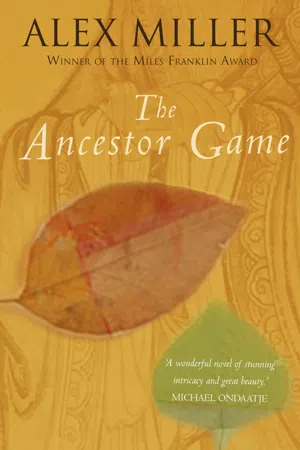
Steven Muir, August Spiess and his daughter Gertrude, and Lang Tzu all acknowledge a restless sense of cultural displacement, an ambivalence in their relations with the culture of European Australia.
Steven left England for Australia as a young man and his one attempt at returning is unsuccessful. August Spiess, although he speaks frequently of returning to his native Hamburg, fails to make the journey, as does his daughter Gertrude. Lang Tzu's very name defines his fate: two characters which in Mandarin signify the son who goes away.
The 'game', however, does have winners. For despite their yearnings for the home of their ancestral dreams, a desire to belong somewhere that is truly their own, none of Miller's characters leaves Australia, and each in their own way comes to see that to be at home in exile may be a defining paradox of the European Australian condition: the paradox of belonging and estrangement that perhaps lies uneasily at the heart of all European cultures.
eBook - ePub
The Ancestor Game
About this book
Information
Print ISBN
9781741142266
Subtopic
Literature General
THE ENTRANCE TO THE OTHER-WORLD

The last of the yellow leaves had turned brown and fallen from the poplar by June. It was now too cold, most days, to sit out on the mound. Lang had retreated to the gas fire in his front room. Nothing I suggested would shift him. He agreed readily, and even with apparent enthusiasm, to all my proposals, but he did nothing. It became obvious he was determined to proceed no further with me. I persisted, however, looking for ways to cajole him. None of it worked. We both just ended up drinking more and staying up even later than usual. It began to get a bit exhausting after a while.
Then I arrived at Coppin Grove one Saturday at my usual time, shortly after two o’clock, and found he wasn’t at home. This had never happened before and I realised that it might be all over. I might not be able to retrieve the situation. These thoughts scrambled through my mind as I stood at the front door waiting longer than I knew was sensible. I felt a bit shocked, afraid for the first time of how it was really going to turn out for me. I was trying not to remember that my old illusion that I could go back to England if Australia failed me, the myth I’d dragged out and given a shake every time there had been a crisis in my life, was no longer available to comfort myself with. Trying not to remember it induced a pang of homesickness, a moment of vivid nostalgia for England and safety.
Certain he wasn’t going to be there, but unable to face turning round and just going away again, I went to the back of the house and knocked on the kitchen window and called. I didn’t want to be forced to acknowledge just how much Lang and The Chronicle of the Fengs meant to me. I wanted to be getting on with it, to keep going at it. I didn’t want to glimpse, however obliquely, my extraordinary vulnerability to him. He wasn’t there of course. Through the brownish film of grease on the window, I could see the mess on the kitchen table. Empty winecasks and junk mail mostly, with bills from the SEC and the Board of Works scattered through it, and fine-art auction catalogues, dozens of them. And a piece of mummified roast pork-on-the-bone, which had been lying there since the night of my first visit to the house in February, when he’d insisted we dine on pork Shanghai style at three o’clock in the morning.
I stood on the verandah for a long time wondering what to do, for at least a half hour, staring out at the garden. A drizzling rain had begun to fall. Which made some sort of sense of standing under the shelter of the verandah. If I didn’t do something at once, if I didn’t make something happen which was so major and so decisive that he could neither ignore it nor fail to be drawn into it (if I wasn’t able, by some means, to worm my way into a vital region of my host) then the project was over. I would have been defeated by his fear and by his alcoholism, one the symptom of the other, and by the impossible inertia of the house and its contents, those mountains of unexamined memorabilia belonging to his past and to Victoria’s, which lay there on the English mahogany dining table gathering dust like furnishings for the after-life in the tomb of an extinguished dynasty.
I stood outside the back door looking towards our old base camp, thinking these thoughts and feeling let down and bitter towards him. He might at least have telephoned me to say he would be going out today. No doubt he would claim he had and that I’d failed to answer my phone. But he wouldn’t have. For to have done so would have meant risking a confrontation. To have phoned me would have meant bringing his reluctance to continue with our project into the open and talking about it. A reluctance he denied feeling. So how could he talk about it? It was all in my imagination, he would claim. He would challenge me to show some evidence of it and would insist I was being paranoid and unfair to him. Hadn’t he always been enthusiastic about my ideas, about the work? I was stuck, that was my trouble, he’d suggest, I had writer’s cramp or block or whatever it was called and was looking for a scapegoat. He’d take the blame for that too if it would make me feel better.
I would emerge from any such discussion scarified and exhausted. His logic would be irrefutable. He would gently imply that while an apology from me would be nice he wasn’t going to insist on one. He’d let it pass. It didn’t matter to him. Things like that, dignity and saving face and such like, were of no consequence to him. There were bigger things for some people to worry about in this life than who was in the right and who was in the wrong. And while I was rendered mute and angry he would seize the initiative and urge that we begin work at once on the next section. Come on Steven, cheer up. Let’s get on with it. Look at all this stuff. We haven’t touched it, yet. You can’t see where we’ve been. Let’s get my mother’s gold out and have a look at it. It’s in here somewhere.
But if I were to take him up on the offer, by some means the work would get frustrated and only the drinking would get done. We’d be unable to find his mother’s gold, or anything else of interest. The truth was, and I knew it, I was supposed to read his indirect messages only and to behave accordingly. I was supposed to capitulate without a fuss. And if I wanted something to do, I could always recite Burns to him when he was feeling low and have a drink to keep him company. Possibly I might even consider going away altogether for a while and waiting soundlessly until I was summoned, one evening when he was feeling lonely again.
Gertrude’s question made complete sense to me at last. What was I going to do? I knew exactly what she’d been asking. I had no idea what the answer might be. The rain was sheeting across the garden now, a heavy mist driven by a cold southerly. One of the cane chairs had been blown onto its side weeks ago in a storm. I decided this was the moment to right it. I went out along my disappearing path to the mound, which looked less of an eminence in this heavy light than it had in the clear dry weightlessness of autumn, when it had seemed to float a little above the rest of the garden, drawn up as much then by optimism and by Gertrude’s amber wine as by the refractive qualities of the light, no doubt. I set the chair on its legs and tried to brush the leaves from its seat, but they clung flatly to the wet surface of the cane. I gave it a firm shove, so that its legs were forced a little into the earth, which was spongy from more than a week of heavy rain. Then I stood behind the chair with my hands on its back, as if there were someone seated in it. Someone content to sit and gaze towards the summerhouse through the leafless coppice. As if I were their companion, an attendant to their needs, occupying a place with them somewhere between that of a friend and an employee. An amanuensis, possibly. A servant really, but enjoying the peculiar dignities bestowed by an intimacy with the employer’s person and most private thoughts. If it was to be Victoria in the chair then I didn’t mind, I had no objection to my questionable status. She could depend on my loyalty.
I was getting wet but I didn’t want to leave. The garden was a miserable sight, bare and cold and dripping and black. Still I didn’t leave. He’d been right. There were things I had to know. Things I couldn’t hope to guess. If he denied me access to the material, then I would be unable to go any further. My fiction, just as Victoria’s had been, was dependent on a supply of reliable information. It couldn’t subsist on invention. At best the task was always going to be an impossible one and its successful completion therefore an unlikely paradox. The task, the only task I could see as being worth attempting, was to penetrate the impermeable face of present reality. I must do it despite the impermeability of the barrier, and I must do it rather than go around the barrier or ignore it. I must get beneath the hard surface by one means or another, because that is where the fictional strata lay, under the polished face of the great enigma of reality, that huge sculpted monolith, a massive object of worship constructed by our ancestors so long ago that no clue as to the means of its construction survives. The puzzle we find our attention bound to despite our efforts to look elsewhere, despite our efforts to find a place in our consciousness which is not within its shadow.
To get beneath the impermeable barrier of present reality, I believed my writing would have to acknowledge the existence of the barrier. My writing would have to contain the barrier. It would have to be the barrier itself. Verisimilitude, on at least one of its operational levels, I considered vital to the enterprise. I knew I needed the facts as reference points if I were to have any chance at all of encountering the feelings and the intuitions which I sought. She had thrown off Coppin Grove and her mother and her sisters in order to locate her fiction of the northern hemisphere within herself. I was required to do something similar.
Without their leaves, the straight grey poles of the poplar suckers looked like a monstrous cereal crop of some kind. A whimsical mockery of old agricultural practices and far-eastern influences. I could see the entire assemblage laid out in one of the courtyards of the National Gallery. Sculpture for the people. I began to feel an intense resentment towards the suckers. I did need a scapegoat. But doesn’t everyone? Did this make him right about everything else as well?
I can’t be sure, but I rather think I may have said this aloud; to Victoria, whom I knew would appreciate its silliness. She might have leaned back in the chair, making the cane creak, and have reached up with her hand for mine and have given a soft laugh. I realised it is possible to love the dead whom one has never met.
The rain had set in more heavily. I felt helpless standing there with my hands on the empty chair. Had he gone to see Tom Lindner? Should I abandon this nonsense and go to the gallery and drink champagne with them and discuss the price of art? What is the price of art? Should I join them? I am ready, I would say. Let us drink to something. And then let us go on drinking. I ordered myself to count to three and on three to release the chair and leave the garden. But I couldn’t go through with it.
When my mother had reminded me that the Sidney Nolan monograph related to my own past and not to my father’s, I’d felt so defeated for a minute or two that I couldn’t think. She might as well have revealed to me that something as implacable and incontrovertible as Providence or Fate was against the realisation of my conscious intentions. The kind of thing Huang warned Lien about Feng having on his side. He is in league with Fate. He might as well have said the Devil. Don’t waste your energies trying to get the better of that. You’ll fail.
The wind had dropped and the rain had begun to fall heavily almost straight down, as it does in Hokusai’s woodcuts. The summerhouse was fortified by the suckers. As if the ground around it had been staked, the way the defenders of the village in Kurosawa’s Seven Samurai staked the ramparts with sharpened bamboos to keep the bandits out. Taking the chair with me I left the mound and forced my way through the suckers to the summerhouse.
There was a strong smell of cat spray. The boards sagged a bit but did not give way, and the wide upturned eaves provided shelter for more than three-quarters of the interior. I put the chair down. There were three empty teachests lined with silver paper and there was a small table and a chair. The table and chair were broken. Not smashed, but fallen apart, the joints weathered out. It wouldn’t take much to repair them. And there was some other junk in a pile in one corner. As if someone had come along and had a go at cleaning up but had abandoned the task. I pulled out the silver lining from one of the teachests and spread it on the wet seat of the cane chair I’d dragged in, and I sat down and looked out at the rain. As the heat of my thighs began to warm them through, my trousers gave off a vapour and a pleasant self-smell. My silver-lined chair was windproof and cosy. I was comfortable. I felt relieved that I’d avoided being entirely frustrated by his absence from the house. The rain continued heavily. I was glad of its grey, intimidating screen. I was glad to be made invisible by it. I stared out at it, feeling that I’d reached a sanctuary, pleased now that Lang was not at home and grateful to have achieved a respite from him and from the exhausting manoeuvrings of the game.
From where I was seated the mound appeared insignificant. It was not a prominent feature of the landscape from the perspective of the summerhouse. The dominant elements of the view – and these opposed each other in an interesting way-were, to the north, the opaque mass of the house, blocking off the light from that source as if it signified an end, as if there could be no going any further in that direction; and, to the east, the tall, open stand of eucalypts, the remnant of native forest, which glowed in the rain with a cold interior phosphorescence, promising diffuse and interesting spaces to the curious traveller.
These two vertical features, the house and the forest, confronted each other across the open area of lawn. The mound from here was a no-man’s-land. It was an abandoned base camp. Abandoned by everyone, by the mother and by the daughter and now by us. I began to see that the summerhouse was positioned at the trig-point of this triangular arrangement. The summerhouse, neither itself quite house nor clearing nor alluring space, but possessing elements of the features of all three, was in fact the interstitial place from which, with the cunning trigonometry of her fiction, she had surveyed her landscape. The summerhouse was the indeterminate feature by means of which she had located herself and engineered her escape from Coppin Grove.
I knew I’d realised something that ought to have been obvious to me for a long time. Something that had been obscured, however, until this last week or two, by the tremulous mask of aspen leaves, the dense thicket of suckers that was at last leafless and no longer able to conceal the secret hidden at its heart. It was a shock to find myself seated there. It seemed I had found my way there, not by any conscious deductive process, not as the result of careful observation, but by the instinctive homing intuitions of a true parasite. It seemed that I’d been making my way towards her workplace all the time. Going out to the mound had not just seemed like the establishment of a base camp, it really had been one, a preparatory stage towards the eventual occupation of the summerhouse. I was delighted by this extension of my metaphor, of myself as a parasite, as ‘one who eats at the table of another’.
The rain was slackening. When it stopped altogether, I resolved that I would go to the lean-to where I’d found the cane furniture and I’d get the axe I’d seen there and hack a pathway through the suckers to the steps of the summerhouse. The path would signify my occupation. It would be undeniable. I would knock her table and chair together and he would find me already hard at work, as if I were Victoria returned from the northern hemisphere – as Gertrude had it in her image – one hundred years on. The summerhouse would be my winter quarters. He would be required to approach me along my path. I would abandon him.
When he returned from drinking with Lindner, he would find that I had not retreated in confusion from his door, defeated, but had inserted myself into the interstice created by his momentary absence, and that I had thereby seized the indirect initiative myself. He would see, to his dismay, that the situation had changed during his absence, but not as he had foreseen, nor as he had planned. He would see that if he wished to reinstate himself, then he would have to read my signs. I’d been too clever for him. He’d underestimated me. He would not be able to ignore the challenge to the interpretation of his material implied by my occupation of her worksite. It was a masterful stroke of indirectness.
She had written, ‘This bright autumn day with the sun warm against my shoulders, the twenty-seventh of May 1908, he is dying. My half-brother from Shanghai, who is wholly Chinese, is with him. I can see my brother’s shadow at the window. He stands behind my father’s chair and waits to become the second Feng. He is a practical man. I believe Australia means nothing to him … I would like to cease writing and walk among the trees, among that remnant of bushland which lies yonder, between the riverbank and the road … The shadow of my brother has gone from the window. My father, the first Feng, is dead. I am alone, now, with my horse and my fiction. I am in my thirtieth year. I have been many years in preparation. Now even Shinje, the Lord of Death herself, could not be better mounted for such a journey as I intend to make.’
From where I was seated it was not possible to see the upper storey windows of the house. I got up and moved my chair closer to the edge and sat down again. I looked up towards the large bay window at the back of the house, which I took to be the one Victoria had referred to. Lang was up there, standing at the window, watching me …
In the house he handed me a glass of wine and remained close beside me, his shoulder just touching my upper arm, sheltering beside me. He seemed extraordinarily fragile. I recalled an impression I’d formed of him even before we’d met, that he might not be going to have a middle-age but might carry his arrested youthfulness all the way to old age and even to the moment of his death – a solitary figure far out from shore on the dangerously thin sea ice, moving away slowly. Then when I looked again he was gone. The landscape was empty. It was a northern winter landscape I saw him in, almost the icy fogbound river where my mother and I had held our brief vigil in memory of my dead father. I knew I would wake one day to find that Lang no longer existed. A line from Tarn came to me and I spoke it aloud: Like the snow falls in the river, a moment white then melts for ever.
He moved away and leaned on the window sill, his face half-turned towards m...
Table of contents
- COVER PAGE
- TITLE PAGE
- COPYRIGHT PAGE
- DEDICATION
- CONTENTS
- BOOK ONE
- BOOK TWO
Trusted by 375,005 students
Access to over 1.5 million titles for a fair monthly price.
Study more efficiently using our study tools.
Frequently asked questions
Yes, you can cancel anytime from the Subscription tab in your account settings on the Perlego website. Your subscription will stay active until the end of your current billing period. Learn how to cancel your subscription
No, books cannot be downloaded as external files, such as PDFs, for use outside of Perlego. However, you can download books within the Perlego app for offline reading on mobile or tablet. Learn how to download books offline
Perlego offers two plans: Essential and Complete
- Essential is ideal for learners and professionals who enjoy exploring a wide range of subjects. Access the Essential Library with 800,000+ trusted titles and best-sellers across business, personal growth, and the humanities. Includes unlimited reading time and Standard Read Aloud voice.
- Complete: Perfect for advanced learners and researchers needing full, unrestricted access. Unlock 1.5M+ books across hundreds of subjects, including academic and specialized titles. The Complete Plan also includes advanced features like Premium Read Aloud and Research Assistant.
We are an online textbook subscription service, where you can get access to an entire online library for less than the price of a single book per month. With over 1.5 million books across 990+ topics, we’ve got you covered! Learn about our mission
Look out for the read-aloud symbol on your next book to see if you can listen to it. The read-aloud tool reads text aloud for you, highlighting the text as it is being read. You can pause it, speed it up and slow it down. Learn more about Read Aloud
Yes! You can use the Perlego app on both iOS and Android devices to read anytime, anywhere — even offline. Perfect for commutes or when you’re on the go.
Please note we cannot support devices running on iOS 13 and Android 7 or earlier. Learn more about using the app
Please note we cannot support devices running on iOS 13 and Android 7 or earlier. Learn more about using the app
Yes, you can access The Ancestor Game by Alex Miller in PDF and/or ePUB format. We have over 1.5 million books available in our catalogue for you to explore.