- English
- ePUB (mobile friendly)
- Available on iOS & Android
eBook - ePub
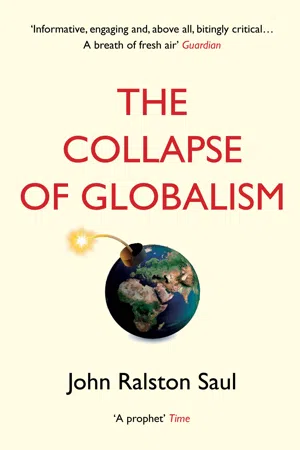
The Collapse of Globalism
About this book
Globalization is dead. Nation states are resurgent, international trade has enriched the few rather than the promised many, and democratic values are on the retreat. The shining-eyed optimism of more open, more equal societies has given way to demagoguery and nationalism. As the problems of immigration, extremism and the economy cause the world's nations to rethink their relationships, John Ralston Saul's brilliantly insightful
The Collapse of Globalism lights the way to where we go from here.
Information
PART I
CONTEXT
[A law which prevents free trade is a] law which interferes with the wisdom of the Divine Providence, and substitutes the law of wicked men for the law of nature.
— Richard Cobden, speeches, 1843
— What do you need her for?
— What I needed God for, before I became an atheist. Something to worship.
— August Strindberg, The Creditors, 1888
To attempt to apply economic determinism to all human societies is little short of fantastic.
— Karl Polanyi, Commentary 3, no. 2, 1947
Ideology provides a lens through which one sees the world, a set of beliefs that are held so firmly that one hardly needs empirical confirmation.
— Joseph Stiglitz, Globalization and Its Discontents, 2003
1
A Serpent in Paradise
Globalization emerged in the 1970s as if from nowhere, fully grown, enrobed in an aura of inclusivity. Advocates and believers argued with audacity that, through the prism of a particular school of economics, societies around the world would be taken in new, interwoven and positive directions. This mission was converted into policy and law over twenty years — the 1980s and ’90s — with the force of declared inevitability.
Now, after three decades, we can see the results. These include some remarkable successes, some disturbing failures and a collection of what might best be called running sores. In other words, the outcome has had nothing to do with truth or inevitability and a great deal to do with an experimental economic theory presented as Darwinian fact. It was an experiment that attempted simultaneously to reshape economic, political and social landscapes.
That very clear idea of Globalization is now slipping away. Much of it is already gone. Parts of it will probably remain. The field is crowded with other competing ideas, ideologies and influences ranging from the positive to the catastrophic. In this atmosphere of confusion, we can’t be sure what is coming next, although we could almost certainly influence the outcome.
Leading figures who once said nation-states should be subject to economic forces now say they should be reinforced to face global military disorder. Prophets of Globalization who said “Privatize, privatize, privatize” now say they were wrong, because the national rule of law is more important. Economists are angrily divided over whether to loosen or tighten controls over capital markets. Increasingly strong nationstates, like India and Brazil, are challenging the received wisdom of global economics. Pharmaceutical transnationals find themselves ducking and weaving to avoid citizen movements.
Dozens of examples like these tell us that we are transiting one of those moments that separate more driven or coherent eras. It is like being in a vacuum, except that this is a chaotic vacuum, one filled with dense disorder and contradictory tendencies. Think of it as a storm between two weather fronts. Or think of those moments in fast-moving sports, like soccer or hockey, when a team loses its momentum and there is furious, disordered activity until one side finds the pattern and the energy to give it control.
These moments tend to begin with denial on all sides. The confusion frightens those who thought they were setting the direction. And it disappoints those who criticized that direction. There is nothing decisive or noble about the situation. The options are not clear.
Yet, a period of uncertainty is also one of choice, and therefore of opportunity. We cannot know how long it will last. Probably not long. And those choices that set the future will come insidiously, in fits and starts. Some have already presented themselves and somehow been processed, without our fully registering that a determining step was taken.
The shape of what comes next will therefore be decided — a conscious act — or it will be left to various interest groups to decide for us, or simply to fate and circumstance. It will probably emerge from a mix of all three. The soundness of the outcome will depend on the balance between these necessary mechanisms. The most dangerous disequilibrium will have favoured fate and circumstance over the other two. The most mediocre, interest groups. The soundest equilibrium would be led by conscious public decisions.
This book is about our ability to choose. It is also about where those choices might lead us.
To believe in the possibility of change is something very precise. It means that we believe in the reality of choice. That there are choices. That we have the power to choose in the hope of altering society for the greater good. Do we believe that our governments must inevitably tax the poor through stealth taxes such as state-controlled gambling? Or do we believe there is a choice? Do we believe that unserviceable Third World debt could be written off, if we chose to do so? The conviction that citizens have such power lies at the heart of the idea of civilization as a shared project. And the more people are confident that there are real choices, the more they want to vote — a minimal act — and of greater importance, the more they want to become involved in their society.

What does Globalization mean? Defining received wisdom is often a scholastic trap. Worse still, as the British Liberal John Morley put it a century ago, “If we want a platitude, there is nothing like a definition.”1 It is better to come at the subject in a context.
How much of Globalization will disappear? When a grand idea or ideology is fresh and the sailing is easy, even the most serious proponents make all-inclusive claims on its behalf. This grand view makes it easier for them to impose the specific changes they want. When things become more complicated, as they do, most of the same advocates retreat to more modest claims, while still insisting on the central nature of their truth and its inevitability. Many will angrily deny they ever claimed more.
Yet the papers, books, theses, speeches and articles on the subject, from country after country, are perfectly clear. For a quarter-century — at least until the mid-’90s — public and economic debate and the resulting policies were driven by an all-inclusive vision of what Globalization was and why it was inevitable. Those texts are also a reminder of how computers have made economics even more dismal, and how much less this approach to economics is about thought than about statistics of uncertain value. That which never was a science struggles with difficulty to remain a domain of speculative investigation.
As to which parts of the Globalist belief system will disappear and which will stay, we have no idea. If everything went it would be dangerous. The last thing we need is rampant nineteenth-century nationalism combined with old-fashioned protectionism as an international principle. But once large forces begin to move about in a period of uncertainty, we cannot know the outcome. Look back. Put yourself in the context of times that led to great reversals. The people of those eras were usually amazed at how easily the once inevitable became the soon forgotten; and this whether the change in question was for the better or the worse.
If you look around today there are clear examples of Globalization as a success story. The most obvious is the growth in trade. And there are the examples of its failures. Think of New Zealand or, in a more comic vein, of the deregulated airline business. And then there are the running sores. The Third World debt crisis is now in its third decade.
Perhaps most important, there are other, broader forces at work — a growing para-political engagement of young people; the normalization of accelerated international violence; the re-emergence of nineteenthcentury-style nationalism in a range running from the merely predictable to the most destructive; the emergence of new national models, for example, some which are not racially based; and the straightforward reaffirmation of the nation-state, even inside the least expected of places, the European Union.
What these random examples tell us is that social and political realities since the early 1990s have not unfolded as predicted. These altered realities are now setting the course, in place of the economic forces that for the last three decades have been declared to be in charge. Or rather, to be inevitably in charge.
A shrinking number of people believe that economics could actually set a broader course for any civilization. I’ve noticed that not many people even bother listening when the old assertions of global economic inevitability are made. Inside the small, closed world of economists and officials and interest group associations and specialist writers, that sort of talk does go on. Why not? But most of us are elsewhere. And so, therefore, is the world.
What about our life in such an in-between time? I described this as a vacuum — an interregnum between two unreasonable certainties. If we use it as a short, positive moment of uncertainty when choice is privileged, well then, it becomes possible to emerge into a less ideological and more humanitarian era. This is not an unreasonable ambition or expectation. History is filled with interregnums — some military, some religious, some political, and many of them economic.
Ours is to a great extent a vacuum of economic thought, which adds an element of even greater uncertainty because economics is a romantic, tempestuous business, rather theatrical, often dependent on the willing suspension of disbelief by the rest of us. As with other fashions, its truths change more often than in more concrete sectors.
Civilizations, religions, languages, cultures, nations, even nation-states tend to last centuries. For economic theories a quarter-century is a good run. A half-century is unusual. More than that is something to boast about.
Most of these vacuums become filled with a swirl of concerns, not just military or economic or religious. They reflect the complexity of real life. Some of them have been used intelligently, some disastrously. And in some cases people are so convinced that the reigning ideology is inevitable that they never realize they are in a vacuum. So they are amazed to find themselves abruptly heading in another direction.
Admitting to the need for change is not the most common human trait. And the more power we have, the less change interests us; indeed, the more it frightens us. Nevertheless, eras do stumble, grind, pitch to an end and then, there we are, once again groping our way through an obscure vacuum.
There were those remarkable years in the early sixteenth century when religious reform movements in northern Europe might have led to a strengthened and inclusive one church. The complex tension between Erasmus and Luther illustrated that choice was still possible. Perhaps because so much depended on Erasmus’s ethical leadership and he was simply too old, the positive turned negative and tension turned to violent division with hundreds of thousands of dead. Or there were those few years after the fall of Napoleon when a fairer European society seemed possible, at least until Metternich’s influence over the power structures of the continent became dominant and he tied everyone up in a situation resembling peace without hope. Or those few years after the First World War when all seemed possible. Most of the smaller nationstates that saw in the Treaty of Versailles their chance for independence actually had to wait until 1989. Now some twenty-five of them, new nations or newly independent nations, are getting their first real chance to act as independent entities. They have finally become what many would call a Westphalian or others a nineteenth-century nation-state. They wish to express in the fullest possible manner their national existence. We don’t know if this will be positive or negative. What we do know is that in one corner Globalists are declaring the nation-state to be a weakening phenomenon of the past, while in another corner two dozen nation-states stand fresh born, full of energy and ambition with at least a century’s worth of frustration to work out.
John Maynard Keynes was on the British delegation at Versailles in 1919 and he resigned in protest when he saw the opportunities of that vacuum being thrown away in the negotiations. In 1919 he published his first explanatory protest. It began:
The power to become habituated to his surroundings is a marked characteristic of mankind. Very few of us realize with conviction the intensely unusual, unstable, complicated, unreliable, temporary nature of the economic organization by which Western Europe has lived for the last half century. We assume some of the most peculiar and temporary of our late advantages as natural, permanent and to be depended on, and we lay our plans accordingly.2
The economic organization he was referring to was the first great modern experiment with free trade, perhaps even with Globalization, one that had risen out of the messianic struggle against the Corn Laws in Britain and then spread around Europe.
At this point you may well hear a chorus of true believers protesting that that was then. Now is now. And now we are far more integrated and in a far more complex manner, because technology, just for starter...
Table of contents
- Cover
- Title
- Copyright
- Contents
- Prologue
- Part I: Context
- Part II: The Rise
- Part III: The Plateau
- Part IV: The Fall
- Part V: and Where are we Going Now?
- Epilogue: The Return of Choice The Refusal of Choice
- Notes
- Acknowledgments
- Index
Trusted by 375,005 students
Access to over 1.5 million titles for a fair monthly price.
Study more efficiently using our study tools.
Frequently asked questions
Yes, you can cancel anytime from the Subscription tab in your account settings on the Perlego website. Your subscription will stay active until the end of your current billing period. Learn how to cancel your subscription
No, books cannot be downloaded as external files, such as PDFs, for use outside of Perlego. However, you can download books within the Perlego app for offline reading on mobile or tablet. Learn how to download books offline
Perlego offers two plans: Essential and Complete
- Essential is ideal for learners and professionals who enjoy exploring a wide range of subjects. Access the Essential Library with 800,000+ trusted titles and best-sellers across business, personal growth, and the humanities. Includes unlimited reading time and Standard Read Aloud voice.
- Complete: Perfect for advanced learners and researchers needing full, unrestricted access. Unlock 1.5M+ books across hundreds of subjects, including academic and specialized titles. The Complete Plan also includes advanced features like Premium Read Aloud and Research Assistant.
We are an online textbook subscription service, where you can get access to an entire online library for less than the price of a single book per month. With over 1.5 million books across 990+ topics, we’ve got you covered! Learn about our mission
Look out for the read-aloud symbol on your next book to see if you can listen to it. The read-aloud tool reads text aloud for you, highlighting the text as it is being read. You can pause it, speed it up and slow it down. Learn more about Read Aloud
Yes! You can use the Perlego app on both iOS and Android devices to read anytime, anywhere — even offline. Perfect for commutes or when you’re on the go.
Please note we cannot support devices running on iOS 13 and Android 7 or earlier. Learn more about using the app
Please note we cannot support devices running on iOS 13 and Android 7 or earlier. Learn more about using the app
Yes, you can access The Collapse of Globalism by John Ralston Saul in PDF and/or ePUB format, as well as other popular books in History & World History. We have over 1.5 million books available in our catalogue for you to explore.