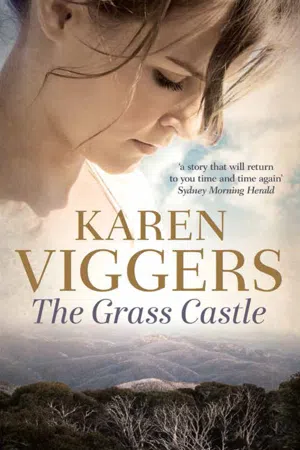
Abby is a young woman shying away from close contact with others and running from a terrible event in her early teens which has shaped her life. Then she meets Daphne, the daughter of a pastoralist, who grew up in a remote valley of the Brindabella Ranges. Daphne raised her family in the high country with her husband Doug, in a world of horses, cattle and stockmen. But the government forced them off their land, and years later, Daphne is still trying to come to terms with her departure from the mountains and the tragic impact it had on her husband.
Though years and life experience separate Abby and Daphne, they understand each other, and a gentle friendship forms. While Abby's traumatic past hampers her involvement with journalist Cameron, Daphne tussles with her own family history and the shadow it may have cast over the original inhabitants of the land. Both women must help each other face the truth and release long-buried family secrets before they can be free.
The Grass Castle is a sweeping rural epic that reflects the strength which resides in us all: the courage to learn and grow from the past.
eBook - ePub
The Grass Castle
About this book
Information
1
Night spreads its thick blanket over the valley. There is no moon, no light. Abby is alone in the car park, staring into darkness. She sees a wink of tail-lights somewhere along the road: two red fireflies flickering briefly in the bush. She hears the distant rumble of a car engine going too fast, now slowing for a corner. Then it is quiet. The national park is all around her—she can feel it. The soft hoot of a boobook owl somewhere in the distance. The muffled coughs of kangaroos. Higher up, against the sky, invisible granite crags hunch their stony shoulders. They are watching, always watching.
At the back of the four-wheel drive, she turns on a light and loads the last of her gear: her backpack, the esky. The journalist is gone and she’s not sure what to think; whether she should think at all. Probably not, none of it means anything. He’s a reporter and he was doing his job. That is the extent of it. She must take this afternoon for what it was and surf on, skimming surfaces, landing lightly. It’s the easiest way.
She’s been in the valley since morning, following her kangaroos through their monotonous herbivore day. Early, she tracked her radio-collared animals and watched them bounce among their colleagues before settling to graze. Kangaroos don’t do much, it seems. They sleep, graze, recline, hassle each other. But their movements are points on a map which tells her what their lives are made from: how the range of each animal overlaps, and how this changes when the grass grows . . . or doesn’t grow, as in this drought. Her work doesn’t sound like much, but it forms the shape of her career. She’s a researcher in training—paid almost nothing to wander among kangaroos, taking measurements that might help explain an ecosystem.
The lack of money doesn’t matter, or so she tells herself. Hopefully she will be paid more once she’s established her career. What matters is that she is doing something she cares about, something meaningful, and that she is making a contribution to saving this beautiful, complicated world. Equally important is that she is outdoors, not cooped up in some dreary office bathed in fluorescent light and surrounded by people staring like zombies at computer screens . . . although she does her share of screen-staring too, when she’s entering data or tussling with the strange and slippery discipline of writing up her research.
Working here returns her to her childhood. It reminds her of horse-riding through the bush with her mother, when often a kangaroo would appear suddenly on the track, startling the horses. Abby was always impressed by the kangaroo’s power as it surged away. She loves the way kangaroos move, the elegant efficiency of it. Where else on this planet can you see animals bound so gracefully with a muscular tail for counterbalance? She likes to watch how they interact, the liaisons that form in the mob: bands of mothers with young at foot. Did her own mother tend to her with such vigilance? Surely she must have felt her mother’s attentive hands stroking her hair. But she can’t remember. Ten years since her mother died and she still misses her. There’s a wall in her mind she can’t look behind, places she can’t go for fear of memories.
She switches off the light and slams the back door of the vehicle, pauses and listens to the quiet of the night, the rustle of air moving in the grass. Usually she goes straight home after work, but today the journalist came for the interview, so she stayed late. They talked, and now he is gone, driving back to town in his fancy sports car. The park is empty: just her, the kangaroos, and the wind.
She clambers into the vehicle, starts the engine and puts it in gear. She’s comfortable behind the wheel. Working here day and night, her body knows the road. She can drive almost without thinking.
She comes to the corner where perhaps she saw the journalist’s tail-lights blinking several minutes ago, and she brakes reflexively—it’s a sharper curve than you might think. The four-wheel drive slows smoothly, swings the turn, wheels gripping. Then she sees lights ahead and her heart lurches. It must be him, the journalist. And something must have happened. She knows already what it is.
The WRX is angled across the road, headlights flaring. She pulls up on the roadside and drags on the handbrake. The journalist is standing in front of his car looking down, and he’s folding his hands over and over. She slides out, her boots crunching on tarmac as she walks around the car.
A kangaroo is splayed on the road: its body crumpled, head erect, nostrils wide, ears quivering. The hind legs are skewed, dark clots of blood on its furry coat, a black pool expanding around it like oil. Abby sees the exaggerated lift and fall of the kangaroo’s chest, hears the laboured suck of its breathing. She sees the soft pale underside of the animal’s exposed belly, notices the pouch. ‘Can you turn off your headlights?’ she says quietly.
The bush hisses and sighs and the journalist looks at her, not understanding.
‘Your lights,’ she says. ‘They’re too close and bright. She’s frightened.’
He jerks with delayed comprehension then strides to his car and reaches inside. The road falls to sudden darkness and Abby swallows the beat of panic in her chest. She knows how this must end.
‘Perhaps you could leave your parkers on,’ she suggests.
There’s a faint click and the dim glow of parking lights softens the curtain of night. Cameron, the journalist, is staring at her, eyes and hair wild. He expects something of her—something she knows she can’t deliver.
‘You think it’s a girl?’ he asks, voice gravelly.
Not a girl, she says to herself. A female. Aloud she states: ‘She has a pouch.’
‘I hope I haven’t killed her baby,’ he says.
Pouch-young, she wants to say. It’s called a pouch-young. Even now, with this before her, she can’t suppress her inner scientist. She gazes up and finds a faint sliver of moon edging above the ridge. Then she looks at Cameron, still watching her, his face pinched.
‘Will she be all right?’ he asks.
The loaded question. She had known it would come as surely as she’d known what had happened when she saw his headlights on the road. Placing a hand on the bonnet of his car, she tucks her emotions inside. She’ll have to explain it to him as kindly as possible.

Cameron had come to her via her PhD supervisor, Quentin Dexter—an ecologist with an international reputation for scientific excellence. Quentin had handballed Cameron’s phone call on to Abby so she could do a soft-touch kangaroo story. Thanks, she’d thought at the time. Soft-touch wasn’t a term she would use to describe her research. She’d tried to worm out of it; she’d never had direct contact with the media before and she was afraid she would say the wrong thing. But Quentin insisted this was part of being a scientist. He said she should get used to it if she wanted an academic career.
Cameron suggested they meet in Abby’s office or at a café on campus to go through a few questions. Then he would hunt down some kangaroo shots from the wildlife archives and write his article for the Wednesday environmental supplement . . . if they could just fix a time? But Abby knew the university wasn’t right. It had pretty spreading grounds, carefully cultivated and manicured. But it was a bit like a museum—especially when the students were on holidays and the grounds were empty—and it seemed unlikely anything of consequence could happen there. Even the cockatoos, screeching regularly overhead, seemed to be laughing.
No, if they had to do this interview, Cameron should come to her valley where she could explain her work more clearly and he could get a feel for the place. In the morning she’d be busy, and later in the day the kangaroos would retreat to the wooded slopes. So late afternoon would be best. The kangaroos would be grazing, and the journalist could see them doing their thing.
She waited for him in the car park, but he was late, and she passed time tidying her gear, brushing grass seeds from the back of the work vehicle, checking her notebooks, watching the weather. By the time he arrived, she had almost given up. When his blue WRX came rushing too fast across the tarmac, she knew she wasn’t going to like him. He was tardy, flashy and impatient. He would want to finish the job and get back to his office. She watched him unfold from his sports car, rising to ridiculous heights above her. Let him try to patronise her and the interview would be over before it began. He reached into his car to tug out a black leather shoulder bag, before turning to meet her.
‘I’m Abby Hunter,’ she said, extending her hand.
‘Cameron Barlow.’
‘You’re late,’ she said.
He smiled without hint of apology. ‘Yes, I know. It’s genetic. Hope you had something to do.’
‘My work truck has never been cleaner.’
He was undeniably attractive, with tousled black hair that needed a cut, and he wore a hint of arrogance—something in the tilt of his head, or maybe it was the way his lips twitched as he looked down at her. His beige trousers and light suede coat were office-smart beside her work uniform of jeans, thermals and saggy woollen jumper. She felt small beside him, and he peered around the valley with an undisguised assessing stare that annoyed her. What did he see here, she wondered. Not the beauty of it, that was certain. Even she, with her upbringing in the Victorian mountains, had taken some time to warm to the different grandeur of this place, to love its tawny colours, the scabby peaks, the harsh blue skies—absent today.
‘Dry, isn’t it?’ he said, offhand. ‘Pity we couldn’t have arranged some green grass.’
‘It’s a drought,’ she said.
‘Green would have been good for the photos, but no matter.’ He shrugged and peered about. ‘Where are the kangaroos?’
‘You didn’t see any?’ She couldn’t conceal her surprise. From the park gates the road ran alongside open meadows where grass grew in frost hollows even in the driest of seasons. Kangaroos were always there, grazing or sleeping. He must have passed dozens without noticing.
‘I was concentrating on the road,’ he said, smiling blandly. ‘I don’t get to navigate such lovely twists and curves very often.’ He glanced at his shiny blue car. ‘The beast took control, I’m afraid.’
The beast—he said it in such a tender way she wondered if he was referring to himself or to his sports car. Perhaps he hadn’t even noticed the trees and the valley—it seemed all he’d appreciated was the road. ‘You’ll see plenty of kangaroos,’ she said, pointing up the valley. ‘But we’ll have to walk. There’s not much to see in the car park.’
His eyes and nose crinkled and he looked down at his shoes—nice leather lace-ups with polished toes.
‘It’s okay,’ she said. ‘It’s too dry for mud. And there’s a track. We’ll wander along and find some kangaroos for you.’
‘Good,’ he said. ‘I want to see them move.’
She felt reluctance in him as she led him from the car park along the old four-wheel drive track that ran among tussock grass and the dug-out furrows of a rabbit warren, recently ripped. Perhaps he seriously didn’t want to be here and she’d made a mistake inviting him. It was obvious he didn’t get out of his office too often, at least not to places where his hair might get ruffled and his shoes dirty. For a moment she was tempted to lead him the long way, skirting round the edge of the valley and up the steeper, rougher hills, so she could see him puff and struggle in those inappropriate shoes. But, glancing more carefully at his physique, she noted he looked fit—no soft city belly or double chins. Maybe he was worried about the time; he kept glancing at his watch. She hadn’t any idea of his other commitments, and perhaps it was a bit much to force him to come all the way out here simply to feel the atmosphere . . . her purist values running amok. She grappled with a flash of guilt, but was over it almost immediately. He’d manage. And the fresh air would be good for him.
As they walked up the valley, the interview looming, she felt a clutch of shyness, and was suddenly tongue-tied. What should she say to impress a journalist? What would he want to know? She waited nervously while he paused to stoop over his shoulder bag. When he straightened he had a small digital recording unit in his hand.
He nodded at her encouragingly and smiled. ‘Mind if I point this at you while we talk?’
Her shyness ratcheted up a level. ‘I’m not sure,’ she said. ‘My voice sounds horrible in recordings.’
‘Don’t worry.’ He flashed a reassuring grin. ‘It’s purely for re...
Table of contents
- COVER PAGE
- TITLE PAGE
- COPYRIGHT PAGE
- DEDICATION
- CONTENTS
- PART I
- PART II
- PART III
- PART IV
- PART V
- EPILOGUE
- ACKNOWLEDGEMENTS
Trusted by 375,005 students
Access to over 1.5 million titles for a fair monthly price.
Study more efficiently using our study tools.
Frequently asked questions
Yes, you can cancel anytime from the Subscription tab in your account settings on the Perlego website. Your subscription will stay active until the end of your current billing period. Learn how to cancel your subscription
No, books cannot be downloaded as external files, such as PDFs, for use outside of Perlego. However, you can download books within the Perlego app for offline reading on mobile or tablet. Learn how to download books offline
Perlego offers two plans: Essential and Complete
- Essential is ideal for learners and professionals who enjoy exploring a wide range of subjects. Access the Essential Library with 800,000+ trusted titles and best-sellers across business, personal growth, and the humanities. Includes unlimited reading time and Standard Read Aloud voice.
- Complete: Perfect for advanced learners and researchers needing full, unrestricted access. Unlock 1.5M+ books across hundreds of subjects, including academic and specialized titles. The Complete Plan also includes advanced features like Premium Read Aloud and Research Assistant.
We are an online textbook subscription service, where you can get access to an entire online library for less than the price of a single book per month. With over 1.5 million books across 990+ topics, we’ve got you covered! Learn about our mission
Look out for the read-aloud symbol on your next book to see if you can listen to it. The read-aloud tool reads text aloud for you, highlighting the text as it is being read. You can pause it, speed it up and slow it down. Learn more about Read Aloud
Yes! You can use the Perlego app on both iOS and Android devices to read anytime, anywhere — even offline. Perfect for commutes or when you’re on the go.
Please note we cannot support devices running on iOS 13 and Android 7 or earlier. Learn more about using the app
Please note we cannot support devices running on iOS 13 and Android 7 or earlier. Learn more about using the app
Yes, you can access The Grass Castle by Karen Viggers in PDF and/or ePUB format, as well as other popular books in Literature & Literature General. We have over 1.5 million books available in our catalogue for you to explore.