- English
- ePUB (mobile friendly)
- Available on iOS & Android
eBook - ePub
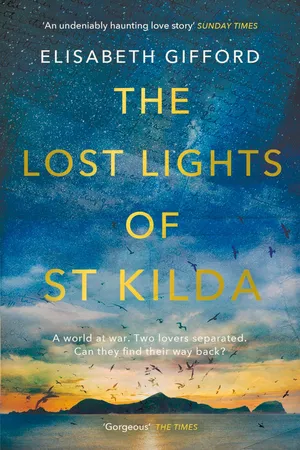
The Lost Lights of St Kilda
About this book
'Desperately romantic, lyrically written and with a fascinating plot' Katie Fforde 1927: When Fred Lawson takes a summer job on St Kilda, little does he realise that he has joined the last community to ever live on that beautiful, isolated island. Only three years later, St Kilda will be evacuated, the islanders near dead from starvation. But for Fred, memories of that summer - and the island woman, Chrissie, with whom he falls in love - will never leave him. 1940: Fred has been captured behind enemy lines in France and finds himself in a prisoner-of-war camp. Beaten and exhausted, his thoughts return to the island of his youth and the woman he loved and lost. When Fred makes his daring escape, prompting a desperate journey across occupied territory, he is sustained by one thought only: finding his way back to Chrissie. The Lost Lights of St Kilda is a sweeping love story that crosses oceans and decades. It is a moving and deeply vivid portrait of two lovers, a desolate island and the extraordinary power of hope in the face of darkness. 'A gorgeous, melancholy love story.' The Times 'An undeniably haunting love story.' Sunday Times
Information
Subtopic
Scottish HistoryCHAPTER 1
Fred
TOURNAI PRISON, 1940
Five days in darkness deep as a pit and my mind begins to play tricks. I hear the silence as singing, a faint choir in a distant room. Gaelic? English? Not Jerry, that’s for sure. Sometimes, it’s the darkness itself, blooming into images that swell and fade on the air, fuelled, no doubt, by the throbbing in my hand. Two nails gone, pulled out by the Gestapo. Worst of all is when the air becomes solid and I gasp, heart hammering, sweat on my palms. Then the only escape is to hold my mind steady and stand on my island again, looking out at the Atlantic and the curve of white sand around the bay. Slowly, very slowly, I turn in a half circle to see the crofts and the rise of the hills beyond like a comforting arm sheltering the village. A thin veil of cloud rises over the summit of Conachair, evaporating away as it starts to pour down the hillside, and high above, a sky that’s pure blue and endless. I breathe in deeply, the air clean and sea-blessed. Concentrating now so that the scene before me does not flicker or fade, I take a step, and another. Blades of grass, oiled and bright with sun, pass beneath my feet, the turf sprinkled with white daisies and tormentil as I move towards the line of bothies along the curve of the shore. A dog barks a greeting. Mary Gillies sits in front of a cottage spinning, the squeak of the turning wood as she lets the thread in and out, singing something in Gaelic as she works, but she does not raise her head as I pass by. Halfway along the row of cottages, I take the narrow path between a bothy and a byre, moving up past the burn race with the familiar irises and their spear-shaped leaves, yellow flower heads fluttering. One step at a time, I rise beyond the village towards Conachair, the fine webbed clouds over its summit. And now, standing on its heights, dizzy with the wind on my face, the air hazed with a moist brightness, all around is the ocean, a vast disc of rippled glass beneath an infinity of sky. I drink in the purity of so much blue. Some eight miles away, the islet of Boreray and her sea stacs like the hump of a whale guarding her two calves. I stand there, rocked by the wind, and a deep peacefulness comes to me. Nowhere in the world that’s as true or as home. Then my eyes scan back down to the village, my vision magnifying the dear houses below.
And there we are, sitting outside the bothy, Archie smoking, both of us reading in the evening light. But where is she? If I could see her one more time. That way she had of teasing and putting us in our place, two students from Cambridge who thought we knew it all.
I hear the rattle of bolts being shot back. The island fades. The iron door of a Tournai prison cell opens, squealing its pain. Just enough light creeps in to outline the barrel-shaped tunnel, ten feet long to the end wall. Damp brick scratched with graffiti, names from the boys of the 51st. No window. I wait for the guard to put a bowl of barley swimming in water on the floor, but instead a man is pushed in. He staggers and falls. Behind him, the guards drag in a body, the head slumped between shoulders pulled up in their sockets like a chicken on a butcher’s hook. A boy. They leave him on the cold concrete, face against the filth. I have just enough time to register the first man’s grey hair, gaunt, a civilian shirt and grey trousers, before the door slams shut. The darkness floods back. The bolts rattle back in place. I can hear the older man shuffling about. His voice.
‘Kenneth, Kenneth, will ye wake now,’ patting him on the cheek, urgently. ‘Come on now, man.’ There’s a groan of pain in reply. ‘That’s it now. I’ll bide with ye, Kenneth. That’s it, man. Breathe now. You’re all right. We’ll see the light again.’
‘Donal?’
‘Aye, I’m here, Kenneth.’
‘Are we dead now, Donal?’
‘No. We’re back in the fort, in the cellars.’
‘Dead would be better.’
‘We’ll come through. One day you’ll be home, standing in the lane before your own wee house.’
I flinched at this. What were the odds, really?
‘You sleep a while now, Kenneth.’
A shuddering sigh.
‘Caught escaping?’ I ask in a whisper.
‘Aye.’
‘Fred Lawson. Cameron Highlanders. I’d shake hands but they’ve left them a bit of a mess.’
‘Donal MacIver, Seaforths. Three of us. The other man shot. And Kenneth here’s taken a very bad beating.’
‘Is he going to pull through?
‘He’s still strong in spite of the past months, but it’s the will he needs now. The boys came into this war with such determination and now. . .’
‘And now here we are, left behind to rot in a German prison, the Queen’s own Highlanders. Not what we planned.’
‘But we’ll come through yet. We’ll come through.’ I heard the man shift and exhale with pain. His voice came again in the dark, fainter now. ‘But will you excuse me now, son. I may just shut my eyes for a while.’
Both of them out cold. The only clue that they were still there was the intermittent sound of breathing. I found myself straining to make out the particular sound of Kenneth’s breath, faint and wetly ragged – ready to crawl over there if it stopped. And do what in this blackness? Give him a talk on wanting to live?
So many like Kenneth in the German prison camps. When the call went out in ’39 the boys came in droves from the Highlands and Islands to join the Camerons, the Black Watch, the Seaforths, and the Gordon Highlanders, the Argylls, and the Sutherlands; descended from the men who had once fought alongside Wallace and Bruce, or battled to the death on the fields of Culloden. Along with the regiments from Aberdeen and Dundee, they become the 51st Highland Division – famous in the Great War as the men who never gave up. The fighting 51st.
So how bitter it was when the order came to put down arms and surrender alongside the French army, finally overrun by Hitler’s panzer divisions. The Gordons, fighting a rearguard action in the woods of Normandy, had to be issued the order twice. They couldn’t believe a command to surrender. Nearly all of them little more than boys.
I was older than most when my call-up papers came, a good few years past thirty. I’d been working as a drilling engineer for mining companies overseas. I was straight in as sergeant, assigned to the radio signals division. And since I was born in Uist, I was attached to the Cameron Highlanders. It was good to hear the Gaelic spoken again after so long. There’d not been much call for it during my years out in South America and Malaya.
Maybe it was hearing the old language again, but you came back to me so clearly then. I’d catch sight of you standing in the doorway as I sat alone on my bunk polishing my boots. Waking in the morning, as the barrack room came into focus, I’d see you, standing near my bed, the breeze from the hills come with you, and each time it would pierce me through with such a longing for days that were gone.
I’d refused you from my mind for so long, stubborn in my anger, but now I was a man wakened from a dream and I saw how I’d let the years slip by. All I longed for was to see you again, just one more time.
I asked a boy from Harris if they’d heard any news there from the folk on St Kilda. He looked at me with surprise.
‘And where is it you have been hiding yourself to not know that there is no one on the island of St Kilda now. Not one living soul.’
The blood drained from my legs. I sat down on a chair. ‘What are you saying? You’re not saying they starved one winter?’
‘No. But they came close enough. They were taken off the island after a very bad winter. Did you no see it on the newsreel in the cinemas?Ten years back. Nineteen thirty, it must have been. They live on the mainland now. I dinna’ ken where.’
I hadn’t followed the news from Europe. I couldn’t remember what I’d been doing ten years ago in the sticky heat of Malaya’s dusty towns and scrubland jungle of tepid beer and brief evenings with Malay girls. Nothing I wanted to recall with any pride. And now it came to me, a dawning realization of the chasm between us. All those chances to turn back and find you long gone. I had no way of contacting you now. No idea where you were living. Too many years sacrificed to my pride and my anger.
It was your face that had stayed with me as we fought in France. It was you who’d sustained me when we were hungry and without sleep for nights as we fought the retreating action back towards the Normandy coast. We had to smash equipment as we fled, the radios and the boxes of transmitter valves thrown out of the truck and shattering on the asphalt like summer fireworks. But we still hoped we’d make it home. We’d heard the army north of us had been taken off the beaches at Dunkirk by boats and by a miracle were back home to England.
At St Valery we were told to make our way down to the beach where boats would evacuate us too. But as soon as we got there, I saw we were lost. We stood on the top of cliffs three hundred feet high; at the foot, a narrow strip of beach strewn with bodies. The Germans had set up gun emplacements on the cliffs across the bay and were picking off the men as they went down the steep paths single file. A rolling fog had come in. There was no way a ship could navigate its way in. A boat that had come in earlier had already sunk under fire.
No one was coming to take us home.
We turned back to the town, now blazing and exploding like a giant bonfire, the shelling constant. By morning, the French general had ordered a white flag to be hoisted from the church spire. We had surrendered. In the town square there was a huge pile of rifles.
You could hear men’s guts creaking from emptiness as the Germans marched us east. They wouldn’t let us break ranks to fetch water. In front of me, a man fell, faint from exhaustion. The guard ran down and cracked his head with a rifle butt, shot him when he failed to wake up. At night we were herded into fields surrounded by rolls of razor wire that the Jerry had gone on ahead and got ready for us. ‘You can’t fault them for how organised the buggers are,’ said Tom from Dundee. He let the potatoes he’d grubbed up roll out of his pocket onto the floor and we all shared what we had from our quick foraging in the wide flat fields that ran along each side of the road. A marvel how good a raw potato tastes when you’re starving hungry. The next night we collected wood to make a fire as soon as the guard was further up the line, managed to cook them, but by the third night the French farmers had got wise to the threat of ten thousand men raiding their field and stood with sticks to defend their crop, and we didn’t blame them.
We passed into Belgium. They shipped us onto empty coal barges, crammed us down in the sooty hold so you could hardly breathe. Then back to walking again.
The first real food we saw was spread out on trestle tables as they marched us into a station. We had our photo taken in front of it with the Red Cross nurses in uniform standing behind the tables ready to serve it out. As soon as they had their picture they packed all the food away without it crossing our lips.
We were herded towards cattle trucks. They started loading us in forty at a time. I knew there’d be little chance of coming back once we were on the trains. A prison camp in the east, labouring for the Reich. I was standing in a group next to the great black engine breathing out its clouds of steam and soot. I sidled to the back of the column. When a fight broke out, I saw my chance, stepped back into the steam cloud and away along the tracks in the fading light of evening.
I made it as far as the coast, living on the handouts that the farmers gave me, risking their lives to invite me in for a meal. One night, a couple insisted that I have their bed while they slept in the kitchen. I’d found civilian clothes by then, buried my uniform, keeping nothing but my compass. So when I was picked up on the heavily guarded Belgian coast, trying to find a boat to get home, I was interrogated as a spy. They gave me the full treatment, plus a month in the Tournai punishment cells.
In the darkness, I listened to the breathing on the other side of the cell. One slow with a wheeze, the other more uneven, a pause as if the next breath might not come. Perhaps I slept. When the door opened next, a faint grey light trickled in as the guard put the bowls down. I could make out the two forms against the distempered brick. The older man, Donal, slumped against the wall. The boy was tipped over, a jacket under his head against the cold of the concrete, a patch where he had dribbled a dark spool of blood. Then the black loneliness that filled our cave came down once more.
The boy began to cry. ‘I can’t do it. I can’t do it any more.’
I could hear the sound of a head banging and banging against the concrete. The scrape of Donal reachi...
Table of contents
- Cover
- Title
- Copyright
- Chapter 1
- Chapter 2
- Chapter 3
- Chapter 4
- Chapter 5
- Chapter 6
- Chapter 7
- Chapter 8
- Chapter 9
- Chapter 10
- Chapter 11
- Chapter 12
- Chapter 13
- Chapter 14
- Chapter 15
- Chapter 16
- Chapter 17
- Chapter 18
- Chapter 19
- Chapter 20
- Chapter 21
- Chapter 22
- Chapter 23
- Chapter 24
- Chapter 25
- Chapter 26
- Chapter 27
- Chapter 28
- Chapter 29
- Chapter 30
- Chapter 31
- Chapter 32
- Chapter 33
- Chapter 34
- Chapter 35
- Chapter 36
- Chapter 37
- Chapter 38
- Chapter 39
- Chapter 40
- Chapter 41
- Chapter 42
- Chapter 43
- Chapter 44
- Chapter 45
- Chapter 46
- Acknowledgements
- Note on the Author
Trusted by 375,005 students
Access to over 1.5 million titles for a fair monthly price.
Study more efficiently using our study tools.
Frequently asked questions
Yes, you can cancel anytime from the Subscription tab in your account settings on the Perlego website. Your subscription will stay active until the end of your current billing period. Learn how to cancel your subscription
No, books cannot be downloaded as external files, such as PDFs, for use outside of Perlego. However, you can download books within the Perlego app for offline reading on mobile or tablet. Learn how to download books offline
Perlego offers two plans: Essential and Complete
- Essential is ideal for learners and professionals who enjoy exploring a wide range of subjects. Access the Essential Library with 800,000+ trusted titles and best-sellers across business, personal growth, and the humanities. Includes unlimited reading time and Standard Read Aloud voice.
- Complete: Perfect for advanced learners and researchers needing full, unrestricted access. Unlock 1.5M+ books across hundreds of subjects, including academic and specialized titles. The Complete Plan also includes advanced features like Premium Read Aloud and Research Assistant.
We are an online textbook subscription service, where you can get access to an entire online library for less than the price of a single book per month. With over 1.5 million books across 990+ topics, we’ve got you covered! Learn about our mission
Look out for the read-aloud symbol on your next book to see if you can listen to it. The read-aloud tool reads text aloud for you, highlighting the text as it is being read. You can pause it, speed it up and slow it down. Learn more about Read Aloud
Yes! You can use the Perlego app on both iOS and Android devices to read anytime, anywhere — even offline. Perfect for commutes or when you’re on the go.
Please note we cannot support devices running on iOS 13 and Android 7 or earlier. Learn more about using the app
Please note we cannot support devices running on iOS 13 and Android 7 or earlier. Learn more about using the app
Yes, you can access The Lost Lights of St Kilda by Elisabeth Gifford in PDF and/or ePUB format. We have over 1.5 million books available in our catalogue for you to explore.