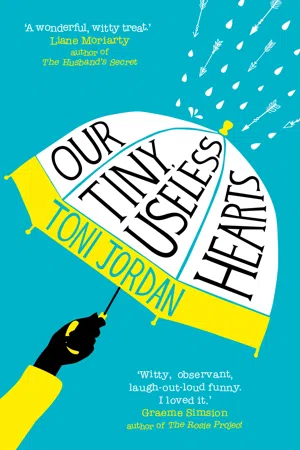
'Witty, observant, laugh-out-loud funny. It's rare to find a novel that keeps you laughing as this one does; the characters are sharply drawn and frighteningly familiar and the story never stops throwing up surprises. I loved it.' - Graeme Simsion, author of
The Rosie Project
Henry has ended his marriage to Caroline and run off with his daughter's teacher, Martha. Caroline, having shredded a wardrobe-full of Henry's suits, has gone after them.
Craig and Lesley have dropped over from next door to catch up on the fallout from Henry and Caroline's all-night row.
And Janice, Caroline's sister, is staying for the weekend to look after the children because Janice is the sensible one.
Then Craig enters through the bedroom window expecting a tryst with Caroline and finds Janice instead, Lesley storms in full of threats, Henry, Caroline and Martha arrive back from the airport in separate taxis - and let's not even get started on Brendan the pizza guy.
Janice can cope with all that. But when her ex-husband Alec knocks on the door things suddenly get complicated...
'A new Toni Jordan is always a special pleasure and her latest is a wonderful, witty treat of a novel: cutting and clever, and yet so very romantic, as though P.G. Wodehouse had satirised life in the suburbs.' - Liane Moriarty, author of
The Husband's Secret
- English
- ePUB (mobile friendly)
- Available on iOS & Android
eBook - ePub
Our Tiny, Useless Hearts
About this book
Information
Print ISBN
9781760293819
Subtopic
Women in FictionThe morning after my sister Caroline’s wedding to Henry, our mother smashed every dish in the house. Every plate, every glass, every saucer. The bone-china platters etched with roses that she’d piled with sandwiches and little cakes when she was president of our high school mothers club—these she cracked over her knee like kindling. The flutes that were a gift from some great-aunt for her engagement to our father, the set with stems like twigs that lived on the top shelf—these she hurled sideways with her old softball pitching arm and watched spear against the walls to explode in a shower of crystal. She shattered the glass in every framed photograph with her elbow, she overturned vases and fruit bowls. Apples thudded and rolled to all corners of the room, peaches cascaded and liquefied on impact.
I watched her from the doorway of what had been my room and I felt like a small child again, one who would never understand the currents beneath the surface of grown-ups. She advanced from cupboard to shelf to the divider above the kitchen bench, sometimes pausing to stamp on something particularly offensive and grind it into the carpet, and all the while her face was soft, without any trace of the tight wrinkles that sometimes framed her mouth or the tension stockpiled in her jaw line. Perhaps it was this gentle face, or maybe it was the occasional twist of her hips—it all seemed less Texas porcelain massacre and more avant garde interpretive dance. The early light through the big eastern windows made each individual shard glitter, like a mirror ball dying in a tragic disco explosion. And the noise! I’m amazed the neighbours didn’t come running, but that’s the whole point of the suburbs, I guess. Nice big yards, lots of space and privacy to start your own hydroponic weed farm or take up nudism or destroy all evidence of whatever it was my mother was trying to erase. When you know people too well, it’s difficult to give them a friendly wave as you put the bins out.
When she stopped and everything was quiet again, she wiped her brow with her sleeve. A thread of blood inched down her temple from where some flying chip had grazed her.
‘It’s all been for nothing,’ she said to me. ‘All of it. The last fifteen years.’
Caroline and Henry were in Bali by then. When they came home, tanned and massaged and pedicured with their pupils transformed from the usual circles into tiny love hearts, I told Caroline that Mum had been burgled by a well-known criminal bric-a-brac gang. Caroline was living in NewlywedLand, where the air smells of roses and tiny invisible string quartets lurk in every room waiting for your husband to arrive, then launch into ‘I’ve Had the Time of My Life’ on their tiny invisible violins.
‘Who would want that old rubbish?’ Caroline said. ‘People are morons.’
Not long after that, Mum sold everything and moved to an ashram in Uttarakhand where she’s known as Saraswati, and it was as though our past had been papered over.
Caroline and I haven’t seen her since, but every year birthday cards arrive in the mail, randomly. One year it might be August 6th and the next, January 31st. None of these dates coincides with the anniversary of my actual birth, even though my mother knows the date of my birth. She was definitely there at the time. These non-birthday cards all have a colourful Hindu goddess on the front—often wearing gold and red and a great deal of jewellery, sometimes with many arms—and inside Mum writes something like:
Dear Janice (or Dear Caroline, when it’s my sister’s non-birthday, or Dear Mercedes or Paris, when it’s Caroline’s girls’),
Happy Birthday! I love you! I miss you! This is the daughter of Lord Shiva, who was created from the tree,
Kalpavriksha! Her name is Ashokasundari!
Remember, don’t be too good! Free yourself from expectation!
GIVE IN TO THE REVOLUTION IN YOUR SOUL!!!
Love, Saraswati (Mum) (Grandma)
*
When Caroline married Henry she was twenty-six and I was twenty-three and Mum was forty-nine. Fifteen years, then, was the amount of time that Mum raised us by herself after Dad left.
I thought Mum was unduly pessimistic. I’d always liked Henry. He was a different breed from the boys in my microbiology lab who strove all year, with some success, to grow colonies of bacteria in the shape of boobs. Henry was not only employed, he owned a suit. He was the most dashing of Caroline’s boyfriends and the only one she truly fell for, this big blond rugby player with thighs like legs of ham and sharp blue eyes and a degree in electrical engineering who drove a fourth-hand red BMW with enough dents to make it ironic instead of pretentious. Henry was on the fast track to success at Telstra. They adored each other.
Now it’s another fifteen years later. I’m in Caroline’s kitchen at ludicrous o’clock on a Saturday morning, leaning against open shelves filled with Caroline’s elegantly, eminently smashable dinner service, and I’m beginning to see Mum’s point.
Henry waved goodbye to solid some years ago when he swapped rugby for pinot and Foxtel. Now he’s soft, with an indoor pallor, and the blond hair is mostly a memory. He’s squatting on the floor of the dining room, balancing on the balls of his feet and his leather shoes are squeaking and the seams of his trousers are straining and his bones are creaking. He’s looking even paler than usual and his face is damp: a chubby vampire with a fever. He’s doing his best to eyeball his girls. My nieces, Mercedes and Paris. Henry, envisaging the world from the perspective of the four feet and under.
‘Let me put it this way,’ he says to them. ‘You like bananas, right? Everyone likes bananas.’
Some conferring is required. Paris stretches on her tippy toes and whispers in Mercedes’ ear. ‘Bananas are for school but at home we like mangoes better but only when Mummy cuts them up or else we have to sit in the bath,’ Mercedes says, after advisement.
‘Right. Mangoes. Sure. Well, marriage is like a mango.’
Henry folds his arms as he delivers this gem and from where I stand in the kitchen, it’s clear he expects it to make his case. His daughters, though, are a tough audience. None of us got much sleep last night and they are still pyjama-clad with tousled hair and that intoxicating warmth that small children have when they wake, but they’re solemn little people, staring steady and blue.
Henry runs his fingers through his strands. ‘Imagine if mangoes were all you got to eat, breakfast lunch and dinner. Even if mangoes were your favourite food, you’d be pretty sick of mangoes after fifteen years, wouldn’t you?’
‘Are biscuits allowed, for little lunch?’ says Paris, through Mercedes.
‘Mangoes or nothing.’
‘Can we have ice-cream on top? Just a tiny bit.’
‘Only mangoes. That’s it. Forever. You’re surrounded by other fruit all right, everywhere you go. Strawberries brushing against you, mandarins slinking around the office in their tight little skirts, bending over the photocopier to fix paper jams. And the lychees. Don’t get me started on the lychees.’
‘Henry,’ I say.
‘What’s a lychee?’ says Mercedes.
‘It doesn’t matter. What I’m trying to say is: can either of you comprehend the kind of discipline it takes to be married for fifteen years?’
‘Not really,’ Mercedes says. ‘I’ve never been married. I’m seven.’
‘Right, of course. Marriage, girls, is hard time, that’s what it is. Monogamy, monotony. Mangoes. They sound the same, right? That’s no coincidence.’
‘Henry,’ I say.
‘Seeing the same face every morning, e v e r y s i n g l e morning, day in, day bleeding out. If I took a sawn-off shotgun down to the 7-Eleven and waved it in Raju’s face and spent the contents of the cash drawer on crack and hookers I’d get less than fifteen years.’
‘Henry,’ I say. ‘That’s a little above their pay grade.’
Paris whispers in Mercedes’ ear. ‘She wants to know what crack is,’ says Mercedes.
‘It’s an illegal drug, sweetheart. It helps take the peaks and troughs out of the day, like Mummy’s sav blanc.’
‘Henry.’ I walk over and squat on the floor beside him. ‘Age-appropriate, remember? I have a great idea. Why don’t I take them to the park? I’m desperate to push two little girls on the swings until my arms fall off and if you don’t lend me these two, I’ll be forced to kidnap a couple off the street.’
Henry holds up his palm. The girls don’t move.
‘Janice, please,’ he says to me. Then, to the girls, ‘This is no reflection on any particular mango. Your mango is a wonderful mango. Wonderful. But that’s not the headline. The headline is: is it fair to be on an enforced diet of mangoes when the world is an enormous fruit salad?’
Mercedes and Paris squint like talent-show judges. This is an important question, they can sense it. ‘Mummy makes us cheese on toast,’ Mercedes says finally. ‘We like that. And lamb chops. And noodles. And sausages. The skinny ones, but.’
He slaps his beefy thigh and attempts to pivot out of his squat but unbalances and instead lurches to his knees, which crunch on the floorboards. ‘That’s my girls. Anyway, Mummy and I still love you very much. That’ll never change. Despite the archaic cultural construct that your mother and I find ourselves trapped in.’
All the while he’s been talking, I’ve been aware of a faint clicking and whirring; I wave my hand to deter non-existent mosquitos. Caroline and Henry live in an outer-suburban pocket of dream acre-block farmlets where every home has space for a few chickens and the occasional orchard or kitchen cow. It’s the semi-rural 4WD idyll belt and I almost open my mouth to say the crickets are loud this morning, when I feel a sneaking dread. I tell Henry to keep it G-rated until I get back.
When I get to Caroline and Henry’s bedroom at the end of the corridor, I’m faced with a scene of devastation. Henry’s suits are spread out over the unmade bed like a two-dimensional gay orgy: here a Paul Smith, there a Henry Bucks, everywhere a Zegna. The trouser-half of each and every one of them is missing its crotch and Caroline, chip off the old block, is peering over them with her reading glasses on the end of her nose and the good scissors in her hand.
She’s still in her nightie, freshly foiled hair loose and a silk kimono draped over her shoulders. She looks forlornly at her symbolic castration and sighs, just like Mum did all those years ago. ‘What a waste,’ she says, as she shakes her head.
‘Maybe not super-helpful at this point, Caroline darling,’ I say.
She shrugs. ‘These trousers failed in their primary duty, which is to contain the penis. They have only themselves to blame.’
‘Nothing’s been decided yet. People make mistakes, Caroline. Marriage is a marathon, not a sprint.’
‘Earth to cliché-girl: do you know who took these suits to the drycleaner?’ she says, as she smooths and folds the legs of a maimed Henry-surrogate and sits on the bed. ‘Who washed all these shirts? Did the ironing? All right, Toula does the ironing, but you get my point. See this tie?’ She reaches for a pale blue serpent nestling on the pillow. Crotch-butterflies flutter to the ground at her feet. ‘I bought him this tie when he got his last promotion. It was a congratulatory tie. A tie that said your wife loves you. A chastity tie. It was not a tie to preside over the shagging of some schoolteacher young enough to be his much younger sister.’
‘You’re angry, of course you are.’
‘Honestly Janice, do you live on Mars?’ she says, as she lops the head off the blue tie. ‘Here on this planet, every action has a reaction.’
I take the scissors. ‘All the same, let’s keep the collateral damage to a minimum. Please, Caroline?’
‘Well excuse me. Some of us like being married.’ She shoots me a look. ‘Are you on Henry’s side, is that it?’
I open my mouth, but I’m saved by the doorbell.
‘I’ll get it!’ she yells.
‘It’s my house too!’ yells Henry, from the lounge room. ‘That means it’s equally my front door and I will be the one who gets it.’
‘Neither of you will get it,’ I yell back at them. ‘You will each stay in your designated corners and I will get it.’
I stalk back down the hall, past where Henry is still squatting and saying god knows what to the girls, who nod back at him. I almost intervene but the bell rings again so I keep going: he’s their father, he only wants what’s best for them. Besides, they’ll need something to tell their analysts when they grow up.
When I open the door, it’s Craig and Lesley from next door. What luck.
‘Janice,’ Craig says. ‘It’s been ages. You look well.’
‘Janice,’ Lesley says. ‘Aren’t you the ministering angel? You must have arrived very early. Or did you stay over?’
In this suburb, everyone knows each other. They pop in for drinks, they pick up each other’s kids from drama class, they traipse through neighbours’ yards as shortcuts on the way somewhere. Progressive dinners. Weekends at the snow. It’s frightening. In the inner city where I live, people have the decency to ignore each other in general, and marital s...
Table of contents
- COVER PAGE
- TITLE PAGE
- COPYRIGHT PAGE
- CONTENTS
- BEGIN READING
- ACKNOWLEDGMENTS
Trusted by 375,005 students
Access to over 1.5 million titles for a fair monthly price.
Study more efficiently using our study tools.
Frequently asked questions
Yes, you can cancel anytime from the Subscription tab in your account settings on the Perlego website. Your subscription will stay active until the end of your current billing period. Learn how to cancel your subscription
No, books cannot be downloaded as external files, such as PDFs, for use outside of Perlego. However, you can download books within the Perlego app for offline reading on mobile or tablet. Learn how to download books offline
Perlego offers two plans: Essential and Complete
- Essential is ideal for learners and professionals who enjoy exploring a wide range of subjects. Access the Essential Library with 800,000+ trusted titles and best-sellers across business, personal growth, and the humanities. Includes unlimited reading time and Standard Read Aloud voice.
- Complete: Perfect for advanced learners and researchers needing full, unrestricted access. Unlock 1.5M+ books across hundreds of subjects, including academic and specialized titles. The Complete Plan also includes advanced features like Premium Read Aloud and Research Assistant.
We are an online textbook subscription service, where you can get access to an entire online library for less than the price of a single book per month. With over 1.5 million books across 990+ topics, we’ve got you covered! Learn about our mission
Look out for the read-aloud symbol on your next book to see if you can listen to it. The read-aloud tool reads text aloud for you, highlighting the text as it is being read. You can pause it, speed it up and slow it down. Learn more about Read Aloud
Yes! You can use the Perlego app on both iOS and Android devices to read anytime, anywhere — even offline. Perfect for commutes or when you’re on the go.
Please note we cannot support devices running on iOS 13 and Android 7 or earlier. Learn more about using the app
Please note we cannot support devices running on iOS 13 and Android 7 or earlier. Learn more about using the app
Yes, you can access Our Tiny, Useless Hearts by Toni Jordan in PDF and/or ePUB format. We have over 1.5 million books available in our catalogue for you to explore.