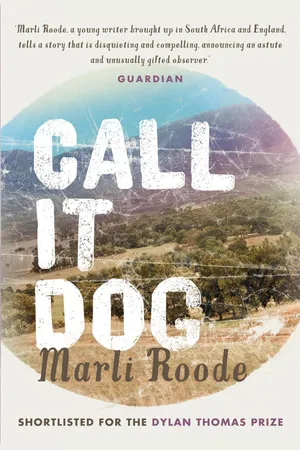
SHORTLISTED FOR THE 2013 DYLAN THOMAS PRIZE
LONGLISTED FOR THE 2014
SUNDAY TIMES SA FICTION AWARD
Jo returns to South Africa after ten years in the UK to cover the riots sweeping the Jo'burg township of Alex. Nico, her estranged Afrikaner father, reappears and asks her to help prove his innocence in the murder of a black man, abducted by the security forces decades earlier. As they set off on a road trip through South Africa's now-unfamiliar landscape, it becomes clear that Nico knows more about the murder than he is letting on, and Jo begins to wonder whether she is his accomplice, or his captive.
Set against the backdrop of a country struggling to absorb its bloody history and forge a new democracy,
Call It Dog asks whether justice and truth are more important than the bonds of loyalty and love, and explores what is it like to feel you no longer belong in the land of your birth - or to your own family.
eBook - ePub
Call It Dog
About this book
Information
Contents
1. A Season in Paradise
2. Some Afrikaners Photographed
3. This Is How It Happened
4. Bad Conscience
5. Too Long: 16 days ago
6. The Right to Make Promises
7. The Structure of Things Then
8. The Greatest Weight
9. The Transported
10. On Being Sane in Insane Places: 13 days ago
11. Intersections
12. The Tame People: Two days later
13. Please Do Not Feed the Animals
14. Particulars
15. The Blue Plan
16. In Other Words
17
18. Underground People
19. The Red Plan
20
21. Johannesburg Streets
22. We Who Are Homeless
1
A Season in Paradise
I find him in Empangeni. My father lies on his back at the edge of the sugar-cane valley, one arm under his head, the other flung out, fingers plaiting scrub and yellow weed flowers. The camera next to him is shuttered and blind. He squints at the wavering sky, which moves with heat if not with wind. Empangeni rises behind us: tin shanties glint through the sugar-mill smoke and dusty tracks cross the red hills to mark mission churches, now crumbling. In front of us, the green swarm of cane stretches to the horizon.
‘When did you get here?’ I ask.
‘Just now.’
I stand over him, waiting. We’re quiet, at right angles to each other. I close my eyes and lift my face to the sky as though hoping to feel rain. But the early-morning sun burns through my eyelids, red light suddenly inside my head.
‘How did you know I was here?’ I ask. The heat touches my shoulders and chest, a blessing.
‘I read your stuff online. By Jo Hartslief in Johannesburg, South Africa.’ He speaks in a British accent, mispronouncing my surname the way they all do. His would be no easier for them, the rolling r of Roussouw something only the Welsh would be able to attempt. ‘The articles were good,’ he says.
His compliment surprises me. ‘Thanks.’ I look down at him, the sunspots fading from his skin and clothes as my eyes adjust to the light.
‘Well, not too bad anyway. A bit “human interest” for my liking.’ He doesn’t move to put air quotes around the term, and he doesn’t need to. ‘Too many interviews with crying refugees.’
Lying down, my father’s belly slopes up from his ribcage. I wonder if it will hang over his waistband when he stands up. He’s grown a beard, which is red and grey in patches, and his nose has been broken since I last saw him. It’s hooked now, but at fifty-three, he’s too old for it to be handsome.
Before I can decide whether or not to get irritated, he asks: ‘Were you staying near Alexandra?’
‘No. I’ve been going into the townships with Tumelo, the photographer I’ve been working with. He knows where to go.’
‘He’s good,’ he says, nodding his approval. ‘He’s taken one or two nice shots.’
Tumelo’s a war correspondent and has been taking photos much longer than my father has. I sometimes search stock-photo libraries for the pictures my father takes – of steaming bowls of pasta and sauce, moist slabs of cake. I want to ask how his slathering shoe polish onto raw meat and frosting grapes with hairspray qualifies him to judge, but I know better, even after so many years.
‘Most of the other journalists out here from overseas, it’s obvious they’re staying in nice hotels in Jo’burg,’ he says.
I too have been staying in a nice hotel in Jo’burg, spending the money my grandmother left me on swimming pool access and a queen-sized bed. But I haven’t been able to sleep in it.
‘And using copy from the news wires anyway, getting the local photographers to do all the difficult work for them,’ he scoffs. This is something he’s always banged on about, that photographers never get enough recognition. I don’t let on that I agree with him. ‘But your stuff is different.’
‘Thanks.’ I wonder how long he’ll let me have this.
‘Of course you’d be stupid enough to go there. They warned the press that it’s too dangerous, especially for a woman, and of fucking course you went anyway.’ He looks at me for the first time, his eyes triumphant slivers in the glare. ‘I hope those kaffirs roughed you up a bit, put their pink hands all over your pasty skin. That’d teach you.’
I gather fistfuls of my skirt at my sides to steady myself against what I know is coming. ‘Teach me what?’
‘That you can’t just come back here after so long and still know how it is – how bad it’s gotten – or how to stay safe.’ He turns his frown back on the sun. ‘You can’t come back after ten years and have it be your home any more.’
‘I never said it was.’
‘I bet they only picked you to come out here because of your surname. That and the nostalgia for swimming pools and Mandela that you whip out when you’re trying to be exotic and interesting.’
I force myself to breathe in for four counts and hold it just as long. But my voice wavers with the heat that has come to my face nonetheless. ‘You don’t know why I came out here, or what happened when I was in Alex.’ The words are wet. And he can hear it, has always been able to tell when he’s scored a point, even over the phone. In spite of myself, I want to tell him about the fires, the bloody blankets on the side of the road. That before I left London two weeks ago on assignment for a magazine, I’d called a few of my other contacts to see if they’d be interested in a series of articles about corruption and cronyism in South Africa. When the riots broke out, I was a cheap source of copy; ‘already in-country’ was how they put it. But I know that my father doesn’t care about how I ended up in Alex, and if I try to explain myself to him he will have won. Right now, I want to hurt him with something trite and true. ‘You have no idea who I am.’
He looks at me and smiles, his forehead moving upwards with the force of it. ‘If you’re anything like me – and I know you are – you probably need a cigarette right about now. Why don’t you sit down?’
Before I can stop myself, I straighten my shoulders and neck to stand taller. My father laughs.
‘When did you dye your hair?’ he asks.
My hand wants to make a hiding place for my fringe, but I will my fingers to be still. ‘I dunno – two years ago?’
‘Don’t ask me – I dunno the answer.’ He watches a hadeda hang in the air above us. It drops lower, lazy with early morning. Its feet rake the cane leaves before it lands near the old Mercedes I rented in Durban. ‘Red doesn’t suit you. And you’ve gotten thin. Too thin.’ He waves his hand at me as though wiping a mirror. ‘Did you do all this for that boy?’
I think he means Dan, the only boyfriend I’ve ever told him about. ‘No.’ I broke up with Dan long before I changed my hair.
‘For a girl, then.’ I wonder if he’ll flick his tongue through the V of his fingers. He’s done it before. ‘Did you let your underarm hair grow out so you could dye that as well?’
‘Yeah. I stopped wearing make-up too – oh, and I burned all my bras.’ He doesn’t react and I keep going, even though I know better. ‘And of course I hate all men and only listen to Ani DiFranco.’
‘Who’s that?’
I shrug. ‘It doesn’t matter.’
‘Every time I see you, I wonder if you’ll look like your mom,’ he says, his eyes on me again. ‘But luckily, my genes were stronger than Karen’s.’ He laughs again.
‘Look, Nico, what do you want from me?’ I hope the name hurts him. ‘I have to get back and, you know, do my job.’
He turns his head away from me and spits into the grass. ‘I’m honoured you’d, you know, come out to the bundu just to see me.’
‘Don’t be. You begged me to come.’ Without looking, I find the right key in my handbag and hold it ready for the ignition. ‘And it’s the first time you’ve ever needed anything from me my whole life, so that’s why I’m here: to satisfy my curiosity, and then bugger off back to the arrangement we had before.’
‘Kak, man. We haven’t seen each other in three years—’
‘Three and a half.’ I sound proud, like a child bragging about how long she’s held her breath underwater. There are so many ways for him to win.
‘OK, three and a half years. Not since that shit-hole pub in London.’ He smiles, baring teeth too far back in his mouth. ‘So you came here today after three and a half years just out of curiosity?’
I shake my head, not wanting to admit that after his phone call I was actually worried about him, but I can see now that he’s fine, the same as always. I shouldn’t have come.
‘Good,’ he says. ‘I needed to get you here, and what I need from you now...well, curiosity isn’t enough to make you give it to me.’ He pauses. ‘Why don’t you sit down?’ He stares at me, not really asking.
I sit this time, legs crossed. Sweat is already pooling under my thighs. I bought the skirt at the airport in Johannesburg, an orange, sequinned cocoon; there’ll be two damp ovals on the back of it when I get up.
The hadeda hunches closer.
‘How’s your grandmother?’
He doesn’t know she died a month ago. I should tell him. But he turns his head. A check on his to-do list. ‘She’s fine.’
‘Your accent’s changed,’ he says. ‘You sound like a proper Pommy now.’ His fingers are motionless as he watches the bird. I stop pulling at grass and watch it too.
In Benoni, where I grew up, hadedas were dull and grey as closed oysters. Mornings I would see them preening in the garden and let the dog out to sprint circles into the frosted grass, driving the squat birds onto aerials and streetlights. There, they complained in mournful kazoos about the Maltese terrier and the pale brunette child too slow to run after them herself. But here, in the sun, the bird is suddenly beautiful, its wings skating the spectrum from green to purple, like the inside of a shell, as it moves towards us.
‘In case you haven’t been paying attention, the bird’s name is Frank,’ my father says. ‘We’ve been watching each other since I got here. It seems he’s finally decided to come down for a smoke.’ From the pocket of his shorts, my father edges a pack of Peter Stuyvesant and a box of matches. His fingers, quick with habit, extract three cigarettes. Frank moves towards us. My father puts two cigarettes on his stomach, motioning for me to take one.
‘I’m going to light a match using just one hand,’ he brags from around the cigarette between his teeth. The tip bobs as he talks, punctuating his sentence.
The match catches and Frank cocks his head, wary of the flame. But my father and I both breathe it in. He turns his head towards the creature. It stares, curious and suspicious.
‘Come on, dickhead.’ My father waits for Frank to fetch the cigarette off his stomach. But the bird is still, almost judgemental. ‘Well, fuck off then, Frank,’ he says, blowing smoke at the bird.
Frank, made grey again, objects: ‘How-how-he. How-how-he.’ It’s almost as though he’s lamenting: I thought we were friends – how could he speak to me like that?
I laugh.
‘I said, fuck off, Frank!’ This time my father sits up, and Frank’s cigarette rolls into the scrub, bent. Frank glares, first with his left eye and then with his right, the red on his beak suddenly angry. My father glares back, the ember on his cigarette bright as he takes a long drag.
I sit quietly, a good audience.
Calmly now: ‘Frank, let me make myself clear. You are not welcome here. I need to talk to Jo and I won’t have you butting in. Your points are trite, your vocabulary kak and you always try to make every conversation about you. Now, if you know what’s good for you, you’ll go.’
Frank huddles lower, his neck folded away like a beach chair in winter.
‘And don’t even think about making your displeasure known by shitting on my car on your way out.’ My father turns, his back now to the bird. Frank pauses and begins to preen himself. In my sunglasses, my father sees Frank’s disobedience. He whirls, shouting, ‘Hamba!’ Go.
The bird spreads out, grey and suddenly other, in a running start, and I’m strangely afraid of it as it takes off. I duck, but its feet skim cane not skin. It circles the field once, slowly, before straightening out and heading towards the mountains.
My father’s shout has stirred the wind; sugar cane clack their objection to Afrikaner words so deep in Zululand.
‘When you put your cigarette out, do it properly,’ he says. Serious now. ‘It hasn’t rained here in months.’
I wonder how long he’s been in Natal, if he’s moved here. Last I knew, he was living in Cape Town. But I don’t ask and we sit silently. Beyond the road into town, soil turns into sand and later into red rock. Sparse outcroppings of weeds and abandoned mud huts dot the hillside.
On the way up from Durban this morning I crossed the Tugela River, where the water slows after its long trip and aloes bloom succulent spikes. There, the redcoats had crossed, bringing guns and white man to Zululand. Neither had left yet.
And there I was, a turncoat, making the same trip.
‘What’re we doing here?’ I ask, straightening Frank’s cigarette. The paper is wrinkled and dusty.
‘I wanted to show you this because I think you’ll appreciate it.’ My father is being deliberately obtuse, trying to pique my interest.
I won’t ask again, so I wait. A bumblebee undresses the daisy weeds.
‘I’ve been here once before.’ He straightens his legs out in front of him and points his toes. Both of the shoelaces on his leather walking boots are double-knotted. ‘Walked through the furrows in between cane fields. Sat in their shade.’
I thin...
Table of contents
- Cover
- Title page
- Copyright page
- Dedication page
- Epigraph page
- Contents
- Acknowledgements
- A Note on the Author
Trusted by 375,005 students
Access to over 1.5 million titles for a fair monthly price.
Study more efficiently using our study tools.
Frequently asked questions
Yes, you can cancel anytime from the Subscription tab in your account settings on the Perlego website. Your subscription will stay active until the end of your current billing period. Learn how to cancel your subscription
No, books cannot be downloaded as external files, such as PDFs, for use outside of Perlego. However, you can download books within the Perlego app for offline reading on mobile or tablet. Learn how to download books offline
Perlego offers two plans: Essential and Complete
- Essential is ideal for learners and professionals who enjoy exploring a wide range of subjects. Access the Essential Library with 800,000+ trusted titles and best-sellers across business, personal growth, and the humanities. Includes unlimited reading time and Standard Read Aloud voice.
- Complete: Perfect for advanced learners and researchers needing full, unrestricted access. Unlock 1.5M+ books across hundreds of subjects, including academic and specialized titles. The Complete Plan also includes advanced features like Premium Read Aloud and Research Assistant.
We are an online textbook subscription service, where you can get access to an entire online library for less than the price of a single book per month. With over 1.5 million books across 990+ topics, we’ve got you covered! Learn about our mission
Look out for the read-aloud symbol on your next book to see if you can listen to it. The read-aloud tool reads text aloud for you, highlighting the text as it is being read. You can pause it, speed it up and slow it down. Learn more about Read Aloud
Yes! You can use the Perlego app on both iOS and Android devices to read anytime, anywhere — even offline. Perfect for commutes or when you’re on the go.
Please note we cannot support devices running on iOS 13 and Android 7 or earlier. Learn more about using the app
Please note we cannot support devices running on iOS 13 and Android 7 or earlier. Learn more about using the app
Yes, you can access Call It Dog by Marli Roode in PDF and/or ePUB format, as well as other popular books in Literature & Literature General. We have over 1.5 million books available in our catalogue for you to explore.