- English
- ePUB (mobile friendly)
- Available on iOS & Android
eBook - ePub
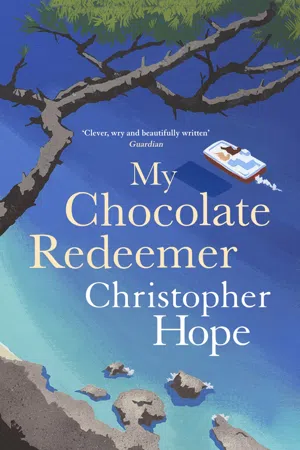
My Chocolate Redeemer
About this book
Bella is a teenage chocolate junkie - fashion-mad and God-haunted - who lives in the lakeside village of La Frisette in France with her aristocratic grandmother. When an exotic black stranger turns up and takes an entire floor in the grandest hotel in her small community, there is considerable dismay amongst the local populace. Worse still; word spreads that the unwelcome guest is a polygamous African tyrant, overthrown in a coup and exiled amid rumours of embezzlement and cannibalism. The question is, why is he interested in no one but Bella?
Information
Subtopic
Literature GeneralIndex
LiteratureChapter 1
I take my ease upon our private beach. ‘Relax Bella,’ I tell myself, ‘you’re among friends.’ That’s not quite true – but then if you can’t tell yourself stories, who is there to talk to? You should know!
Although it’s called, rather grandly, a plage privée it’s really a semi-circular wooden platform, or jetty, by the lakeside, specially reserved for guests of the Priory Hotel. A notice warns trespassers to keep away. The wooden slats are grey with age, warm and deeply grooved, and through them I can see the baize-green water, striped with dusty silver where the sun falling between the slats strikes the surface. In the shade the green blackens and thickens but in the shallows where the sunshine pierces to the sandy floor, the water is brilliantly clear. Over to my right is a mountain covered with trees and scrub through which the grey rock shows. Rearing several hundred metres above the lake, it is part of the chain of mountains curving behind the hotel and the village of La Frisette. Jutting out into the water, this natural headland forms a small bay where the weekend yachts ride at anchor, stripped of their sails, each wagging a naked mast like a warning finger. To my left the lake opens up, stretching to the further shore and the distant mountains with which this vast reservoir is ringed, and behind those mountains are greater mountains still. Alps. In the distance power-boats rip the lake to tatters with skiers criss-crossing the foaming wakes. Closer to shore the windsurfers lean back pulling on the wishbone spar of the bellying sail, keeping their difficult balance; backwards and forwards they ride, displaying the remoteness of ploughmen. Nearest of all float the severed heads of the swimmers. With the hazy glitter of mid-morning the further shoreline vanishes and the mountains beyond are a smudged outline. This great stretch of water is a thoroughfare where all traffic rides, including the big ferries connecting the little towns around the lake.
Our corner of the lake is a backstreet, a parking lot, quiet and secluded. These qualities undoubtedly led the monks to found their monastery in the village of La Frisette. From its high point, the Church of the Immaculate Conception, the village curves delicately down the mountainside to the water’s edge where the Priory stands looking out across the lake. All roads lead to the lake dipping between crumbling walls held together by climbing roses. Once it would have been difficult to reach this spot, except by water, in the days before the little road ran the length of the lakeside as it does now. Mountains behind, water before, a fine defensive position. The little road divides the hotel behind me from the wooden plage privée, continuing around in a curve which ends abruptly when it comes up against the rocky lower slopes of the headland. The little lakeside road gives access to the big houses carved into the mountainside, neighbours of the Old Priory, which was so fabulously wealthy before the Revolution that it took the wrecking parties, chosen from amongst the peasantry, three days and nights to burn its manuscripts, brocades, miniatures, its silver candlesticks and golden chalices. They spared the Priory, though, and allowed an empty house swept clean of monks and vanities to fall into gentle ruin. It must have made the rich really sad when the Priory closed down. All their pretty things were burnt. They had invested so much in the monks’ house. It was like money in the bank, only it was better than money in the bank because it stored up treasures in heaven. The rich are still here, in their triple-storeyed summer houses set well back from the little shore road, with wonderful views across the lake. But the monks are long gone.
The Priory’s the grandest hotel hereabouts. There has been a church on the spot since the ninth century when an unhappy queen, deserted by her husband, settled here and devoted herself to good works. At least that’s the contention of André, its owner, who loves it like a mistress. Perhaps, considering its origins, it would be better to say he loves it like a wife. Or a sister. Or a madonna. For the Priory is after all holy ground and retains something of its odour of sanctity, thanks to André who has spent years preserving and refurbishing it. He wants to retain its monastic qualities, eased, but not overwhelmed, by certain comforts. Clearly this is an impossible task since there are demands made by guests who come to a luxury hotel groggy with dreams from the glossy magazines – which centrally heat the minds of the rich – stoking up expectations which the fabric of a sixteenth-century Carthusian Priory cannot provide. And it costs him too much.
André has fought off several attempts by Monsieur Cherubini to buy the Priory as a home for his political party, the Parti National Populaire. André’s answer has been one stiff finger, an astonishingly violent gesture in a gentleman. Monsieur Cherubini’s paper, La Liberté, has run hostile stories headlined: what aliens bloom in the garden of the carthusians? This despite the fact that the Priory has no gardens unless you count the inner courtyard with its old well and statue of a mother and child. But La Liberté has never let facts spoil a good story and, between you and me, it’s an attitude I rather like.
André has the cheeks of a shelled boiled egg, full fleshed, tightly gleaming. His eyelashes are long and lovely. Although he modernises the interior little by little, he insists on preserving the spirit of the place. This is contradictory, as I’m sure he realises, yet he persists, giving that soft apologetic smile to all objections. André’s need to avoid giving pain is so deep and genuine it actually encourages the feelings it is supposed to prevent: it makes you feel bad when you realise how hard he’s trying to spare your feelings, and how many feelings there are to spare. For example, the old cloisters are glassed-in against the wind and dust so that the guests look out on the wild green courtyard in the centre of the building as if peering into a glasshouse. Here the priors of the monastery were buried though their graves have vanished. An old well, overgrown with climbing roses, stands in the corner. In the Priory’s heyday it was the vegetable gardener’s privilege to grow the roses. On a low wall, the life-size stone madonna presides with the sacred child. The baby redeemer plays with her rosary and she looks down at his foot which she holds in her hand – it’s a fond yet professional glance. She might be examining it for injury or deformation – in fact the foot is very beautiful – or she might be a saleslady assessing his shoe-size. It would have been more sensible to cover the open courtyard, to put a roof on it, but that, says André, would have been to damage the architectural unity of the Priory. And this he will not have, he declares in the same quiet, sorrowful tones in which he told me he was once a Parisian stockbroker.
‘I was a monster of the Bourse.’ And if that was not enough to shock a girl, he added, ‘With offices in Lyons.’
There was no mistaking the wistful note of regret, of shyness, of shame, with which this very ordinary statement of fact was offered. Please note: he said ‘offices’. At first I thought he must mean branches, and said so. But he was gently adamant.
‘With offices in Lyons,’ he repeated.
These dread offices lay heavily on his mind. Did he mean perhaps that the geographical location of the offices reflected badly on the status of a Parisian stockbroker? Or was it because, though claiming Parisian attachments, in fact he had been based at Lyons and was forced to commute? That seemed unlikely. After thinking about it for some time it appeared more probable that André had, in his Parisian days as a monster of the Bourse, possessed offices in both Paris and Lyons and for some inexplicable reason the second set of offices caused him agony and humiliation. For the life of me I cannot think why this should be so. Does it mean that although he had turned away shuddering from his old life in Paris, he was always haunted by the knowledge that it had not been enough for him to yell, grab, stuff his pockets on the Market, that so great had been his greed and ambition that he had flung his net over half of France? Perhaps it is memories like these that make him confess: ‘I was a terror, once.’ And then with a quiver of downcast lashes which give his face that eggy, Humpty Dumpty about-to-fall look, he adds, ‘Of course, you’re too young to understand. I don’t mean you’re at all immature, quite the contrary. You’re a young woman now, Bella –’
In my experience a middle-aged man who couples confessions of his former terrorism with compliments on my maturity is usually being dead bloody boring and is at the mercy of his erectile tissue. But there is nothing of this in André’s pale blue eyes. He smoothes his hand across the few crispy grey hairs remaining on his shell of a head and looks at me as if I were the Virgin descending. Ferocity seems very unlikely in one such as André in his pink shirt and midnight-blue pants, his espadrilles and his gentle, apologetic smile. Indeed, he is so self-effacing and shy that he is frequently taken to be a member of the staff by guests visiting the Priory for the first time and is to be seen cheerfully carrying suitcases up the great stone staircase, passing the weeping wooden Nereids who guard the front door, with eyes averted. I shall also say it’s probably unavoidable since the young cretins he employs as bellhops, baggage carriers and waiters have only the wispiest idea of their responsibilities and no great desire to sweat for their wages. The big, heavy suitcases having been unpacked from the boot of the Mercedes or the BMW in the dusty parking lot behind the hotel, the astonished guest will find the bellhop apparently inviting him to divide the load between them – always of course offering the guest first choice.
‘Will Monsieur take this case, and I the other? Or does he prefer the other?’
These boys, Armand, Tertius and Hyppolyte, are hired (need I reveal it?) in Lyons in the summer months when the hotel is full and the permanent staff cannot manage without extra help. They’re not bad, if somewhat loutish and far too young to be really interesting. But what can André do? Though I know it embarrasses him horribly to see his guests treated in this cavalier fashion, he has no option but to run along behind the perspiring arrival, snatch the heavy case from him and glower at the young idiot so lacking in grace and consideration.
And yet he considers himself guilty of monstrous crimes. He seeks forgiveness for wolfish deeds. He shudders to think of himself in the days when he was a beast on the Paris Bourse, with offices in Lyons. He must have ravaged his private clients, or his clerks, or the buyers from the big institutions, or terrorised his staff in the office in Lyons and done something so horrible that it caused him burning shame. But what these crimes were, what blood was spilt, what scalps taken, what hideous dreams disturbed his sleep, no one can tell. He seeks salvation, he goes about in pink and blue, all gentleness and humility. He wishes to repent; the deeply appealing and sympathetic thing about André is his need to make an act of public contrition. Naturally this is virtually impossible in our age. What is one supposed to do if one wishes to proclaim one’s penitence? Go on a pilgrimage, or fight in the crusades, or endow a monastery?
Well, not quite. But in taking over the old priory and converting it into a hotel, André has done the next best thing. And by being always so humble and self-effacing, talking as little as possible, eating sparingly, tolerating the whims and excesses of his guests and dealing with such exemplary kindness with his novice baggage boys, he does his best to reflect, in a modest way, the lifestyles of the former inhabitants of this old grey-stoned Carthusian retreat under its roof of pale red tiles. The milky flagstones of the cloisters are worn smooth by generations of patrolling monks.
‘I was a terror once.’
How those words of André’s haunt me! What does he mean, terror? And where is it now? When you stop being its possessor or its victim what happens to this terror? Does it die? Or go into hiding? I know about terror in books. The Terror of Robespierre and Marat. Blood and more blood. I remember the leg of Princess Lamballe, after her body was ripped to pieces, stuffed in a cannon, her head on a pole, and her heart roasted and eaten. That was the official Terror – written up – from the books we knew it, always from the books. You visit it like a public monument. You walk around it. When you’re tired you go home. Only when I begin to think, when I feel for the people pulled from their houses and accused by the Committee of Public Safety, when I hear their cries and screams as they were dragged to the guillotine, then I begin to be frightened. That was the Reign of Terror. How strange that there should be a reign during a revolution which killed a king! It’s as if other people’s terror is not open to us. We all need our own.
But first we must hear the call, and wake, alone, to face our fear. Through the wooden slats I can see shoals o...
Table of contents
- Title page
- Dedication
- Epigraph
- Contents
- Prologue
- La Frisette
- Chapter 1
- Chapter 2
- Chapter 3
- Chapter 4
- Chapter 5
- Chapter 6
- Chapter 7
- Chapter 8
- Chapter 9
- Chapter 10
- Chapter 11
- Chapter 12
- Zanj
- Zanj
- About the Author
- Copyright Page
Trusted by 375,005 students
Access to over 1.5 million titles for a fair monthly price.
Study more efficiently using our study tools.
Frequently asked questions
Yes, you can cancel anytime from the Subscription tab in your account settings on the Perlego website. Your subscription will stay active until the end of your current billing period. Learn how to cancel your subscription
No, books cannot be downloaded as external files, such as PDFs, for use outside of Perlego. However, you can download books within the Perlego app for offline reading on mobile or tablet. Learn how to download books offline
Perlego offers two plans: Essential and Complete
- Essential is ideal for learners and professionals who enjoy exploring a wide range of subjects. Access the Essential Library with 800,000+ trusted titles and best-sellers across business, personal growth, and the humanities. Includes unlimited reading time and Standard Read Aloud voice.
- Complete: Perfect for advanced learners and researchers needing full, unrestricted access. Unlock 1.5M+ books across hundreds of subjects, including academic and specialized titles. The Complete Plan also includes advanced features like Premium Read Aloud and Research Assistant.
We are an online textbook subscription service, where you can get access to an entire online library for less than the price of a single book per month. With over 1.5 million books across 990+ topics, we’ve got you covered! Learn about our mission
Look out for the read-aloud symbol on your next book to see if you can listen to it. The read-aloud tool reads text aloud for you, highlighting the text as it is being read. You can pause it, speed it up and slow it down. Learn more about Read Aloud
Yes! You can use the Perlego app on both iOS and Android devices to read anytime, anywhere — even offline. Perfect for commutes or when you’re on the go.
Please note we cannot support devices running on iOS 13 and Android 7 or earlier. Learn more about using the app
Please note we cannot support devices running on iOS 13 and Android 7 or earlier. Learn more about using the app
Yes, you can access My Chocolate Redeemer by Christopher Hope in PDF and/or ePUB format, as well as other popular books in Literature & Literature General. We have over 1.5 million books available in our catalogue for you to explore.