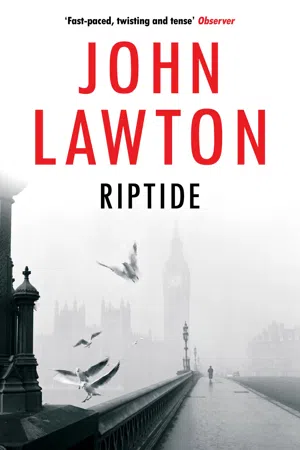
Written by 'a sublimely elegant historical novelist as addictive as crack' (
Daily Telegraph)
The Inspector Troy series is perfect for fans of Le Carré, Philip Kerr and Alan Furst.
1941.
After ten years spying for the Americans, Wolfgang Stahl disappears during a Berlin air raid. The Germans think he's dead. The British know he's not. But where is he?
MI6 convince US Intelligence that Stahl will head for London, and so Captain Cal Cormack, a shy American 'aristocrat', is teamed with Chief Inspector Stilton of Stepney, fat, fifty and convivial. Between them they scour London, a city awash with spivs and refugees.
When things start to go terribly wrong, ditched by MI6 and disowned by his embassy, Cal is introduced to his one last hope - Sergeant Troy of Scotland Yard...
eBook - ePub
Riptide
About this book
Information
Contents
Stilton
§ 1
§ 2
§ 3
§ 4
§ 5
§ 6
§ 7
§ 8
§ 9
§ 10
§ 11
§ 12
§ 13
§ 14
§ 15
§ 16
§ 17
§ 18
§ 19
§ 20
§ 21
§ 22
§ 23
§ 24
§ 25
§ 26
§ 27
§ 28
§ 29
§ 30
§ 31
§ 32
§ 33
§ 34
§ 35
§ 36
§ 37
§ 38
§ 39
§ 40
§ 41
§ 42
§ 43
§ 44
§ 45
§ 46
§ 47
§ 48
§ 49
§ 50
§ 51
§ 52
§ 53
§ 54
§ 55
§ 56
§ 57
Troy
§ 58
§ 59
§ 60
§ 61
§ 62
§ 63
§ 64
§ 65
§ 66
§ 67
§ 68
§ 69
§ 70
§ 71
§ 72
§ 73
§ 74
§ 75
§ 76
§ 77
§ 78
§ 79
§ 80
§ 81
§ 82
§ 83
§ 84
§ 85
§ 86
§ 87
§ 88
§ 89
§ 90
§ 91
§ 92
§ 93
§ 94
§ 95
§ 96
§ 97
§ 98
§ 99
§ 100
§ 101
§ 102
Historical Note
Stilton
§ 1
Berlin April 17th 1941
It was an irrational moment. A surrender of logic to the perilous joy of common nonsense. When the train stopped between stations on the S-Bahn, Stahl felt exposed, fearful for his life in a way that made no sense. High on the creaking metal latticework, the train tortured the tracks and juddered to a halt. Then the lights went out and Stahl knew that there was an air raid on. Yet again the RAF had got through to a city that the Führer had told them would never see a British plane or hear the crash of a British bomb. Berlin the impregnable, some of whose citizens now trembled and wept in the darkness, packed into a swaying train, high above the streets.
It was irrational. He was no more at risk here than on the ground. It just seemed that way – as though to be stuck on the elevated tracks like a bird on the wire made him into . . . a sitting duck. He recalled a phrase of his father’s from the last war, one every old Austrian soldier used occasionally – every old British soldier too, he was certain – ‘If it’s got your name on it . . .’ which meant that death was inevitable, and urged a grinning stoicism on those about to die.
The raid distracted him. He had been pretending to read a newspaper. He always did when he waited for the word. Tonight he had been oddly confident that there would be word. So confident, he became worried that he would miss her. More than once he had carried the pretence into practice, and had been caught engrossed in some nonsense in the Völkischer Beobachter and all but oblivious when she had brushed past him and muttered a single sentence.
The train moved off, the lights still out, sparks visible on the tracks below – hardly enough to make them the moving target his fellow-Berliners thought they were. At Warschauer Straße station passengers shoved and kicked till the doors banged open, a human tide surging for ground level and the shelters. The moment had passed, he was happier now in the open air and, as ever, curious about the men who dropped death on the city night after night. He stepped onto the platform, gazing into the clear, night sky hoping for a glimpse of a Blenheim or a Halifax. This was a reprisal raid. Last night – and into the small of hours of the morning – as the wireless had crowed all day, the Luftwaffe had blasted central London.
She brushed his shoulder. So quick, so quiet he could have missed her. A dark woman in a belted, brown macintosh, almost as tall as he. He could scarcely describe her face – he didn’t think he’d ever seen her eyes.
‘You are in the gravest danger. Go now. Go tonight.’
He heard his heart thump in his chest. He had expected this for so long that to hear the words uttered at last was like a body blow. The wind knocked from his lungs, his pulse doubled, a weakness in the knees that was so hackneyed a response he could scarcely believe it was happening to him.
‘Go now,’ she had said. ‘Go tonight.’
‘Leave Berlin,’ it meant, ‘leave Germany.’ And with that phrase, twelve wretched years of his life were stitched and wrapped and over.
A uniformed corporal grabbed him by the arm with not so much as a ‘Heil Hitler’, and pulled him towards the staircase. His cap went flying, rolling onto the tracks, the little silver skull glinting back at him in the moonlight.
‘It’s a big one, sir. We have to take cover.’
Stahl knew the man. That meant he was getting sloppy. He should have known the man was there. An Abwehr clerk – a privileged pen-pusher, the sort who’d never see the front line except as punishment. Stahl could not recall his name – odd that, that he should have a hole in his memory, a memory so precise for words heard, so precise for words seen – but he let himself be manhandled, clerkhandled, into a shelter: a concrete blockhouse beneath the S-Bahn station, hastily thrown up in the winter of 1939. Throughout the false start of Czechoslovakia and the easy victories over Poland and France, the Führer had made swift provision for bomb-shelters, whilst reminding them all that they weren’t going to be bombed. It was a brave man – in Stahl’s experience, a drunken man – who pointed out the anomaly.
Stahl was surprised. He’d never been in a street shelter before. He’d half expected satanic darkness, piss in the corner, vomit on the floor. But it was clean and only faintly malodorous. It was warm, too – the combined heat of all those bodies and the pot-bellied French stove against the back wall, looted from the Maginot Line less than a year ago, into which an enthusiastic youth, with phosphorous buttons on his jacket, was stuffing the remains of a beer crate. He stripped off his raincoat and draped it over one arm. The concrete cell was dimly lit by a ring of bulkhead lights – light enough for people to see him for what he was.
A middle-aged man in rimless spectacles had both arms wrapped around a whimpering woman. He stared at Stahl, patted his wife gently on the back. She too turned to look at Stahl and, finding herself looking up at an SD Brigadeführer in full uniform, less hat – all black and silver and lightning – she stopped whimpering. Stahl stood shoulder to shoulder with the corporal, sharing a small room with fifty-odd strangers, and heard the murmurs of fear and reassurance dwindle almost to nothing as though he himself had silenced them. It wasn’t him. It was the uniform. It possessed a power he had never thought he had. He wore it out of choice. His job permitted him civilian dress if he saw fit: Canaris wore plain clothes, Schellenberg wore them more often than not, but the dulled imaginations of the Geheime Staatspolizei – long since abbreviated to Gestapo – favoured a ‘civilian uniform’ of trilby hats and leather greatcoats. Stahl felt better in a real uniform. In a world where all identities were false it was a plain statement. The boldness of a barefaced lie. It seemed to him far less sinister than the ubiquitous leather coat. Why the Berliners should be more scared of him in a shelter than on a train needed no thought – they were showing treasonable fear in the presence of a man whose power over them might well be life and death – and he stood between them and the door.
When the all-clear sounded, Stahl found himself in the street with the Abwehr corporal once more. This time the man saluted. The contrived formality of a barked ‘Heil Hitler’ – contrived, Stahl knew, since there was hardly a man in the Abwehr who didn’t secretly despise Hitler, the Party and the SS. Stahl returned the salute, scarcely whispering the Heil Hitler. Perhaps he’d said it for the last time?
The man was right. It had been a heavy raid. They’d listened to the bombs explode, felt the earth shake, for well over an hour – wave after wave of bombers, so many he’d given up the focused monotony of counting. Now the air stank of cordite, and a haze of dust hung over the city in the moonlight.
He walked home through blitzed streets of dust and debris, almost empty of traffic – cars were abandoned at the roadside, trams did not run, people scurried like ants in all directions, directionless. Stahl turned the corner into Kopernikusstraße ten minutes later. It was deserted, almost silent. His apartment block and the one next to it had collapsed like bellows, breathed their last and died. The main staircase clung precariously to the wall where the strength of the chimney-breast had resisted the blast. He could see the top floor as clearly as if someone had pulled away the front, like the hinged facade of a doll’s house. He could see his own apartment, the floor hanging skewed, his bed with one leg resting on nothing, four floors of nothing, his mahogany wardrobe, one door open, almost tilting into the void, and his overcoat flapping on the back of the bedroom door.
There was no sign of rescue. In the distance he could hear sirens, but he’d had to climb over piles of rubble to get this far, and as far as he could see the other end of the street was no better. It would be an hour or more before anyone, any vehicle, got through.
He stepped into the remains of the concierge’s sitting room. The old woman sat at her piano, her forehead resting on the upturned lid, symmetrically between the candlesticks, dead. There didn’t seem to be a mark on her. What had killed her? Had her heart simply stopped at the sound of the bomb? Had she hit middle C and died? She sat in a ring of rubble but, it seemed, all of it had missed her, falling around her as though some invisible shield had guarded her body even as her spirit fled. He had liked the old woman. He had played this piano many times at her request. She had let him play simply for the pleasure of it, not caring what he played, but Stahl had seen tears in her eyes when he played Mozart. Mozart – Mozart had been the first snare. He had used Mozart to snare Heydrich. He had attracted his attention by appealing to the man’s taste, by playing Mozart and by playing upon the man’s childhood memories. Heydrich had grown up with music – his father had taught music in Dresden – he played the violin well, not as well as Stahl played the piano, but well nonetheless. It was the weak link in a man not known to have weaknesses, and Stahl had used it to work his way into Heydrich’s confidence. Not his affection. He had never seen affection for anyone in Heydrich. All the Nazis were mad – Heydrich no more nor less mad than Hitler or Himmler, but he was, Stahl thought, cleverer, more self-contained. Whatever lurked in Heydrich was well battened down. He threw no tantrums. He had his emotional outlet – music.
When, one day in 1934, after dozens of impromptu pootlings by Stahl, Heydrich had asked him if he knew a Mozart piece for violin and piano, the A major Mannheim Sonata, Stahl knew he had hooked him. They had played the piece at least fifty times over the year – many others besides, but Heydrich always came back to the Mannheim Sonatas as his starting point as though the duets, those sparse dialogues between the violin and the piano, held a significance for him that he would not utter and of which Stahl would not ask.
It was a pity. Stahl liked them. He’d never play any of them again now. They would be for ever associated with Heydrich in his mind and he had no wish to see a mental image of Obergruppenführer Reinhard Heydrich again. He would, almost daily, but he’d try not to.
In the back room Stahl found the body of Erwin Hölzel. At least he assumed it was Hölzel. There was a bloody fruit pulp where the face had been. The poor bugger had been blown through from the floor above.
Stahl looked up, past the jagged edges of floorboards, through Hölzel’s apartment, through his own, into the night sky. Then it came to him. He could scarcely believe his luck. Perhaps there was a God after all?
He climbed carefully up the staircase, testing each tread with one foot before putting his whole weight on it. From the top floor he looked out across the street. There were half a dozen people milling about – but distractedly, unfocused, bew...
Table of contents
- Cover
- Author biography
- Title page
- Copyright page
- Dedication page
- Acknowledgements
- Contents
Trusted by 375,005 students
Access to over 1.5 million titles for a fair monthly price.
Study more efficiently using our study tools.
Frequently asked questions
Yes, you can cancel anytime from the Subscription tab in your account settings on the Perlego website. Your subscription will stay active until the end of your current billing period. Learn how to cancel your subscription
No, books cannot be downloaded as external files, such as PDFs, for use outside of Perlego. However, you can download books within the Perlego app for offline reading on mobile or tablet. Learn how to download books offline
Perlego offers two plans: Essential and Complete
- Essential is ideal for learners and professionals who enjoy exploring a wide range of subjects. Access the Essential Library with 800,000+ trusted titles and best-sellers across business, personal growth, and the humanities. Includes unlimited reading time and Standard Read Aloud voice.
- Complete: Perfect for advanced learners and researchers needing full, unrestricted access. Unlock 1.5M+ books across hundreds of subjects, including academic and specialized titles. The Complete Plan also includes advanced features like Premium Read Aloud and Research Assistant.
We are an online textbook subscription service, where you can get access to an entire online library for less than the price of a single book per month. With over 1.5 million books across 990+ topics, we’ve got you covered! Learn about our mission
Look out for the read-aloud symbol on your next book to see if you can listen to it. The read-aloud tool reads text aloud for you, highlighting the text as it is being read. You can pause it, speed it up and slow it down. Learn more about Read Aloud
Yes! You can use the Perlego app on both iOS and Android devices to read anytime, anywhere — even offline. Perfect for commutes or when you’re on the go.
Please note we cannot support devices running on iOS 13 and Android 7 or earlier. Learn more about using the app
Please note we cannot support devices running on iOS 13 and Android 7 or earlier. Learn more about using the app
Yes, you can access Riptide by John Lawton in PDF and/or ePUB format, as well as other popular books in Literature & Literature General. We have over 1.5 million books available in our catalogue for you to explore.