'Clever, brave and urgent. I thought about
Lost Property for days after I finished it.' Sarah Moss, author of
Ghost Wall
'Fascinating and eloquent discussion of nationalism, art and conflict,
leavened with wry humour.'
Mail on Sunday
____________________
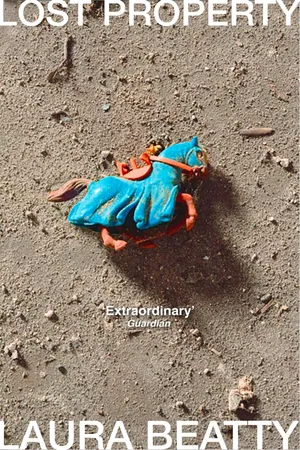
In the middle of her life, a writer finds herself in a dark wood, despairing at how modern Britain has become a place of such greed and indifference. In an attempt to understand her country and her species, she and her lover rent a busted-out van and journey through France and down to the Mediterranean, across Italy and the Balkans, finishing in Greece and its islands. Along the way, they drive through the Norman Conquest, the Hundred Years War, the Italian Renaissance, the 1990s and on to the current refugee crisis, encountering the shades of history, sometimes figuratively and sometimes - such as Joan of Arc, sitting pertly in the back of the van - quite literally.
As she roadtrips through 10,000 years of civilization, watching humanity repeat itself with wars over borderlines and exceed itself with the creation of timeless art, the writer begins to reckon with the very worst and the very best in our collective natures - and it is in seeing the beauty beside the ugliness, the light among the trees, that she begins to see, finally, a way for her to go home.
- 265 pages
- English
- ePUB (mobile friendly)
- Available on iOS & Android
eBook - ePub
Lost Property
About this book
Information
Subtopic
Literature GeneralIndex
Literature1
Let’s start again, more calmly.
In the world of poems or stories intractable problems find their solutions in some sideways step to a parallel reality, a place that is elsewhere but companionably alongside. Think of Dante and Gulliver and Gilgamesh. Think of the fairy tales you were told as a child. You take a journey by foot or ship, or you open a door in a wardrobe, or you take the proffered magic cloak, or the proffered hand of Virgil. Whichever way it is, you slip round the back of the wind, or down through the circles of Hell, and if you pay attention, and you don’t drop it or give it accidentally away, you come out holding the answer. Often the answer you hold is simply acceptance. So you could say there aren’t any answers. There isn’t even understanding a lot of the time, but still parallels can be a comfort – they offer connection between things that will always be separate and they allow, in fact they thrive on, difference. That used to be the point of books. They provided the parallel.
Something is lost and I can see now that it may be me. The world, both human and planetary, seems to me to be broken and instead of fixing it we have simply removed our lives into some other, better, curated reality – inside screens, in the printed text, to a world we have made, like children, out of words and pictures. And I have fallen into the gap between the two.
If my condition is normal for my time of life, if it has a name and a little pill to match, then I don’t want to know it. I feel as though it’s the world that is sick – just that no one except me has noticed. Cassandritis, you could call it, and as I do so I can’t help hearing, with a shiver of rightness, the name hidden in that second syllable.
So I’m packing up and making a change. Nothing unusual about that; it is quite normal to take a sabbatical. I’ll just go for a year and come back wiser, or quieter, or more calm. I don’t expect, in midlife, to be offered any cloaks and I don’t think Virgil will stir himself for less than an epic poet, but I could put my faith in parallels. I’m not expecting things to be better anywhere else. I don’t know what I’m looking for. Hope perhaps.
Now that I have made the decision, now that I have resisted the pull to give in to the madness of it all, as if in reward, in these wide and graceful streets the sun is shining. London can be a lovely city when you are leaving it. Brisk light and shadow on the grand nineteenth-century buildings, and I am going to buy storage boxes, to put my life into.
The trees are in their autumn beauty and many people are out, holding hands, talking languages, walking. Nothing looks especially wrong. The homeless have been tidied, as far as possible, out of sight; swept into dust-heaps on every corner under the humps of their nonetheless stinking blankets. The newspapers, as on most days, cry outrage as though innocent, but everyone still has a hand to hold.
‘Don’t look at the down and outs. Don’t look at the hoardings,’ my one self says. ‘It may not be as bad as it looks and there are reasons for everything in life.’
Shops are reassuring places; I am immediately distracted.
I could buy a laundry basket that folds away, a peg box, a desk tidy in leaf print, an elephant-foot waste basket. The solutions are all here. Here you can look better, live better, improve your cars, kitchens, skin, hair, partner, clothes, desks, waste management, character. Everything is new. Nothing yet has failed or been spoilt. Nothing has betrayed its initial promise and there is everywhere so much well-lit space and so much choice. The swing doors open and shut continually, wafting the smell of factory-newness out into the street to tempt those outside to come in. Come in. Come in. And in and out again floods the obedient crowd, hurrying home to be better.
I start grazing, gathering up armfuls of new stuff before I’ve even reached the department where I will buy the storage boxes to put the old stuff in. This is exactly what I’ve always been looking for! And it is beautiful! And this! And look at this!
I come to my senses in the home-storage department, glazed with picking things up that I don’t need. ‘Put it down,’ my one self says to my other. ‘Put it all down. This too is madness.’ I reluctantly put away the desk tidy. I put away the elephant’s foot and the peg bag. Instead, I buy plain see-through plastic boxes with lids, for ten pounds a throw. I go home and put my clothes into them, folded carefully. They are pitifully visible through the sides of the box. I also put in my knick-knacks, pencils, notebooks, all my other belongings. I look at them too. The process is oddly ceremonial, like a burial, but ‘Nevertheless,’ I say to myself, ‘go on.’
The mansion flat where I live has an outside balcony with, at the back, a little room that used to be a privy, now a walk-in cupboard. The stuff that will fit will go in there. Someone else will have my room. The flat isn’t mine; it belongs to my aunt who is away in St Petersburg. So now I have no fixings, no place at all in this country of my birth, and this is a hard thing. I am sweeping myself from the surface of my life. Nevertheless, I go on. I carry the boxes out and stand them in a stack in the cupboard.
Down on the street, the woman with the carrier-bag three-piece suite, who thinks she is Britannia, hasn’t moved. I can see her out of the window each time I pass. She is still sitting among her belongings on her step. So I stop my packing, pull my phone from my pocket and look up ‘belongings’ and ‘belong’. The word has such emotional charge in English. I look up French, Spanish, Italian, German, Bosnian, Bulgarian, Greek. Only the Bulgarians have a word that has the same root for both. Most differentiate between possessions and people. They use two separate words. None of them use one that contains within it an equivalent of longing. Being and longing and belonging.
‘Belongings,’ my one self says, with authority, to my other. I like to pontificate. ‘Belongings don’t matter, whereas belonging does.’ But there’s no comfort here. My other self is hurled abruptly into mourning, among the drifts of possessions, and the see-through containers. Belongings do matter. They are little weights that tie us to our lives in time and place. These vases with frogs and flowers were given to me as a child. This pot with a cow on it my son made when he was seven. This picture I bought with my first earnings. These things are hooked and weighted like anchors, holding me moored to the fact of my life, my past. Who will I be when I’ve cast off?
When the van arrives and the rest of my furnishings, my pictures and all my books are driven off into storage I stand at the traffic lights, a lone figure, stationary among a flood of movement, while the people and the traffic pour relentlessly past, either side. I watch the van out of sight. And BritAnnia snug among her bags, on her doorstep, watches me. Now I have nothing. I feel lightly giddy, as though whatever force holds my feet to their print on the ground might slacken suddenly, as though I might unmoor and float away. My belongings were so solid, such tangible proof of my life in reality, of myself. Without them there is no evidence; nothing left but the finite mess of body that I am, and my waning life which floats constantly in front of me, lit like a moon.
Normally, under these conditions, there would be a guide to take me by the hand, to lead me somewhere enlightening, show me things, explain. Quest literature is full of gods made into pillars of salt, or cloud; of sorcerers or genies, or, as I said before, epic poets returned from the grave. No one has yet come forward.
I am sitting on a railway bench, thinking about this, on a day when the sky has pulled itself down as far as my feet, thick as a duvet. I am waiting for a delayed train. Around me and away down the tracks whitish shadows bulk dim into the distance, even the most solid things reduced to suggestion. Little red tail-lights of trains to elsewhere swallowed in fog. Stillness. Foundering. On the digital board the estimated time of my train recedes into the future as if things had started running backwards. I’m not surprised.
I should say ‘we’. We are sitting on a railway bench, because I’m not in fact alone. I don’t have a guide, as such, but I have the man I share my life with. We are doing this together, although of the two of us I am the only one in extremis, the only one looking for answers. He isn’t bothered by the intractability of the world. He is never in one place for long enough to feel implicated by its failure.
‘The thing is,’ I tell him, ‘I was hoping for a guide to point us in the right direction.’
‘What do you mean?’ he says quickly. ‘I am a guide.’ It’s true. He is. He has a small travel business. He takes people round archaeological sites. He’s an expert on the ancient world – Greece and Rome in particular. ‘Won’t I do?’ He sounds mildly aggrieved.
‘I know, of course,’ I say, before correcting myself. ‘I mean, perfect.’ Although it isn’t. I had promised myself the obliterating gravitas of Virgil. There is nothing heavy about Rupert, his four decades of knowledge so lightly worn. To cover my confusion and to apologize, I say, ‘I was hoping you could do something like Virgil does for Dante; slap me in the face with the nature of man, show me the heart of life.’
He leans forward, his beard beaded with mist. ‘How often would you like slapping – daily? Or just once a week?’ He has his eyebrows lightly raised, his head ironically tilted. He knows if he slaps me I will slap him back. I look at him as he sits beside me. He doesn’t have the nose to be Virgil. Sideways on, his nose and his forehead make one line and his eyes, all the time, have the look of somewhere else. Also he has a kind of detachedness. He looks a bit like Hermes. It wouldn’t be hard to imagine…
‘Can’t you just pretend?’ he says, as if he’d read my thoughts. ‘If I was a god in disguise, you wouldn’t be able to tell.’ Now it is my turn to look ironic. He isn’t a god but it’s true: if he was, I wouldn’t know. He pulls a filled baguette out of the pocket of his old leather coat and begins wolfing through it as though it needed killing first.
‘What did Hermes do?’ I ask.
‘Well, his official title is the Psychopomp,’ he says between mouthfuls. ‘He’s a guide, traditionally of animals as well as people. He deals in dreams and cattle and technology. He is a trickster and a thief, and he guides souls on their final journey to the Underworld.’ I think on what he’s said. Some of it is OK.
‘Either way I will have to put you into my account,’ I say to him, half apologetic. I know he doesn’t like to be pinned down. ‘I mean, it wouldn’t be honest to leave you out. I’m not the sort of person who would just set off on a major journey by myself.’
He looks at me in silence, his mouth very full. After a while he swallows. ‘You can’t put someone called Rupert into a book,’ he replies, and goes back to eating.
He is right, though not for the reason he would have given. When I write his name down he drains out of it, as if the loops of the letters were holes in a sieve. Empty.
What shall I do – call him something else? Nothing else works. Everything I try feels false. I ask him what he thinks. He is silent again. Then he puts up one hand in front of his very full mouth to act as a shield. He always talks with his mouth full.
‘If you put me in, it won’t really be me. It will be someone else.’ Little flecks of something like pickle spray from his lips.
‘No,’ I say, hesitating, ‘it won’t… True.’ It is an odd paradox that for the sake of truth I have to use his real name, but that the result will be someone invented.
That seems to be the end of the conversation.
We need a vehicle. We are on our way to test-drive a second-hand campervan in which to make our journey. The dealership is in a hinterland of scrub outside Pangbourne, gorse mostly, being picked round by ponies in a cat’s cradle of electric fencing. We rock our way, by taxi, a little hopeless, up a track in and out of potholes to a concrete yard. The driver says he is happy to wait; lots to look at here. He says it like it’s the greatest joke ever made. It’s true, it’s a sorry set-up. There is a litter of forgotten-looking vans too big for what we want and a Portakabin, tilted as if standing on one leg ashamed, and well it might be. Out of it, as we pull up, comes someone blazing with reddish hair, part boy, part fox, with several sets of keys jingling in his hand and a cocky little terrier trotting behind him. His clothes look as though he had slept in them not just last night but for the whole of last week. But he is impossibly, almost embarrassingly handsome. I have to make myself look away. Instinctively I try pulling myself together. How have I got so old, so invisible? I look brightly round at the collapsed vehicles. The one we are trying out is very small. Rupert and the fox boy sit in the front seats, their shoulders touching and their heads hunched forward, and I, sitting sideways on one of the benches, can’t see out of the back windows unless I fold myself in half. When the boy turns the key there is complete silence. The van is dead. Unfazed, he hops out and jump-leads it back to life.
‘It’s not the fastest,’ he says as we move at a slow running pace, back down the track. ‘But once it’s going, it’ll go forever.’ In the rear-view mirror I can’t help noticing that my mouth is open. I shut it and look at the needle of the speedometer. We are on the open road. It is trembling with effort, trying to hold itself at sixty.
‘Thanks,’ Rupert says over the rattle of the engine. ‘We’ll have a think.’ He says it in a way that means ‘we are not interested’ and ‘you’ll never hear from us again’ and I find myself surprised because, despite the jump-leads, despite the junkyard hopelessness of the outfit, I am not able to see past the fox boy’s patter, the power of his blazing looks. Obviously, or so I thought, we were going to buy it.
Finally, days later, we settle on a second-hand Romahome. It is fifteen feet by five, more or less, made of yachting fibreglass on the Isle of Wight, an upside-down boat on wheels. A good vessel for an upside-down time. I like the fact that its name is that of a tribe of outsiders, and I like the fact that, read backwards, it spells amor. Let’s hope that will be some protection.
London to Greece overland, to the island of Syros, is where we are going. You can fly the distance in a few hours and one change. It isn’t what people consider ‘a journey’. But we are going by parallel. We plan on taking months.
We provision ourselves for the trip. We buy a fold-up colander to save space, teabags for a continent devoted to coffee, a fold-up steamer so we can cook two things in one pot, a fold-up shovel for latrine digging, a camping shower that can be hung from a tree. Or rather, Rupert buys. The wood has closed about me again and I am in a different place. In this savage and extreme world, why are we busying ourselves buying kettles? I walk round the shops very carefully, newly aware that my body, which is all I have, is very soft, very puncturable.
Rupert considers torches, maps, e-guide books. He makes lists and crosses things off. Sometimes he asks me, sometimes he just looks at me as if to ask and then carries on. The closer the deadline comes, the worse it gets. I leave my purse in a shop in Richmond and he travels the two-hour round-trip to retrieve it for me as a matter of course. I am aware all the time that I am being very gently carried. I don’t feel bad. It is a matter of practicality. I haven’t actually checked but it feels now as though I have no skin at all, as though the complex networks of vein and muscle, the wet mesh of my capillaries, are directly exposed to London’s air. I worry briefly about grit.
Meanwhile, on the floor in the...
Table of contents
- Cover
- Title
- Copyright
- Before
- Chapter 1
- Chapter 2
- Chapter 3
- After
- Translations
- Picture credits
Trusted by 375,005 students
Access to over 1.5 million titles for a fair monthly price.
Study more efficiently using our study tools.
Frequently asked questions
Yes, you can cancel anytime from the Subscription tab in your account settings on the Perlego website. Your subscription will stay active until the end of your current billing period. Learn how to cancel your subscription
No, books cannot be downloaded as external files, such as PDFs, for use outside of Perlego. However, you can download books within the Perlego app for offline reading on mobile or tablet. Learn how to download books offline
Perlego offers two plans: Essential and Complete
- Essential is ideal for learners and professionals who enjoy exploring a wide range of subjects. Access the Essential Library with 800,000+ trusted titles and best-sellers across business, personal growth, and the humanities. Includes unlimited reading time and Standard Read Aloud voice.
- Complete: Perfect for advanced learners and researchers needing full, unrestricted access. Unlock 1.5M+ books across hundreds of subjects, including academic and specialized titles. The Complete Plan also includes advanced features like Premium Read Aloud and Research Assistant.
We are an online textbook subscription service, where you can get access to an entire online library for less than the price of a single book per month. With over 1.5 million books across 990+ topics, we’ve got you covered! Learn about our mission
Look out for the read-aloud symbol on your next book to see if you can listen to it. The read-aloud tool reads text aloud for you, highlighting the text as it is being read. You can pause it, speed it up and slow it down. Learn more about Read Aloud
Yes! You can use the Perlego app on both iOS and Android devices to read anytime, anywhere — even offline. Perfect for commutes or when you’re on the go.
Please note we cannot support devices running on iOS 13 and Android 7 or earlier. Learn more about using the app
Please note we cannot support devices running on iOS 13 and Android 7 or earlier. Learn more about using the app
Yes, you can access Lost Property by Laura Beatty in PDF and/or ePUB format, as well as other popular books in Literature & Literature General. We have over 1.5 million books available in our catalogue for you to explore.