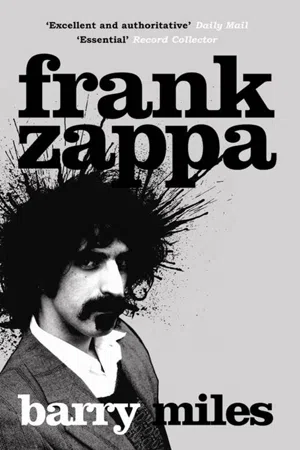
Barry Miles knew Frank Zappa intimately and was present at the recording of some of his most important albums. This sparkling biography brings the Zappa the musician and composer, Zappa the controversialist and Zappa the family man (despite his love of groupies, he was married for more than 30 years) together for the first time.
Barry Miles' biography follows Zappa from his sickly Italian-American childhood in the 1940s (when his father, Frank senior, worked for the US military and was used to test the efficacy of new biological warfare agents) to his death from cancer in the 1990s. Miles shows how Zappa's goal had been to become a classical composer, until he realised that he would starve to death pursuing this ambition in post-war America. In an effort to make music people would actually listen to, in the mid-1960s he joined a noisy new band called 'The Mothers of Invention'. Before long, Zappa had taken over as singer, song writer and lead guitarist and together they exploded on to the San Francisco freak scene. Following the release of recordings such as
Freak Out,
Absolutely Free,
We're Only In It For the Money and
Hot Rats, Zappa's reputation in the United States and in Europe, especially the UK, Germany and Holland, took off. When the Berlin wall fell, Frank was surprised to learn that his extravagant music embodied sixties liberty for a generation of dissidents (including Vaclav Havel, who invited Zappa to be his minister for culture).
Frank Zappa is an authoritative and hugely enjoyable portrait of a singular man and a vivid evocation of the West Coast scene.
eBook - ePub
Frank Zappa
About this book
Information
Print ISBN
9781843540922
Subtopic
MusicContents
| Illustrations | |
| Introduction | |
| 2 | California |
| 3 | Lancaster, CA |
| 4 | Ontario, CA |
| 5 | Cucamonga |
| 6 | Studio Z |
| 7 | The Strip |
| 8 | Freak Out! |
| 9 | Laurel Canyon |
| 10 | New York City |
| 11 | The Log Cabin |
| 12 | Bizarre/Straight |
| 13 | 200 Motels |
| 14 | Waka/Jawaka |
| 15 | On the Road |
| 16 | Dr Zurkon’s Secret Lab in Happy Valley |
| 17 | Days on the Road |
| 18 | Orchestral Manoeuvres |
| 19 | Wives of Big Brother |
| 20 | One More Time for the World |
| 21 | On Out |
| 22 | Afterword |
| Bibliography | |
| Discography | |
| Films and Books | |
| Index |
Introduction
In 1965 Cucamonga was just a village: a few streets clustered either side of Foothill Boulevard, historic Route 66, where it crossed Archibald Avenue about 75 miles east of Los Angeles. Around 7,000 people were scattered in the suburban desert sprawl that extended all the way to LA and connected the twin towns of Ontario-Upland to the west and San Bernardino to the east. Though this was the mid-sixties, the Cucamongans lived in a fifties time warp. It was a conservative, right-wing village and the male population wore short-sleeved white shirts and bow ties. Even a T-shirt was looked upon with suspicion. Cucamonga had a high school, a court house, a holy-roller church, a malt-shop and a recording studio, Studio Z, built by local boy Paul Buff, but now owned by 24-year-old Frank Zappa.
Business was slack: few Cucamongans wanted to record their bands, even at the very reasonable rate of $13.50 an hour, so Frank had to drive 75 miles to Sun Village in the High Mojave Desert every weekend where he earned $7 a night playing in a bar band. With him in the studio lived his 18-year-old girlfriend Lorraine Belcher and his high-school friend Jim ‘Motorhead’ Sherwood.
One of Zappa’s schemes was for a low budget science-fiction movie: Captain Beefheart Versus the Grunt People, starring Captain Beefheart (aka Don Vliet) and his parents. Zappa had bought $50-worth of stage flats that took up much of the back room of Studio Z, and had painted them with cartoon designs for a rocket ship and a mad scientist’s lab. Despite having no money, he had confidently announced a casting call for the movie. This drew the attention of the local police. Tipped-off by the Cucamonga police department, Detective Sgt Jim Willis from the San Bernardino sheriff’s office vice squad auditioned for the part of Senator Gurney (the ‘role of the asshole’, as Zappa put it) and was convinced he had uncovered a vice den.
To Sgt Willis, Studio Z looked like a bohemian ‘pad’. The walls were covered with newspaper clippings and memorabilia: a threat from the Department of Motor Vehicles to revoke Zappa’s driver’s licence, his divorce papers, a still of him on The Steve Allen Show, rejection letters from several music publishers, pop art collages and song lyrics. One was ‘The Streets of Fontana’, a parody of the folk music standard ‘The Streets of Laredo’, which Zappa used to sing with Ray Collins in the local clubs as a joke.
As I was out sweeping the streets of Fontana
As I was out sweeping Fontana one day
I spied in the gutter a mouldy banana
And with the peeling I started to play . . .
As I was out sweeping Fontana one day
I spied in the gutter a mouldy banana
And with the peeling I started to play . . .
To Sgt Willis this was no joke. Zappa was clearly a threat to society. He ordered a surveillance team to drill a hole in the wall of the studio and for several weeks undercover police gathered evidence of subversive behaviour.
Then Sgt Willis visited the studio, this time in the guise of a used-car salesman. Attracted by the smart sign over the door (TV PICTURES), he explained that he and the boys were having a little party and wondered if Zappa could make him an ‘exciting film’ to suit the occasion. Zappa – who was living on peanut-butter sandwiches and instant mashed potatoes scrounged by Motorhead from the blood-donor centre – rapidly calculated that such a film would cost $300 to make. This was beyond the budget of the San Bernardino vice squad, so Zappa suggested that a tape-recording might suffice and would cost only $100.
Willis outlined all the things he would like to hear on the tape (including ‘oral copulation’) and Zappa said it would be ready the next day. Their conversation was relayed to a police tape recorder in a van parked across the street via a wrist-watch transmitter, like something out of a Dick Tracy cartoon.
That evening Zappa and Lorraine bounced around on the bed to make the springs squeak for a half-hour tape and added gasps, moans and what the police later described as ‘blue’ dialogue. There was no actual sex. Zappa edited out all the giggles and laughter and then, ever the professional, added a musical backing track. Sgt Willis showed up the next day and offered him $50.
Zappa complained that the deal was for $100 and refused to hand over the tape. At that moment the door burst open and two more sheriff’s detectives, plus another from the Ontario police department, rushed in, closely followed by a reporter from the Ontario-Upland Daily Report and a photographer. Zappa and Lorraine were arrested and handcuffed. Willis and his team searched the premises while the photographer’s flash bulbs went off. They seized every scrap of tape and strip of film in the studio and even took away Zappa’s 8mm projector as ‘evidence’.
Zappa and Lorraine were taken to the county jail and booked on suspicion of conspiracy to manufacture pornographic materials and sex perversion, both felonies.
It was front-page news in the Daily Report: under the heading 2 A GO-GO TO JAIL they breathlessly described how: ‘Vice squad investigators stilled the tape recorders of a free swinging a-Go-Go film and recording studio here Friday and arrested a self-styled movie producer and his buxom red-haired companion.’
Paul Buff loaned Zappa the money to get out on bail and Zappa got an advance on royalties from Art Laboe at Original Sound – who had a Mexican Number One with ‘Tijuana Surf’ by the Persuaders (Zappa had written the B-side: ‘Grunion Run’) – to have Lorraine released. They were arraigned the next week at the Cucamonga Justice Court across from Studio Z.
Before the trial, Zappa’s elderly, white-haired lawyer took him aside and asked: ‘How could you be such a fool to let this guy con you? I thought everybody knew Detective Willis. He’s the kind of guy who earns his living waiting around in public rest rooms to catch queers.’ Zappa had never heard of anything like it. The idea that there were people employed in the police department to do such things was a revelation.
He and Lorraine – now described as ‘a buxom red-haired girl of perfect physical dimensions’ by the increasingly excited Daily Report – appeared before the judge. At one point in the proceedings, he took them both, along with all the lawyers, into his private chambers to hear the ‘pornographic’ tape. It was so funny the judge started laughing, which outraged the prosecution. The case was being brought by a 26-year-old assistant district attorney who demanded that Zappa serve time for this piece of filth, ‘in the name of Justice!’
The case against Lorraine was dropped and Zappa was found guilty of a misdemeanour. He was given six months in jail, with all but ten days suspended, then put on three years probation. During this time he was not allowed to be in the company of a woman under 21 without a chapter one and, most importantly, must not violate any of California’s traffic laws.
The ten days in San Bernardino County Jail had a traumatic effect on Zappa, shocking him out of his innocence and creating the cynical, suspicious persona that defined him throughout his life.
Forty-four men were crammed together in Tank C in temperatures reaching 104 degrees. The lights were on all the time. There was one shower at the end of the cell block, but it was so grimy Zappa didn’t shave or shower at all. One morning he tipped his aluminium breakfast bowl over and at the bottom, stuck in the creamed-wheat, was a giant cockroach. He enclosed it in a letter to Motorhead’s mother, but the prison censor found it and threatened him with solitary confinement if he tried anything like that again. Zappa was powerless to fight back and sat there imagining monster guitar chords powerful enough to crack open the walls.
By the time he got out, he no longer believed anything the authorities had ever told him. Everything he had been taught at school about the American Way of Life was a lie. He would not be fooled again. He made sure that his pornographic tape was heard by everyone – he remade it time and time again, at least a couple of times on each album, rubbing it in the face of respectable society, making America see itself as it really was: phoney, mendacious, shallow and ugly.
1 Baltimore
Zappa means ‘hoe’ in Italian, symbol of the back-breaking toil of the Sicilian peasants who had to scratch a living from the dry stony ground. Frank Zappa’s father, Francis Vincent Zappa, was born on 7 May 1905 in Partinico, western Sicily, a small town of about 20,000 people. Partinico is twelve miles west of Palermo along a twisting mountain road. An area of astonishing beauty, with Greek temples, Roman bridges, Saracen mosques, Romanesque churches and cloistered monasteries set among olive groves and vineyards, it is also the Mafia heartland.
After the Second World War, the ‘...
Table of contents
- Cover
- Title Page
- Copyright page
- Dedication page
- Contents
Trusted by 375,005 students
Access to over 1.5 million titles for a fair monthly price.
Study more efficiently using our study tools.
Frequently asked questions
Yes, you can cancel anytime from the Subscription tab in your account settings on the Perlego website. Your subscription will stay active until the end of your current billing period. Learn how to cancel your subscription
No, books cannot be downloaded as external files, such as PDFs, for use outside of Perlego. However, you can download books within the Perlego app for offline reading on mobile or tablet. Learn how to download books offline
Perlego offers two plans: Essential and Complete
- Essential is ideal for learners and professionals who enjoy exploring a wide range of subjects. Access the Essential Library with 800,000+ trusted titles and best-sellers across business, personal growth, and the humanities. Includes unlimited reading time and Standard Read Aloud voice.
- Complete: Perfect for advanced learners and researchers needing full, unrestricted access. Unlock 1.5M+ books across hundreds of subjects, including academic and specialized titles. The Complete Plan also includes advanced features like Premium Read Aloud and Research Assistant.
We are an online textbook subscription service, where you can get access to an entire online library for less than the price of a single book per month. With over 1.5 million books across 990+ topics, we’ve got you covered! Learn about our mission
Look out for the read-aloud symbol on your next book to see if you can listen to it. The read-aloud tool reads text aloud for you, highlighting the text as it is being read. You can pause it, speed it up and slow it down. Learn more about Read Aloud
Yes! You can use the Perlego app on both iOS and Android devices to read anytime, anywhere — even offline. Perfect for commutes or when you’re on the go.
Please note we cannot support devices running on iOS 13 and Android 7 or earlier. Learn more about using the app
Please note we cannot support devices running on iOS 13 and Android 7 or earlier. Learn more about using the app
Yes, you can access Frank Zappa by Barry Miles in PDF and/or ePUB format. We have over 1.5 million books available in our catalogue for you to explore.