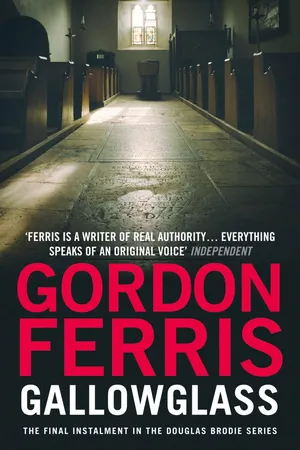
Douglas Brodie is dead. The Glasgow Gazette announced the tragic death on 26 June 1947 of their chief crime reporter.
Just three weeks before, life was rosy. After a tumultuous winter chasing war criminals across Glasgow, Douglas Brodie was revelling in the quiet life. His relationship with advocate Samantha Campbell was blossoming and he'd put the reins on his impulsiveness. Hope and promise filled the tranquil summer air.
A day later, Brodie was arrested for the kidnap and murder of Scotland's top banker.
The case against Brodie is watertight: caught with a gun in his hand next to a man with a bullet in the head - from Brodie's own revolver. He has no alibi. No witnesses. Despite Samantha's best efforts, Brodie faces the gallows. Is this the sordid end for a distinguished ex-copper, decorated soldier and man of parts?
- 376 pages
- English
- ePUB (mobile friendly)
- Available on iOS & Android
eBook - ePub
Gallowglass
About this book
Information
Subtopic
Crime & Mystery LiteratureIndex
LiteratureCONTENTS
Prologue
One
Two
Three
Four
Five
Six
Seven
Eight
Nine
Ten
Eleven
Twelve
Thirteen
Fourteen
Fifteen
Sixteen
Seventeen
Eighteen
Nineteen
Twenty
Twenty-One
Twenty-Two
Twenty-Three
Twenty-Four
Twenty-Five
Twenty-Six
Twenty-Seven
Twenty-Eight
Twenty-Nine
Thirty
Thirty-One
Thirty-Two
Thirty-Three
Thirty-Four
Thirty-Five
Thirty-Six
Thirty-Seven
Thirty-Eight
Thirty-Nine
Forty
Forty-One
Forty-Two
Forty-Three
Forty-Four
Forty-Five
Forty-Six
Forty-Seven
Forty-Eight
Forty-Nine
Fifty
Fifty-One
Fifty-Two
Fifty-Three
Fifty-Four
Fifty-Five
Fifty-Six
Fifty-Seven
Fifty-Eight
Fifty-Nine
Sixty
Sixty-One
Sixty-Two
Douglas Brodie Book 1
Douglas Brodie Book 2
Douglas Brodie Book 3
Danny McRae Book 1
Danny McRae Book 2
PROLOGUE
He was dead. It was announced in his own newspaper, the Glasgow Gazette. Instead of the usual crime column, there was a brief editorial. It described the tragic death of their chief crime reporter and staunchly defended him against the unproven charge of murder. It was a brave stance to take, given the public outcry and the weight of evidence against him.
Finally and conclusively, his death was confirmed in the tear-streaked faces of the women by the fresh-dug grave. It was spelled out in chiselled letters on the headstone, glistening oil-black in the drizzle:
Douglas Brodie
Born 25 January 1912
Died 26 June 1947
Died 26 June 1947
‘A man’s a man for a’ that.’
In the circumstances there were only four mourners: two women and two men. Of the black-garbed women, the taller held an umbrella aloft in two hands. Only the tufts of blonde hair on a pale neck showed beneath the hat and veil. She sheltered her smaller companion: a veiled and stooped figure clutching a bible and dabbing at her face with a lace hankie. Alongside was a human water feature: one man clutching the handles of a wheelchair while rain cascaded off his hat on to the rubberised cape of the man in the chair.
Bit players lurked off stage. A man and a boy leaning on their shovels in a wooden bothy, staring despondently at the mound of earth as it grew heavier and more glutinous by the minute. Further down the green slope, a man in the dog collar of the Church of Scotland, scuttling for home, dreaming of a hot toddy after his desultory oration by the graveside. It had taken some persuasion even to get Douglas Brodie consigned to this cemetery. There had been an embarrassed debate with the kirk and Kilmarnock corporation about using a Christian burial site for the interment of a man who’d committed two mortal sins: murder and suicide. But Agnes Brodie’s quiet insistence was not easily denied.
The two women had had enough. They turned and started to shuffle their way back down the path towards the metal gate in the high sandstone wall. They clutched each other for support on the wet gravel. The standing man birled the wheelchair round and fell in behind the women. Pusher and passenger struggled with brake and shoe leather to keep the chair straight and stop it careering down the slope. Behind them the straight rows of stones marched towards the horizon of lush green Ayrshire hills.
Their transport was waiting, chugging out a pall of grey smoke into the dank air, wipers thumping back and forth like a metronome. For the needs of the mourners, they’d hired a converted Bedford van, painted black, with windows and two rows of facing seats. It took a while and considerable manoeuvring to get the four ensconced on the benches and the chair crammed into the rear. Once seated, they were off into the steady downpour. They closed the window between themselves and the driver and were free to talk.
‘Are you all right, Agnes?’ said Samantha Campbell. ‘It’s over now. We can get on.’
Agnes Brodie sniffed and wiped her nose and eyes with her hankie.
‘Ah never thought Ah’d see the day. It’s not right for a son to go before his mother.’
Sam patted her hand and turned to the men sitting facing them.
‘You’re drookit, the pair of you. I hope you haven’t overdone it, Wullie. Can you get that cape off him, Stewart? Dry out a bit?’
She reached to help him pull it over his head and drop it on the floor. The smell of wet rubber tanged the air. His face was blanched and he took in two shuddering breaths to settle himself.
‘That’s better. Thanks, hen.’
‘I said you shouldn’t have come. You’re barely out of hospital.’
‘I’m fine, lassie.’ To prove his fitness, Wullie McAllister, sometime doyen of crime reporting at the Glasgow Gazette, reached into his jacket, pulled out his pack of Craven A, lit up and drew luxuriously on his cigarette. Stewart, his companion, slid a window open an inch.
‘Ah should have brought a half-bottle,’ Wullie said wistfully. ‘Will you be having a wee bit of a wake? Raise a glass to him? Even though we’re so few.’
Sam and Agnes exchanged glances.
‘Surely we should get you straight home? Get you into dry clothes?’ asked Sam.
‘Inner warmth. That’s what Ah need.’
Sam smiled at Agnes and lifted an eyebrow. ‘Of course, Wullie. A dram it is. And I’ve got some soup on the go as well.’
They were quiet for a bit, then Agnes spoke.
‘Such a poor turnout, as well.’
‘You can hardly blame them, Agnes. We asked for privacy in the Gazette and the Kilmarnock Standard.’
‘Ah suppose so, Samantha. A’ the same.’
Wullie flourished his fag at the thought. ‘He wouldnae have wanted a fuss. You know what Brodie’s like.’
Stewart joined in. ‘They all wanted to come from the Gazette. Wullie talked them out of it. Said he’d represent them.’
Sam nodded. ‘And I was approached by half the synagogue at Garnethill. You know what Douglas did for them. I said it just wasn’t right. It would have felt wrong somehow.’
Agnes persisted. ‘Not even his old regiment. There should have been a piper.’
Wullie blew out smoke. ‘Mrs Brodie, funerals are dreich enough affairs without “The Flowers of the Forest” making our ears bleed.’
Again, silence left them with their thoughts all the way across the sodden Fenwick Moors and back on to the rain-lashed streets of Glasgow. It was only as they began the climb up to Park Terrace and Sam’s home that Wullie spoke.
‘Ah’ll fair miss him, so Ah will.’ He unfurled a huge white hankie and gave his nose a good blow.
Sam pursed her lips. She reached out and touched his hand.
‘Wullie, I have a confession—’
‘Wheesht, hen, Ah know you blame yourself.’
She hesitated as the car drew to a halt by the kerb. She nodded.
‘You’re right. It would never have happened if he’d got through to me that night.’
Agnes shook her head. ‘You cannae blame yourself, Samantha. Douglas wouldn’t have listened to you anyway. He was as stubborn as his faither.’
‘I might have persuaded him. It could have turned out differently . . .’
ONE
It was as if I’d had a blood transfusion. Or perhaps it was just the warm June sun on my brow after the longest, coldest winter in Scottish records. Rising with first light, strolling through Kelvingrove Park down the winding paths lined with new-minted leaves. Then across to the Western Baths Club to carve out spluttering lengths in the great echoing hall. Something was making my blood sing, as though – and I scarcely dared hope – I’d finally emerged from festering anger and self-pity.
They say the best blades are toughened by heat and hammering. Time and again over the past eight years I’d been fired in the furnace, pounded flat, and quenched. In blood. I was at last rising from the dust of the African campaign, the damp of the Ardennes, and the soul-shrivelling scenes from the death camps. Last month, in merry May, a line had been drawn in my personal ragged history when the death penalties had been carried out on the Nazi overseers of Ravensbrück. It was as if the hangman had performed an exorcism with every pull on his lever.
Or maybe it was the couple of sessions I’d had with a head doctor. Sam had cajoled me into seeing the husband of an old pal of hers: Dr Andrew Baird. There was no couch, no tweed and pipe, no inkblot tests or unravelling of my childhood. Baird – about my own age, intense and engaging – was even prepared to come to me. We sat in Sam’s library, each nursing a glass of whisky, while he gently plied me with questions.
‘When the war ended you were commanding a company of Seaforth Highlanders?’
‘I’d been given Acting Major. We’d fought our way from Normandy to Bremen.’
‘But you didn’t come home with them?’ he said casually, taking off his specs and cleaning them on his tie.
‘Sam’s briefed you well.’ I smiled. ‘No, I studied languages at Glasgow before the war, French and German. The top brass found out and I was assigned to sift Nazi goats from Wehrmacht sheep and send the former off to military courts.’
‘Harrowing?’
‘They weren’t nice people. They’d done bad things.’
‘You saw?’
‘Yes. Belsen.’
He nodded. ‘When did they let you come home?’
‘November ’45.’
‘Back here?’
I shook my head. ‘Couldn’t face it. All too . . . normal, somehow. I just needed time off. I was demobbed in London and hung around there for a few months.’
‘Doing?’
‘Drinking mainly.’ I hefted my glass and swilled its golden contents. ‘Then I began pulling myself together. Started getting work as a reporter.’
‘When did the nightmares start?’
‘Oh, mid ’45, I suppose. It figures, doesn’t it?’
‘Yes. Very typical. I’m seeing a lot of men like you, Douglas. They called it shell shock in the Great War. Now it’s combat stress, or battle fatigue. But you know what I’m talking about?’
‘I was fine during the battles, Doc.’ I smiled again.
‘That’s how it works. We’re only just appreciating how deep the trauma runs when a man is subjected to horror on a continual basis, such as war, or recurring acts of violence. Seems like you received more than your fair share.’
We met for a second time a week later and I told him about my recent experience of getting dragged into the hunt for the war criminals who’d used Scotland as a staging post to South America.
‘And this January you ended up in Hamburg with Samantha. Back in uniform?’
‘Ridiculous, wouldn’t you say?’
‘Asking a lot of a chap, I’d say. And the nightmares began again.’
‘They never really stopped.’
‘While the drinking got worse.’
‘Never really stopped either, Andrew. But, yes, I ...
Table of contents
- Cover
- Title Page
- Copyright Page
- Dedication Page
- Contents
- Prologue
- One
- Two
- Three
- Four
- Five
- Six
- Seven
- Eight
- Nine
- Ten
- Eleven
- Twelve
- Thirteen
- Fourteen
- Fifteen
- Sixteen
- Seventeen
- Eighteen
- Nineteen
- Twenty
- Twenty-One
- Twenty-Two
- Twenty-Three
- Twenty-Four
- Twenty-Five
- Twenty-Six
- Twenty-Seven
- Twenty-Eight
- Twenty-Nine
- Thirty
- Thirty-One
- Thirty-Two
- Thirty-Three
- Thirty-Four
- Thirty-Five
- Thirty-Six
- Thirty-Seven
- Thirty-Eight
- Thirty-Nine
- Forty
- Forty-One
- Forty-Two
- Forty-Three
- Forty-Four
- Forty-Five
- Forty-Six
- Forty-Seven
- Forty-Eight
- Forty-Nine
- Fifty
- Fifty-One
- Fifty-Two
- Fifty-Three
- Fifty-Four
- Fifty-Five
- Fifty-Six
- Fifty-Seven
- Fifty-Eight
- Fifty-Nine
- Sixty
- Sixty-One
- Sixty-Two
- Douglas Brodie Books
- Danny McRae Books
Trusted by 375,005 students
Access to over 1.5 million titles for a fair monthly price.
Study more efficiently using our study tools.
Frequently asked questions
Yes, you can cancel anytime from the Subscription tab in your account settings on the Perlego website. Your subscription will stay active until the end of your current billing period. Learn how to cancel your subscription
No, books cannot be downloaded as external files, such as PDFs, for use outside of Perlego. However, you can download books within the Perlego app for offline reading on mobile or tablet. Learn how to download books offline
Perlego offers two plans: Essential and Complete
- Essential is ideal for learners and professionals who enjoy exploring a wide range of subjects. Access the Essential Library with 800,000+ trusted titles and best-sellers across business, personal growth, and the humanities. Includes unlimited reading time and Standard Read Aloud voice.
- Complete: Perfect for advanced learners and researchers needing full, unrestricted access. Unlock 1.5M+ books across hundreds of subjects, including academic and specialized titles. The Complete Plan also includes advanced features like Premium Read Aloud and Research Assistant.
We are an online textbook subscription service, where you can get access to an entire online library for less than the price of a single book per month. With over 1.5 million books across 990+ topics, we’ve got you covered! Learn about our mission
Look out for the read-aloud symbol on your next book to see if you can listen to it. The read-aloud tool reads text aloud for you, highlighting the text as it is being read. You can pause it, speed it up and slow it down. Learn more about Read Aloud
Yes! You can use the Perlego app on both iOS and Android devices to read anytime, anywhere — even offline. Perfect for commutes or when you’re on the go.
Please note we cannot support devices running on iOS 13 and Android 7 or earlier. Learn more about using the app
Please note we cannot support devices running on iOS 13 and Android 7 or earlier. Learn more about using the app
Yes, you can access Gallowglass by Gordon Ferris in PDF and/or ePUB format, as well as other popular books in Literature & Crime & Mystery Literature. We have over 1.5 million books available in our catalogue for you to explore.