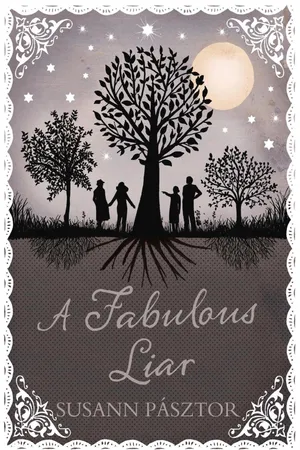
Joschi Molnar is an enigma: father, Holocaust survivor, wit, and fabulous liar. After his death his three surviving children are left with contrasting versions of his life, yet corresponding attitudes to their childhood: thirty years since Joschi Molnar died, his lasting legacy is one of confusion, unanswered questions, and irrevocable differences.
On what would have been their father's 100th birthday, the Molnar children - along with Joschi's sixteen-year-old grand-daughter, Lily - stage a reunion: but in a lively Italian restaurant, as they remember the man that none of them really knew, their shared history dissolves into tall tales, fights, confessions and laughter.
- English
- ePUB (mobile friendly)
- Available on iOS & Android
eBook - ePub
A Fabulous Liar
About this book
Information
Print ISBN
9781848878488
Subtopic
Literature GeneralContents
Prologue
1
2
3
4
5
6
7
8
9
10
11
12
13
14
15
16
17
18
Prologue
ONE SUNNY AUTUMN MORNING in September 1959, József Molnár prepared to put an end to his life. The previous evening, in a station bar, he had sought suitable words of farewell for his loved ones, and posted the three letters. He booked himself into a city-centre hotel that he knew from previous visits. It let rooms by the hour, and was in a former underground air-raid shelter. After he had choked down several sleeping tablets with a little water, he lay down on the once-pink bedcover, studied the mould stains and the flaking plaster on the ceiling, listened to the dripping tap and the traffic trundling away above his head, and waited for death.
But what he took for dying was only another beginning of the end, and instead of death the landlord appeared, followed by a gruff emergency doctor, because József had only been able to pay for two hours, and that wasn’t long enough to die. And so it was that the following day three people gathered around a different bed – a hospital bed this time, with clean white sheets – gazing with concern at József’s pale, exhausted face. (He had every reason to look pale and exhausted. Stomach pumping is no small matter, and neither is a failed suicide, especially since its cause had not yet been erased from the world.)
It was three women who were bending over him, all careful to keep their distance from one another. Two of them had never met before and never would again. Both were pregnant. One was about to give birth, while the other had known only for a few days that she was expecting, and was full of expectations in fact because there was nothing that she wanted more than this tired, skinny man who would rather have been dead. The third already had a child by him. The child was twelve years old and far from happy.
They were all crying, because each of them had reason enough. After all, one had nearly lost her husband, the other the one she finally wanted to marry, and the third an ex-husband from whom she had once separated with the heaviest of hearts and despite a powerful sense of commitment. They sobbed with pain and with helplessness, but also with embarrassment, because lashing out at one another by the bed of an attempted suicide was simply unthinkable, and making a scene wasn’t on either, at least not straight away. József knew that too, but it didn’t make the situation any better.
After they had, one by one, expressed their concern, silence fell in the room, because none of them was sure what should happen next. But we are, after all, talking about the late 1950s, and in those days something like a social hierarchy was still respected: wife came before ex-wife who came before lover. And so, after a while, two of the women discreetly, if reluctantly, withdrew, one for ever, the other for at least half an hour, and József Molnár was left alone with his wife.
1
IN MY FAMILY people often get to know each other very late, and sometimes not at all. On the other hand, a lot of thinking is done about other family members, particularly when we don’t know anything about them or would prefer to know nothing. And stories are told, and you can never be sure whether they’re true or not or who could have made them up. Because what other families call their family tree is, in our case, a kind of Sudoku that people have been working on for years, and with lots of rubbings-out, because there’s a different result every time. The stories simply won’t fit. Some rule each other out, others outdo one another with florid details, and anyway it’s too late to check because there’s no one left who knows the answer. Because that’s the only thing the stories have in common: all their heroes are dead.
This weekend my grandfather József, known as Joschi, would have turned a hundred. My grandfather was a man who lost his wives and children the way other people lose socks or biros. If it wasn’t fate that took them away from him, he made sure that he lost them himself. Sadly I never met him. When he died, my mother and Hannah were just a few years older than I am today. I’m sixteen. Hannah and my mother are half-sisters. They were fourteen the first time they saw each other, and since then they’ve met each other quite often. Hannah is five months younger than my mother. My family has done a lot of thinking on this subject, and there are tons of stories about it.
The idea of turning Joschi’s hundredth birthday into a special sort of family reunion was Hannah’s, but without my support it would certainly have been scuppered by resistance on my mother’s part. One problem was Buchenwald. The other problem was Gabor. In the case of Buchenwald, my mother had understood at last that it was finally time for her to visit the place where her father had been a prisoner. Gabor was a different matter. Gabor is also a child of my grandfather’s, although child is a slightly odd term for a sixty-year-old. My mother had always known Gabor, but she was fourteen when she found out he was her half-brother. They hadn’t heard from one another for about thirty years. I’m sure it would sound far more exciting if I were to go on to say that we had to dig Gabor out from the Australian outback or some remote weather station in Siberia, but actually we found him in my mother’s address book. For over three decades he’d been living about 400 kilometres from us, always in the same house in the same street with the same phone number that my mother put in her diary year after year without ever feeling a desire to phone him up. They had nothing to say to each other, was her explanation, which I found very suspicious if only because there was practically nothing in the world that my mother didn’t have something to say about. Hannah was also of the opinion that there was a certain risk involved in inviting Gabor to this reunion, but she insisted on everyone being present, and as it was taken as read that Joschi’s first two children had died in Auschwitz, and no one had any names or clues or concrete information about them, Gabor made the gathering complete. Along with me, of course, the only grandchild as far as we knew.
I had offered to ring Gabor because I thought it might be exciting to greet an unknown uncle with the words ‘Hi there, this is your niece’, but Hannah said it was her business, and she did persuade him to come. She said afterwards it had been hard work. My mother said she was sure he must have demanded money for it, but I don’t believe that, particularly since I’ve never heard her say a single kind word about Gabor. When I asked Hannah about her relationship with Gabor, she told me she’d met him for the first time a few years after Joschi’s death, and they simply hadn’t been on the same wavelength. Even that I found somehow suspicious. Hannah’s the one who’s most involved in our family Sudoku, and that she should have been the one to neglect a source of information for several decades struck me as rather unprofessional. It didn’t have to be love at first sight. When I said that to her, she laughed and said she would be perfectly willing to change her opinion after all these years, but she’d also have to have a good reason. I have to say, I was gradually becoming very curious about my uncle.
Our plan was to meet on Friday at the station in Weimar to pick Gabor up from the train and then all drive together to the hotel. Buchenwald was scheduled for Saturday, and Sunday was Joschi’s birthday, but how exactly we were going to celebrate it no one could really imagine. My suggestion that we name a star after him, or at least an area of high pressure (I’d found out that the chances of one starting with the letter J were good for mid-October), had been mercilessly dashed. If there was a meteorological phenomenon that Joschi could be compared to, my mother said, it was more like a whirlwind. So we left the ceremonial part open and hoped for spontaneous inspiration.
And now we were standing on the draughty platform, my mother and I, waiting for Gabor’s train to come in at last. The arrivals board showed a fifteen-minute delay, and the computerized voice from the loudspeaker repeated this information every few minutes and in the end asked us in German for our understanding and thanked us in English for our patience. I thought the English text was somehow nicer, even though I felt neither understanding nor patient. My mother started counting the platforms, out of boredom, I assumed, but then she suddenly asked me if she’d ever told me the story of Joschi’s journey on which he had supposedly only taken trains that left from platform 5, no matter where they were going – the main thing was platform 5, only ever platform 5.
‘Was that a true story or did he just make it up?’ I asked.
‘Good question,’ my mother replied.
My grandfather was a storyteller, and of course my mother has become one as well. I know most of them, even if I often used to get places and names and times mixed up. The funny thing about these stories is that the ones everyone claims are true sound as if they’d been made up by someone who didn’t know anything about storytelling. Sometimes my mother comes up with a new one, but the old, old stories that I grew up with have changed with the course of time. They flourished and got longer and more involved, more ludicrous and more painful, because my mother never tells a story twice in the same way, and no one in the world would ever dare to interrupt her by saying ‘I know that one already’, unless he was weary of life or stupid or hadn’t really been paying attention. The best thing is watching her do it: her eyes gleam, or grow narrow and hard, and her voice sounds full or piercing, and sometimes amused or mocking, and even if my head spins afterwards I know that these stories have found their place somewhere inside me, where they wait for me to summon them up.
I was just wondering if it would be OK to get out my iPod and listen to a bit of music, but at that moment the train suddenly came in, and at the same time I realized how nervous my mother was. Her back was so stiff that mine started hurting too, so I relaxed my muscles and hoped the same thing would happen to her. Not many people got off the train in Weimar. We were around the middle of the platform and had a good view in both directions, and I spotted Gabor first, although I didn’t know what he looked like. I only knew pictures that showed him as a grinning twenty-year-old on his moped, and by now he was three times that age. I nudged my mother and pointed to him, and her back stiffened even further, if that was possible, so it had to be him.
‘I don’t get it,’ she whispered. ‘He’s the spit of Joschi.’
‘I think he’s the spit of you,’ I whispered back, without thinking of the consequences. Obviously it was a stupid remark, particularly since Gabor had a bald patch. The top part of his head peeped out like bare earth from a semi-circle of long grey hair held together by a rubber band at the back. He was wearing jeans and a brown checked shirt and over it a worn brown jacket, and on his considerable nose there rested a pair of aviator sunglasses from the 1970s that looked as if he and they had grown old together. The sunglasses were as thick at the edges as the bottom of a bottle. He looked like a maths teacher. My mother didn’t look like a maths teacher. But something about the way he peered along the platform with a frown and squinting eyes was very familiar to me.
‘Now I know,’ I said. ‘You’ve both got big noses and meerkat faces.’
‘Everyone under the age of eighty-one has a face like a meerkat when he’s peering for someone on a station platform,’ my mother snorted angrily and set off.
Because I thought she was more in need of my support than my company, I lagged about two or three metres behind her. I counted her steps: as she took the fifth one she had to step over a dog lead, and with the ninth one she tripped slightly. With the thirteenth Gabor finally recognized her – which was good for me, because another three steps and she would simply have walked past him and it would have been up to me to greet him. Gabor looked at my mother and blinked nervously behind his thick glasses. He stretched out his hand, but then changed his mind and instead reached behind him to his thin ponytail, as if to check that it was still in the right place. Then he lowered his arm again. He looked scared.
‘Hello, Marika,’ said Gabor. He pronounced it properly, in the Hungarian way with the stress on the first syllable, and that must have worked in his favour. Most people say Ma-riiii-ka, and it’s hard to persuade them not to, because there was once a Hungarian actress who put up with that mistake for a hundred years because she was really deaf from birth and couldn’t hear herself singing or anyone else saying her name, or at least that’s what Joschi told my mother.
‘Hi, Gabor.’ They stood facing one another with their arms dangling at their sides and clearly neither one of them had any great desire to touch the other. Either that or they weren’t brave enough. When they had last seen each other shortly after Joschi’s death, my mother was a punk and Gabor was an arsehole – at least that’s what my mother claims. I know enough about punk to know that these two qualities are irreconcilable, and it looked to me as if they wanted to start exactly where they’d left off. Or stop, maybe, because nothing else happened. I could tell by my mother’s stiff shoulders that my relaxation spell hadn’t worked.
I decided to make myself known, and Gabor, who seemed very pleased with the change, called out when he saw me: ‘What – that couldn’t be my niece? My goodness, I thought you were still a little girl . . .’
I obligingly shed a few years on the spot. ‘Hi, I’m Lily,’ I said and held out my hand. His was freezing, and his smile looked as if he’d been practising it in the train, and hadn’t quite finished in time even though the train had been so late. His teeth were small and surprisingly white. They probably weren’t his own. He smelled of cigarette smoke and maths teacher.
‘Hey, I’ve brought you something,’ he said, and started rummaging in his battered olive-green shoulder bag. ‘But it hadn’t occurred to me that you were almost grown up – oh, here it is.’ He took out a brown plush bear. ‘This is the hero of our department,’ he said proudly. ‘He’s passed all the tests with flying colours. Maximum traction on all limbs simultaneously, constant pressure, extreme temperatures, even his eyes stayed in right to the end, and God knows you can’t say that about his colleagues.’
I admit it, my mouth was really hanging open because I didn’t understand a thing, even though I knew I’d grasped all his words correctly. Gabor was holding the bear right in front of my nose in such a way that there was nothing I could do but grab it. Maximum traction on all limbs? Gabor wouldn’t have looked half as pleased if he had any idea how obnoxious his words had sounded.
‘Could you please repeat that?’ my mother said, and pulled a face as if she was a member of PETA or the Humane Society and might give them a call at any minute.
Gabor started to explain, but at that moment Hannah finally came running over, wearing, as ever, a fluttering silk scarf, talking to someone invisible, and plainly late. She was waving and gesticulating and speaking on the phone all at the same time, and when she caught up with us she simply thrust her mobile into a bewildered Gabor’s hand and then threw her arms around his neck. I would have loved to have known who ...
Table of contents
- Cover
- Title page
- Copyright page
- Contents
- Prologue
- 1
- 2
- 3
- 4
- 5
- 6
- 7
- 8
- 9
- 10
- 11
- 12
- 13
- 14
- 15
- 16
- 17
- 18
- Acknowledgements
Trusted by 375,005 students
Access to over 1.5 million titles for a fair monthly price.
Study more efficiently using our study tools.
Frequently asked questions
Yes, you can cancel anytime from the Subscription tab in your account settings on the Perlego website. Your subscription will stay active until the end of your current billing period. Learn how to cancel your subscription
No, books cannot be downloaded as external files, such as PDFs, for use outside of Perlego. However, you can download books within the Perlego app for offline reading on mobile or tablet. Learn how to download books offline
Perlego offers two plans: Essential and Complete
- Essential is ideal for learners and professionals who enjoy exploring a wide range of subjects. Access the Essential Library with 800,000+ trusted titles and best-sellers across business, personal growth, and the humanities. Includes unlimited reading time and Standard Read Aloud voice.
- Complete: Perfect for advanced learners and researchers needing full, unrestricted access. Unlock 1.5M+ books across hundreds of subjects, including academic and specialized titles. The Complete Plan also includes advanced features like Premium Read Aloud and Research Assistant.
We are an online textbook subscription service, where you can get access to an entire online library for less than the price of a single book per month. With over 1.5 million books across 990+ topics, we’ve got you covered! Learn about our mission
Look out for the read-aloud symbol on your next book to see if you can listen to it. The read-aloud tool reads text aloud for you, highlighting the text as it is being read. You can pause it, speed it up and slow it down. Learn more about Read Aloud
Yes! You can use the Perlego app on both iOS and Android devices to read anytime, anywhere — even offline. Perfect for commutes or when you’re on the go.
Please note we cannot support devices running on iOS 13 and Android 7 or earlier. Learn more about using the app
Please note we cannot support devices running on iOS 13 and Android 7 or earlier. Learn more about using the app
Yes, you can access A Fabulous Liar by Susann Pasztor, Shaun Whiteside in PDF and/or ePUB format. We have over 1.5 million books available in our catalogue for you to explore.