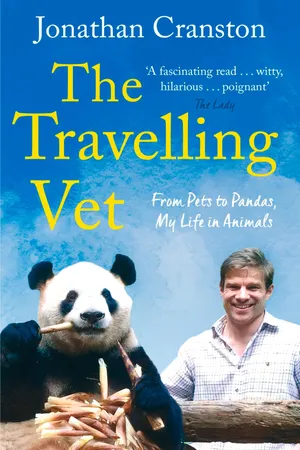
Jonathan Cranston is no ordinary vet. In addition to his day job in the Gloucestershire countryside treating cows, dogs, pigs and cats, he's also worked with an astonishing range of species around the world, including crocodiles, rhinos and pandas. In this charming collection he introduces us to some of his favourite patients, ranging from beloved family pets through to magnificent creatures of the wild.
Whether microchipping armadillos, anaesthetising giraffes or birthing a calf, Jonathan's love for his work and the entire animal kingdom is infectious. From the preposterous (castrating a sugar glider) to the poignant (encountering victims of rhino poaching), the stories in
The Travelling Vet will delight and enthral every animal lover.
- 323 pages
- English
- ePUB (mobile friendly)
- Available on iOS & Android
eBook - ePub
About this book
Information
Print ISBN
9781760633202
Subtopic
Zoology1
ARMADILLO

‘Armadillos make affectionate pets, if you need affection that much.’
Will Cuppy
The animal kingdom is vast and incredible. I personally think it’s impossible not to watch nature documentaries without being filled with awe and amazement at the array of different types of animals with whom we are privileged to share this planet.
It is a common assumption that, as a veterinary surgeon, I will automatically know about, and be able to treat, any animal that finds itself on the consulting-room table, or behind a stable door. So it often comes as a shock and disappointment to others when I confess that I don’t immediately know, say, the common ailments of Triturus cristatus (the great crested newt). That said, I still love that assumption, and I have tried my hardest to fulfil it, but sadly, even over a five-year degree course, there are several species that just don’t make the cut. The maned wolf, the giant panda, the snow leopard and the pufferfish, to name but a few.
So how does the veterinary curriculum work? Well, there are six main species we study in great depth at veterinary school, and they are all mammals: the horse, the cow, the pig, the sheep, the dog and the cat. A few weeks’ teaching is given over to ‘small furries’ (rabbits, hamsters, guinea pigs and the like), with a couple of days allocated to reptiles and birds, and maybe the odd hour to amphibians and fish. This may seem woefully inadequate, particularly if you are a lover of one of the many species that doesn’t feature prominently in the veterinary curriculum, but let’s think about this for a minute and do some maths. At a conservative estimate there are 8.7 million different species on the planet, so in a typical degree course we would have precisely 18 seconds per species to learn everything there is to know about their anatomy, physiology, behaviour, therapeutic pharmacology, medicine, surgery, dentistry, endocrinology, oncology, and reproduction. Oh, and that would be studying twenty-four hours a day, seven days a week, for the entire five years, and with no time to prepare for the biggest part of the job, namely the three Cs of human interactions: care, compassion and counselling. So unfortunately, but I hope understandably, there have to be one or two omissions.
For some, gaining an MRCVS qualification is just the first step in a lifetime’s journey of studying these more exotic animals, and for the rest of us these specialists become the go-to-gurus. For those in general practice there are several skills we have to learn to mitigate this knowledge deficit. Firstly there is the principle of animal comparisons. For example, to most intents and purposes, you can treat a rabbit as if it were a miniature horse: they are both hindgut fermenters, doing most of their digestion in their caecum, and have hypsodont teeth meaning that their teeth continually grow. Alpacas and llamas are both ruminants like cattle and sheep, and ferrets share many characteristics with dogs. Then there is the idea of lateral thinking. If I am treating a dog with diarrhoea, who has involuntarily redecorated his owner’s sitting room, I am faced with a series of questions. What has caused it? What body systems are involved? What are the animal’s immediate and long-term requirements? Is it dehydrated, requiring fluid therapy? Does it have a bacterial infection, necessitating antibiotics? Does it have a parasitic burden and require deworming? Or has he just gorged on the family’s Sunday lunch? If I can solve the puzzle for a dog, why can’t I solve it for a meerkat, reindeer or wallaby? And, of course, if all this fails, there’s always Google . . .
Yes, I confess that in my ten-year career I may have referred to Google one or two or several hundred times. I remember the first occasion. I was a couple of months qualified and my boss, Simon, asked me to do a home visit to inject a client’s private collection of green tree pythons. Several of them had gone down with a respiratory infection caused by mycoplasma and, given the value of such a collection, Simon had suggested treating them all. I was game and eager for anything. Besides, it was my boss’s request, so I did not feel I could refuse. The only problem as I saw it was that I had never even heard of a green tree python before, let alone known anything about them. And as the ‘newbie’, I would need to gain the client’s trust as well as fending off a barrage of questions over the hour it would take to treat every one of his ten snakes. I did not want to appear a complete ignoramus, of course, and so knowing that attack is often the best form of defence, I thought if I could drop in a few useful facts early on, I might just gain his confidence and respect enough to transform this daunting visit into a more manageable and interesting experience. So to Google I went. I discovered that Morelia viridis is found in or near the rainforests of New Guinea, the Indonesian Islands and Cape York Peninsula in Australia, thus requiring a hot humid environment. As its name suggests, it lives mainly in trees, and feeds on small rodents and reptiles. They require a certain expertize to keep in captivity, but if conditions are right then they’ll thrive. Armed with this knowledge and feeling a bit more confident, I set off.
The owner greeted me suspiciously, clearly assessing my credentials as a veterinary surgeon to the herpetoculture community. I smiled warmly as I introduced myself, trying to disguise my trepidation. I was going to have to work hard to earn his trust, I could see, but I wasn’t surprised: a collection as extensive as his was worth several thousand pounds, so this was a serious hobby. He took me through the house to a purpose-built reptile house in the garden. It was an impressive set-up. The heat and humidity hit me instantly and I felt like I had just stepped into the Amazon Jungle. There were half a dozen vivariums in a ‘U’ shape against the three walls, all just a mass of green arboreal foliage camouflaging the occupants within. Next to each glass tank was a digital monitor displaying its temperature and humidity. I’d only ever seen such a professional set-up in a public reptile house before, and I realized this guy definitely knew what he was doing. I felt way out of my depth, but tried to compose myself. After all, all I had to do was inject them, and I had done that before. But this was someone from whom I could learn a lot, so I had to pitch it just right. He had to feel confident and comfortable with my professional ability, and able to relax enough to start talking about his passion, rather than being guarded and protective over his babies. I knew I had a limited window of opportunity to make an impression, and this was it.
‘The humidity really hits you when you walk in,’ I began, ‘we could actually be in a New Guinea or Indonesian rainforest.’ It wasn’t my best one-liner ever. It was a start, but I needed to follow it up.
‘They can be pretty difficult to keep in captivity, replicating their natural arboreal environment, but I have to say this is the most impressive set-up I’ve ever seen.’ The compliment paid off; I could sense him start to relax. Maybe one more would do it. I wandered over to one of the vivariums and peered in. The camouflage was incredible and it took me a moment to see the occupant. Saddling one of the branches in three coiled loops, her head resting in the middle, was a stunning lime-green snake with flecks of white across the whole of its body. I’d seen pictures on Google, but in real life they were truly incredible.
‘I love the unique way they saddle a branch . . . They really are so beautiful.’
That final comment was enough to engage him, and his guard went down. It was as though I knew the secret handshake to the club. I was in! As we proceeded with the task in hand, he started telling me about each snake individually as I injected it. The job was quickly done, but with plenty more serpentine knowledge to share, and a captive audience to share it with, he offered me a cup of tea. Fascinated with what I was learning and relieved that the visit had gone so well, I happily accepted. An hour later I finally left and the warmth with which he bid me farewell felt like a lifelong friendship. As I walked down the drive to my car, I allowed myself a smile of satisfaction. From then on, whenever he rang the practice he always requested ‘the veterinary herpetologist’.
Google paid off on that occasion, but I’d had a leisurely half-hour lunchbreak in which to do my research and preparation. The next occasion it came to my rescue I was not afforded the same luxury.
I’ve often been asked what the strangest animal I’ve ever seen in the consulting room would be. There are a few contenders – a Cuban tree frog, a sugar glider and a skunk would probably make the top ten – but there was one consultation that will forever stick in my memory: the armadillo.
It had been a regular Friday in March. I’d started my day at 6 a.m. on the middle of Exmoor reading a tuberculin test for a herd of sixty cattle. It was a cold morning and we were working in a small dilapidated farmyard miles from any other human habitation. The single intradermal comparative cervical tuberculin test (SICCT) is the standard TB test for cattle. Dating back a hundred years, it involves injecting the skin on the animal’s neck with avian and bovine tuberculin, then returning seventy-two hours later to inspect the injection site: if the bovine site has swollen more than the avian site it is highly suggestive that the animal has the disease. This was my return visit, and I knew that the second part of the test was not going to be completely straightforward; it never was with the Exmoor cattle. This was an eclectic herd of year-old animals, which had been bought from market as calves and barely known any human interaction from the day they stepped off the lorry. All were hybrid breeds, mostly from a Friesian–Hereford mother crossed with a beef bull such as a Charolais, Aberdeen Angus, Belgian Blue, Simmental or Limousin. It was the Limousin crosses that always caused the problem. Wild and liable to spook, it only required one of those in a herd to set the rest of the group off. I had spent enough time chasing flighty cattle across fields, marshes and moorland to know that it was always them leading the charge. While my Tuesday visit had gone smoothly enough, the cattle were now primed, wary of the cattle crush – and of us.
As we let them out of the barn into the orchard, the leading steer told me all I needed to know. Head up, eyes alert, snorting as he trotted at a fast pace, he was wild and agitated. In that moment I knew this job, which could have been over and done with in half an hour, was going to take several hours, and require Land Rovers and quad bikes to chase the herd over the moor. Sure enough, the steer immediately led the charge, jumping and circling in the orchard, looking for any weakness in the gate, wall or hedge. After a few moments he found it, and headed for the 4-foot gate separating the orchard from the field and moorland beyond. Making a poor attempt to jump the gate, his back quarters landed on the gate, buckling it, but his momentum was enough to snap the bail twine that had fixed it to a rotten post, and so the gate was dragged 10 metres into the field before the steer finally cast it off as he bolted for freedom. With no gate, and the field and freedom so inviting, the rest of the herd didn’t waste any time following their comrade, leaving the four of us standing in the orchard looking on at the mud being churned up behind them as they disappeared into the distance.
Three hours later I left the farm, job done, but now running late for my next visits.
The rest of the day’s visits passed less energetically: a calf with pneumonia, a few calf castrations, a lame horse with a foot abscess, and then a lambing which turned out to be a caesarean. Since my days as a vet student I had always loved lambing time, and to bring two little lambs into the world and then see them up and suckling Mum, their tails wiggling like crazy, was such a happy sight. Sadly, though, the economics didn’t always stack up, and so we were rarely called upon to assist, but this was a good ewe, and the farmer had been keen, so I had done the caesarean and the two healthy lambs justified the decision.
With my large-animal visits completed, I raced back to the surgery to start my small-animal consultations at 4 p.m. It had been a non-stop day, shovelling a sandwich into my mouth as I drove between my visits, and only giving my dog Max a quick few minutes’ exercise down a farm track. When he gave me a look of disgust I promised him a walk on the beach after work as I coaxed him back into the car.
Arriving back at the surgery, I saw it was 3.45 p.m.: only enough time to clean myself up, grab a cup of tea and my white coat, and then head into my consulting room. I looked over my list of bookings to mentally prepare myself and see if there were any ongoing cases that needed more attention. I was fully booked with consultations running from 4 to 6.30 p.m. Each slot was ten minutes long, so there were fifteen in all. An initial glance told me it was a fairly routine list: half a dozen vaccinations, a lame dog, a couple of vomiting/diarrhoea cases, a cat with a skin irritation . . . I scanned the list more closely, to see if there were any clients or animals I recognized. The 5.10 p.m. appointment caught my attention; according to the computer, the client was called Mr Smith and the patient was called ‘Armadillo’.
I’d come across some odd animal names in my time. In fact, we used to play a game at vet school, in our final year on rotations, to see if we could identify the animal breed by the name its owner had given it. ‘Charlie’ was going to be a black Labrador, destined for the orthopaedics department; ‘Rocky’ would be a boxer coming in to see the cardiologist; and ‘Tiny’ was obviously a dachshund, off to see the neurologist. ‘Armadillo’ was a new one for me. I clicked on his client card to bring it up. Was this a dog or a cat, I thought? Looking through the information, it seemed that this was a new client with a new animal, and all it told me was that Mr Smith was bringing Armadillo in to be microchipped.
The first half of my session proceeded uneventfully. As I bid farewell to my 5 p.m. ap...
Table of contents
- Cover
- Title Page
- Dedication
- Contents
- List of Illustrations
- Preface
- Introduction
- 1 Armadillo
- 2 Giraffe
- 3 Swan
- 4 Snow Leopard
- 5 Goat
- 6 Elephant
- 7 Chicken
- 8 Maned Wolf
- 9 Holstein Cow
- 10 Rhinoceros
- 11 Donkey
- 12 Ferret
- 13 Giant Panda
- 14 Pig
- 15 Iguana
- 16 Crocodile
- 17 Kangaroo
- 18 Zebra
- 19 Sugar Glider
- 20 Wildebeest
- Acknowledgements
- Picture Sections
- Copyright
Trusted by 375,005 students
Access to over 1.5 million titles for a fair monthly price.
Study more efficiently using our study tools.
Frequently asked questions
Yes, you can cancel anytime from the Subscription tab in your account settings on the Perlego website. Your subscription will stay active until the end of your current billing period. Learn how to cancel your subscription
No, books cannot be downloaded as external files, such as PDFs, for use outside of Perlego. However, you can download books within the Perlego app for offline reading on mobile or tablet. Learn how to download books offline
Perlego offers two plans: Essential and Complete
- Essential is ideal for learners and professionals who enjoy exploring a wide range of subjects. Access the Essential Library with 800,000+ trusted titles and best-sellers across business, personal growth, and the humanities. Includes unlimited reading time and Standard Read Aloud voice.
- Complete: Perfect for advanced learners and researchers needing full, unrestricted access. Unlock 1.5M+ books across hundreds of subjects, including academic and specialized titles. The Complete Plan also includes advanced features like Premium Read Aloud and Research Assistant.
We are an online textbook subscription service, where you can get access to an entire online library for less than the price of a single book per month. With over 1.5 million books across 990+ topics, we’ve got you covered! Learn about our mission
Look out for the read-aloud symbol on your next book to see if you can listen to it. The read-aloud tool reads text aloud for you, highlighting the text as it is being read. You can pause it, speed it up and slow it down. Learn more about Read Aloud
Yes! You can use the Perlego app on both iOS and Android devices to read anytime, anywhere — even offline. Perfect for commutes or when you’re on the go.
Please note we cannot support devices running on iOS 13 and Android 7 or earlier. Learn more about using the app
Please note we cannot support devices running on iOS 13 and Android 7 or earlier. Learn more about using the app
Yes, you can access The Travelling Vet by Jonathan Cranston in PDF and/or ePUB format. We have over 1.5 million books available in our catalogue for you to explore.