What follows, which explores some of the charms, the quirks and the peculiar allure of cricket from a variety of perspectives, is not intended as a memorial for long-lost sepia days. The game is still alive. Whether it turns out to be therapy for me or entertainment for you remains to be seen. To achieve both would be a bonus.
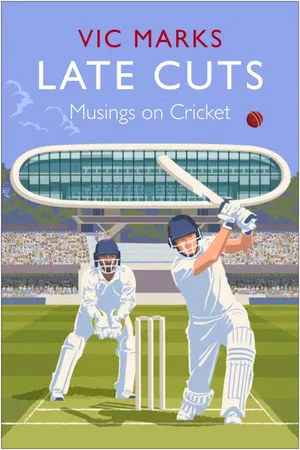
From Somerset stalwart to acclaimed writer and broadcaster, Vic Marks has lived a life steeped in cricket. In
Late Cuts he takes us beyond the boundary rope, sharing the parts of the game fans don't get to see, from the food served at lunchtime (then - sweaty ham; now - quinoa, cranberry and feta salad) to the politics of the dressing room.
Whether revisiting his playing days to reveal the secrets of bowling a killer spell and what it feels like to be heckled by a riled-up crowd, or ruminating on the current state of the game (don't mention The Hundred!), this amusing and insightful collection will delight all cricket lovers.
- 282 pages
- English
- ePUB (mobile friendly)
- Available on iOS & Android
eBook - ePub
About this book
Information
Print ISBN
9781838953065
Subtopic
Sociology1
Selection
‘My God, look what they’ve sent me.’
England captain A. C. MacLaren, 1902
THEY KEPT PICKING him for fifteen years but Ian Botham’s description of a Test selector, delivered at a cricket dinner in the 1980s, was none too flattering. ‘They bring him out of the loft, take the dust sheet off, give him a pink gin and sit him there. He can’t go out of a 30-mile radius of London because he’s normally too pissed to get back.’
Well, this would have raised a laugh. In that era the selectors were sometimes old amateurs, who were more likely to be gin-slingers, and – expenses apart – they were unpaid. I’m not sure they were all drunkards, though. In fact, the chairman of selectors when Ian was England captain was Alec Bedser, very much the professional’s professional as a player, and he held the post longer than anyone in history – for thirteen seasons.
Ray Illingworth, another old pro, was the first chairman to be paid, partly because he was dovetailing as England’s team manager in the mid-1990s. Ever since then it has been a job with a salary, during which time David Graveney, Geoff Miller, James Whitaker and Ed Smith have held the post now known as the national selector. Smith, in particular, is well paid. He certainly cannot afford to be seen with a pink gin during working hours. However, idiosyncratic sunglasses are permitted.
The task of a selector is simple: he/she has to deliver teams/touring squads and then let the coach and captain get on with it. The basics of the job are so straightforward that there are thousands of armchair selectors out there with thousands of different theories who think they can do better. We can all pluck out a dozen names or more and then offer our expert opinion with absolute confidence, in the comforting knowledge that we will seldom be held to account. No one will remember our crackpot theories for long. But it is trickier for the real selectors; their mistakes are remembered far more frequently than any triumphs.
In reality it is very rarely a matter of making brilliant, trailblazing choices that no one else has ever contemplated before. More often it is a case of taking the least bad option as events dictate the next move. Consider England’s leading run-scorer, Alastair Cook. He was always going to play Test cricket but his elevation to the team did not come about as the final step of a carefully crafted plan. Rather, in March 2006, he was rushed halfway around the world to Nagpur from the Caribbean, where he was touring with the England A team, after both Marcus Trescothick and Michael Vaughan were suddenly unable to play in the first Test against India. Upon arrival in Nagpur, Cook was catapulted straight into the team; he hit 60 in his first innings and an unbeaten century in his second. There followed 160 more Test matches for Cook without ever being dropped. Yet he needed a couple of sudden absentees to get started.
Successful selection is dependent on solid research, sound judgement, the odd hunch, a bit of luck and a reservoir of decent players. It can be hampered by tunnel vision, a desperation to pursue fairness rather than the best side, inflexibility, prejudice, wishful thinking and a dearth of good players. We remember the bad selections far more easily than the good ones and they are usually more fun to revisit. But let’s try to identify some of the good ones first.
In fact the Lancashire captain, A. C. MacLaren, a stately galleon of a cricketer at the start of the twentieth century, will appear in both categories. MacLaren was an amateur, of course, but often an impecunious one, and it may be that he was capable of starting an argument in an empty room. He went to Harrow, where he declared that his fag was ‘quite useless’ and ‘a snotty little bugger’, which is a rare description of Winston Churchill.
Neville Cardus hero-worshipped MacLaren, partly because he was the captain of his beloved Lancashire, but perhaps also because Cardus was indebted to him for enhancing his career as a journalist. At the age of 50 MacLaren led a scratch side to victory over the almost invincible Australians of 1921 and Cardus was, of course, there to report it. In fact, having badgered his office to let him cover the match in Eastbourne, it transpired that he was the only leading journalist present to record this staggering defeat of the tourists. This was one of just two games that the Australians lost on their thirty-eightmatch tour. Cardus was in clover at Eastbourne, while his peers were elsewhere.
Cardus described his hero as ‘the noblest Roman of them all… there never was a cricketer with more than the grandeur of A. C. MacLaren’. Lancashire’s autocratic captain was obviously a formidable batsman, capable of scoring runs in isolation and, occasionally, in bulk – he hit 424 not out against Somerset at Taunton in 1895, which became the highest score ever recorded in first-class cricket at the time. Alan Gibson took a slightly different view of him to Cardus (though he might not have expressed it too readily in his presence): ‘England may have had worse captains but I would be hard put to name two or three,’ he wrote in a wonderful book, The Cricket Captains of England, that surveyed England’s leaders on the field up to Mike Gatting. However, Gibson acknowledges that MacLaren was box office, though he puts it more elegantly than that; in the twenty-first century we would have made sure that we did not miss any of his press conferences. ‘England under MacLaren must have been a good side to watch, save for the partisans, but an uncomfortable side in which to play,’ he wrote.
The bald statistics are not in MacLaren’s favour. He led England in four Ashes series – in 1899, 1901/02, 1902 and 1909 – and Australia won all of them. Yet MacLaren’s selection of S. F. Barnes for the tour of 1901/02 was surely a good one – and Barnes was not necessarily an obvious choice at the time. He was already 28 years of age but had only appeared in seven first-class matches in his life as he preferred to play in league cricket and for his beloved Staffordshire in the Minor Counties competition. In 1901, when a professional in the Lancashire League, Barnes was invited to bowl at MacLaren in the nets at Old Trafford. Cardus recalls the event and quotes MacLaren: ‘He thumped me on the left thigh. He hit my gloves from a length. He actually said, “Sorry, sir!” and I said, “Don’t be sorry, Barnes. You’re coming to Australia with me.”’
And so he did. Barnes took seven wickets in his first Test in Sydney and England won the match. But by the third game he was injured through over-bowling and the series was eventually lost 4-1. Nonetheless, selecting Barnes in the first place was assuredly a good decision – just as Javed Miandad thrusting Wasim Akram, who had hardly played any first-class cricket at the time, into the Pakistan Test side in 1985 was soon justified. Of course, both cases look like the most obvious selections imaginable with hindsight since Barnes and Akram proved to be such brilliant, innovative bowlers.
Sydney Barnes was extremely single-minded, stubborn, difficult to handle and always determined to be properly remunerated for his skills. And MacLaren was MacLaren, haughty and intransigent. The relationship was bound to be spiky, to say the least. On the trip home from that Ashes series the boat hit rough seas and MacLaren, never known for his cheery optimism, famously remarked, ‘At least if we go down we’ll take that bugger Barnes down with us.’
Barnes took 189 wickets in twenty-seven Test matches at 16.43 apiece. No bowler has taken wickets so swiftly or cheaply for England. He was the ultimate craftsman, capable of spinning the ball, not cutting it, as he was always keen to point out, in both directions at medium pace. After his retirement he became a calligrapher. In the 2012 Wisden Peter Gibbs – once of Oxford University, Derbyshire and Staffordshire – wrote a lovely piece in which he describes being the youngster in the side given the daunting task of looking after Barnes, now into his nineties, while he was watching Staffordshire playing. Gibbs was asked to get some autographs from Barnes, an undertaking he attempted with some trepidation and a biro. Barnes demanded a fountain pen. ‘Giving him a biro was like asking Yehudi Menuhin to play the ukulele,’ wrote Gibbs.
A good selection may come in the form of omitting someone surprising. Alec Bedser might be the nearest any England bowler has come to Barnes. He cut the ball, rather than spinning it, as well as propelling inswingers for which Godfrey Evans often stood up at the stumps. After the Second World War Bedser carried the England bowling tirelessly with modest support, the ball shrinking into his massive hands for over after over. I once disappointed my wife when looking at Michelangelo’s David in Florence by observing ‘Blimey, he’s got hands like Alec Bedser.’
Eventually some assistance for Bedser was at hand in the form of Brian Statham, Fred Trueman and Frank Tyson. As ever, the first Test of the 1954/55 Ashes series was in Brisbane, a venue that has prompted some odd decisions by England captains. In recent times, if 2002 still counts, Nasser Hussain inserted Australia, who were 364-2 at the close of play on the first day. The match was lost by 384 runs. Hussain was lambasted for his decision but he found himself in good company.
In 1954 Len Hutton, having omitted all his spinners – and he had some good ones available in Johnny Wardle and Bob Appleyard – put Australia in at the Gabba. They made 601-8 and won the match by an innings and 154 runs. Bedser, who had been recovering from shingles, took 1-131 from 37 overs and witnessed as many as seven catches go down off his bowling. Neither Statham nor Tyson were any more effective.
Three weeks later England were in Sydney for the second Test – tours were more leisurely expeditions then – and Hutton, after much agonizing, made a momentous decision. He dropped Bedser, the backbone of the England side for so long. The attack was given more variety with the inclusion of the two spinners but the critical difference was that something clicked for Tyson, who had by now moved to a shorter run-up. In Sydney, Tyson shredded the Australian batting line-up through magnificent, unadulterated speed and the pattern was set for the series.
Hutton, England’s first professional captain, had made the right decision, albeit in the wrong way. After all Hutton’s deliberating, Bedser only learned of his omission when looking at the team sheet pinned up in the dressing room half an hour before the start of play. The strategy was rather better than the man-management in an era when the captain had to do everything himself. England, with Tyson running riot, won the series 3-1. Bedser played just one more Test match against South Africa in the summer of 1955.
In 1956 England obviously decided that the touring Australian batsmen would be fragile on turning pitches especially against the spinners, Jim Laker and Tony Lock. But England’s batting was none too sturdy either. The first Test at Nottingham, a wet one, was drawn. Australia won the second at Lord’s by 185 runs. The selection panel – chaired by Gubby Allen and including Les Ames, Wilf Wooller and Cyril Washbrook – was by now very concerned about England’s batting line-up. As they were mulling over the team for the third Test at Leeds, Allen instructed Washbrook to go and get some beer. By the time he returned, his fellow selectors had chosen him for the next match. Washbrook, once the regular opening partner of Hutton and the first professional captain of Lancashire, was 41 and he had not played Test cricket since the 1950/51 tour of Australia. ‘Surely the situation isn’t as desperate as that,’ he said. Beyond the portals of Lord’s there was consternation and despair that the selectors had chosen one of their own committee.
A few days later at Headingley Peter May won a good toss since the pitch was expected to assist the spinners, but England were soon 17-3. May was still at the crease and he recalled afterwards, ‘I have never felt so glad in my life as when I saw who was coming in.’ It was Washbrook. This pair shared a partnership of 187, May making 101 and Washbrook 98 before being lbw to Richie Benaud. England’s total of 325 was enough to ensure an innings victory as Laker and Lock set to work on a deteriorating surface. Now the press and the public hailed a masterstroke. Washbrook failed to reach double figures in his two other innings in the series, but the tide had been turned. After Laker’s 19 wickets in the next match at Old Trafford and a soggy draw at The Oval, England won the series 2-1. The recall of Washbrook had not been such a bad idea after all.
Of course, anyone can select the exceptional players. It would not have taken too much insight to see that David Gower, Mike Atherton, Ian Bell or Mark Ramprakash were high-quality batsmen destined for Test cricket (even though the latter provides a reminder that nothing is guaranteed once you get there). So the unlikely selections that come good are a better indication of the fertile, lateral thinking that leads to the odd inspired selection. In the modern era, which encompasses players I have played against or watched, Tony Greig and his selection panel (Ken Barrington, Len Hutton and the former umpire Charlie Elliott, along with Bedser) produced one of those.
In July 1975 Geoffrey Boycott was in self-imposed exile; Mike Denness had just been sacked by Bedser as England captain after a massive defeat in the first Test against Australia at Edgbaston, a decision the outgoing captain agreed with, which is an unusual state of affairs. In a letter to Bedser a few weeks afterwards, Denness wrote ‘the decision you came to in the end was undoubtedly for the better and the interest of the game… I only regret that you personally had to take so much stick from the “mass media”.’ So Greig took over as captain and, in the absence of Boycott, he decided he needed some no-nonsense bloody-mindedness to blunt the pace and aggression of Dennis Lillee and Jeff Thomson, who had so tormented Denness and the other England batsmen during the previous winter’s tour. In Australia Denness’s form hit rock bottom to the extent that Doug Walters in the gully would complain – just loudly enough – to the slip cordon as the England captain made his way to the crease: ‘Oh no! Look who’s coming in now. We’re going to be held up for at least another ten minutes.’
After Denness had been sacked, the new captain consulted widely around the county circuit. According to the man finally selected, David Steele, ‘Greigy went to see the umpires and they gave him a nod. Good move, that.’ Steele – at the age of 33 with a first-class batting average of 31 for unfashionable Northamptonshire, prematurely grey hair and a pair of National Health spectacles (or so it seemed) – was pitchforked into the Test team. At Lord’s before the match, Hutton greeted him as ‘Dennis’ but Steele was not too bothered by that. He was going out to bat for England.
This was in the pre-helmet age and out strode Steele at number three on his debut, looking like a jockey from the shoulders up because the peak of his cap was pointing skywards. Actually it took rather a long time for him to get to the middle because, having left the unfamiliar home dressing room, he took one flight of stairs too many and ended up in the toilets on the lower-ground floor of the Lord’s Pavilion before backtracking. Upon arrival in the middle, he was greeted by Lillee as ‘Groucho’.
Clive Taylor of The Sun memorably dubbed him ‘the bank clerk who went to war’. Hooking Lillee three times off the front foot – he was always on the front foot – Steele hit a half-century and added 96 with captain Greig. He topped the England batting averages after three Tests, hitting 365 runs at 60.83. There was no winter tour, which meant he was free to attend the BBC’s Sports Personality of the Year programme. And he won the trophy. At the time he was only the second cricketer, after Jim Laker, to do so. He also won 1756 lamb chops from a local butcher, which was the number of runs he scored in his benefit year. It is not beyond the realms of possibility that he counted them all.
The following summer Steele played in all five Tests against the all-conquering, non-grovelling West Indies, having hit a century in the first match at Trent Bridge. Along with just four other England cricketers, he survived to play the entire series. But he was surplus to requirements for the winter tour to India and the reason given by Greig was that Steele’s method would not be suited to the trial by spin that awaited England there. Steele felt hard done by after being on the receiving end of some serious pace bowling in his eight Test matches and he may have had a point. I’m not so sure he was that weak against spin, although this is based on slightly dubious evidence: the recollection that he usually played me all right. The challenge from Bedi, Chandrasekhar and Prasanna might have been slightly different. Steele was quick to plunge on to the front foot, which you are not supposed to do against spinners, and he could look limited and cumbersome but he certainly had the calm single-mindedness to be successful and in those eight Tests he proved beyond doubt how he relished playing at the highest level.
So that was it for Steele as an England cricketer, though he kept playing county cricket until 1984. He was also a handy left-arm spinner, who once should have had Viv Richards stumped by a mile when bowling for Derbyshire against Somerset. His exasperation was obvious; soon after his escape, Viv hit one of his innocent deliveries into a distant tree, which prompted Steele to chide the great man, ‘Look, you’re not supposed to knock conkers down until September.’ He was a very good selection in 1975 and a memorable one, who captured the hearts of the cricketing public and beyond.
Another unlikely England Test cricketer, who also began his career with Northamptonshire, was Neil Mallender. By the time he was called up at the age of 30 he had been at Somerset for almost five years. He was chosen for the Leeds Test of 1992 as a Headingley specialist plucked out to bowl on what was the most capricious surface in the country. This is no lo...
Table of contents
- Cover
- Title
- Copyright
- Contents
- Preface
- 1. Selection
- 2. Captains
- 3. Partnerships
- 4. The Spell
- 5. Declarations
- 6. Crowds
- 7. Failure
- 8. Food
- 9. Twelfth Man
- 10. Press Conferences
- 11. The Library
- 12. Somerset
- Afterword
- Acknowledgements
- Index
Trusted by 375,005 students
Access to over 1.5 million titles for a fair monthly price.
Study more efficiently using our study tools.
Frequently asked questions
Yes, you can cancel anytime from the Subscription tab in your account settings on the Perlego website. Your subscription will stay active until the end of your current billing period. Learn how to cancel your subscription
No, books cannot be downloaded as external files, such as PDFs, for use outside of Perlego. However, you can download books within the Perlego app for offline reading on mobile or tablet. Learn how to download books offline
Perlego offers two plans: Essential and Complete
- Essential is ideal for learners and professionals who enjoy exploring a wide range of subjects. Access the Essential Library with 800,000+ trusted titles and best-sellers across business, personal growth, and the humanities. Includes unlimited reading time and Standard Read Aloud voice.
- Complete: Perfect for advanced learners and researchers needing full, unrestricted access. Unlock 1.5M+ books across hundreds of subjects, including academic and specialized titles. The Complete Plan also includes advanced features like Premium Read Aloud and Research Assistant.
We are an online textbook subscription service, where you can get access to an entire online library for less than the price of a single book per month. With over 1.5 million books across 990+ topics, we’ve got you covered! Learn about our mission
Look out for the read-aloud symbol on your next book to see if you can listen to it. The read-aloud tool reads text aloud for you, highlighting the text as it is being read. You can pause it, speed it up and slow it down. Learn more about Read Aloud
Yes! You can use the Perlego app on both iOS and Android devices to read anytime, anywhere — even offline. Perfect for commutes or when you’re on the go.
Please note we cannot support devices running on iOS 13 and Android 7 or earlier. Learn more about using the app
Please note we cannot support devices running on iOS 13 and Android 7 or earlier. Learn more about using the app
Yes, you can access Late Cuts by Vic Marks in PDF and/or ePUB format. We have over 1.5 million books available in our catalogue for you to explore.